

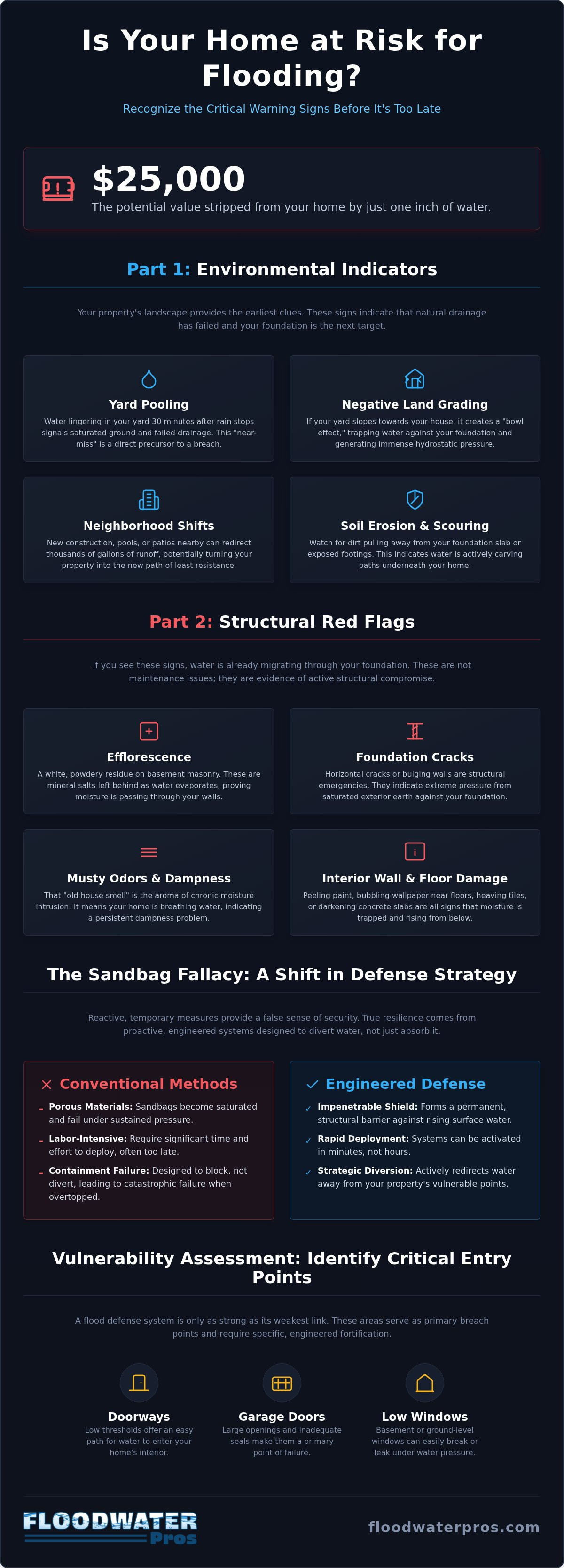
A single inch of water can strip $25,000 from your home’s value in hours. It’s a staggering figure that turns a minor storm into a financial catastrophe. You’ve likely looked at your basement or yard during a heavy downpour and wondered if that pooling water is just a nuisance or a disaster in waiting. Recognizing the signs your home needs flood protection isn’t about being alarmist. It’s about being prepared. You already know that standard homeowners insurance won’t save you when the water rises. That uncertainty is a heavy burden to carry.
We’re moving past the era of passive hope and temporary sandbags. This guide identifies the critical structural and environmental red flags that signal your property is at risk. You’ll learn to distinguish between routine maintenance and urgent calls for fortification. We provide a clear checklist of vulnerabilities and show you how to transition to an engineered defense. From the Fortress Flood Diversion System to rapid-deploy barriers, you’ll gain the confidence to invest in permanent protection. It’s time to stop reacting to the weather and start outsmarting it.
Key Takeaways
- Spot subtle environmental warnings. If your yard pools after moderate rain or nearby construction shifts water paths, your foundation is likely the next target.
- Recognize the structural signs your home needs flood protection. Efflorescence and masonry cracks are not just maintenance issues; they are evidence of active water migration.
- Audit your property’s weakest links. Doorways and garage doors serve as primary breach points that require specific, engineered fortification to remain impenetrable.
- Move beyond the sandbag fallacy. Porous materials offer a false sense of security. True resilience requires a system designed to divert water rather than just contain it.
- Shift from recovery to prevention. Learn how the Fortress Flood Diversion System provides a permanent, structural shield against the high stakes of rising surface water.
Environmental Indicators - Assessing the Land Around Your Foundation
FEMA flood maps provide a broad view of regional risk, but they often miss the micro-flooding occurring at your doorstep. Relying on outdated data is a dangerous gamble. You must look at the land itself. The "Near-Miss" phenomenon is your final warning. If you see consistent pooling in your yard after a moderate storm, your property’s natural drainage has failed. It's not a minor nuisance. It's a precursor to a breach. When water lingers, it’s looking for a way in.
Surface Water Patterns and Pooling
Observe your property thirty minutes after the rain stops. If the ground remains submerged, your land has lost its ability to shed liquid. Look for "dead zones" where silt and mud have choked out the grass. These are the physical footprints of past surges. Street-level gutters that overflow near your driveway indicate that local infrastructure is overwhelmed. This is one of the most visible signs your home needs flood protection. You can't control the city's pipes, but you can fortify your own perimeter.
Neighborhood shifts change the hydraulic landscape. New construction nearby often involves large concrete footprints that redirect thousands of gallons of runoff. If a neighbor adds a pool or a new garage, your property might suddenly become the path of least resistance. When the ground becomes fully saturated, it loses its capacity to absorb any additional moisture. This creates a direct threat to your foundation. Understanding broader flood management strategies helps you see your home as a structural asset that requires its own dedicated defense system.
Topographical Vulnerability and Land Grading
Your yard's grading is your first line of defense. A negative grade, where the land slopes toward your house, is an invitation for hydrostatic pressure. This pressure doesn't just sit against your walls; it forces water through concrete pores. The "bowl effect" in your landscaping traps water and turns your yard into a temporary reservoir. This is a structural emergency in slow motion.
- Soil Erosion: Watch for dirt pulling away from your slab or foundation. This signals that water is actively carving paths underneath your home.
- Retaining Walls: Analyze neighboring walls. They often act as funnels, dumping massive volumes of runoff directly into your "bowl."
- Foundation Scouring: Look for exposed footings or deep ruts along the perimeter.
These environmental red flags aren't suggestions. They are evidence of a system under duress. When the soil can no longer protect your home, an engineered diversion system becomes a necessity. Passive hope won't stop a surge, but a proactive defense will.
Structural Red Flags - Signs Your Foundation is Already Compromised
Your foundation is under constant assault. Water doesn't just sit; it migrates. It seeks weakness. Efflorescence is the white, powdery residue often found on basement masonry. It is a chemical signal that water is passing through your walls. These are the mineral salts left behind after moisture evaporates. If you ignore it, you’re ignoring a breach in progress. Spalling is the next stage of decay. This occurs when the concrete surface flakes or pits because of internal water pressure. Your walls are literally shedding their structural strength.
Not all cracks are equal. Hairline fissures might indicate natural settling, but horizontal cracks or bulging walls are structural emergencies. They indicate that the exterior earth is saturated and heavy. Identifying signs of foundation water damage early allows you to act before a moderate storm becomes a total loss. Musty odors are the invisible warning. That scent is more than just an "old house" smell. It is the aroma of chronic moisture intrusion. It means your home is breathing water. Recognizing these signs your home needs flood protection is the first step toward permanent security.
Interior Wall and Floor Anomalies
Watch your finishes. Peeling paint or bubbling wallpaper near the floor isn't a cosmetic flaw. It's a sign that moisture is trapped behind the drywall. Look at your basement floor. Heaving or buckling tiles indicate upward pressure from a rising water table. Darkening concrete slabs are even more serious. When a slab turns a deep, consistent gray, it’s holding liquid like a sponge. It has reached its saturation point.
Hydrostatic Pressure and Seepage
Hydrostatic pressure is the force of water pushing against your home's exterior. It is relentless. This pressure often forces water through the "cove joint." This is the tiny gap where your walls meet the floor. You might also find rust on the base of furnace jackets or water heaters. These are clear signs your home needs flood protection before the next seasonal surge. It's time to consider an engineered diversion system to redirect that force away from your structural assets.
The Strategic Failure of Conventional Methods - Why Sandbags and Hope Aren't Enough
Sandbags are a relic of a bygone era. They offer a psychological shield but a porous physical one. Water doesn't just go over them; it goes through them. By the time you see the signs your home needs flood protection in the form of seeping burlap, it's already too late. The 2026 storm seasons have proven that traditional sump pumps are equally vulnerable. When the grid goes down or the volume exceeds mechanical capacity, your basement becomes a basin. Passive hope isn't a defense strategy. It's a gamble with your equity.
The hidden cost of the "wait and see" approach is staggering. FEMA estimates that a single inch of water can cause $25,000 in damage. This makes every delay in implementing property flood mitigation solutions an expensive mistake. Once water enters the masonry, the damage is often irreversible. Your home's value depends on its integrity. Protecting that integrity requires moving beyond the limits of conventional hardware.
The Limits of Flood Insurance
Insurance is a recovery tool. It isn't a preventative shield. Many homeowners mistakenly believe a policy protects their home from damage. It doesn't. It only attempts to reimburse the loss after the catastrophe has occurred. Payouts rarely cover the total cost of high-end structural restoration or the loss of irreplaceable heirlooms. The psychological toll of displacement is a cost that no adjuster can calculate. With 2026 premium hikes and the NFIP reauthorization deadline approaching, physical fortification has become a more viable return on investment. You aren't just buying equipment. You’re securing your peace of mind.
Why Redirection Beats Retention
The engineering logic is clear. Moving water away is always safer than trying to hold it back. Temporary, non-engineered barriers rely on weight and friction. They eventually succumb to the sheer force of a surge. A professional flood diversion system design creates a path of least resistance for the water. It guides the surge around your property rather than letting it press against your walls. This approach eliminates the hydrostatic pressure that causes foundations to buckle. It's the difference between a shield that eventually breaks and a strategic gate that redirects the threat. True resilience isn't found in a pile of sand. It's found in engineering.
Vulnerability Assessment - Identifying Critical Entry Points
A structural audit begins where the air meets the floor. Your home's entry points are its greatest vulnerabilities. While you may have fortified your foundation, water often takes the path of least resistance through doorways and vents. These are the soft targets in your perimeter defense. Recognizing these specific signs your home needs flood protection requires a shift in perspective. You must stop seeing doors as exits and start seeing them as potential floodgates. If your entry points aren't sealed, your home isn't protected.
The Threshold Test
Measure your lowest entry point. Compare this height against historical local crests or the surges documented during the 2024 storm season. If your threshold sits within 12 inches of a previous high-water mark, you are in the strike zone. Standard weather stripping is designed for drafts, not liquid weight. If you can see light through the bottom of your door, water will follow. Porous wood door frames also allow invisible seepage. The water saturates the wood and migrates into your subfloor before you ever see a puddle on the carpet.
The garage door is the largest and weakest opening in the modern home. It is a massive surface area designed for wind load, not hydraulic pressure. Even a few inches of rising water can buckle the panels or bypass the bottom seal entirely. Once the garage is breached, water has an interior path to your utility rooms and living spaces. It is a critical failure point that requires specialized, structural fortification rather than temporary fixes.
Utility and Vent Protection
Look for stealth entry points. Dryer vents, HVAC air intakes, and electrical conduits are often located just inches above the ground. These penetrations act as straws. They draw floodwater directly into your home's mechanical core. Sealing these points requires residential flood protection systems that are engineered for high-pressure environments. Improvised solutions like duct tape or plastic sheeting will fail under the weight of a surge. They offer a false sense of security that vanishes when the pressure rises.
Sometimes the threat comes from within. Municipal sewer systems often turn against your home's plumbing during heavy surges. If you notice slow drains or gurgling toilets during heavy rain, you are seeing the signs your home needs flood protection in the form of a backflow prevention strategy. This is a biohazard risk that compromises your entire interior. You need a proactive plan to secure these entry points before the next storm arrives. Protect your home's weakest links by consulting with an expert on Fortress engineered barriers today.
The Fortress Evolution - Transitioning to Engineered Defense
Recognizing the signs your home needs flood protection is the first step toward structural survival. The second step is moving from passive hope to active fortification. Traditional methods like sandbags are reactive and often fail under the weight of a true surge. The Fortress Flood Diversion System represents a fundamental shift in strategy. It doesn't just sit and wait for the water. It engineers the path of least resistance. It turns your property into an impenetrable shield. This is the evolution of residential resilience.
Tactical Diversion vs. Passive Resistance
The science of protection is found in redirection. While standard walls try to hold back the ocean, the Fortress Diversion system creates a perimeter shield that guides water away from your foundation. This approach neutralizes hydrostatic pressure before it can compromise your masonry. In high-stakes environments, redirection has saved structures where simple retention would have resulted in catastrophic collapse. By moving the water around your estate, you protect the ground itself from saturation and scouring. You aren't just fighting the water; you're outsmarting it.
Modern Barrier Technology
Defense doesn't have to be permanent or unsightly. The Fortress Inflatable Flood Barrier offers rapid deployment for the 2026 storm season. You can secure your perimeter in minutes without the backbreaking labor of moving thousands of pounds of sand. It is a tactical response for the modern homeowner. For high-end or historic properties, the Fortress Transparent Liquid Paintable Flood Barrier provides an invisible layer of armor. It seals porous surfaces without altering the aesthetic of your home. It’s an engineered seal that remains dormant until the surge arrives. You get the protection of a bunker with the appearance of a luxury estate.
Fortification is not a DIY project. Professional installation is the critical difference between a system that holds and a system that fails. Expert engineering ensures that every barrier is positioned to maximize its defensive potential. You’ve seen the red flags in your yard and foundation. You understand the risk. The next step is a professional engineering assessment to map your property's specific vulnerabilities. Transitioning to a Fortress system means you no longer have to fear the forecast. You are prepared. You are protected. You are resilient.
Secure Your Perimeter: From Vulnerability to Fortification
The red flags in your landscape and foundation are not just maintenance tasks. They are the early warnings of a structural crisis. From the white dust of efflorescence to the "bowl effect" in your yard, your property is signaling its limits. Relying on sandbags or insurance is a recovery plan, not a defense strategy. Recognizing the signs your home needs flood protection allows you to act while your equity is still intact.
True resilience requires a shift from passive hope to engineered certainty. You need a system that doesn't just hold water back but redirects it entirely. Our professional US-wide installation teams bring military-grade security to residential estates through custom diversion system design and engineered Fortress technology. Don't wait for the next surge to test your home's limits. Secure your legacy with a Fortress Flood Diversion System assessment today. You have the power to turn your home into an impenetrable sanctuary. The peace of mind you deserve is within reach.
Frequently Asked Questions
What are the most common signs of a high flood risk for a house?
The most common indicators include consistent yard pooling after moderate rain and the presence of efflorescence, which is a white, powdery mineral deposit on basement walls. You should also watch for neighborhood construction that alters local drainage paths. These are clear signs your home needs flood protection before a minor surge becomes a structural failure. If your property sits at a negative grade, water is essentially invited to press against your foundation.
Can I rely on FEMA flood maps to know if I need protection in 2026?
You cannot rely solely on FEMA maps because they often fail to account for localized micro-flooding or recent land development. While FEMA's Risk Rating 2.0 now uses property-specific features to set insurance rates, mapped zones remain a broad approximation. Approximately 40% of all NFIP claims originate from properties outside designated high-risk areas. Real protection requires a site-specific engineering assessment rather than a glance at a generalized government map.
Is standing water in my yard a sign of a potential flood problem?
Standing water is a critical warning that your soil has reached its saturation point. When the ground can no longer absorb moisture, the excess liquid has nowhere to go but against or into your foundation. This "bowl effect" creates immense hydrostatic pressure that can buckle masonry over time. If water remains visible thirty minutes after a storm, your property’s natural drainage has failed, necessitating an engineered diversion system to protect your structure.
What is the difference between flood insurance and flood protection?
Flood insurance is a financial recovery tool designed to reimburse you after a disaster has occurred. It does not prevent water from entering your home or stop structural decay. Flood protection, such as the Fortress Flood Diversion System, is a preventative shield that physically redirects water away from your property. While insurance helps you rebuild, engineered protection ensures that your home’s structural integrity and irreplaceable belongings remain untouched by the surge.
How do I know if my basement cracks are from flooding or settling?
Vertical hairline cracks often result from natural house settling, but horizontal cracks or bulging walls are structural emergencies. These structural red flags indicate that the earth outside your basement is saturated and pushing inward with immense force. If you notice these patterns along with dampness or musty odors, they are definitive signs your home needs flood protection. Settling is a nuisance; water-driven pressure is a threat to your home's foundation.
Are sandbags effective for protecting my home from rising water?
Sandbags are largely ineffective because they are porous and rely on weight rather than a structural seal. Water easily seeps through burlap and gaps between the bags, providing only a false sense of security. They are heavy, labor-intensive, and often fail during the high-volume surges seen in recent years. Modern alternatives, like the Fortress Inflatable Flood Barrier, provide a superior, rapid-deploy shield that creates an actual physical barrier against rising surface water.
What is a flood diversion system and how does it work?
A flood diversion system is an engineered solution designed to redirect the path of water rather than just containing it. The Fortress Flood Diversion System creates a perimeter shield around your property, guiding the surge toward safer drainage areas. This reduces the hydraulic load on your home’s foundation and entry points. By controlling the water's movement, the system neutralizes the threat of flooding before it can breach your home’s structural defenses.
Can I install flood protection barriers myself or do I need a professional?
While some temporary barriers are marketed for DIY use, true structural fortification requires professional engineering and installation. FloodWater Pros manages the entire process from custom system design to on-site implementation across the United States. Professional installation ensures that barriers are correctly positioned to withstand intense hydraulic pressure. An improvised or incorrectly installed system is a liability that can fail at the exact moment you need it most.


