

A standard national flood map isn't a shield. It's a high-stakes gamble that puts your entire operation at the mercy of a rising tide. You've likely looked at these maps and felt the growing ambiguity. With federal regulations like the HUD floodplain management rules shifting in late 2026, the baseline for safety is constantly moving. The fear of massive asset loss and permanent business interruption is real. It's a heavy burden for any leader to carry.
The good news is that you can stop guessing. A professional commercial building flood risk assessment moves you from a state of vulnerability to a position of absolute command. You'll gain a clear, actionable understanding of where your structure is weak and exactly how to fortify it. This article outlines the roadmap for installing engineered flood defenses that provide long-term resilience. We'll help you master these complexities so you can replace uncertainty with a definitive plan for asset protection. It's time to build a fortress that ensures your business stays dry and operational, no matter what the horizon holds.
Key Takeaways
- Learn why generic flood maps fail to protect high-value assets and how a site-specific engineering audit provides the data you actually need.
- Identify high-risk structural vulnerabilities like glass storefronts and underground parking through a comprehensive commercial building flood risk assessment.
- Understand how to calculate hydrodynamic loads to ensure your physical barriers can withstand the actual force of moving water against your facility.
- Follow a clear five-step framework to audit your facility perimeter and identify every opening below the critical 500-year flood level.
- Transform your vulnerability into a tactical blueprint for deploying engineered defenses like the Fortress Flood Diversion System.
Beyond the Map — Why Generic Risk Data Fails Commercial Assets
A FEMA map is a broad brush stroke across a complex landscape. It serves a purpose for insurance premiums. It doesn't account for the specific path water takes when it hits your loading dock. A true flood risk assessment for a business property is a site-specific engineering audit. It looks at the physics of your building rather than just the zone on a government map. You need a commercial building flood risk assessment to move beyond generic data and into a strategy of structural fortification.
The Limits of National Flood Data
Flood Insurance Rate Maps (FIRMs) often fail to predict how flash floods impact urban storefronts. These maps are based on historical riverine or coastal data. They don't account for the failure of local drainage infrastructure or the way a new development next door changed the local topography. In an urban environment, a three inch downpour can turn a street into a river in minutes. If your facility sits at the bottom of a concrete basin, the national map won't warn you about the surge coming for your lobby. Base Flood Elevation is the calculated height to which floodwater is anticipated to rise during a base flood, and failing to meet or exceed this level can create significant legal and financial liability for commercial property owners.
Calculating the True Cost of Inaction
The real danger isn't just the water. It's the Business Interruption Gap. Insurance might cover the cost of a ruined carpet, but it rarely covers the total loss of revenue while your doors are closed for months of remediation. A professional commercial building flood risk assessment identifies these critical points of failure before they are tested by nature. It's about property valuation. A building with a verified, engineered defense plan is a more valuable asset than one left to chance. This transition is vital. Adopting a shield mindset means you stop waiting for the storm and start building the fortress.
You must shift from reactive recovery to proactive fortification. This approach prioritizes engineered redirection, ensuring water is moved away from your structure rather than just hoping a temporary barrier will hold it back. Modern engineering focuses on systems like the Fortress Flood Diversion System to redirect the energy of the water. It protects the structural integrity of the foundation. By identifying these needs during an audit, you transform from a victim of the elements into a master of your environment. You gain the profound relief that comes with total security.
Anatomy of Authority: Key Components of a Professional Risk Audit
A professional audit is a forensic investigation. It goes beyond the basic layers of Risk Mapping, Assessment, and Planning (Risk MAP) to look at the specific physics of your site. Moving water is a battering ram. A commercial building flood risk assessment must calculate the exact hydrodynamic loads your glass and steel facades will face. If you don't know the force, you can't build the shield. Static water is heavy, but moving water is destructive. We analyze topographical redirection mapping to identify the natural channels water will follow across your asphalt and landscaping. This isn't just about where the water sits. It's about where it flows and the pressure it exerts on every ingress point. Every door, vent, and conduit is a potential breach.
Engineering the Perimeter Defense
Soil saturation is a silent killer for foundations. During a flood, the ground around your building becomes a heavy, pressurized slurry. This hydrostatic pressure can crack structural concrete long before the water reaches the first floor. We look at Dry Floodproofing standards to ensure your building remains watertight and structurally sound. The Fortress Flood Diversion System is designed to work with your existing landscape. It redirects energy away from the building rather than just absorbing the blow. It turns your perimeter into an active defense line that works with nature instead of fighting it.
Mechanical and Electrical Hardening
Sub-grade utilities are usually the first point of failure. If your mechanical room is in the basement, your building is vulnerable. We assess the height of electrical panels and backup generators to ensure they stay above the 500-year flood level. A professional commercial building flood risk assessment uncovers these hidden entry points before they become catastrophic breaches. Non-return valves are another critical component. They prevent sewage backflow from turning a flood into a biohazard. Every conduit entering the building is a highway for water. A thorough audit identifies these risks so you can seal them effectively. Understanding these components is the first step toward resilience. You can't protect what you haven't measured. If you're ready to move from vulnerability to security, starting with a professional site audit is the only logical path forward.
Structural Vulnerability — Identifying Critical Points of Failure
A building is only as strong as its weakest ingress point. While an engineering audit identifies the "how" of water movement, this stage of a commercial building flood risk assessment focuses on the "where" of structural failure. Most commercial structures are designed to handle vertical gravity loads and lateral wind loads. They aren't built to act as hulls. When water surrounds a facility, it transforms the building into a vessel that isn't watertight. Understanding these failure points is the difference between a minor cleanup and a total asset loss. We look for the invisible paths: foundation weep holes, electrical conduits, and expansion joints. These small gaps become high-pressure jets when the water rises.
The Storefront Crisis
Standard commercial glass storefronts are a primary point of failure. Large-pane glazing is beautiful, but it's incredibly fragile under hydrostatic pressure. Just 12 inches of standing water can exert enough force to shatter non-reinforced glass or buckle standard aluminum frames. It isn't just the glass that fails; it's the seals. Standard commercial doors don't have the gasket integrity to hold back a surge. We analyze these openings to determine if the surrounding masonry can even support a barrier. If the walls are non-reinforced, the water pressure might push the entire frame into the building. To counter this, the Fortress Transparent Liquid Paintable Flood Barrier seals invisible gaps and microscopic pores in the building envelope that standard materials miss.
Basements and Below-Grade Risks
Loading docks and underground parking garages are essentially funnels for disaster. They are the lowest points on your property and often the first to breach. While FEMA's Risk Mapping, Assessment, and Planning (Risk MAP) program provides vital data on regional hazards, it doesn't account for the specific geometry of your parking ramp. The danger here isn't just surface water; it's hydrostatic uplift. When the soil becomes saturated, it exerts an upward force that can actually lift or crack a concrete floor slab. This creates a "seepage" scenario that quickly turns into a "breach."
You need a defense that matches the scale of the threat. For high-volume entry points like ramps, the strategic placement of a Fortress Inflatable Flood Barrier provides rapid, heavy-duty perimeter defense. This system creates an impenetrable seal across wide spans where traditional sandbags would fail. Foundation costs in flood-prone areas are already 15% to 20% higher than average due to these risks. Protecting that investment requires a proactive shield. By identifying these critical points during your commercial building flood risk assessment, you can deploy the right technology before the first drop of rain falls. You transform from a vulnerable target into a fortified asset.
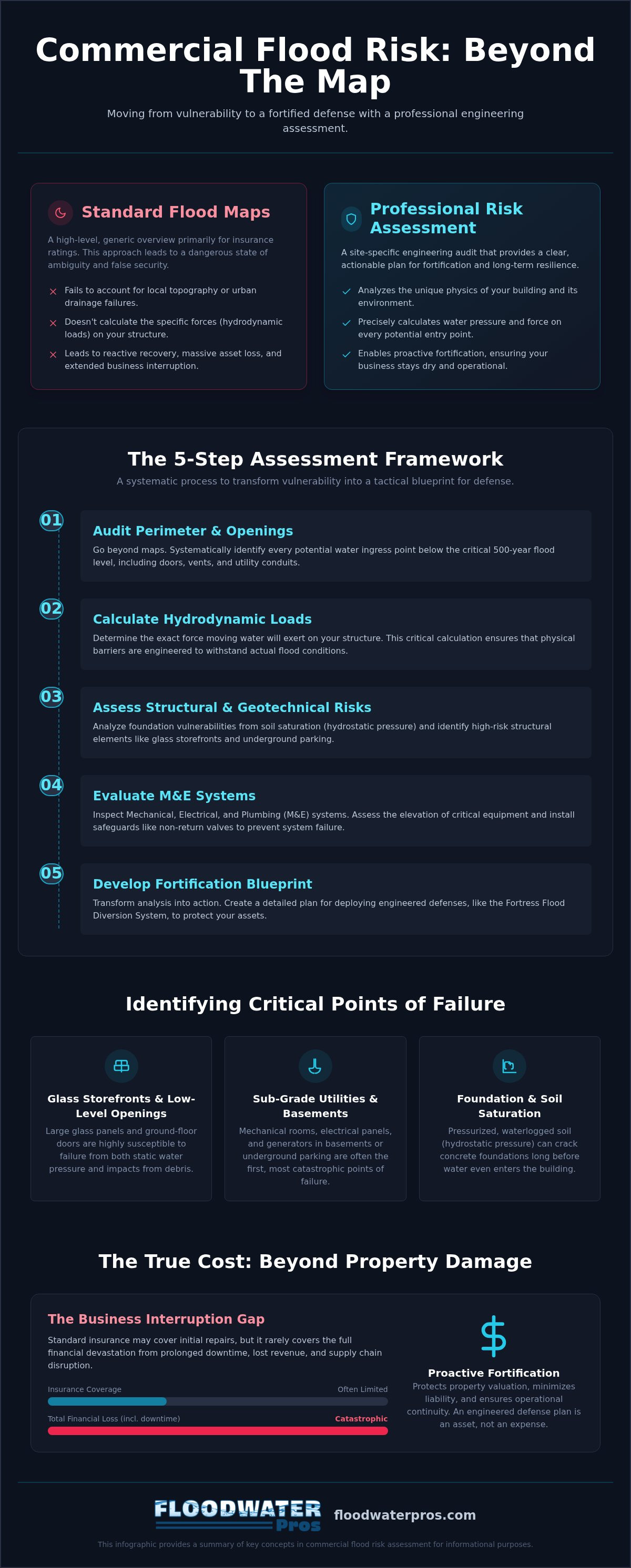
The Assessment Blueprint — A 5-Step Framework for Facility Managers
A tactical blueprint is the bridge between vulnerability and total asset security. For facility managers, a commercial building flood risk assessment isn't just a report; it's a sequence of defensive maneuvers designed to protect business continuity. You can't manage what you don't measure. This five-step framework provides the clarity needed to transform your site into a fortress. It moves you past the ambiguity of national maps and into a state of unwavering readiness.
- Step 1: Historical Data Review. We analyze past flood heights and frequency to understand the specific environmental pressures your site has already faced.
- Step 2: Perimeter Walk-Through. We identify every opening, vent, and conduit below the 500-year flood level to find your building's hidden weaknesses.
- Step 3: Asset Valuation. We prioritize protection for high-value equipment, server rooms, and data centers that cannot afford a single minute of downtime.
- Step 4: Response Time Audit. We determine how fast your defenses must be deployed to outpace a rising surge.
- Step 5: Engineering Consultation. We finalize a strategy that focuses on diversion rather than simple water retention to protect structural integrity.
Prioritizing the Protection Zone
Every square foot of your interior isn't equal. We help you create a 'Criticality Matrix' to rank your spaces by their importance to daily operations. The first 3 feet of elevation are the most critical for commercial defense. Most utility damage and equipment failure happens within this zone. By integrating these findings into your broader Business Continuity Plan (BCP), you ensure that your response is coordinated and decisive. You aren't just reacting to water; you're executing a pre-planned defense of your primary revenue drivers.
Operational Readiness and Deployment
A barrier is only effective if it's in place before the water arrives. We test the 'Human Element' to see if your staff can deploy heavy-duty barriers in under 30 minutes. In urban environments, the speed of deployment is often the only thing standing between a dry floor and a submerged lobby. Permanent systems provide constant security, while deployable systems offer flexibility for high-traffic areas. The choice depends on your specific operational constraints. Secure your facility before the storm. Contact FloodWater Pros for an engineered assessment.
Don't wait for the next alert to realize your plan has gaps. If you're ready to move from vulnerability to a state of profound security, it's time for a professional vulnerability audit that covers every structural detail. This is the first step toward building an impenetrable blueprint for your assets.
From Analysis to Action — Deploying the Fortress Defense Strategy
A commercial building flood risk assessment is only as valuable as the physical defenses it inspires. Data identifies the threat, but engineering neutralizes it. Once the audit is complete, you must transition from a state of awareness to a state of total fortification. We don't just provide a report. We provide a shield. This final phase of the process involves deploying high-stakes technology designed to withstand the actual physics of a flood. It is the moment where your business continuity plan becomes a physical reality.
The transition from analysis to action focuses on three proprietary pillars of defense. First, we implement the Fortress Flood Diversion System for large-scale water redirection. This isn't a passive wall; it's an active structural maneuver. For rapid, heavy-duty perimeter defense at loading docks or entrances, we utilize the Fortress Inflatable Flood Barrier. Finally, we apply the Fortress Transparent Liquid Paintable Flood Barrier to seal the microscopic pores of your building envelope. This multi-layered approach ensures that no path for water remains open.
Engineered Redirection: The Fortress Advantage
Redirection is a superior strategy to simple water retention. When you hold water directly against a building, you create a "swimming pool effect." The hydrostatic pressure builds until the foundation or walls buckle under the weight. The Fortress Flood Diversion System changes the math. It redirects the energy of the water around your facility, moving the threat away from your critical assets. This system is built for the high-velocity flow and heavy debris common in urban flash floods. It's durable, resilient, and engineered for the most extreme hydrodynamic loads. Professional installation is non-negotiable for these systems. Our full-service workflow ensures that the engineering specifications match the on-site execution, preserving both system performance and your warranty.
The Final Defense: Seamless Integration
Military-grade protection shouldn't compromise your building's professional appearance. By combining inflatable barriers with our transparent paintable sealant, we achieve a defense that is both impenetrable and nearly invisible. The Fortress Transparent Liquid Paintable Flood Barrier creates a seamless, watertight skin over your existing masonry and glass frames. It works in tandem with the Fortress Inflatable Flood Barrier to provide a redundant shield. This integrated strategy means your facility is ready for a 500-year event without looking like a bunker. You gain the profound relief of knowing your assets are safe. Don't wait for the flood. Fortify your business with the Fortress system today.
The "Full-Service" advantage is what separates a true partner from a generic contractor. We manage the entire process from the initial commercial building flood risk assessment through to final installation. This single-workflow approach eliminates the "Business Interruption Gap" and ensures every component of your defense is calibrated to the specific vulnerabilities of your site. It is the only way to achieve unwavering readiness in a shifting climate.
Securing the Horizon: Your Blueprint for Structural Resilience
Resilience isn't a passive state. It's a deliberate, engineered choice. You've already seen how generic maps fail to account for the high-stakes physical reality of your specific facility. A professional commercial building flood risk assessment is the only way to identify structural failure points before they are tested by a surge. By shifting your strategy from reactive recovery to proactive redirection, you protect both your physical assets and your business continuity.
We provide more than just a report. Our expert engineering and installation team delivers a total transformation of your perimeter. We utilize proprietary Fortress Flood Diversion Technology to meet the highest national commercial protection standards. You don't have to live with the ambiguity of shifting floodplains. You can choose to be a vigilant guardian of what you've built. The relief of total security is within reach. Take the decisive step toward an impenetrable defense today. It's time to replace uncertainty with structural integrity.
Request Your Engineered Commercial Flood Risk Assessment
Frequently Asked Questions
What is included in a professional commercial flood risk assessment?
A professional audit includes a site-specific engineering review of your building's envelope and surrounding topography. It identifies every potential ingress point, from loading docks to utility conduits. We calculate specific hydrodynamic loads to ensure your structural defenses can withstand the force of a surge. This commercial building flood risk assessment serves as the tactical precursor to installing engineered systems like the Fortress Flood Diversion System. It's a forensic look at your unique vulnerabilities.
How often should a commercial building's flood risk be reassessed?
You should reassess your risk every three to five years or whenever major local construction alters the surrounding drainage. New developments next door can completely change how water flows toward your property. Significant regulatory shifts, such as the 2026 HUD floodplain management rules, also necessitate a fresh look. Staying current ensures your defense strategy evolves with the changing environment. It's about maintaining a state of unwavering readiness against shifting threats.
Can a risk assessment help lower my commercial flood insurance premiums?
Yes, documenting your mitigation efforts can influence your risk profile. While we don't provide insurance brokerage, a commercial building flood risk assessment provides the engineering proof that your facility is fortified. As of 2026, NFIP limits for commercial properties remain at $500,000 for buildings and $500,000 for contents. Professional assessments show you've taken steps to protect assets beyond these coverage caps. It creates a record of proactive structural protection.
What is the difference between dry floodproofing and wet floodproofing?
Dry floodproofing aims to keep the interior completely dry by sealing the building envelope. This involves systems like the Fortress Transparent Liquid Paintable Flood Barrier or inflatable perimeters. Wet floodproofing allows water to enter specific areas while using flood-resistant materials to minimize damage. For high-stakes commercial assets, dry floodproofing is almost always the preferred strategy. It protects expensive equipment and data centers from even the slightest moisture exposure.
How do I know if my building needs a permanent or a temporary flood barrier?
The choice depends on your operational needs and the frequency of flood events. Permanent systems like the Fortress Flood Diversion System offer constant, passive protection for high-risk zones. Temporary barriers, such as the Fortress Inflatable Flood Barrier, are ideal for loading docks that require daily access but need rapid defense during a storm. A professional audit determines the right balance. It ensures your defense doesn't interfere with your primary revenue drivers.
What are hydrodynamic loads and why do they matter for my assessment?
Hydrodynamic loads represent the destructive force exerted by moving water and debris. Static water is heavy, but moving water acts like a battering ram against your foundation and glass storefronts. These loads are a critical component of your assessment because they dictate the strength required for your barriers. If you don't calculate these forces accurately, your defense might buckle. We use these metrics to calibrate the structural integrity of every shield we install.
Will a flood risk assessment identify vulnerabilities in my building's foundation?
Yes, a comprehensive audit looks specifically at soil saturation and hydrostatic pressure. When the ground around your building becomes saturated, it exerts massive pressure against your foundation walls and floor slabs. This can cause structural cracking or even floor uplift. Identifying these invisible risks allows us to recommend specific sealants or diversion strategies. It's about protecting the very bones of your building from the pressure of the rising tide.
How long does it take to complete a full engineered assessment for a large facility?
The timeline depends on the scale and complexity of your facility. A physical site walk-through usually takes one to two days for a large commercial property. Following the visit, the data analysis and engineering report typically require two to three weeks to finalize. This detailed blueprint provides the exact specifications needed for installing a Fortress defense. It's a methodical process designed to ensure your blueprint for resilience is both accurate and impenetrable.


