

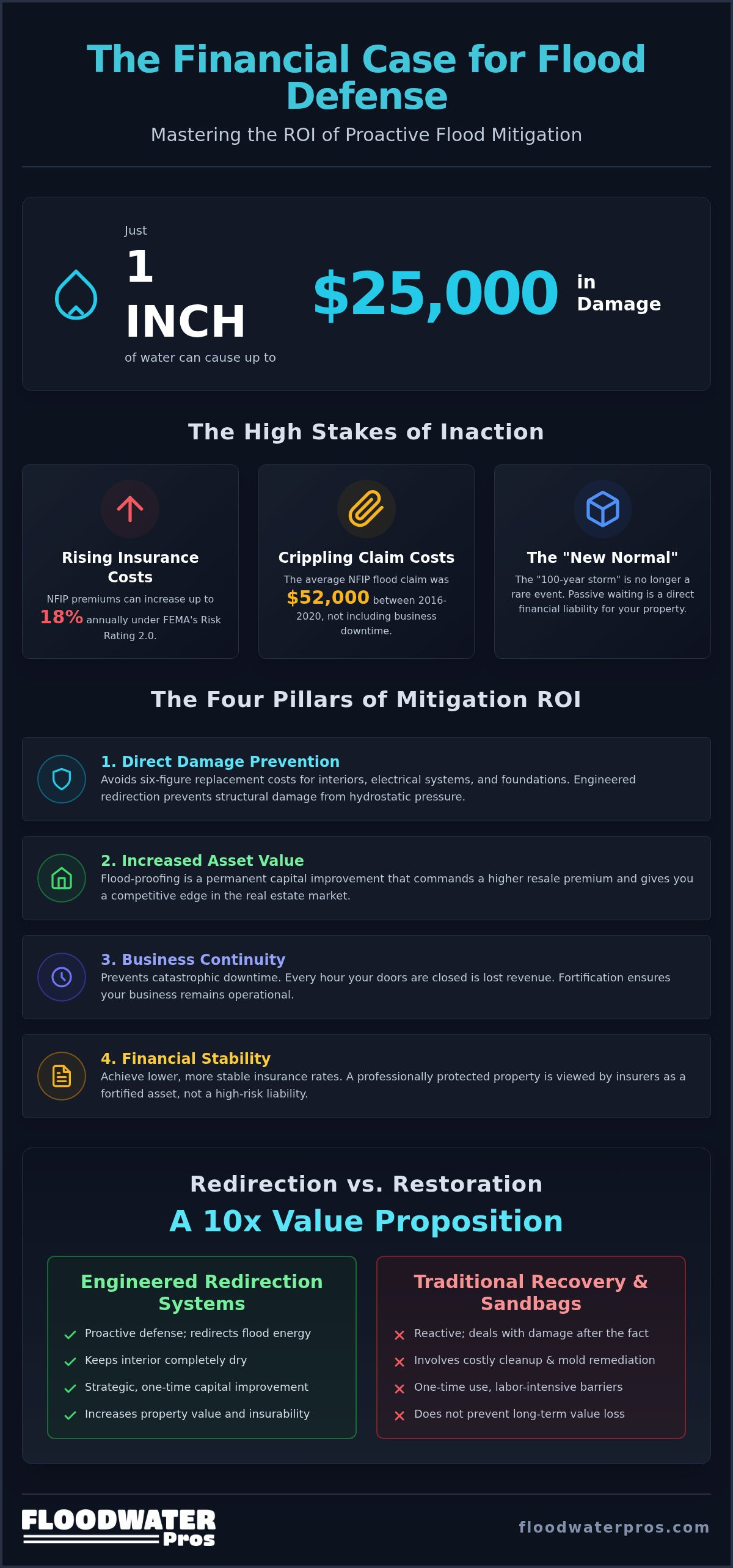
Just one inch of water inside your building can cause up to $25,000 in immediate damage. It's a staggering figure that turns a simple storm into a financial catastrophe. For many property owners, the math feels impossible. You're facing NFIP premium increases of up to 18% annually while trying to protect your most valuable assets from unpredictable threats. Calculating ROI of flood mitigation isn't just about spreadsheets. It is about the strategic redirection of risk through engineered fortification.
It's natural to feel overwhelmed by the rising costs of insurance and the complex array of defense technologies available today. You want a shield that works, but you also need a clear financial justification for the upfront investment. This guide will help you master the financial framework of flood defense. We'll show you how to transform high-stakes risk into long-term asset security. We will explore the "triple-dividend" of adaptation and how professional systems like the Fortress Flood Diversion System create measurable value. You'll learn how to secure lower insurance costs and gain the peace of mind that only comes from engineered certainty.
Key Takeaways
- Recognize why passive waiting is a financial liability and how a single inch of water can trigger $25,000 in structural damage.
- Master the specific property owner's formula for calculating ROI of flood mitigation by assessing vulnerability and base flood elevation.
- Identify the four pillars of mitigation ROI, focusing on avoided physical damage and the critical value of business continuity.
- Evaluate why modern engineered redirection systems offer ten times more value than traditional recovery methods or one-time-use sandbags.
- Understand how professional installation and the Fortress Flood Diversion System turn flood defense into a strategic capital improvement.
The High Stakes of Inaction — Why Flood Mitigation ROI Matters in 2026
Traditional risk models are dead. The "100-year storm" is no longer a rare anomaly; it has become a frequent, seasonal guest. When calculating ROI of flood mitigation, you must start by acknowledging that passive waiting is a financial liability. It is a slow-motion disaster for your equity. Every single inch of water that breaches your threshold can cost upwards of $25,000 in structural damage. This isn't just a repair bill. It's a direct hit to your asset’s long-term value. In 2026, flood defense is not an optional upgrade. It is a fundamental requirement for property preservation.
Moving from a mindset of "cost" to one of "investment" is critical. A cost is a drain on resources with no return. An investment, like a professional fortification system, acts as a shield that generates value by preventing catastrophic loss. This is why calculating ROI of flood mitigation is no longer a luxury; it is a survival tactic for your balance sheet.
The Escalating Cost of Flood Damage
The damage from a flood event is rarely limited to what you see on the surface. Direct structural damage hits your foundations, electrical systems, and drywall immediately. Between 2016 and 2020, the average NFIP flood insurance claim was approximately $52,000. That figure doesn't account for the indirect costs that can cripple a business or family. These include mold remediation, displacement expenses, and lost revenue during downtime. Effective flood management strategies must transition from reactive recovery to proactive fortification to avoid these compounding expenses. Average Annual Loss (AAL) represents the expected financial loss from flood events averaged over a long-term period and serves as the primary benchmark for your risk.
Insurance Realities in a High-Risk Era
Insurance premiums are no longer stable. With the full implementation of FEMA’s Risk Rating 2.0, premiums are now tied to property-specific risks like elevation and distance to water. If your current rate is below the "Full Risk Premium," you could face annual increases of up to 18% until you reach that cap. Mitigation offers the only viable path to rate stabilization. Private insurers and federal programs now reward properties that demonstrate engineered resilience. A Fortress Flood Diversion System, when professionally installed, changes your insurability profile. It signals to underwriters that your property is a fortified asset rather than a vulnerable liability. This engineered certainty is what transforms a high-stakes threat into a manageable, secure investment.
Quantifying the Shield — The Four Pillars of Mitigation ROI
ROI is more than a line item on a balance sheet. It is a structural safeguard. When calculating ROI of flood mitigation, you must look beyond the immediate price tag. True value is found in the intersection of physical protection, financial stability, and psychological relief. We categorize these benefits into four distinct pillars that define the total return on your investment. Understanding these pillars allows you to see fortification as a proactive asset rather than a reactive expense.
Pillar 1: Direct Damage Prevention
Physical assets are the most vulnerable during a surge. Replacing high-value interior finishes, custom cabinetry, and sensitive electrical equipment can easily exceed six figures. The Fortress Flood Diversion System provides a critical advantage here. Unlike traditional barriers that simply hold water back, this system redirects the energy of the flood. This prevents hydrostatic pressure from collapsing your foundation or buckling your walls. Without professional barriers, cleanup involves hazardous waste removal and extensive mold remediation. With them, your interior remains bone dry. You can evaluate your specific risk profile by consulting with the experts at FloodWater Pros to see how redirection beats restoration.
Pillar 2: Asset Value and Marketability
Flood-proofing is a permanent capital improvement. It doesn't just protect the building; it elevates its market status. In an era where flood risk is a top concern for buyers, engineered defense systems provide a significant competitive edge. A fortified property commands a higher resale premium because the risk has been mitigated by design. For commercial owners, this translates to lower vacancy rates and higher tenant retention. Businesses can't afford downtime. Every hour your doors remain closed is revenue lost to the storm. Fortification ensures your business remains an active, income-generating asset while competitors are forced to shutter.
Pillar 3: The Intangible Returns
Traditional calculators often ignore the human element. The "Storm Anxiety" cycle is a real burden for property managers and families. It's the stress of watching the radar and the fear of losing irreplaceable sentimental items. Mitigation breaks this cycle. It offers the relief of knowing your structural integrity is secure. There is also the value of immediate re-entry. While others wait months for contractors and materials, a fortified property is ready for use as soon as the water recedes. This speed of recovery is a massive component when calculating ROI of flood mitigation for those who value their time and mental well-being.
Redirection vs. Restoration — Comparing Modern Systems to Traditional Recovery
Traditional flood defense relies on desperation. Modern fortification relies on engineering. When calculating ROI of flood mitigation, many property owners mistakenly compare the price of a professional barrier to the cost of a stack of sandbags. This is a false equivalence. One is a recurring expense that frequently fails; the other is a permanent capital improvement designed for total asset security. Choosing between redirection and restoration determines whether you are managing a crisis or mastering a risk.
The Hidden Costs of Sandbags
Sandbags represent a false economy. They are labor-intensive, one-time-use failure points that create a logistical nightmare. The cost of labor to fill, deploy, and eventually dispose of contaminated sand can be staggering. Beyond the budget, there is the environmental toll of plastic waste and toxic silt. Many sandbag barriers fail under prolonged hydrostatic pressure because they are porous and unstable. Relying on them is a "Wait and See" approach that often leads to restoration costs ten times higher than the cost of proactive defense. Every failed sandbag is an invitation for the $52,000 average insurance claim to become your reality.
Fortress Flood Diversion: Redefining the Perimeter
The strategic superiority of the Fortress Flood Diversion System lies in its name. It redirects water away from your structure rather than merely attempting to retain it. This fundamental shift in physics protects your foundation from the crushing weight of a surge. For those prioritizing aesthetics, the Fortress Transparent Liquid Paintable Flood Barrier provides an invisible layer of armor. It seals the building envelope without altering its visual profile. This is essential for historical properties or high-end commercial estates where curb appeal is part of the asset value.
When speed is the priority, the Fortress Inflatable Flood Barrier offers rapid deployment ROI. Flash floods don't give you hours to stack sand; they give you minutes to react. These inflatable systems can be deployed by a small team, providing military-grade security in a fraction of the time. By calculating ROI of flood mitigation through the lens of lifecycle costs, the choice is clear. A reusable, engineered system pays for itself the moment the first storm hits, while traditional recovery methods continue to drain your resources year after year.
The Property Owner’s Formula — Calculating Your Personal Return
Calculating ROI of flood mitigation requires moving beyond abstract national averages. You need a formula that accounts for your specific building envelope and risk profile. This process transforms a perceived expense into a clear financial strategy. By quantifying your vulnerability, you can justify the investment in professional fortification. It is the difference between hoping for the best and engineering a certain outcome.
Calculating Your Vulnerability Score
Your first step is identifying the Base Flood Elevation (BFE) for your specific lot. Modern flood maps provide a baseline; however, historical data often reveals a more aggressive reality. You must identify "Critical Failure Points" such as low-entry doorways, vents, or basement windows. Once you know where the water will enter, you can estimate the cost of a single major flood event. This estimate must include structural repair, the replacement of high-value contents, and the cost of time. Displacement often lasts months. Every week you are out of your building is a week of lost productivity or additional living expenses. The Benefit-Cost Ratio (BCR) for a private estate is the net present value of all avoided damages divided by the total cost of the fortification system. If your BCR is above 1.0, the system is a profitable investment. National studies show that for every $1 spent on mitigation, society saves $6 in future disaster costs.
The 10-Year ROI Projection
A short-term view hides the true value of defense. You must apply the "Mitigation Multiplier" over a 10-year horizon to see the full impact of your decision. This projection compares cumulative insurance savings against the one-time cost of a professional Fortress system installation. Under FEMA’s Risk Rating 2.0, properties that lack mitigation face annual premium increases of up to 18%. Fortifying your property is the only way to stop this financial bleed.
Fortress diversion systems are designed for zero-cost maintenance. Unlike sandbags that require replacement or mechanical systems that need annual servicing; these barriers remain ready without ongoing fees. Your "Break-Even" point usually occurs after the first avoided event. If a $25,000 damage event is prevented, the system has often already covered its initial cost. Over a decade, the avoided damage, lower premiums, and preserved asset value create a return that far exceeds traditional investments. To begin your specific calculation, contact FloodWater Pros for a professional assessment of your property’s unique vulnerability.
Securing the Future — The Fortress Advantage as a Strategic Investment
True asset security requires more than a temporary fix. It demands a system that integrates seamlessly with your property’s architecture while providing impenetrable defense. When calculating ROI of flood mitigation, the Fortress Flood Diversion System stands as the gold standard of engineered certainty. This isn't a mere barrier. It is a sophisticated redirection tool that manages the immense force of moving water. By choosing a system designed for resilience, you are shifting from a reactive posture to a state of total readiness.
Professional installation is the critical variable that many property owners overlook. A high-quality product is only as effective as its deployment. FloodWater Pros provides a national footprint of engineering expertise to ensure every barrier is a structural success. This professional touch guarantees that your fortification meets the rigorous standards required for insurance compliance and long-term efficacy. It transforms the system into a certified capital improvement rather than a DIY experiment.
For high-value estates, protection must not compromise visual integrity. The Fortress Transparent Liquid Paintable Flood Barrier offers a specialized solution for those who require invisible armor. This technology seals the building envelope against moisture and surges without altering the aesthetic profile of the structure. It is the ultimate ROI for owners of historical or architectural landmarks who need to balance preservation with modern risk management.
Beyond the Product: The Power of Engineering
DIY solutions often negate your potential ROI through improper placement or poor sealing. A single gap in your perimeter can lead to total failure, rendering your investment useless. Professional engineering plans account for complex perimeters, drainage patterns, and hydrostatic pressure. This custom-engineered approach ensures that water is moved exactly where it needs to go. It provides the structural peace of mind that a generic, off-the-shelf product simply cannot deliver.
Taking the First Step Toward Fortification
The journey toward security begins with a comprehensive consultation. Our experts move from risk assessment to the design of an engineered defense plan tailored to your specific vulnerability. Early investment is the most strategic move you can make. Beating the "Hurricane Season Rush" ensures your property is fortified before the next threat appears on the radar. It is time to move beyond the uncertainty of the storm cycle. Secure your legacy with a professional flood ROI assessment today.
Mastering the Financial Shield: Your Path to Permanent Security
The era of reactive recovery is over. Fortifying your property is no longer just a defensive move; it is a strategic capital improvement that pays dividends for decades. By calculating ROI of flood mitigation through the lens of long term asset security, you move from vulnerability to engineered certainty. The data is clear. Industry standards confirm a documented $6 saved for every $1 spent on mitigation. This isn't just about spreadsheets. It's about the profound relief of knowing your structural integrity is absolute and your equity is shielded from environmental threats.
FloodWater Pros provides the proprietary Fortress engineered diversion technology required to master environmental risk. Our national professional installation network ensures your defense system is a structural asset, not a temporary fix. You don't have to face the rising tide of insurance premiums and storm anxiety alone. You can transform high stakes risk into a secure, dry future. Take control of your property's financial destiny before the next surge. Your legacy deserves a shield that never wavers.
Calculate Your Protection Strategy — Consult with FloodWater Pros
Frequently Asked Questions
Is flood mitigation worth the investment for a home not in a high-risk zone?
Yes, because low-to-moderate risk areas account for approximately 25% of all flood insurance claims. A single inch of water causes up to $25,000 in structural damage, making the cost of inaction far higher than fortification. Mitigation acts as a proactive shield against the increasing frequency of flash floods. It is a strategic move to protect your home's equity before a disaster occurs.
How much can I expect to save on insurance with a Fortress Flood Diversion System?
Savings depend on your specific risk profile under FEMA’s Risk Rating 2.0. However, properties that demonstrate engineered resilience often see significant premium stabilization. Professional installation of a Fortress Flood Diversion System signals to insurers that the property is a lower risk. This can prevent the maximum 18% annual premium increases allowed under current federal guidelines, ensuring long-term financial predictability.
What is the average ROI for commercial flood protection systems?
The average ROI for commercial systems is often measured by the industry standard of $6 saved for every $1 spent on mitigation. For businesses, this calculation includes avoided structural damage and preserved revenue from avoiding downtime. Calculating ROI of flood mitigation for a commercial asset must factor in business continuity. A dry facility remains operational while competitors face months of costly restoration.
How does the Fortress Paintable Flood Barrier impact property value?
The Fortress Transparent Liquid Paintable Flood Barrier acts as a permanent capital improvement that increases marketability. It provides military-grade security without compromising the building's aesthetic profile. Prospective buyers view invisible fortification as a premium feature that reduces future liability. This engineered certainty often leads to higher resale values and faster closings in areas where rising water is a documented concern for investors.
Can I calculate my flood ROI without a professional assessment?
You can estimate basic returns using historical maps, but a professional assessment is required for accuracy. Professional engineering identifies critical failure points in your building envelope that DIY estimates often miss. Calculating ROI of flood mitigation accurately requires precise data on base flood elevation and structural vulnerability. Without an expert's eye, your formula may underestimate the true cost of potential damage or the efficiency of redirection.
What happens to my ROI if flood maps change in my area?
Your ROI typically increases when flood maps are updated to show higher risk. As more properties are moved into high-risk zones, your pre-existing fortification becomes a massive competitive advantage. You avoid the sudden spike in insurance premiums that neighbors will face. Your property remains a fortified asset while the surrounding market struggles with new regulatory costs and increased vulnerability to rising water levels.
Are inflatable flood barriers more cost-effective than permanent walls?
Inflatable barriers offer superior ROI in scenarios requiring rapid, temporary deployment. Unlike permanent concrete walls, the Fortress Inflatable Flood Barrier doesn't require massive excavation or permanent landscape changes. It provides a flexible defense that can be deployed by a small team only when a threat is imminent. This lower upfront labor cost and high reusability make it a highly cost-effective choice for many property owners.
How long does it take for a flood barrier system to pay for itself?
A flood barrier system often pays for itself after the first major storm event is successfully redirected. If a professional system prevents a single $52,000 average insurance claim, the initial investment is frequently covered immediately. Over a 10-year horizon, the combination of avoided losses, lower insurance premiums, and preserved property value ensures a return that far exceeds traditional financial instruments or passive recovery methods.


