

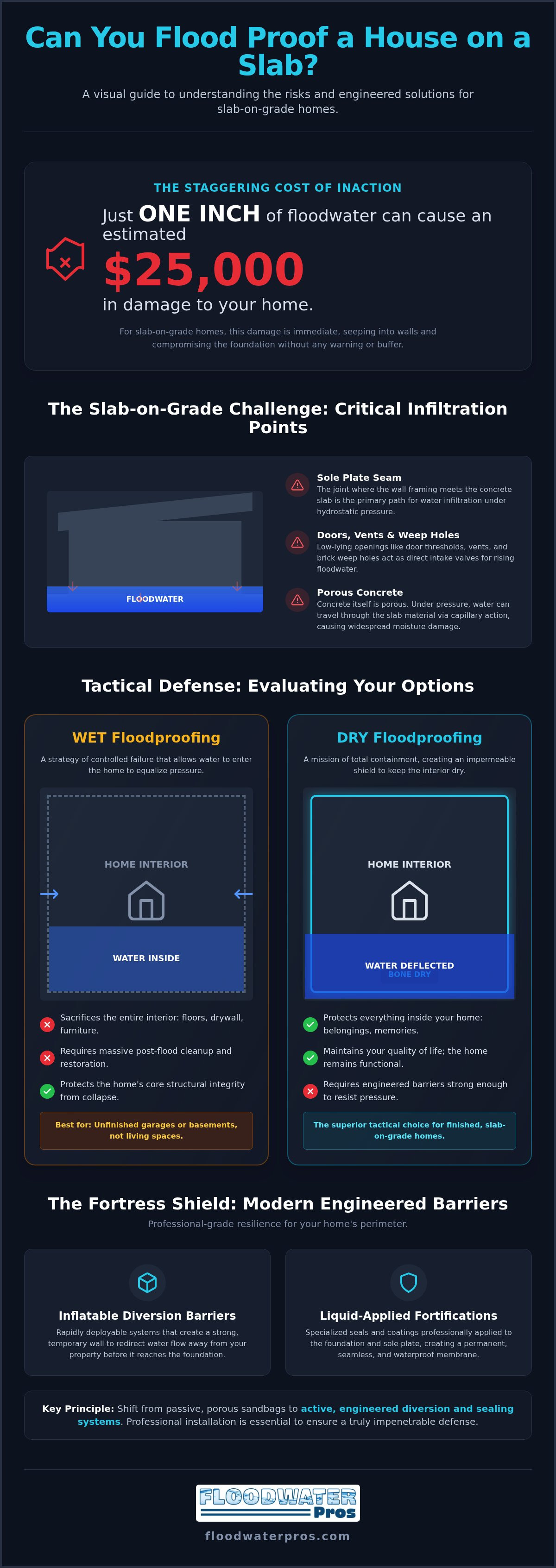
FEMA estimates that a single inch of floodwater can cause approximately $25,000 in damage to your home. For a house built on a concrete slab, that water doesn't just sit on the floor; it seeps into the walls and compromises your foundation. You've likely spent nights watching the clouds, feeling the weight of potential loss and the frustration of ineffective DIY sandbags. It's a high-stakes gamble you shouldn't have to play. You need to know: can you flood proof a house on a slab without the massive expense of structural elevation?
The answer is a definitive yes. You can transform your home into a fortress without the $80,000 price tag of lifting the entire structure. This guide reveals how engineered diversion systems and professional barriers create an impenetrable shield against rising waters. We'll simplify the engineering terms and show you how non-structural defenses provide the peace of mind you deserve. From inflatable barriers to liquid-applied fortifications, you'll discover a clear path to keeping your home dry and your future secure. It's time to stop reacting to the rain and start defending your domain with professional-grade resilience.
Key Takeaways
- Discover the definitive answer to can you flood proof a house on a slab by shifting from passive sandbags to active, engineered diversion systems.
- Understand why dry floodproofing is the superior tactical choice for finished slab-on-grade homes to prevent water from penetrating the vulnerable sole plate.
- Learn how the Fortress Shield line, including inflatable barriers and liquid-applied seals, creates an impenetrable perimeter around your property.
- Realize why professional engineering and national installation are essential to ensure your home remains a sanctuary during high-stakes environmental threats.
The Slab-on-Grade Challenge — Understanding the Vulnerability
Existing homes built directly on the ground face a unique set of threats. Unlike houses with crawlspaces or basements, there is no vertical buffer between your living room floor and the rising water. This proximity creates an immediate crisis. When water rises, it reaches your interior space almost instantly. Many homeowners ask: can you flood proof a house on a slab when the water is already at the doorstep? Understanding the physics of your foundation is the first step toward a real solution.
Why Slabs Are High-Risk in Flood Zones
Slab-on-grade construction offers zero lead time. Without a sub-floor area to collect initial seepage, every inch of rising water outside translates to an inch of damage inside. Concrete might look solid, but it is naturally porous. At a molecular level, water travels through the material via capillary action. Hydrostatic pressure is the force of standing water against a structure. This pressure intensifies as water depth increases. It pushes moisture through microscopic cracks and pores that you can't see until the carpet is soaked. Effective flood management strategies require acknowledging that your foundation is not a waterproof tank by default.
The Critical Infiltration Points
Water is a relentless opportunist. It finds the path of least resistance, which is often the sole plate. This is the structural point where your wall framing meets the concrete slab. Even if your walls are strong, this seam is rarely watertight. Door thresholds and low-lying vents are early failure points. If your home has brick siding, the weep holes intended for ventilation become high-speed intake valves during a flood. These gaps are often overlooked during DIY prep, leading to total property loss despite your best efforts.
Traditional sandbags offer a false sense of security. They are porous, heavy, and often fail to create a tight seal against flat concrete. They might hold back some debris, but they won't stop the hydrostatic pressure from forcing water under your walls. Protecting a slab home requires a tactical shift from holding water back to redirecting it entirely. You need a barrier that integrates with the structure rather than just leaning against it. This is about creating an impenetrable shield for your most valuable asset.
Dry vs. Wet Floodproofing — Evaluating Your Tactical Defense
You face a critical tactical decision when the clouds gather. Do you let the water in or keep it out? The strategy you choose determines whether your home remains a sanctuary or becomes a restoration project. Homeowners often ask: can you flood proof a house on a slab without losing everything they own? The answer lies in the fundamental difference between wet and dry floodproofing methods. One accepts the water; the other defies it.
The Reality of Wet Floodproofing a Slab
Wet floodproofing is a strategy of controlled failure. It relies on the installation of engineered flood vents that allow water to flow freely into and out of the structure. The goal is to equalize hydrostatic pressure. This prevents the weight of external water from buckling your foundation or collapsing your walls. While this protects the structural shell, it abandons the interior. For a slab-on-grade home, this means your hardwood floors, lower drywall, and kitchen cabinets are sacrificed to the current. This method is best reserved for unfinished garages or storage areas where the loss of property is manageable. It requires the use of water resistant materials like metal studs and concrete floors. It is a surrender of your living space in exchange for structural survival.
The Case for Dry Floodproofing
Dry floodproofing is a mission of total containment. It involves creating an impermeable seal around the entire perimeter of your home to keep the interior bone dry. This is the preferred choice for homeowners who want to protect their furniture, electronics, and irreplaceable family memories. Because this method prevents water from entering, the structure must be strong enough to withstand the immense weight of standing water pushing against it. It requires high strength barriers and specialized seals at every entry point. Exploring advanced barrier technology is the first step toward achieving this level of fortification. When deciding can you flood proof a house on a slab, dry floodproofing offers the only path that maintains your quality of life. It transforms your home into a fortress that remains functional even when the streets are submerged. This tactical investment provides the relief of security and the confidence of a dry interior.
Engineering the Perimeter: Redirection vs. Retention
Most homeowners approach flood defense as a "last stand" at their front door. They pile sandbags against the entrance and hope for the best. This is retention, and for a slab-on-grade home, it is a losing strategy. When you ask can you flood proof a house on a slab, you must look beyond the walls. You need a managed perimeter. True protection shifts the battlefield away from your foundation and into the yard where you have the space to win.
The difference between sandbags and engineered diversion is the difference between a temporary patch and a permanent shield. Retention systems try to hold water back with brute force. Redirection systems move water away entirely. By managing the hydrology of your property, you neutralize the threat before it ever touches your sole plate. This tactical approach protects the structural integrity of your home while offering the relief of a dry interior.
The Strategic Advantage of Diversion
Redirecting water flow is the most effective way to reduce hydrostatic pressure on your foundation. The Fortress Flood Diversion System acts as a proactive barrier. It creates a buffer zone around your home. These engineered systems are designed to use the weight of the floodwater itself to increase the seal against the ground. This creates an impenetrable line of defense that can be deployed far from your exterior walls. This distance is vital because it protects your landscaping and prevents saturated soil from pressing against your slab. It's a professional-grade solution that replaces panic with a calculated plan of action.
The Failure of Temporary DIY Fixes
Many people rely on plastic sheeting and sandbags because they're familiar. However, sandbags are porous and require massive manual labor to deploy. They leave gaps that water exploits with ease. Plastic sheeting is even more vulnerable; it's easily punctured by floating debris like branches or trash. These methods offer a false sense of security that fails when the stakes are highest. Engineered barriers provide a repeatable and reliable defense. They are built for resilience and structural strength. You don't have to lift your home to save it. You simply need to implement a system that is stronger than the storm. A managed perimeter ensures that your home remains a sanctuary, regardless of the rising tide outside.
The Fortress Shield — Modern Barriers for Slab Homes
The primary concern for many homeowners remains: can you flood proof a house on a slab when the water is already rising? The answer is found in the Fortress Shield. This is not a single product but a coordinated system of modern barriers. It provides a definitive, structural answer to environmental threats. By utilizing advanced materials, we create a defensive layer that stops water before it can cross your threshold. This transformation from vulnerability to security is what defines a truly protected home.
Rapid Deployment with Inflatable Barriers
Speed is the most critical factor during a flash flood. You don't have the luxury of time when a storm surge hits. The Fortress Inflatable Flood Barrier is engineered for rapid deployment. Its heavy-duty construction is designed to absorb the impact of floating debris that would puncture standard plastic sheeting. You can stage these barriers in advance and have them fully operational in minutes. This is professional-grade protection that doesn't require a construction crew to activate. It's a bold innovation for a high-stakes problem.
Invisible Protection with Liquid Coatings
Standard barriers often ignore the microscopic entry points. The "cold joint" between the slab and the wall framing is a notorious weak spot. The Fortress Transparent Liquid Paintable Flood Barrier provides an invisible seal for these critical areas. It is a high-strength coating that adheres to thresholds, vents, and seams. Because it is transparent and paintable, it protects your home without ruining its appearance. This allows you to maintain your curb appeal while knowing your property is fortified against infiltration. It's a strategic partner in your home's defense.
True safety comes from a multi-layered approach. Custom engineering ensures that every unique gap in your property's perimeter is accounted for. We manage the engineering phase to ensure these systems integrate perfectly with your home's specific layout. When you ask can you flood proof a house on a slab, you are looking for a solution that works every time. Stop relying on luck and start relying on a system that has mastered the niche of protection. Explore our professional barrier systems to begin your journey toward lasting peace of mind.
Professional Implementation — Securing Your Home’s Future
A defensive system is only as strong as its weakest point. For slab homes, those weak points are often invisible to the untrained eye. Professional installation isn't just a convenience; it's a structural necessity. When you ask can you flood proof a house on a slab, you aren't just buying a product. You are investing in an engineered solution designed to withstand extreme hydrostatic pressure. A single mistake in the sealing process can lead to total failure when the water rises. You need a partner who understands the high stakes of environmental defense.
The Engineering and Installation Process
Our process begins with a comprehensive site assessment. We analyze the specific hydrology of your property to understand how water moves during a storm. This data drives the customized design of your barrier system. Our national professional installation teams ensure that every component is fitted to the exact specifications of your home's perimeter. A "set it and forget it" mentality is dangerous in high-stakes flood zones. We manage the engineering from start to finish. This ensures your Fortress system functions exactly as intended when the environment turns hostile. Flood mitigation efforts provide a significant return on investment. Some estimates suggest a return of $6 to $13 for every $1 spent on professional protection. This isn't just about saving money on repairs; it's about safeguarding your mental well-being and long-term security.
Final Readiness Checklist
Your flood barrier is a life-safety system. It requires the same level of readiness as a fire suppression system. Maintaining structural integrity means performing regular inspections of your Fortress components. You should stage your barriers well before hurricane season begins. Waiting for a storm warning is a recipe for disaster. Readiness is the difference between a dry home and a total property loss.
Follow this protocol to ensure total protection:
- Inspect all seals and inflatable components for wear or debris.
- Verify that liquid coatings remain intact and free of punctures.
- Practice deployment to ensure your team can act within minutes.
- Check that all diversion paths are clear of obstructions.
Professional protection transforms your relationship with the weather. You no longer need to fear the sound of heavy rain on your roof. You gain the profound relief of security and the knowledge that your sanctuary is fortified against the unpredictable. Secure your slab-on-grade home with a professional Fortress system today.
Secure Your Sanctuary: The Path to Total Resilience
Protecting your property is a duty. It's no longer enough to rely on the hope that the rain will stop. You've seen that the answer to can you flood proof a house on a slab is a definitive yes. It requires moving from passive retention to active, engineered diversion. By creating a managed perimeter with proprietary Fortress Flood Diversion Systems, you neutralize the threat before it reaches your door. This tactical shift ensures your living space remains functional and dry even during extreme environmental events.
Our national engineering and installation teams specialize in high-stakes residential defense. We don't just sell barriers; we provide a structural shield tailored to your property's specific hydrology. This professional implementation ensures your home remains a dry haven regardless of the rising waters outside. You can trade the vulnerability of uncertainty for the relief of total security. The stakes are too high for DIY guesswork. Take the decisive step toward safeguarding what you value most. Fortify your home with FloodWater Pros; get an engineered quote today. Your home is your fortress. We ensure it stays that way.
Frequently Asked Questions
Is it possible to completely flood proof an existing slab home?
Yes, achieving total protection is possible through engineered dry floodproofing. This process involves creating an impermeable seal around your home's perimeter to keep the interior bone dry. When homeowners ask can you flood proof a house on a slab, they are often looking for a tactical alternative to structural elevation. Our Fortress systems are designed to withstand the hydrostatic pressure that forces water through porous concrete. It's a structural answer to a significant environmental threat.
Can I use the Fortress system if I live in a high-velocity flood zone?
The Fortress system is engineered for high-stakes residential defense. However, high-velocity zones, known as V zones, have unique structural requirements due to the added force of waves and moving water. A professional site assessment is mandatory to determine if dry floodproofing is the appropriate tactical choice for your location. We analyze the anticipated water speed and impact potential to ensure your barrier provides the impenetrability required for your specific environment.
How much does a professional flood barrier system cost for a slab home?
The cost of a professional flood barrier system is determined by your property's unique hydrology and the size of the perimeter you need to protect. Because every home requires a customized engineering plan, we don't offer generic pricing. It's important to consider the return on investment. Research suggests that every $1 spent on mitigation can save $6 to $13 in future damages. Investing in a professional shield is a strategic move to prevent total property loss.
Will dry floodproofing my house lower my insurance premiums?
Implementing professional dry floodproofing measures can influence your long-term insurance costs. While the NFIP focuses on wet floodproofing for compliance in high-risk zones, many private insurers recognize the value of engineered barriers. Mitigation efforts that reduce the risk of a total property loss are often viewed as a positive risk factor. You should consult with your provider to see how a professional Fortress system impacts your specific policy. It's a proactive step toward safeguarding your financial future.
Do I need a permit to install a flood diversion system on my property?
Permitting requirements for flood diversion systems vary by local jurisdiction and floodplain management regulations. Most structural changes or significant landscape alterations intended for flood control require professional engineering and approval. We manage the engineering phase to ensure your system meets the necessary standards. This ensures your defense is not only physically strong but also fully compliant with safety regulations. Professional guidance is essential to navigate these complex structural requirements correctly.
Can I install the Fortress Flood Diversion System myself?
No, the Fortress Flood Diversion System requires professional on-site installation. Precision is the difference between a dry home and a catastrophe. Our national installation teams ensure that every seal and diversion path is executed according to the engineering plan. A DIY approach lacks the specialized equipment and technical expertise needed to manage high-stakes hydrostatic pressure. Professional implementation is the only way to guarantee your home’s structural integrity and your peace of mind during a storm.
What happens to the water that is redirected away from my house?
Redirected water follows a managed path designed to flow away from your foundation and toward lower ground or existing drainage infrastructure. The goal of the Fortress Flood Diversion System is to move the threat away from your slab before it can infiltrate. We assess the natural slope and hydrology of your yard during the engineering phase. This ensures that the water is moved safely without creating new vulnerabilities for your property. It's a strategic redirection of force.
How long do inflatable flood barriers last?
Fortress Inflatable Flood Barriers are designed for long-term resilience and repeated use. These are heavy-duty systems built to withstand the impact of floating debris and harsh environmental conditions. Their lifespan depends on regular inspections and proper storage when not in use. By following our readiness checklist and maintaining the material's integrity, your inflatable barrier remains a reliable life-safety system for many years. It's a durable investment in your home's future and your family's safety.


