

Your FEMA flood map is a generalization, not a shield. While a map tells you the statistical probability of a disaster, it cannot see the specific cracks in your foundation or the way your driveway channels runoff toward your basement. It's natural to feel a spike of anxiety every time a heavy storm hits. You aren't alone in your confusion over conflicting flood scores that seem to change with every website you visit. We understand that the fear of foundation failure is a heavy burden when the clouds turn gray. This guide moves you beyond generic data to a comprehensive home flood risk assessment that identifies your property's unique structural vulnerabilities.
You'll learn how to stop reacting to the weather and start dictating where the water goes. We're going to show you how to transform your property from a target into a fortress. We will cover the engineering behind structural fortification and the strategic implementation of the Fortress Flood Diversion System. By the end of this article, you'll have an actionable plan to redirect water away from your foundation. You deserve the peace of mind that comes through engineered security and a proactive defense strategy.
Key Takeaways
- Learn why FEMA maps are only a starting point and how environmental modeling provides a more accurate view of your property's specific threats.
- Discover how a professional home flood risk assessment shifts the focus from broad statistics to the actual structural vulnerabilities of your foundation.
- Identify high-risk entry points like garage thresholds and utility vents where floodwater's most likely to breach your home's defenses.
- Perform a perimeter audit to map how land grading and heavy rainfall patterns create a path of least resistance toward your structure.
- Understand the engineering philosophy of redirection and why the Fortress Flood Diversion System is more effective than just trying to block water.
Decoding Your Home's Flood Risk Profile: Maps vs. Reality
FEMA’s Special Flood Hazard Area (SFHA) is a regulatory tool; it isn't a guarantee of safety. Many homeowners believe that staying outside the 1% annual chance boundary means they're secure. This is a dangerous misconception. A professional flood risk assessment reveals that water doesn't respect lines on a government map. In fact, properties in moderate risk zones often face the most catastrophic damage because they lack the structural fortification found in high-risk areas. These areas are often caught off guard, leaving families vulnerable to rising tides and flash floods that the maps never predicted.
FEMA Maps vs. Private Risk Modeling
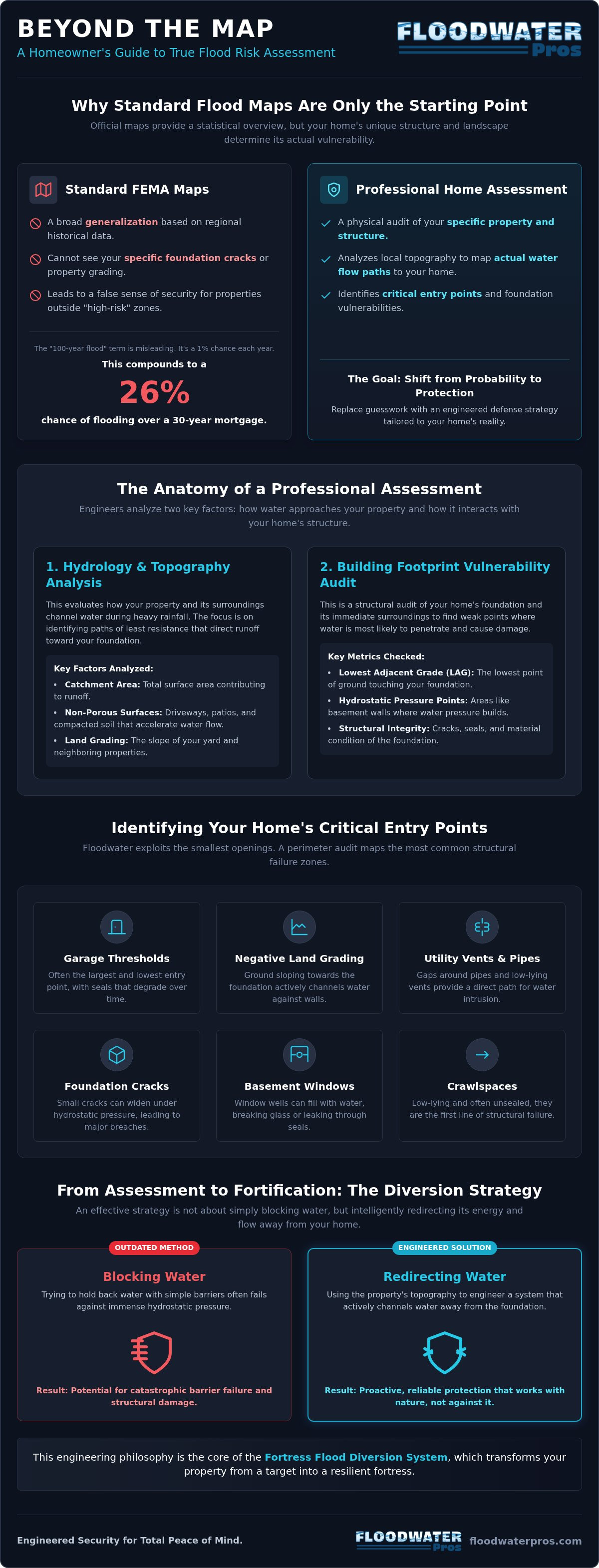
The term 100-year flood is misleading. It doesn't mean a disaster happens once a century. It describes a 1% probability of flooding in any given year. Over the life of a standard 30-year mortgage, that probability compounds to a staggering 26% chance of loss. Historical data is failing. Rapidly shifting climate patterns mean maps from a decade ago are already obsolete. Private environmental modeling, like the First Street Flood Factor, attempts to fill this gap by projecting future risk over the next three decades. While these models are more aggressive, they still lack the granular detail required for a true home flood risk assessment. They see your neighborhood; they don't see your foundation. They predict the rain, but they don't see the path it takes to your basement.
The Limits of Categorical Risk Scores
Risk scores are often reduced to a single digit. A score of 5/10 might suggest moderate concern, but it tells you nothing about your home’s specific entry points. It doesn't account for the localized topography of your backyard or the elevation of your electrical systems. Modern real estate disclosures often provide a false sense of security by focusing on zip codes rather than structural reality. You need to look beyond the number. Your home's safety depends on physical barriers and engineered systems, not a statistical average. True security comes from identifying where the land slopes toward your walls and where the water will actually pool. The process of a home flood risk assessment must move from understanding probability to implementing protection. This requires a shift in mindset from simple insurance compliance to total structural resilience.
The Anatomy of a Professional Home Flood Risk Assessment
Probability is a guess; vulnerability is a fact. While data from the FEMA Flood Map Service Center provides a regulatory baseline, a professional home flood risk assessment focuses on the physical reality of your structure. It is an audit of how water behaves when it meets your specific land. This shift in perspective is vital for homeowners who want to move from passive concern to active fortification. It transforms a vague environmental threat into a manageable engineering problem.
Hydrology and Local Topography Analysis
A property doesn't exist in a vacuum; it’s part of a larger hydraulic system. A catchment area is the total surface area contributing to runoff. Your assessment must evaluate where the neighborhood's water flows during a peak event. Non-porous surfaces like asphalt driveways, stone patios, and even compacted soil act as accelerators. They don't absorb water. They channel massive volumes toward your foundation with high velocity. Understanding these localized flow paths allows for a targeted defense strategy rather than a generic, ineffective one.
The Building Footprint Vulnerability
The building footprint is the most critical metric in any property audit. Engineers analyze the Lowest Adjacent Grade (LAG) relative to predicted flood depths in your specific basin. If your LAG is below the water's expected path, a breach is inevitable without professional intervention. Crawlspaces and basements are often the first lines of structural failure. Hydrostatic pressure builds against these subterranean walls, threatening the integrity of the entire home’s support system. A home flood risk assessment identifies these specific points of weakness before they are exploited by rising water.
Professional engineering is the only way to justify a high-ROI diversion investment. It replaces guesswork with military-grade precision. By identifying the exact hydrology of your plot, you can implement an engineered solution like the Fortress Flood Diversion System. This isn't just about blocking water; it’s about a total structural transformation. It provides the relief of security through calculated, proactive defense. Secure your foundation with a plan built on data, not hope.
Identifying Critical Entry Points and Structural Failure Zones
Water is a relentless opportunist. It doesn't just rise; it hunts for the path of least resistance. A thorough home flood risk assessment must look beyond the property line to identify the specific apertures where your defenses will fail. These aren't always obvious. While you might watch the front door, the water is already exploiting utility penetrations, weep holes, and air vents. It's a strategic invasion that requires a tactical response. Identifying these vulnerabilities is the difference between a dry basement and a total loss.
Thresholds and Aperture Vulnerabilities
Low-lying apertures are your primary breach points. Take a hard look at your garage threshold. If the garage floor sits lower than the crown of the driveway, you've built a funnel for flash floods. Door seals are another critical weakness. Standard weather stripping is designed for drafts, not the weight of standing water. Sliding glass doors are particularly vulnerable. They offer a large surface area for pressure to build and often lack the structural reinforcement to withstand a surge. Sub-grade window wells are essentially open invitations for basement inundation. Without an engineered drainage solution, these wells fill rapidly; they turn a simple window into a high-pressure water intake.
Hydrostatic Pressure and Foundation Integrity
The most dangerous threat isn't the water you see; it's the weight of the water you don't. Hydrostatic pressure is the force exerted by standing water against your foundation. As the ground saturates, thousands of pounds of pressure push inward. If you attempt to seal your home without a diversion strategy, you risk a catastrophic structural implosion. The walls simply cannot hold the weight. Sealing a home to keep water out without providing a way to move that water away creates a pressure cooker effect. When the external force exceeds the structural capacity of your concrete or masonry, the wall collapses inward.
Look for existing signs of stress during your home flood risk assessment. Stair-step cracks in your brickwork or bowing basement walls are early indicators that your foundation is already struggling. In deep flood events, "holding" water back is a losing game. It’s a high-stakes gamble with your home's integrity. This is why redirection is the only viable path to security. By moving the water away from the building footprint before it reaches these failure zones, you neutralize the pressure. You transform a potential collapse into a controlled event. Security isn't found in a seal; it's found in a system that dictates where the water goes.
The Proactive Perimeter Audit: A Homeowner’s Fortification Checklist
A statistical map can't see your backyard. While government data provides a broad overview, a physical home flood risk assessment requires you to step outside and analyze the terrain. You must identify the specific paths water takes during a crisis. This audit is your first line of defense. It transforms a passive concern into a tactical fortification plan. Don't wait for the next disaster to discover your property's weaknesses. Follow these essential steps to secure your perimeter:
- Conduct a Heavy Rain Audit: During the next storm, don't stay inside. Watch where water pools on your property and identify where it channels toward the house.
- Map the Grading: Use a level or string line to verify that the land slopes away from your foundation at all points.
- Inspect External Utilities: Verify that HVAC units, generators, and fuel tanks are elevated above the predicted flood depth.
- Check Subterranean Entry: Locate your sewer backflow valves and ensure they are clear of debris and fully functional.
Grading, Drainage, and Soil Saturation
The ground around your foundation is either a shield or a funnel. Professionals follow the 6-inch rule. This means the soil should slope away from your house at least 6 inches over the first 10 feet. If your land is flat or slopes inward, you are inviting disaster. Saturated soil is a silent enemy. When the ground can no longer absorb moisture, it exerts massive pressure against your walls. Evaluate your existing French drains and swales. If they are clogged or poorly designed, they will fail when you need them most. A home flood risk assessment must confirm that your drainage systems actually move water to a safe discharge point, not just a different part of your yard.
External Utility and Asset Protection
Your home's survival depends on its critical systems. Inspect your HVAC units, generators, and fuel tanks. Elevation is the only permanent solution for these assets. An elevated generator is useless if the control panel or transfer switch remains at ground level. Submerged electronics are instant losses. Outdoor fuel tanks pose a unique threat. In a deep flood, an unsecured tank becomes buoyant. It can tear away from its lines and become a heavy projectile, damaging your home or neighboring structures. For rapid-response protection of these vital assets, deploy the Fortress Inflatable Flood Barrier. It provides an immediate, military-grade perimeter around your utilities. If you're ready to move from a checklist to a permanent solution, contact FloodWater Pros for a professional assessment today.
From Assessment to Fortification: The Diversion Strategy
Identification is the first step toward security. A home flood risk assessment provides the data; now, you must apply the solution. We move beyond the passive hope of insurance and enter the era of active structural defense. The goal is total transformation. You aren't just surviving a storm. You are outmaneuvering it. This is the moment where concern becomes a calculated plan for resilience. You deserve the profound relief that comes from a house that can defend itself.
Redirection is the core of our philosophy. Traditional methods focus on retention. They try to hold water back. This is a losing battle against physics. When you block water, you create a pressure wall. This force eventually finds a way through or under your defenses. Redirection is different. It uses engineering to lead water away from your building footprint. It neutralizes the threat before it ever touches your walls. We don't just stop the water; we dictate its path.
Why Redirection Beats Retention
Consider the futility of sandbags. They are heavy, porous, and prone to rapid failure. They represent a desperate reaction rather than an engineered answer. The Fortress Flood Diversion System replaces this chaos with order. It reduces the hydrostatic pressure load on your structure. This protects your foundation from the silent weight of saturated soil. Beyond safety, this approach preserves your curb appeal. You don't have to sacrifice your landscape for security. Your home remains a sanctuary, even when the environment becomes hostile.
For those who value aesthetics, the Fortress Transparent Liquid Paintable Flood Barrier offers invisible protection. It seals apertures without altering the look of your home. When time is the enemy, the Fortress Inflatable Flood Barrier provides rapid deployment. It creates a military-grade perimeter in minutes. These systems work together to form an impenetrable shield against uncertainty. They are the tools of a vigilant guardian.
Implementing an Engineered Barrier System
Transitioning from a home flood risk assessment to a professional installation is a move toward certainty. DIY solutions often fail during high-velocity events. They lack the structural anchoring required to withstand thousands of pounds of moving water. A professional Fortress installation ensures every component is calibrated to your property's specific hydrology. You gain more than just a barrier. You gain the relief of knowing your legacy is protected by a seasoned expert who has seen it all.
Secure your legacy with a professional Fortress Flood Diversion System assessment today. Don't wait for the next heavy rain to test your defenses.
Secure Your Legacy: The Path to Structural Resilience
Your home is more than just a building. It's a sanctuary that deserves a calculated, professional defense. A comprehensive home flood risk assessment moves you past the uncertainty of generic maps and into a state of total preparedness. You've learned how to identify your property's unique vulnerabilities and how to audit your perimeter for potential failure zones. Now, you must choose to act before the next storm arrives. Moving from a state of concern to a state of engineered security is the only way to ensure your property remains impenetrable.
Don't settle for temporary fixes or the futility of traditional barriers. Fortify your property with the Fortress Flood Diversion System. Our proprietary Fortress technology is specifically engineered to redirect water away from your foundation rather than just trying to block it. Every system is backed by a professional installation handled by our expert team to ensure maximum effectiveness. This is military-grade resilience tailored for your specific landscape. Take command of your environment today. True peace of mind isn't found in a flood score; it's built on a foundation of proactive, engineered security.
Frequently Asked Questions
What is the difference between a flood map and a flood risk assessment?
A flood map is a regulatory baseline that shows statistical probability over a wide area. It doesn't account for your specific property features. A home flood risk assessment is a granular, engineering focused audit of your actual structure. It identifies how water moves across your unique plot of land and where your foundation is most vulnerable. One is a guess based on history. The other is a blueprint for future fortification.
How do I know if my home is at risk of structural failure during a flood?
Look for physical signs like stair step cracks in masonry or bowing basement walls. These indicators suggest your foundation is already under stress. During a flood, structural failure often occurs when the weight of external water exceeds the strength of your walls. If your home sits below the surrounding grade, you're at high risk. A professional audit identifies these failure zones before the next heavy rain event exploits them.
Can I conduct my own home flood risk assessment?
You can certainly perform a preliminary perimeter audit by watching where water pools during heavy rain. This helps identify obvious grading issues. However, a comprehensive home flood risk assessment requires an engineering perspective to calculate hydrostatic pressure and hydraulic flow. Professional expertise is the only way to justify a high ROI investment in permanent defense systems. It moves you from a state of concern to a state of engineered certainty.
Is flood insurance enough to protect my home's structural integrity?
Flood insurance is a financial safety net, not a structural shield. It provides compensation after a disaster has already occurred. It doesn't stop water from entering your home or prevent your foundation from collapsing. Real protection requires physical fortification. Investing in engineered systems ensures your home remains standing and dry. You want to avoid the trauma of loss, not just receive a check after the damage is done.
What are the most common entry points for floodwater in a residential home?
Floodwater is an opportunist that hunts for the path of least resistance. Low lying apertures like garage thresholds, basement windows, and sliding glass doors are primary breach points. Beyond these, water exploits utility penetrations, air vents, and weep holes in your brickwork. Even a small gap around a pipe can lead to significant inundation. Identifying these specific entry points is a critical step in your fortification strategy.
What is hydrostatic pressure and why does it matter for flood protection?
Hydrostatic pressure is the literal weight of standing water pushing against your foundation. As the ground becomes saturated, thousands of pounds of force press inward on your walls. This invisible force is what causes basement walls to buckle or cave in during deep floods. You cannot simply block this pressure without risking structural implosion. This is why our philosophy focuses on redirection to neutralize the force before it reaches your home.
Why is water redirection better than using sandbags?
Sandbags are porous, heavy, and notoriously difficult to deploy effectively. They are a reactive tool that often fails in high volume events. Redirection is a proactive engineering strategy. Instead of trying to hold water back, you dictate where it goes. This approach removes the pressure load from your structure and protects your landscape. The Fortress Flood Diversion System provides a permanent, military grade solution that outperforms traditional, temporary methods every time.
How does a Fortress Flood Diversion System actually work?
The Fortress Flood Diversion System is an engineered perimeter defense designed to steer water away from your building footprint. It creates a structural barrier that channels runoff toward safe discharge points. Our expert team handles the professional installation to ensure the system integrates perfectly with your land's topography. It transforms your home into an impenetrable target. This system provides the relief of security through calculated, proactive defense rather than desperate, last minute reactions.


