

Sandbags don't work when the water starts rising. Most property owners learn this truth only after the first floor is ruined and the restoration bills arrive. The trauma of watching your investment drown is a weight no one should carry twice. You've likely felt that familiar surge of anxiety with every heavy rain forecast, wondering if your current defenses will hold. They rarely do. Traditional methods are reactive and often fail under pressure, leaving you to manage the wreckage instead of preventing it. You need a professional flood damage prevention system that shifts the battle from your doorstep to the perimeter.
It's time to stop fighting the water and start redirecting it. This guide explores how engineered diversion transforms your property from a vulnerable target into an impenetrable fortress. We'll show you how professional systems provide a high-stakes shield against water damage, replacing fear with total structural security. You'll discover the mechanics of advanced barriers, the peace of mind that comes with a proactive defense plan, and how to finally eliminate insurance anxiety. We're moving beyond temporary fixes to establish a permanent standard of resilience.
Key Takeaways
- Stop relying on outdated sandbags that fail under pressure. Modern engineering provides a definitive answer to rising water levels.
- Master the science of redirection. Moving water away from your foundation is safer and more effective than trying to block its path.
- Match the barrier to the threat. Compare inflatable, liquid, and permanent technologies to build a defense that fits your specific terrain.
- Pinpoint your property's vulnerabilities. A professional site assessment reveals exactly where water will strike first.
- Secure your legacy with a professional flood damage prevention system. Expert installation removes the danger of DIY errors so you don't have to worry when the rain starts.
Beyond Sandbags-The Evolution of Flood Damage Prevention Systems
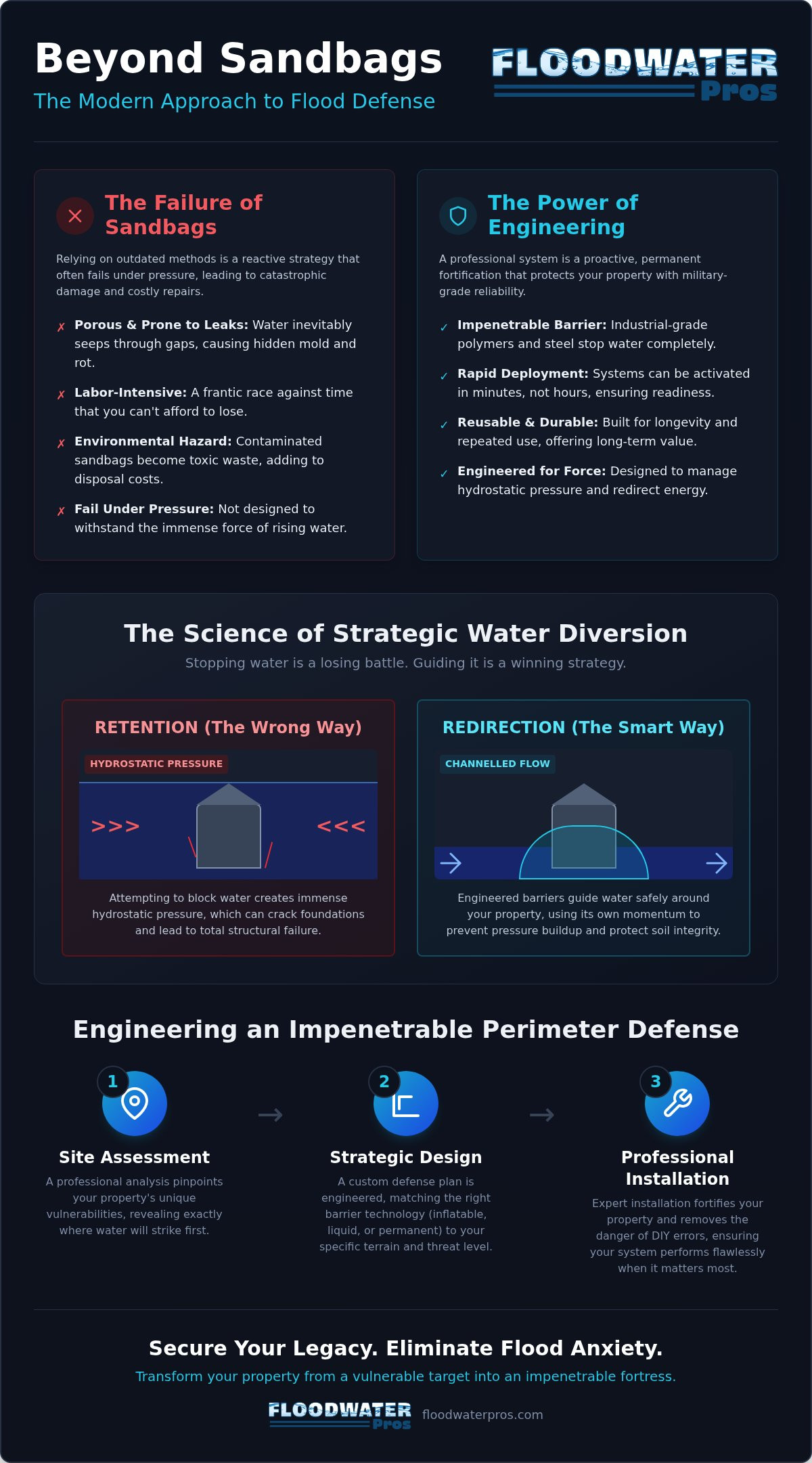
For decades, the standard response to rising water was a frantic pile of sandbags. It's a method born of desperation, not design. A modern flood damage prevention system is fundamentally different. It's a comprehensive network of engineered barriers designed to intercept and redirect rising waters before they touch your foundation. This shift represents a psychological transition from reactive panic to permanent fortification. Instead of just trying to hold back the tide, we focus on structural integrity and the management of hydrostatic pressure. When water builds up against a wall, the pressure can be immense. Modern engineering accounts for this force, ensuring the barrier redirects the energy rather than absorbing the blow.
The Limitations of Traditional Methods
Sandbags and plywood are no longer sufficient defense. They're porous. Water inevitably seeps through the gaps, leading to hidden mold and structural rot long after the surface dries. There's also a labor trap. Relying on manual deployment means you're racing against the clock. If the storm hits faster than expected, you lose. You can't rely on luck when your property is at stake. Beyond the physical failure, there's a hidden environmental cost. Contaminated sandbags often become hazardous waste after a flood. They soak up toxins from the street and sewer, creating a disposal nightmare that adds to the overall restoration expense. It's an expensive, messy, and ultimately unreliable way to protect what you value.
The Architecture of Modern Prevention
Modern protection relies on integrated engineering. These systems don't just sit on the ground; they work with your existing landscape to guide water away. The Evolution of Flood Damage Prevention Systems has moved toward industrial-grade polymers and stainless steel. These materials offer military-grade security that traditional wood or sand simply cannot match. They're built for longevity and repeated use. Deployment speed is the final, critical factor. A professional system can be activated in minutes. This is the difference between safety and catastrophe. While neighbors are still filling bags, your property is already a fortress. This level of readiness provides a shield against uncertainty, ensuring total structural security regardless of the weather forecast. It's about taking control before the crisis begins.
Redirection vs. Retention: The Science of Strategic Water Diversion
Water is relentless. It follows the path of least resistance with a singular, destructive focus. Most property owners believe the goal of a flood defense is to stop water in its tracks. This is a dangerous misconception. Attempting to hold water back is a battle of brute force that the water usually wins. A modern flood damage prevention system must account for velocity and volume to be truly effective. By guiding the flow away from your perimeter, you move from a state of constant vulnerability to one of total structural security.
Understanding Hydrostatic Pressure
Standing water isn't just a nuisance; it's a massive physical load. When floodwater pools against a wall, it exerts hydrostatic pressure. This invisible weight pushes with thousands of pounds of force. For every foot the water rises, the lateral pressure against your foundation increases. Most residential walls weren't designed to withstand these loads. If you rely on simple retention, you risk foundation failure and total collapse. A professional flood damage prevention system mitigates this risk by keeping the water moving. It prevents the pooling that leads to structural buckling and ensures the pressure never reaches a critical point.
The Tactical Advantage of Diversion
Diversion uses the water's own momentum as a defensive tool. Instead of absorbing the impact, we channel the flow toward safe discharge zones. This is the core philosophy behind the Fortress Flood Diversion System. It's engineered to intercept rising waters and guide them safely around your property. When Comparing Barrier Technologies, it's clear that redirection offers the highest level of protection for the lowest structural cost. This method also protects the soil integrity around your home. Saturated soil can't support the weight of a building, leading to settling and structural shifts. By maintaining a dry perimeter, you safeguard the very ground your property stands on. If you want to move beyond basic defense, a custom diversion plan is your most effective shield. It's about outsmarting the water, not just fighting it.
Comparing Barrier Technologies: Inflatable, Liquid, and Permanent Systems
Selecting a flood damage prevention system isn't about finding a one-size-fits-all product. It's about tactical alignment. You must match the hardware to the specific probability and velocity of the water you face. While a coastal estate might require a permanent solution, an urban storefront often needs something deployable. The right technology acts as a high-stakes shield. It transforms your property from a target into a fortified zone that resists the most aggressive environmental threats.
Rapid Response with Inflatable Barriers
Flash floods don't give you hours to prepare. They give you minutes. The Fortress Inflatable Flood Barrier is the definitive emergency solution for these high-velocity scenarios. You can deploy it in minutes, creating a heavy-duty seal that blocks the path of rising water. These barriers are built from industrial-grade polymers designed to withstand the impact of floating debris. Unlike traditional methods, they don't fail when the pressure rises. When the danger passes, these systems offer a small footprint. You can store massive protection in a standard closet or garage. It's the ultimate readiness tool for property owners who need a professional defense at a moment's notice.
Invisible Defense with Liquid Coatings
Some properties require protection that doesn't compromise curb appeal. Historical homes and modern architectural masterpieces shouldn't be hidden behind bulky hardware. This is where the Fortress Transparent Liquid Paintable Flood Barrier excels. It creates an invisible shield that bonds directly to your building's envelope. This professional-grade coating seals porous brickwork, door frames, and vents against seepage. It ensures that water cannot penetrate the structural materials of your home. It's an aesthetic solution that provides military-grade security without changing the look of your estate. You get total structural security without sacrificing the visual integrity of your property.
For estates in high-risk zones, permanent diversion systems provide the ultimate fortification. These are engineered into the landscape itself. They're always standing guard, moving water to safe discharge zones automatically. They maintain the structural security of your property every hour of every day. By choosing the right tool for your specific threat, you move from a state of vulnerability to total peace of mind. Professional protection is a strategic partner in safeguarding your most valuable assets.
Engineering a Perimeter Defense: Assessment and Strategic Placement
A flood damage prevention system is only as effective as the intelligence behind its installation. You cannot defend a property you haven't analyzed. Effective protection starts long before a storm arrives. It begins with a meticulous site assessment that looks beyond the surface. We analyze topography, soil saturation levels, and historical flood data to build a map of your property's specific risks. Without this data, you're just guessing. Professional engineering ensures that every barrier is placed to maximize its defensive potential, turning natural weak points into reinforced strongholds.
Topographical Analysis: Mapping the Flow
Water always finds the low ground. We use precise elevation data to predict exactly how water will move across your land during a surge. This isn't just about where the water is now; it's about where it's going. Understanding drainage capacity is vital. If a diversion system redirects water into a zone that can't handle the volume, you create new problems. We also evaluate soil stability. Diverting high-velocity water can cause rapid erosion, which threatens the very ground your foundation sits on. Our engineers ensure the soil remains intact even during the heaviest diversion events.
Customized Defense Layouts: Strategic Fortification
Every property requires a unique defensive depth. For some, a point-of-entry strategy focuses on sealing doors and vents. For others, a full perimeter defense is the only way to ensure total structural security. We tailor the layout to the specific needs of the site:
- Estate protection: Managing large-scale diversions to keep massive private properties dry.
- Commercial scalability: Protecting storefronts and industrial assets where downtime equals massive financial loss.
- Identifying weak points: Pinpointing exactly where water enters the property first to cut off the path of least resistance.
Strategic placement creates a continuous line of defense. There can be no gaps in your shield. If one section of the perimeter is weak, the entire system is compromised. Professional layout design accounts for these vulnerabilities, ensuring the water is channeled safely away from your assets. Don't leave your protection to chance. You can schedule a professional site assessment to start building your proactive defense plan today. It's the first step in transforming your vulnerability into unwavering resilience.
Professional Installation: Fortifying Your Property with Fortress Systems
Even the most advanced flood damage prevention system will fail if it's installed poorly. DIY attempts often lead to catastrophic results because water finds the smallest oversight. A minor gap in a seal or a weak anchor point becomes the point of failure when thousands of pounds of pressure hit. Professional installation isn't a luxury. It's the final layer of fortification for your property. When the stakes are this high, you can't afford a "good enough" approach. You need the expertise of a team that understands the fluid dynamics and structural requirements of a true perimeter shield. This authoritative approach transforms your vulnerability into total structural security.
Why Precision Matters
Seal integrity is the difference between a dry interior and a total loss. In a flood wall, the weakest link dictates the outcome. Our experts ensure every joint and transition is watertight. Structural anchoring is equally vital. High-velocity water doesn't just push. It lifts and drags. If your barriers aren't professionally anchored into the substrate, the surge can shift them out of alignment. We also focus on professional calibration. Your diversion system must be perfectly aligned with local drainage infrastructure. If the water has nowhere to go once it's redirected, it will eventually find its way back to your foundation. We eliminate these variables through engineered precision and on-site execution.
Securing Your Future
The FloodWater Pros process moves from engineered design to flawless execution. We don't just drop off equipment. We build a shield. This includes a clear plan for maintenance and readiness. You need to know your system is prepared before the storm clouds gather. Regular checks ensure that seals remain pliable and anchors stay secure. The relief of this preparation is profound. You're no longer a victim of the weather. You're a proactive guardian of your investment. When you compare the cost of a professional system to the price of a total structural loss, the long-term ROI is undeniable. It's an investment in tranquility that pays for itself the first time the water rises. Schedule your professional flood risk assessment with FloodWater Pros today.
Secure Your Legacy with Engineered Resilience
The era of reactive defense is over. Relying on sandbags is a gamble you don't have to take. True security comes from understanding that redirection is always more effective than simple retention. By guiding water away from your foundation, you eliminate the hydrostatic pressure that threatens your structural integrity. A professional flood damage prevention system provides the high-stakes shield your property requires. It's about combining advanced technology with precise, site-specific engineering to ensure your perimeter remains impenetrable. You don't have to wait for the next storm to feel secure.
We bring proprietary Fortress technology and nationwide expertise in flood redirection to every project. Our team handles the full-service engineering and installation, removing the stress and danger of DIY errors. This isn't just about installing hardware. It's about a proactive defense plan that transforms vulnerability into total peace of mind. You've worked hard to build your life. Now, take the decisive step to protect it. Fortify your property with a professional Fortress Flood Diversion System today. Resilience is within your reach.
Frequently Asked Questions
How does a flood damage prevention system differ from simple sandbags?
Sandbags are porous, labor intensive, and often fail under prolonged pressure. A professional flood damage prevention system uses engineered materials like industrial polymers to redirect water rather than just trying to block it. This approach manages hydrostatic pressure effectively. It's a permanent or rapid deploy shield that ensures total structural security instead of a temporary, leaky patch. You get a reliable perimeter that doesn't soak up toxic contaminants like sandbags do.
Can a flood diversion system be installed on any type of terrain?
Professional systems are engineered to adapt to diverse topographical challenges. Whether your property sits on a steep slope or flat clay soil, the layout is customized based on a detailed site assessment. Engineers analyze elevation data to ensure the diversion path doesn't cause erosion or overwhelm local infrastructure. This precision makes the system effective on nearly any terrain. It's about working with the land to guide water toward safe discharge zones.
Is the Fortress Transparent Liquid Paintable Flood Barrier really invisible?
The Fortress Transparent Liquid Paintable Flood Barrier is designed to be virtually undetectable once cured. It creates a clear, industrial grade seal over porous surfaces like brick, stone, and door frames. This allows property owners to maintain curb appeal while establishing military grade security. It's the ideal solution for historical estates or modern architectural designs where bulky hardware would compromise the aesthetic. You get high stakes protection without changing the visual character of your home.
How much maintenance does an inflatable flood barrier require?
Maintenance is minimal but essential for long term readiness. You should inspect the barrier annually for any punctures or degradation in the material. It's also vital to check that the deployment equipment is functional. Storing the system in a dry, cool environment ensures the heavy duty polymers remain pliable. This simple routine guarantees your shield is ready to deploy in minutes when a storm hits. Professional readiness is the key to preventing property loss.
Will installing a flood barrier system lower my insurance premiums?
Many insurance providers recognize professional mitigation efforts, though you must check with your specific carrier. Installing a high quality flood damage prevention system demonstrates a proactive commitment to risk reduction. This often leads to reduced insurance anxiety and may qualify you for certain credits or lower rates. It's a strategic investment that protects your property value and your financial stability. Proactive defense is always more cost effective than paying for post flood restoration.
What happens if the flood water exceeds the height of the barrier?
Professional systems are engineered based on historical flood levels to minimize this risk. However, if water exceeds the barrier's height, the system still provides a critical advantage by reducing the initial velocity and volume of the surge. This buys you valuable time and prevents the full force of the water from striking your walls directly. It remains a vital component of a comprehensive defense plan. No system can stop every event, but fortification significantly limits the damage.
How quickly can the Fortress Inflatable Flood Barrier be deployed?
Deployment takes only minutes. Because the Fortress Inflatable Flood Barrier is designed for rapid response, it doesn't require the hours of backbreaking labor associated with sandbags. One or two people can position and activate the system quickly. This speed is the difference between a dry interior and a catastrophe during flash flood events where every second counts. It's the ultimate readiness tool for property owners who need a professional defense at a moment's notice.
Is professional installation required for all Fortress systems?
We strongly recommend professional installation for the Fortress Flood Diversion System to ensure total structural security. While some barriers are designed for rapid deployment, the initial engineering, anchoring, and site calibration require expert precision. Minor errors in placement or sealing can lead to total system failure under pressure. Our full service installation removes the danger of DIY mistakes and guarantees your shield is built correctly the first time. Expert oversight provides the relief of knowing you're truly protected.


