

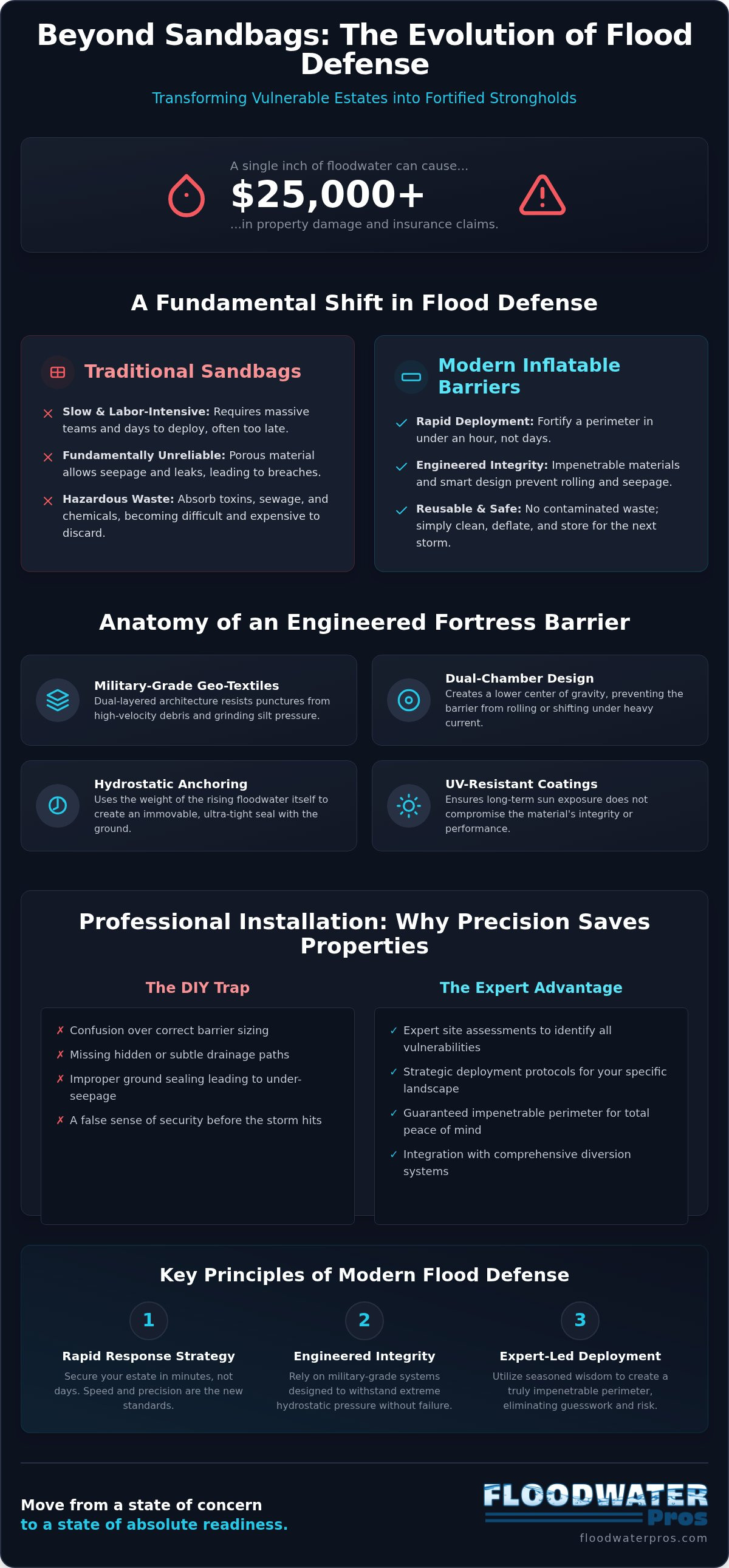
A single inch of floodwater inside your home can trigger over $25,000 in insurance claims. It's a staggering figure that represents more than just money. It's the loss of your sanctuary and the exhaustion of failed defenses. You’ve likely spent nights watching the radar, dreading the back-breaking labor of stacking sandbags that often leak when you need them most. Professional inflatable flood barrier installation changes that dynamic entirely. It replaces desperate manual labor with military-grade engineering. We understand the high stakes of a rising tide and the vulnerability of an unprotected perimeter.
You deserve the profound relief of a dry property after the storm passes. This guide reveals how professional inflatable flood barrier installation transforms vulnerable estates into fortified strongholds. We'll explore the engineering precision required for rapid-deployment systems like the Fortress Inflatable Flood Barrier. You'll learn how a strategic approach to perimeter defense eliminates confusion over sizing and provides a reliable, impenetrable shield. It’s time to move from a state of concern to a state of absolute readiness through professional expertise and seasoned wisdom.
Key Takeaways
- Stop relying on back-breaking sandbags and transition to a rapid-response strategy that secures your estate in minutes.
- Understand how the dual-chamber engineering of the Fortress Inflatable Flood Barrier prevents rolling and ensures total structural integrity.
- Learn why professional inflatable flood barrier installation is critical for identifying hidden drainage paths and ensuring your perimeter remains impenetrable.
- Discover the risks of the DIY trap and how expert site assessments provide the seasoned wisdom needed to safeguard your specific landscape.
- Explore how to integrate inflatable barriers with the Fortress Flood Diversion System for a comprehensive and multi-layered defense strategy.
Beyond Sandbags: The Evolution of Rapid Flood Defense
The climate is changing faster than our defenses. For decades, the sandbag was the only answer to rising water. It was a primitive solution for a complex problem. Today, the stakes are higher. High-value estates and commercial properties face surges that traditional methods simply cannot contain. We are seeing a fundamental shift from desperate water retention to strategic water diversion. This is where professional inflatable flood barrier installation becomes the defining line between a dry home and a total loss. It isn't just about blocking water; it's about engineering a perimeter that dictates where that water goes.
The Failure of Traditional Methods
Sandbags are heavy, porous, and fundamentally unreliable. They require massive teams of people to fill, transport, and stack. By the time a perimeter is set, the water has often already arrived. Even a perfectly stacked wall of sand allows seepage through the gaps. Once the flood recedes, the real nightmare begins. Sandbags absorb toxins, sewage, and chemicals from floodwaters. They become hazardous waste that is expensive and difficult to discard. For a modern estate, a "good enough" mindset is a liability. A single breach renders the entire effort useless and leaves you with a massive cleanup bill.
Why Inflatable Technology Wins in 2026
The technology behind these barriers has evolved significantly. Modern systems leverage the same principles found in inflatable rubber dams used in large-scale civil engineering. These aren't simple tubes; they are engineered structures made from high-strength geotextiles designed to withstand extreme hydrostatic pressure.
Professional inflatable flood barrier installation offers several distinct advantages:
- Rapid Deployment: Fortify a perimeter in under an hour rather than days of manual labor.
- Scalability: The same system protects a single driveway or a thousand-foot shoreline with equal efficiency.
- Structural Integrity: Internal baffles and dual-chamber designs prevent rolling, even under heavy current.
- Environmental Safety: These barriers are reusable and don't create tons of contaminated waste.
In 2026, protection is about speed and precision. You don't need a hundred volunteers; you need an engineered system that deploys with minimal friction. Moving toward an inflatable solution means choosing a proactive shield over a reactive struggle. It's about securing your peace of mind before the clouds even gather. This is the evolution of defense. It's the difference between hoping for the best and being prepared for the worst.
Engineering the Fortress Inflatable Flood Barrier - Built for the Breach
The Fortress Inflatable Flood Barrier is not a simple inflatable tube. It is a sophisticated, heavy-duty defense system designed to meet the breach head-on. In the high-stakes world of flood defense, structural failure is not an option. This is why professional inflatable flood barrier installation focuses on systems engineered with military-grade resilience. Unlike basic temporary fixes, the Fortress system utilizes industrial-grade geo-textiles. These materials are specifically chosen to resist punctures from high-velocity debris and the grinding pressure of rising silt during a surge.
Anatomy of an Engineered Barrier
A true defense system requires layers. The Fortress barrier features a dual-layered architecture. The inner tube provides the primary air or water retention; the outer shell acts as a rugged armor. This shell is treated with UV-resistant coatings to ensure that long-term exposure to the sun doesn't compromise the material's integrity. Sealing mechanisms are equally vital. During inflatable flood barrier installation, the focus is on creating a tight interface with the ground. This prevents under-seepage, a common failure point where water tunnels beneath the barrier and erodes its foundation.
Hydrostatic Pressure and Structural Integrity
The science of flood defense is the science of weight. The Fortress system uses the weight of the floodwater itself to enhance its seal. As the water level rises, the downward pressure increases the friction between the barrier and the terrain. This creates an immovable anchor. Many water-inflated tube systems rely on this principle, but the Fortress dual-chamber design takes it further. By splitting the internal volume, the system gains a lower center of gravity. This prevents the barrier from rolling or shifting even when hit by broadside waves or heavy currents.
Professional sizing is the only way to ensure the system remains stable. Every landscape has a unique "tipping point" where the force of the water could overcome the barrier's mass. In the context of inflatable dams, hydrostatic equilibrium is the state where the internal pressure of the barrier and the external force of the floodwater are balanced to maintain structural stability. If your barrier is too small for the predicted surge, that equilibrium is lost. Consulting with experts on Fortress defense systems ensures your perimeter is sized correctly for your local topography. Precision in engineering transforms a simple barrier into an impenetrable stronghold.
Professional Installation vs. DIY - Why Precision Saves Properties
The temptation to unroll and inflate a barrier without expert guidance is a dangerous trap. Many property owners view inflatable flood barrier installation as a simple task. It is not. A barrier placed without engineering oversight is a liability. It creates a false sense of security while leaving your perimeter vulnerable to flanking and structural undermining. Precision is the only variable that guarantees a dry interior when the surge hits. If a seal fails because of a single overlooked pebble or a slight slope, the entire investment is compromised.
The Critical Importance of Site Assessment
We look beyond the surface. A professional site assessment evaluates topography to ensure water cannot bypass the ends of your defense line. We calculate the roughness coefficient of your driveway or lawn. This determines how well the barrier will grip the substrate under pressure. Without this data, high-velocity flows can shift even the heaviest water-filled systems. We identify strategic anchor points to lock the barrier in place during extreme events. This level of detail prevents the barrier from migrating when the hydrostatic pressure reaches its peak.
The Professional Installation Workflow
Our process begins with custom layout mapping. We identify the specific structural vulnerabilities of your estate. This is never a one-size-fits-all approach. We integrate the Fortress Inflatable Flood Barrier with your existing landscape and the Fortress Flood Diversion System. This ensures that diverted water doesn't pool in secondary low spots or cause unintended damage elsewhere. Finally, we provide on-site training for your staff. Rapid deployment only works if the team knows the exact protocol. Speed is essential, but it must be paired with technical accuracy.
FloodWater Pros provides the seasoned wisdom of experts who have seen every failure point imaginable. We don't just sell products; we engineer strongholds. Professional inflatable flood barrier installation ensures that every seal is tight and every angle is calculated. It is the difference between a catastrophic breach and a total loss. Protecting your sanctuary requires more than a tube. It requires a strategic partner who understands the gravity of the threat. We provide the shield you need to face the rising tide with absolute confidence.
Strategic Deployment Protocols - Securing Your Perimeter
Speed is your greatest ally when the clouds darken and the radar turns red. A flash flood doesn't wait for preparation; it punishes delay. This is why professional inflatable flood barrier installation includes a rigorous staging protocol. Having the equipment is only half the battle. Knowing exactly where to unroll it, how to angle it, and how to secure the base determines whether your property stays dry. We move beyond simple placement to strategic positioning, ensuring your defense line is ready before the first drop hits the ground.
Step-by-Step Deployment Guide
Precision during deployment is what separates a fortified estate from a flooded one. Follow these critical steps to ensure your barrier performs as engineered:
- Step 1: Perimeter Clearance. Sweep the deployment path. Remove large rocks, sharp branches, or construction debris. Even industrial-grade materials can be compromised by unnecessary puncture risks.
- Step 2: Strategic Alignment. Unroll the barrier with the integrated "skirt" facing the anticipated flood source. Unlike basic tubes, the Fortress system should be configured in arcs or L-shapes to divert water away from structural weak points rather than just blocking it.
- Step 3: Sequential Inflation. Begin the inflation process slowly. You can use air for rapid shape-forming, but water filling is often preferred for maximum mass. Sequential filling ensures the barrier settles uniformly against the ground, eliminating gaps.
- Step 4: Joint Overlapping. If your perimeter requires multiple units, overlap the joints according to the engineering plan. This creates a continuous, leak-proof wall that resists the pressure of a rising tide.
Maintenance and Off-Season Readiness
A guardian must always be ready. Your defense system shouldn't sit forgotten in a crate until an emergency strikes. We recommend annual integrity checks to inspect for material fatigue or potential UV damage from previous deployments. Clean the barriers thoroughly after every use. Silt and salt can degrade coatings if left to sit. Ensure the units are completely dry before folding them; moisture trapped in storage leads to mold and material degradation. Finally, conduct dry-run drills with your team. Practicing the inflatable flood barrier installation process twice a year ensures that when the real threat arrives, your response is instinctive and flawless.
Don't leave your property's safety to chance during the next storm surge. Our experts provide the training and engineering support needed to ensure your staff is ready for rapid action. Contact us today to secure your Fortress system and finalize your emergency deployment strategy.
Fortress Protection - Your Shield Against the Rising Tide
True security isn't found in a single product. It is the result of a coordinated ecosystem. While inflatable flood barrier installation provides the primary wall of defense, it works best when integrated into a broader strategy. We don't just block water; we control its movement. By combining the Fortress Inflatable Flood Barrier with the Fortress Flood Diversion System, we create a multi-layered shield that channels surges away from your most vulnerable assets. This holistic approach ensures that no single point of failure can compromise your property. It is the difference between a temporary fix and a permanent state of readiness.
A Multi-Layered Defense Strategy
The Fortress ecosystem is designed for total coverage. The Fortress Flood Diversion System acts as the outer ring of your defense. It steers the bulk of the water toward safe drainage zones. This reduces the direct hydrostatic load on your inflatable barriers. For critical entry points like sliding glass doors, vents, or pedestrian gates, we deploy the Fortress Transparent Liquid Paintable Flood Barrier. This invisible defense provides a 360-degree seal that stops water from infiltrating through structural gaps. A single-product solution often leaves openings. A system approach closes them all. We tailor these solutions for both expansive commercial estates and high-value residential properties, ensuring every asset is protected by military-grade technology.
The Peace of Preparedness
There is a profound emotional ROI in knowing your property is professionally defended. You no longer have to fear the sound of heavy rain or the sight of a rising creek. You gain the confidence of a vigilant guardian. Beyond peace of mind, there are practical financial benefits to consider. Modern residential flood control products are often designed to meet FEMA and NFIP standards for dry floodproofing. Investing in professional engineering and compliant barriers can lead to significant mitigation discounts on flood insurance policies. It's a proactive step that protects your physical sanctuary and your financial future simultaneously.
The next step is clarity. Every landscape has unique vulnerabilities that require an expert eye. A professional site engineering consultation identifies the exact requirements for your specific terrain. We provide the seasoned wisdom and innovative technology needed to transform your perimeter into an impenetrable stronghold. Don't wait for the next storm surge to test your readiness. You have the power to act before the water rises. Secure your perimeter with FloodWater Pros today.
Fortify Your Future: The Path to Total Perimeter Security
The era of hoping for the best is over. We have entered an age where precision engineering dictates the survival of your property. You've seen how sandbags fall short and why a holistic ecosystem of diversion and barriers is the only way to achieve total protection. Choosing professional inflatable flood barrier installation is not just a simple purchase; it's a strategic alliance with experts who understand the gravity of environmental threats. With our proprietary Fortress engineering and national installation experts, you aren't just buying time. You're buying the certainty that your sanctuary will remain dry even when the surge hits its peak.
We utilize military-grade geotextile durability to ensure your shield never falters under extreme hydrostatic pressure. It's time to trade the exhaustion of manual labor for the profound relief of a fortified perimeter. Your estate deserves the highest level of vigilance and a defense system that deploys in minutes rather than days. Take the decisive step today to safeguard what is most valuable. Schedule Your Professional Fortress Engineering Assessment and secure your peace of mind before the clouds gather. You don't have to face the rising tide alone.
Frequently Asked Questions
How long does it take to install an inflatable flood barrier?
Professional deployment of a Fortress system typically takes under an hour for standard residential perimeters. While traditional sandbagging can take days of manual labor, our rapid-deployment engineering allows for quick fortification when minutes count. The exact duration depends on the perimeter length and the complexity of the site layout mapped during your initial consultation. This speed is a critical advantage for estates facing sudden flash flood threats.
Can an inflatable flood barrier be used on uneven ground or grass?
Yes, the Fortress Inflatable Flood Barrier is designed to conform to varied terrain, including grass and moderate slopes. The flexibility of the heavy-duty geotextile material allows the barrier to create a seal over minor irregularities. However, a professional site assessment is critical to ensure the soil permeability and ground roughness coefficient are sufficient to prevent sliding or under-seepage during high-pressure environmental events.
Are inflatable flood barriers reusable after a major storm?
Fortress barriers are fully reusable and designed for multiple high-stakes deployments over several years. Unlike sandbags that become contaminated and must be discarded as toxic waste, our systems are made from durable materials that withstand repeated use. Proper cleaning and storage after the floodwaters recede ensure the barrier remains ready for the next threat. This reusability makes them a sustainable and cost-effective long-term defense strategy.
What is the difference between air-filled and water-filled flood barriers?
Air-filled barriers provide rapid shape-forming, while water-filled barriers offer the mass and weight required for maximum stability. Air is often used for pre-storm staging to get the barrier in position quickly. Filling with water is generally preferred for the final deployment because it uses the weight of the liquid to anchor the system and resist the hydrostatic pressure of the external flood, preventing the barrier from shifting.
Do inflatable flood barriers protect against high-velocity waves?
Fortress systems are engineered to withstand significant hydrostatic pressure, but their performance against high-velocity waves depends on professional sizing and anchoring. The dual-chamber design provides a low center of gravity that prevents rolling under current. For coastal areas or high-flow zones, we integrate strategic anchor points during the inflatable flood barrier installation process to ensure the perimeter remains impenetrable against moving water and debris.
How much flood water can a Fortress Inflatable Flood Barrier actually hold back?
A Fortress Inflatable Flood Barrier can typically hold back water up to 50 inches deep, depending on the specific model and site engineering. The height of protection is determined by the diameter of the barrier and the structural integrity of the ground surface. Our engineers calculate the exact load-bearing requirements for your property to ensure the barrier never reaches its tipping point during a major surge event.
Do I need a permit for professional flood barrier installation?
Permanent modifications often require permits, but temporary inflatable flood barrier installation usually does not. Because these systems are deployable and not permanent structures, they typically fall outside of standard building permit requirements. However, regulations vary by municipality. We recommend checking with local authorities or consulting our national installation experts to ensure compliance with specific regional codes or NFIP standards for dry floodproofing.
How do I maintain the barrier during the off-season?
Maintaining your barrier involves regular integrity checks and proper storage in a dry, temperature-controlled environment. You should inspect the material annually for UV damage or fatigue. It is essential to clean off silt and salt after use and ensure the unit is completely dry before folding. Conducting dry-run drills with your staff ensures that your team remains sharp and ready for rapid action when the next storm approaches.


