

What if flash-flood water reaches your home from a slope or driveway, not the street? To protect property from flash flooding, start by tracing where runoff could travel, collect, and enter. Even a property far from a river may have vulnerable low points, drains, doorways, or garage openings.
It can be hard to know what to fix first or whether temporary measures such as sandbags will help. Preparation can reduce preventable damage, but no single measure guarantees a property will stay dry. If flooding is imminent, protect people and follow official emergency guidance before taking steps to defend belongings.
This guide explains how to assess possible water paths, spot vulnerabilities, and prioritize practical preparation. It also covers how routine upkeep and household readiness differ from physical defenses, and when a property-specific assessment may help you consider engineered protection. The goal is a realistic plan based on your site, not a promise that any one measure will prevent damage.
Key Takeaways
- Slopes, hard surfaces, drainage routes, and low openings can help you identify where floodwater may travel across your property.
- Use a safe walkthrough to record vulnerabilities, but don’t treat visual observations as engineering advice.
- Compare routine upkeep, household readiness, and physical defenses by their purpose, site fit, and limitations.
- Plan around official alerts, evacuation instructions, and household communication. People come before property.
- A property-specific assessment can help determine whether an engineered option may suit your water path and site conditions as you plan to protect property from flash flooding.
Protect Property from Flash Flooding by Understanding the Threat
Not sure whether your property is exposed? A map, a nearby waterway, or the fact that a previous storm caused no damage may not show how water could reach a particular building. Start by noting possible water routes and vulnerable entry points. Use what you observe to plan questions and next steps, not as a reason to take risks. Follow official alerts and evacuation instructions first; property protection comes second.
The National Weather Service describes flash flooding as flooding that develops rapidly. Intense rainfall can overwhelm drainage or send runoff across land, and nearby waterways may rise and spill beyond their banks. The route varies by property. A street may direct water toward an entrance, a slope may channel runoff downhill, or a drain may not carry water away quickly enough.
Hazard awareness can guide preparation, but it cannot guarantee that a property can be floodproofed. Different defenses address different pathways, and no single observation or measure accounts for every condition. For a broader overview of structural and non-structural approaches, see Flood management strategies.
How flash flooding can reach a property
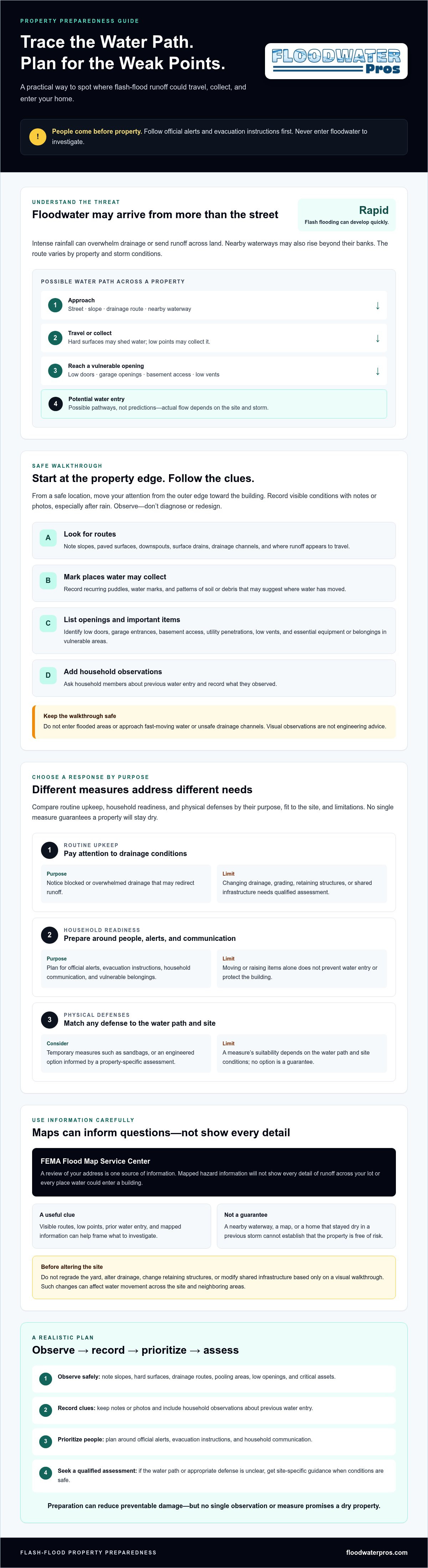
Look beyond the nearest stream or shoreline. Water may approach from a street, flow down a slope, follow a drainage route, or come from a nearby waterway. Once on the property, it can collect at low points and reach the building through low doors, garage openings, below-grade areas, or other vulnerable access points. These are possibilities, not predictions. Actual flow depends on the site and storm conditions.
To protect property from flash flooding, record where water could approach, enter, or pass through. Don’t step into floodwater to investigate. It can hide hazards, and conditions can change quickly.
What to check before choosing a defense
Review your address in FEMA’s Flood Map Service Center as one source of information. Mapped hazard information can help frame questions, but it won’t show every detail of how runoff moves across your lot or where water could enter your building. A property that has stayed dry before isn’t necessarily free of risk.
From a safe location, note the ground’s slope, hard surfaces, drainage paths, low openings, and places where water has collected. Ask household members about previous water entry and record what they observed. These clues can help you identify issues to investigate. Don’t enter flooded areas or approach unsafe drainage channels. If the water path or appropriate defense is unclear, wait until conditions are safe and consult a qualified professional.
Trace the Water Path to Find Your Property's Weak Points
With possible routes in mind, walk from the outer edge of the property toward the building. The goal is to record visible conditions, not diagnose structural risks or design a fix. Take notes or photos from safe locations, especially after rain, and mark where water appears to travel or collect. Blocked or overwhelmed drainage can redirect runoff toward an entrance or foundation, but the right response depends on the site.
Inspect the exterior without entering unsafe areas
Start uphill or near the property boundary and follow the visible slope toward the structure. Note paved surfaces that shed water, downspouts, surface drains, and channels that may carry runoff. Look for recurring puddles, water marks, or patterns of soil and debris that suggest where water has moved. Don’t approach fast-moving water or enter flooded areas to investigate.
Keep a record of what you see, but don’t regrade the yard, alter drainage, change retaining structures, or modify shared infrastructure based only on a visual walkthrough. Those changes can affect how water moves across the site and neighboring areas. Seek a qualified assessment before making them.
Identify openings and critical assets
Continue toward the building and note each low-level point water might reach, including exterior doors, garage entrances, basement access, utility penetrations, and low vents. Also identify essential equipment and belongings stored in vulnerable areas. Knowing what could be affected helps inform your plan, but moving or raising items alone won’t protect the building or prevent water entry.
For a broader look at ways to defend a home, see these residential flood protection systems. If your observations suggest a physical defense may be needed, a property-specific assessment can help clarify what may fit the water path and site conditions. You can review FloodWater Pros flood-protection options as one potential next step.
Before a storm, check slopes, hard surfaces, drainage routes, pooling areas, low openings, and essential equipment. This checklist can help you prepare to protect property from flash flooding, but it isn’t an engineering assessment. For household readiness beyond the property walkthrough, consult the U.S. government’s Ready.gov flood preparedness guide.
Compare Flash-Flood Protection Measures Without Assuming One Fix Is Enough
Different measures solve different problems. Clearing visible debris from a drain supports routine upkeep, while a household plan helps people respond to alerts. Neither necessarily blocks water at a vulnerable opening. A physical defense may address a specific route, but its suitability depends on site conditions and how water approaches. To protect property from flash flooding, compare options by their purpose and limitations rather than assuming one is universally strongest.
| Measure | Purpose and permanence | Deployment and site fit | Key limitation |
|---|---|---|---|
| Routine upkeep | Maintains visible drainage features and helps keep runoff pathways clear. It’s an ongoing task. | Usually involves checking accessible drains and noting changes around the property. | Upkeep can’t ensure drainage will handle every storm or prevent water from arriving by another route. |
| Household readiness | Prepares people to respond, communicate, and protect essential belongings. Plans should be reviewed and updated. | Requires advance planning, supplies, and clear decisions about alerts and evacuation. | It helps people act, but doesn’t physically stop water from entering a building. For safety guidance, consult American Red Cross flood safety. |
| Professionally designed physical defenses | Address a specific water path or vulnerable opening. Some approaches may be permanent; others may require deployment. | Must be assessed against the property layout, water approach, and intended use. | A defense suited to one location may not address other entry points or changing conditions. It isn’t a guarantee against flooding or damage. |
Preparedness and maintenance versus physical defenses
Keep accessible drainage features clear of visible debris, and secure or protect vulnerable items as part of household readiness. These steps can support preparation, but they don’t replace assessing how water moves across the property. Temporary measures, including sandbags, may depend on advance warning, correct placement, and site conditions. A sandbag line or single barrier isn’t a universal guarantee. See this overview of flood barriers versus sandbags for further context.
When a diversion or barrier assessment may help
If runoff repeatedly heads toward the same entrance, or an opening is repeatedly exposed to water, it may be worth exploring a designed physical defense. Diversion aims to guide water away from a structure, but whether it fits depends on the property layout and requires professional review. FloodWater Pros offers the Fortress Flood Diversion System among its engineered options. Learn more about the flood diversion system design concept, or explore FloodWater Pros flood-protection options as a potential next step.
Prepare a Flash-Flood Action Plan Before the Next Warning
A property defense is only one part of readiness. Decide in advance how your household will receive alerts, communicate, and leave if needed. During a flash-flood threat, follow current National Weather Service alerts and local emergency guidance. Never walk or drive through floodwater, and don’t put anyone at risk to protect belongings or inspect a barrier.
Before heavy rain or a flood warning
Set up official emergency alerts for your area and make sure household members know where to find updates. Agree on how you’ll contact one another if separated, where you’ll go if evacuation is advised, and how you’ll account for anyone who may need assistance. Keep important documents accessible and photograph your property’s condition in advance. These records may help you document circumstances later, but they don’t guarantee an insurance outcome.
Ask qualified professionals to explain safe procedures for shutting off utilities at your property, if appropriate. Don’t approach electrical equipment or attempt to operate controls in a flooded or unsafe area. Longer-term defenses need advance planning. Review the engineering considerations for professional flood barrier installation well before a storm, not while water is rising.
During and after a flash-flood threat
Act on instructions from emergency officials. Leave promptly when authorities advise evacuation or when conditions make it unsafe to remain. Don’t delay to move possessions, deploy a barrier, or retrieve equipment if doing so puts you in danger. Never enter floodwater to inspect, adjust, or recover a defense. Water can conceal hazards, and conditions may change without warning.
Afterward, stay away until authorities say it’s safe to return. Watch for visible hazards and avoid areas that appear damaged or unsafe. If you’re unsure whether a route or part of the property is safe, don’t enter it. Follow local guidance.
Keep the order clear: alerts, people, evacuation, then property. Preparation can help you protect property from flash flooding, but it can’t replace emergency instructions or make a dangerous situation safe. Once immediate risks have passed, consider whether your observations point to a longer-term need for a property-specific defense assessment. You can explore FloodWater Pros flood-protection options as part of that planning.
Choose Engineered Property Protection That Fits the Water Path
Once you’ve documented where water may approach and enter, decide whether to explore a designed physical defense. A professional assessment should connect the observed water path to vulnerable openings, site constraints, and the defense’s intended purpose. It should also explain what the approach is not designed to address. A barrier is not a guarantee against flooding or property damage.
Match the protection approach to the property
A diversion approach is intended to guide water away from a structure, but whether it fits depends on the property layout and conditions. The Fortress Flood Diversion System is one engineered option to assess. FloodWater Pros also offers the Fortress Inflatable Flood Barrier and Fortress Transparent Liquid Paintable Flood Barrier. These are distinct approaches, not interchangeable solutions. Suitability should be evaluated against the site. For more on the inflatable option, see inflatable flood barriers for homes.
FloodWater Pros designs, manufactures, and professionally installs its systems. Product selection still depends on property-specific factors, so don’t assume a product name alone shows whether it fits your water path or openings.
What to ask before moving forward
Bring your notes and photographs to the discussion. Ask questions that connect the proposed design to what you observed:
- How does the approach relate to the direction water may travel and the openings you identified?
- What site conditions or constraints could affect the design and its intended use?
- What known limitations should you understand, including water paths the defense may not address?
- Who handles the engineering and installation, and what property details are needed to assess fit?
Clear answers help you understand how a defense could work alongside household readiness and emergency planning. They also help set realistic expectations. The aim isn’t to make a property invulnerable, but to assess whether an engineered approach makes sense for its specific conditions.
If you’re considering engineered options to protect property from flash flooding, take the next step at your own pace. Explore FloodWater Pros flood-protection solutions and consider whether a property-specific assessment is appropriate for your situation.
Build a More Informed Flood-Protection Plan
Start by understanding where water may travel, which openings could be vulnerable, and how your household will respond to official alerts. These observations can help prioritize next steps, but they don’t guarantee protection from flooding. Keep people safe first, and consider a professional assessment if the water path or suitable defense isn’t clear.
FloodWater Pros manages the engineering, manufacturing, and professional on-site installation of its systems. Its options include diversion, inflatable, and transparent liquid paintable barriers. Each may suit different conditions, so a property-specific assessment can help determine what to explore. The goal is to protect property from flash flooding with a realistic plan, not to assume any single measure can prevent all damage.
Explore FloodWater Pros flood-protection solutions and consider whether an engineered assessment fits your property. Understanding your site is a practical next step toward greater readiness.
Frequently Asked Questions
Is it possible to protect a property completely from flash flooding?
No single measure can guarantee protection from every flood condition. A property’s exposure depends on factors such as water paths, drainage, vulnerable openings, and the severity of an event. Preparation and engineered defenses can reduce specific vulnerabilities, but they don’t replace official alerts or evacuation instructions. If you’re unsure what approach fits, ask a qualified professional to assess the site and explain the limits of any proposed defense.
Can sandbags protect a house from flash flooding?
Sandbags may serve as a temporary measure in some situations, but they aren’t a universal defense. Their usefulness depends on factors such as placement, warning time, water paths, and conditions at the property. Don’t treat them as a substitute for an engineered assessment or evacuation. Never enter floodwater to place, adjust, or retrieve sandbags or any other protective measure. Follow emergency officials’ instructions and put people first.
How can I tell whether my property is at risk of flash flooding?
Review FEMA flood hazard information and look for signs such as drainage routes toward the building, low openings, recurring pooling, or past water entry. These clues can help you identify questions to investigate, but a map and visual inspection can’t provide a complete diagnosis. Runoff may affect areas beyond mapped zones. If you’re concerned about a particular route or opening, consider a qualified, property-specific assessment.
What should I do first when a flash-flood warning is issued?
Follow official alerts and emergency instructions immediately. If authorities advise evacuation, leave promptly and don’t delay to move belongings or deploy a barrier. Never walk or drive through floodwater. Keep household members informed and use your planned safe route when available. Protective measures should never take priority over life safety. If conditions become unsafe, follow local emergency guidance rather than attempting to inspect or defend the property.
Are flood barriers enough to protect a property from flash flooding?
A barrier may address a particular water route or opening, but its suitability depends on the system and site conditions. It won’t necessarily address every source of risk or remove the need for alerts and evacuation planning. Before choosing a system, ask a qualified professional about its intended protection, site requirements, known limitations, and maintenance. No barrier should be treated as a guarantee against flooding or property damage.
When should I ask a professional about flood protection for my property?
Consider asking for professional input if water repeatedly approaches the structure, enters through vulnerable openings, or follows a route you can’t confidently address. A property-specific review can help clarify site conditions and which options may be appropriate. FloodWater Pros designs, manufactures, and professionally installs flood-protection systems. Ask who will handle engineering and installation, what property details are needed, and what limitations apply to any proposed design.
Does FEMA flood-map information show every flash-flood risk?
No. FEMA flood hazard information is a useful starting point, not a complete, real-time diagnosis of every property’s exposure. Local drainage patterns, changing site conditions, and rainfall runoff may create risks that aren’t apparent from a map alone. Use official resources alongside safe observations of water paths and past entry. Follow emergency alerts, and seek a qualified assessment if property-specific questions remain unresolved.


