

A barrier that protects a plant’s perimeter can still leave its production line exposed. Manufacturing plant flood mitigation barriers need to account for more than where water may enter. A poor fit for site conditions, equipment, utilities, or busy access routes can leave critical operations vulnerable.
It’s reasonable to want strong protection without creating a new obstacle for staff, vehicles, or daily production. The right approach depends on how water could reach your facility, what needs protection, and how a barrier will work around normal operations.
This guide shows you how to identify exposure points, rank operational priorities, and compare barrier approaches using practical criteria such as site fit, access, and deployment. You’ll also learn what information to gather before a qualified site assessment. The goal is a protection strategy shaped around your plant, not a one-size-fits-all answer.
Key Takeaways
- Prioritize production-critical equipment, inventory, utilities, and access points, not just the building perimeter.
- Compare manufacturing plant flood mitigation barriers by site fit, access impact, deployment needs, storage, and maintenance.
- Map vulnerable openings, traffic routes, utility locations, and operating constraints before comparing barrier formats.
- Plan site review, design coordination, installation access, and stakeholder responsibilities to reduce disruption to plant operations.
- Prepare a concise site brief and assess which approach fits. FloodWater Pros offers diversion, inflatable, and transparent liquid paintable barriers.
Why Manufacturing Plant Flood Mitigation Barriers Must Protect Operations
Floodwater can threaten more than a building’s outer wall. It may reach production equipment, electrical systems, stored inventory, and the routes people and vehicles need to keep a plant running. A plan focused only on the perimeter can miss the operational weak points that matter most.
Manufacturing plant flood mitigation barriers are intended to reduce exposure, not guarantee that no water will enter or that business interruption can never occur. Water may still pass a barrier, so set priorities based on what needs protection and how the facility would respond if water gets inside. Barriers may block or redirect water in different ways. The Flood barrier overview provides a general introduction to barrier types and examples.
Which plant assets and operations need priority protection?
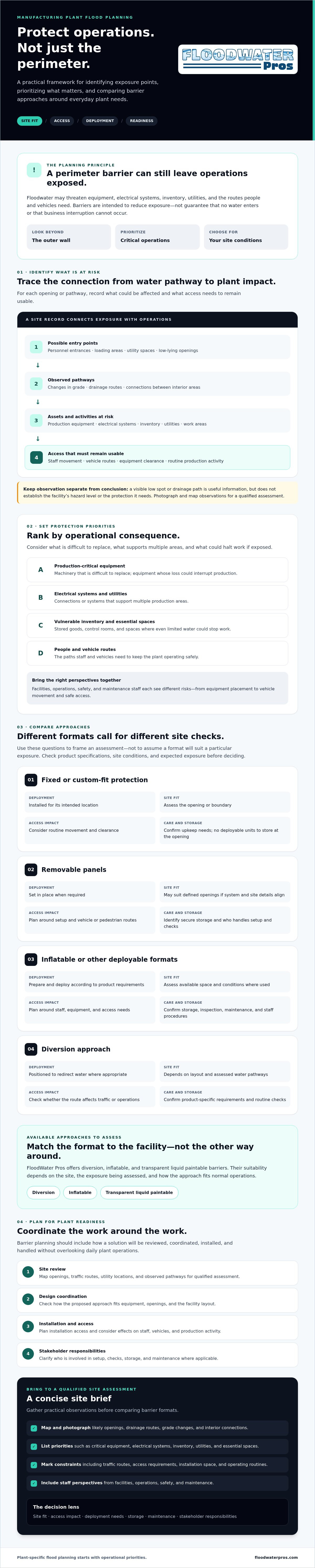
Rank assets by the operational consequences of water exposure. Consider machinery that is difficult to replace, electrical equipment that supports multiple production areas, vulnerable inventory, and spaces where even limited water could halt work. Then trace the dependencies. A control room, utility connection, or access route may be as critical as equipment on the production floor.
Include facilities, operations, safety, and maintenance staff in the discussion. Each team sees different risks, from equipment placement to vehicle movement and safe access. Their combined perspective helps distinguish essential protection priorities from areas that can tolerate disruption.
How do flood pathways reach a manufacturing facility?
Walk the site and record likely entry points, including personnel entrances, loading areas, utility spaces, and low-lying openings. Note changes in grade, drainage routes, and connections between interior areas. Water could enter directly through an opening or cross the grounds before reaching a vulnerable part of the building.
Keep observations separate from conclusions about the facility’s hazard level. A visible low spot or drainage path is useful information, but it doesn’t establish how much water could reach the site or what protection is appropriate. Photograph and map observations for a qualified assessment.
Use a simple site record to connect exposure with operations. For each opening or pathway, note the asset or activity at risk and any access that must remain usable. This gives the protection plan a clear purpose and helps assess whether a barrier fits the facility’s layout and operating needs.
How Manufacturing Plant Flood Barriers Differ by Protection Approach
Barrier formats address different needs. Some are intended to block water at a defined opening; others may redirect water or be deployed when needed. That distinction matters in a plant, where a loading bay, pedestrian entrance, and site boundary can each have different access and protection requirements. The FEMA P-936, Floodproofing Non-Residential Buildings guide offers a reference for considering floodproofing in non-residential facilities.
Use the table to frame assessment questions, not to assume a format will suit a particular exposure. Check product specifications, site conditions, and expected exposure before deciding.
| Approach | Deployment | Site fit | Access impact | Storage and maintenance |
|---|---|---|---|---|
| Fixed or custom-fit protection | Installed for its intended location | Requires assessment of the opening or boundary | Consider effects on routine movement and clearance | Confirm inspection and upkeep needs; no deployable units to store at the opening |
| Removable panels | Set in place when required | May suit defined openings if the system and site details align | Plan around installation and vehicle or pedestrian routes | Identify secure storage and who handles setup and checks |
| Inflatable or other deployable formats | Prepared and deployed according to product requirements | Assess available space and conditions where the system would be used | Plan deployment around staff, equipment, and access needs | Confirm storage, inspection, maintenance, and staff procedures |
| Diversion approach | Positioned to redirect water where appropriate | Depends on site layout and assessed water pathways | Check whether the route affects traffic or operations | Confirm product-specific requirements and routine checks |
When might a plant consider diversion, panel, or deployable barriers?
A diversion approach may be worth assessing when redirecting water fits the site’s pathways and layout. FloodWater Pros offers the Fortress Flood Diversion System as an option to evaluate for that purpose. Panels may be considered at defined openings or boundaries. Deployable formats need a workable storage location and clear staff procedures. These approaches aren’t interchangeable, so confirm each product’s specifications and fit for its intended location.
What trade-offs affect facility operations?
Consider the effect on daily work, not just the barrier itself. Could a fixed installation affect routine access? Would a deployable system require staff to move equipment, manage vehicle traffic, or retrieve stored components? Who will inspect the system and stay familiar with its setup procedures? Include these responsibilities in lifecycle planning, not just purchasing discussions.
Choose manufacturing plant flood mitigation barriers based on documented site conditions, product requirements, and expected exposure. FloodWater Pros designs, manufactures, and professionally installs flood protection systems. Explore its flood barrier options as part of a site-specific evaluation.
How to Compare Manufacturing Plant Flood Mitigation Barriers
Start with the site, not a product brochure. Evaluate manufacturing plant flood mitigation barriers against documented exposure, operational priorities, product requirements, and the responsibilities needed to keep a system ready.
- 1. Define priorities. Rank the equipment, inventory, and production areas where water exposure could have the greatest operational impact.
- 2. Map exposure. Mark openings and possible water pathways on facility drawings. Record access routes, elevations, drainage observations, utility locations, and known entry points.
- 3. Compare formats. Assess how each proposed approach fits the specific opening or area and affects routine access, traffic, setup, and storage.
- 4. Confirm requirements. Review product documentation, operating limitations, installation assumptions, and any site conditions the proposal depends on.
- 5. Assess support and responsibilities. Clarify project scope, installation roles, inspection and maintenance needs, and who is responsible for staff procedures.
For broader business-property context, see this commercial flood barriers guide. Use it to inform questions, then bring plant-specific records into the comparison.
What should a manufacturing facility document before comparing systems?
Gather current facility drawings and note openings, elevations, drainage observations, and known water entry points. Add locations of critical equipment and utilities, operating schedules, vehicle and pedestrian routes, and areas that must remain accessible. Collect existing assessments and relevant site records for qualified review. Mark uncertain observations clearly. A site walk-through alone is not a confirmed hazard analysis.
Which questions reveal whether a proposed barrier fits?
Ask how the proposed layout addresses each mapped exposure point and whether its assumptions match the facility. Request product-specific limitations and engineering assumptions in writing. Clarify who handles installation, deployment procedures if applicable, inspection, maintenance, and staff training. A complete comparison should make responsibilities and project scope clear, rather than leave important operational details open to interpretation.
Compare proposals using the same criteria for each option. FloodWater Pros designs, manufactures, and professionally installs flood protection systems, coordinating a project from engineering through on-site installation. Product suitability and requirements still need to be confirmed for the specific facility.
How to Plan Barrier Installation Without Overlooking Plant Readiness
A suitable barrier still needs a workable installation plan. For a manufacturing facility, planning should connect site review and design coordination with access arrangements, work sequencing, and clear responsibilities. This helps teams identify where installation may intersect with production before work is underway.
Start by reviewing proposed locations and the site conditions that may shape the design. For a diversion approach, water pathways, grades, and surrounding access can influence how the system is planned. See this guide to flood diversion system design for more context on how site conditions inform that approach. Verify engineering, permitting, and code considerations for the specific project with qualified professionals and relevant authorities.
How should installation planning account for active operations?
Identify production areas, entrances, loading zones, utility spaces, and routes that must remain accessible during review and installation. Coordinate proposed work areas and sequencing with facility operations and safety contacts. Consider how vehicle movement, material handling, and scheduled production could be affected.
Agree on responsibilities before work begins. Confirm who coordinates site access, communicates temporary procedures to staff, and resolves operational conflicts. If a proposed work area overlaps with a critical route or production space, raise the issue early so the project team can assess the constraint.
What should buyers confirm before project handover?
Handover should make clear what the project included and how the system is intended to be managed. Ask the project team to review the system scope, operating instructions, inspection needs, and maintenance responsibilities. For deployable components, document who is responsible for storage, setup, and staff familiarity with procedures.
Request a written explanation of design assumptions, product-specific limitations, and unresolved site risks. This helps facilities and operations teams understand what the selected approach addresses and what it does not establish. Keep the documentation available to the people responsible for day-to-day readiness.
FloodWater Pros manages system engineering through professional on-site installation, supporting coordination across project stages. To discuss a site-specific barrier project, review FloodWater Pros’ flood protection systems.
Choosing a Manufacturing Plant Flood Barrier Partner and Next Steps
Choosing manufacturing plant flood mitigation barriers is only part of the decision. A partner should connect the facility’s identified needs to a site-specific system plan, with clear documentation of what is proposed and what remains to be verified. Broad promises aren’t a substitute for product-specific information and a careful property review.
FloodWater Pros designs, manufactures, and professionally installs flood protection systems. Its offerings include the Fortress Flood Diversion System, Fortress Inflatable Flood Barrier, and Fortress Transparent Liquid Paintable Flood Barrier. Assess each option against the plant’s conditions and priorities. Don’t assume any one format fits every site or exposure.
What should a buyer expect from a qualified flood protection partner?
Expect questions about facility use, exposure points, critical assets, access needs, and operational constraints. A proposed approach should explain how it addresses the identified areas and which product limitations or site assumptions apply. Ask how recommendations, project and installation scope, operating requirements, and maintenance responsibilities will be documented.
Be cautious of blanket claims that a system will protect every area or prevent all disruption. Request clear, product-specific support for claims and ask which conditions still need review. A sound project discussion makes both the intended protection and its limits understandable to the teams responsible for the facility.
How can a facility prepare for a first project discussion?
Bring a concise brief that gives the project team a useful starting point. Include:
- Facility use: the type of work performed and areas essential to production.
- Exposure points: known water pathways, openings, and previous problem locations.
- Critical assets: machinery, electrical equipment, inventory, and supporting utilities.
- Access and constraints: routes that must stay open, operating schedules, and limits on work areas.
- Existing information: facility plans, relevant photos, prior assessment findings, and other site records.
Invite facilities and operations stakeholders to share their priorities. Their input can clarify which areas need attention and what a workable project must account for. If an observation is uncertain, label it as such rather than presenting it as a confirmed hazard.
A prepared brief helps move the discussion from general product comparisons to your plant’s actual needs. Share the facility’s use, exposure points, critical assets, access requirements, and known constraints with FloodWater Pros to begin a site-specific discussion about its flood protection systems.
Turn Your Flood Protection Priorities Into a Site Plan
Start with a clear picture of what your plant needs to protect and how water could reach it. Evaluate manufacturing plant flood mitigation barriers against actual exposure points, critical assets, access requirements, and operational constraints. Then compare product documentation, installation scope, and ongoing responsibilities before choosing an approach.
FloodWater Pros brings design, manufacturing, and professional on-site installation together through one provider. Its offerings include the Fortress Flood Diversion System, Fortress Inflatable Flood Barrier, and Fortress Transparent Liquid Paintable Flood Barrier. Which system may fit depends on your facility and should be assessed against site conditions and product requirements.
Prepare facility plans, photos, known water pathways, and a short list of priority assets and access needs. These details can help start a focused, site-specific discussion. Discuss a site-specific flood protection plan with FloodWater Pros and take a practical step toward protecting the operations your facility depends on.
Frequently Asked Questions
Which flood mitigation barrier is best for a manufacturing plant?
The best option depends on the plant’s exposure points, layout, priority assets, and operating needs. A diversion approach may suit a site where redirecting water is appropriate, while other barrier formats may be considered for specific openings or conditions. Compare product specifications and installation requirements against an assessment of the facility. No single barrier type should be assumed to fit every manufacturing site.
Can flood barriers protect manufacturing equipment and inventory?
Flood barriers can help reduce water exposure around identified areas, including machinery, electrical equipment, stored inventory, and production spaces. Suitability depends on where water may enter or travel and whether the selected system fits those conditions. A barrier isn’t a guarantee against all water intrusion or business interruption. Include critical assets and the operations they support when setting priorities and discussing site requirements.
How do I choose a flood barrier for a loading bay?
Start by documenting the loading bay’s dimensions, surrounding surfaces, likely water pathways, and how the area is used. Note vehicle movement, pedestrian access, equipment staging, and whether the opening must remain clear during normal operations. Then ask how a proposed system fits the opening, what deployment or installation involves, and what product limitations apply. Confirm the proposed approach through a qualified, site-specific assessment rather than relying on the opening alone.
Do manufacturing plant flood barriers need professional installation?
Installation needs depend on the barrier format, product requirements, and site conditions. Before selecting a system, confirm whether it requires professional installation, what work is included, and whether the facility needs to prepare access or work areas. For any proposed barrier, review its product-specific installation requirements and clarify responsibilities before the project proceeds.
Can a flood barrier protect a plant without disrupting production?
A project can be planned around production needs, but no barrier or installation plan should be assumed to cause no disruption. Identify routes, loading areas, and workspaces that must remain accessible, then coordinate proposed work areas and sequencing with operations and safety contacts. Ask who will manage temporary procedures and staff communications. Assess the barrier’s deployment and access requirements alongside its intended protection role.
What information should I gather before requesting a flood barrier assessment?
Prepare facility plans, photos, known water pathways, and records of previous assessments. Mark entrances, loading areas, low-lying openings, drainage observations, utility locations, critical equipment, and inventory that needs priority protection. Include operating schedules, routes that must remain open, and constraints on installation work. Invite facilities, operations, safety, and maintenance stakeholders to share relevant details so the assessment can consider both exposure and day-to-day plant needs.
Does FloodWater Pros design and install manufacturing plant flood barriers?
FloodWater Pros designs, manufactures, and professionally installs specialized flood protection systems for residential and commercial properties. Suitability for a manufacturing facility depends on site conditions and product requirements. Share the plant’s exposure points, priority assets, access needs, and known constraints to begin a site-specific discussion.


