

Your utility room isn't just a closet full of pipes and wires. It's the beating heart of your entire commercial operation, and one inch of water is all it takes to stop that heart forever. Implementing robust flood protection for commercial utility rooms is no longer a luxury. It is a structural necessity for survival in an era of increasing environmental threats.
You know that a single storm surge can lead to millions in equipment loss and weeks of painful business interruption. Sandbags won't save your switchgear. Temporary fixes often fail when the hydrostatic pressure rises. We understand the skepticism toward manual solutions that require too much time and offer too little security when the water starts to rise.
This guide will show you how to secure your critical infrastructure using engineered diversion and barrier systems designed for high-stakes environments. We will break down how to achieve peace of mind through structural fortification. You will learn about the Fortress Flood Diversion System, the Fortress Inflatable Flood Barrier, and the Fortress Transparent Liquid Paintable Flood Barrier. These professional systems ensure your facility stays dry, operational, and resilient.
Key Takeaways
- Protecting your facility’s nerve center requires specialized seals that can withstand the immense hydrostatic pressure of a major storm.
- Move beyond ineffective sandbags by prioritizing engineered redirection with the Fortress Flood Diversion System as your primary line of defense.
- Identify the best mix of rapid-deployment tools, like the Fortress Inflatable Flood Barrier, to shield large utility bays and critical entry points.
- Use a rigorous evaluation framework to select the right flood protection for commercial utility rooms based on your specific flood zone and warning time.
- Ensure long-term reliability by choosing professional engineering and installation for infrastructure where a DIY failure isn't an option.
Defending the Nerve Center: Why Utility Rooms Need Specialized Flood Protection
A commercial utility room is the facility's nerve center. It houses the electrical panels, HVAC chillers, and data servers that keep your business alive. Standard flood prep often ignores these spaces, focusing on front lobbies or retail floors instead. Generic solutions fail here because the stakes are fundamentally different. You need precision-engineered flood management strategies that address the specific physics of water ingress. Standard doors and vents aren't designed to hold back thousands of pounds of water. If they fail, your most expensive assets are destroyed in seconds. Effective flood protection for commercial utility rooms requires more than just a stack of sandbags; it demands structural fortification.
The True Cost of Utility Room Downtime
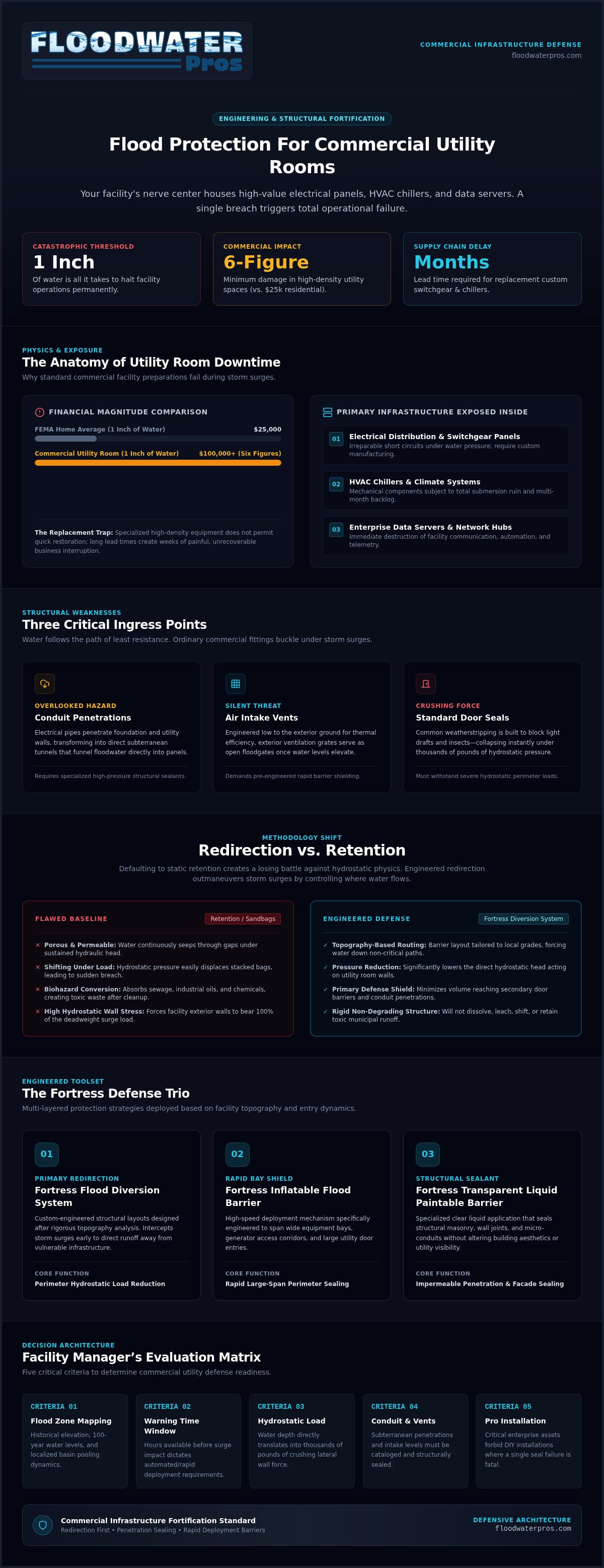
When the power goes out, the business stops. It isn't just about the immediate darkness or the temporary lack of climate control. It's about the months of recovery that follow. Specialized HVAC units and server components often have long lead times. You could be waiting months for a replacement chiller or a custom switchgear panel to arrive. FEMA estimates that just one inch of water can cause $25,000 in damage to a home. In a high-density commercial utility room, that cost easily hits six figures. Utility room vulnerability describes the catastrophic exposure of high-value electrical and mechanical assets to water ingress, where a single breach triggers total facility failure.
Common Vulnerability Points: Doors, Vents, and Conduit
Water is relentless. It finds the smallest path of least resistance to reach your equipment. Conduit penetrations are a major risk that facility managers often overlook. These electrical pipes go through your foundation and walls, creating direct tunnels for floodwater to enter the room from underground. Air intake vents are another silent threat. They often sit low to the ground for efficiency, acting as open windows for rising surges.
Standard door seals are equally problematic. Most weatherstripping is designed to stop drafts and insects, not hydrostatic pressure. When a storm surge hits, the weight of the water creates a crushing force that standard seals cannot withstand. Without specialized flood protection for commercial utility rooms, these entry points become the primary failure sites for your entire infrastructure. Fortification means sealing these penetrations with materials that don't just block water, but resist the physical weight of the flood.
Engineering the Path of Resistance: Redirection vs. Retention
Most facility managers default to retention. They try to hold the ocean back with a simple wall. This is a losing battle. Redirection is different. It's about control. By using engineered systems, you dictate where the water goes. This is the foundation of effective flood protection for commercial utility rooms. It transforms your facility from a target into an obstacle. You don't just wait for the surge to hit your walls. You intercept it. You guide it. You win.
The Philosophy of the Fortress Flood Diversion System
The Fortress Flood Diversion System isn't a one-size-fits-all product. It's a custom-engineered layout. We analyze your facility's specific topography to identify current drainage patterns. By placing these barriers strategically, we force the surge to follow the path of least resistance. This path leads away from your critical assets. Redirection significantly lowers the hydrostatic pressure exerted on your utility room walls. It acts as a primary shield, reducing the load on secondary door seals. It's the most sustainable property flood mitigation solution for 2026. You aren't just fighting the water. You're outmaneuvering it with structural intelligence.
Why Structural Redirection Beats Temporary Sandbagging
Sandbags are a relic of the past. They are porous and heavy. They soak up oil, sewage, and industrial toxins during a flood. This turns them into a hazardous waste nightmare once the water recedes. Under sustained pressure, sandbags shift and leak. The Fortress system provides a rigid, reliable barrier. It doesn't degrade during the storm. It doesn't require a massive crew for deployment. It stands its ground while the water is channeled elsewhere. There's no back-breaking labor and no toxic cleanup. It's a professional-grade defense for high-stakes environments. This level of reliability is essential for flood protection for commercial utility rooms. No leaks. No failure. Total control.
If you want to move beyond basic retention, you need a partner who understands fluid dynamics. You can consult with our engineering team to map your facility's path of resistance and stop a disaster before it starts.
Selecting Your Shield: A Comparison of Commercial Flood Barriers
Not all vulnerabilities are equal. A wide loading dock bay requires a different defense than a small electrical conduit penetration. Effective flood protection for commercial utility rooms relies on a multi-layered shield. You need to match the barrier to the specific threat level and the geometry of the opening. Choosing the right hardware means the difference between a dry facility and a total loss. We categorize these defenses into two main groups: active, rapid-deployment systems and passive, permanent seals. A truly resilient facility uses both.
Fortress Inflatable Flood Barriers for Rapid Deployment
Large utility bays and loading docks are massive targets for rising water. The Fortress Inflatable Flood Barrier is the heavy-duty answer to these wide openings. It's constructed from military-grade materials. This isn't a flimsy tube. It's a high-impact shield that stands up to floating debris and intense surges. You can store it easily when the skies are clear. When the alarm sounds, you deploy it in minutes. It's reusable, reliable, and provides an immediate seal for your largest entrance points. It offers a professional-grade solution for spaces where permanent barriers would interfere with daily operations.
Fortress Transparent Liquid Paintable Flood Barrier for Invisible Sealing
Some vulnerabilities are harder to see. Small cracks in the foundation or conduit penetrations for electrical piping are silent killers. For these tight-clearance areas, the Fortress Transparent Liquid Paintable Flood Barrier is essential. This is a passive defense system. You apply it once, and it stays on the structure without altering its aesthetic. It creates an impenetrable, transparent seal that resists high-pressure water ingress. It's the perfect solution for areas where a physical barrier won't fit or where you want permanent, invisible protection. It works around the clock so you don't have to.
The choice comes down to response time and physical accessibility. Inflatables offer a massive, active defense that you trigger in minutes when a storm is imminent. Paintable barriers provide a 24/7 passive shield that requires zero human intervention during a crisis. By layering these technologies, you ensure that every inch of your utility room is fortified. This strategic combination is the gold standard for flood protection for commercial utility rooms. You don't just hope for the best. You engineer for it.
The Facility Manager’s Evaluation Framework: How to Choose
Facility managers are the architects of resilience. You don't just buy a product; you build a strategy. Choosing the right flood protection for commercial utility rooms requires a cold, hard look at your facility's specific risks. Start with the data. Look at your local flood zone history. Don't just look at the map; look at the predicted surge heights. If you expect three feet of water, your defense must be higher. You also need to audit every single penetration. It isn't just about the main doors. You must account for electrical conduit, floor drains, and low-sitting air vents. If you miss one pipe, you miss the whole room.
Consider the deployment window. How much warning time do you realistically have? If you get hours of notice, you have options. If a flash flood hits in minutes, your strategy must change. You also have to account for the human factor. If a storm hits at 2 AM on a Sunday, who is on-site? If the grid goes down and the building is pitch black, can your team safely deploy a heavy barrier? If your staff is minimal or the response time is narrow, passive systems are your best friend. They work when no one is there to help.
Assessing Hydrostatic Pressure and Flood Depth
Hydrostatic pressure is a crushing force. Water weighs about 62.4 pounds per cubic foot. As the depth increases, that pressure grows exponentially. One foot of water is a nuisance, but four feet of water is a structural threat that can buckle standard walls. Your commercial flood barriers must match the expected surge depth to prevent a catastrophic breach. Sometimes, the barrier is stronger than the wall it's attached to. You might need to reinforce the surrounding structure to ensure the entire system holds firm against the weight of the surge.
Active vs. Passive Protection: Balancing Speed and Security
Active systems like the Fortress Inflatable Flood Barrier offer massive protection for doors, but they require hands-on deployment. Passive systems like the Fortress Transparent Liquid Paintable Flood Barrier are always "on." A hybrid approach is usually the smartest play for critical infrastructure. Use paintable seals for permanent penetrations and vents. Reserve the inflatable barriers for the main bay doors. This strategy balances immediate speed with long-term security. While active systems might have a lower initial cost, passive systems offer a higher ROI by eliminating human error and deployment stress. Every second counts when the water starts to rise. Don't leave your facility's nerve center to chance. You can schedule a professional engineering consultation to identify every hidden vulnerability in your utility room today.
Fortifying Your Infrastructure: Professional Engineering and Installation
Commercial utility rooms are high-stakes environments. A DIY failure isn't just a mistake; it's a catastrophe. When millions of dollars in infrastructure are on the line, you don't guess. You engineer. Professional professional flood barrier system installation ensures there are no gaps in your defense. FloodWater Pros manages the entire engineering lifecycle for your facility. We don't just drop off equipment and leave. Our certified installers verify the seal integrity of every Fortress product on-site. This level of precision is the only way to guarantee flood protection for commercial utility rooms when the pressure rises. If the seal isn't perfect, the defense is useless. We make sure it's perfect.
The Full-Service Advantage of FloodWater Pros
We provide a full-service advantage that local contractors can't match. It starts with custom site engineering. We don't just sell products; we design systems that work with your facility's unique footprint. Our team analyzes flow rates and potential debris impact before a single bolt is turned. Our national reach means we provide professional installation across the United States. Once the hardware is in place, we don't disappear. We provide post-installation support and barrier maintenance training for your team. Your staff will know exactly how to handle the Fortress Inflatable Flood Barrier or check the status of the Fortress Transparent Liquid Paintable Flood Barrier. We turn your facility managers into vigilant guardians who are ready for anything.
Securing Your Assets Before the Next Surge
The window for preparation is closing fast. Storm patterns are becoming more unpredictable every year. Waiting for a "watch" or "warning" is too late for engineered protection. By the time the skies turn gray, the logistics of a professional install are impossible. You can't fortify a building while the wind is howling. You need to act now to secure your critical heartbeat. Contact FloodWater Pros for a comprehensive facility flood risk assessment. We will identify the exact placement for your Fortress Flood Diversion System and ensure your nerve center is impenetrable. Peace of mind isn't a feeling. It's a physical structure. It's a shield that stands between your business and the rising tide. Don't wait for the water to tell you that you should've acted sooner.
Securing the Nerve Center: A Future Without Flood Loss
Your utility room is too valuable to leave to chance. We have explored why standard doors fail and how engineered redirection outmaneuvers rising water. By layering the Fortress Flood Diversion System with specialized barriers, you transform your facility's greatest vulnerability into its strongest defense. This multi-layered approach ensures that even if one line of defense is tested, the heart of your infrastructure remains dry and operational. You are no longer reacting to the weather. You are controlling the environment.
True resilience requires more than just hardware. It demands the precision of expert facility risk assessments and the certainty of national professional installation teams. Implementing comprehensive flood protection for commercial utility rooms is a commitment to operational continuity. Proprietary engineered Fortress systems provide the structural integrity needed to withstand the most unpredictable storm patterns. You don't have to face the next surge with uncertainty. You can choose a path of proactive fortification and seasoned wisdom. It is time to act before the clouds gather.
You have built a business that lasts. Now, build the shield that keeps it standing.
Frequently Asked Questions
What is the best way to seal a utility room door against flooding?
The most effective method involves layering active barriers with engineered redirection. For entryways, the Fortress Inflatable Flood Barrier provides a heavy-duty, reusable shield that handles intense water pressure. It's superior to weatherstripping because it creates a compression seal against the frame. This ensures your facility's nerve center remains dry during a surge. Combining this with the Fortress Flood Diversion System reduces the total load on the door by channeling water away from the threshold entirely.
Can the Fortress paintable barrier be used on electrical conduit penetrations?
Yes, this passive system is specifically engineered for high-risk penetrations. The Fortress Transparent Liquid Paintable Flood Barrier flows into small gaps around electrical piping and conduit, creating an impenetrable seal once cured. It handles high-pressure ingress where traditional caulking fails. Since it is transparent, it allows for visual inspections of the conduit without compromising the barrier's integrity. It's a critical component of comprehensive flood protection for commercial utility rooms that prevents silent leaks.
How long does it take to deploy a Fortress Inflatable Flood Barrier?
Deployment happens in minutes once the alarm sounds. Unlike sandbags that take hours of manual labor, the Fortress Inflatable Flood Barrier is designed for rapid activation by minimal staff. It's constructed from military-grade materials that inflate quickly to create a rigid, high-impact defense. This speed is vital when flash floods or storm surges provide little warning. Your team can focus on other critical shutdown procedures while the utility room bay is secured.
Does the Fortress Transparent Liquid Paintable Flood Barrier change the building's appearance?
No, the barrier is designed to be completely invisible once applied. The Fortress Transparent Liquid Paintable Flood Barrier provides a 24/7 passive defense without altering the building's architecture or aesthetic. It stays on the structure permanently, sealing foundation cracks and vents against water ingress. This makes it an ideal choice for facilities where maintaining a professional appearance is just as important as structural integrity. It protects your assets without the visual clutter of permanent metal dams.
Is professional installation required for the Fortress Flood Diversion System?
Yes, professional installation is a non-negotiable requirement for system reliability. FloodWater Pros manages the entire engineering lifecycle, from initial site assessment to final on-site verification. We don't just ship products; we design and install systems that meet specific hydrostatic load requirements. Certified installers ensure that the Fortress Flood Diversion System is anchored correctly to your facility's topography. This expert oversight eliminates the risk of DIY failure and ensures your flood protection for commercial utility rooms is impenetrable.
How do I calculate the height of flood protection needed for my commercial building?
You must evaluate the Base Flood Elevation (BFE) and historical surge data for your specific location. Engineering standards, such as ASCE 24-24, often recommend protecting to the 500-year floodplain level for critical infrastructure. We conduct expert facility risk assessments to determine the exact protection height required. This calculation accounts for both the static water level and the dynamic force of waves or debris. Protecting to the correct depth prevents water from overtopping your barrier system.
Can these barriers withstand impact from floating debris during a flood?
Yes, Fortress products are engineered to handle the physical impact of floating objects. The Fortress Flood Diversion System uses a rigid design to deflect heavy debris away from the structure. Similarly, the Fortress Inflatable Flood Barrier is constructed from military-grade, puncture-resistant materials that withstand the battering of storm-driven waste. This resilience is vital in commercial environments where floods often carry industrial equipment, vehicles, or lumber. Your utility room remains shielded from both water and physical damage.
What maintenance is required for commercial flood barrier systems?
Maintenance is minimal but essential for long-term readiness. We provide post-installation support and training to help your team inspect seals and barrier materials periodically. You should check for any physical damage to the Fortress Inflatable Flood Barrier after deployment or storage. For passive systems, a quick visual inspection ensures the seal around conduits remains intact. Regular drills ensure your staff can deploy active barriers efficiently. These simple steps keep your structural fortification ready for the next surge.


