

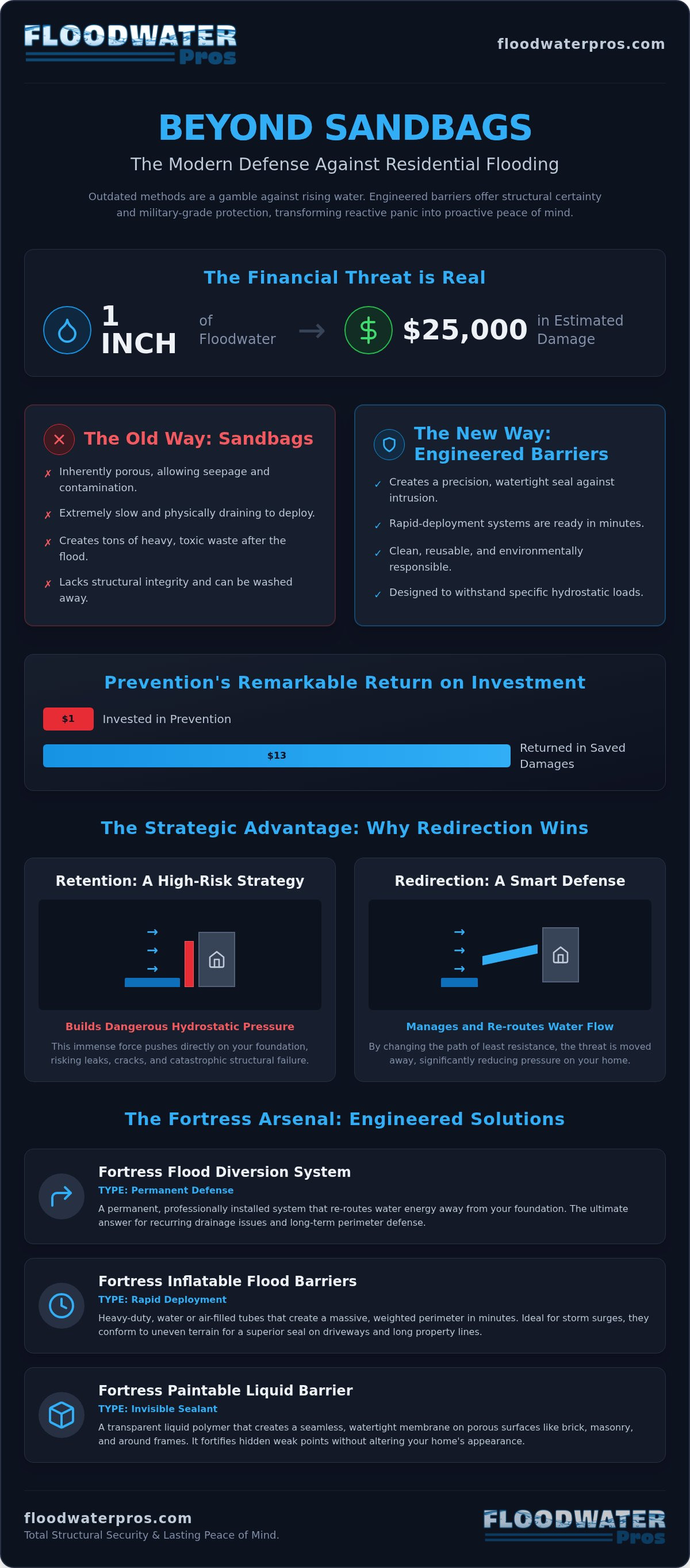
A single inch of floodwater can cause an estimated $25,000 in damage to your home. For most homeowners, this isn't just a statistic; it's a looming threat that creates a constant state of vulnerability. You've likely spent hours hauling heavy, leaking sandbags only to realize they're no match for a serious surge. It's time to stop relying on hope and start investing in structural certainty. Modern residential flood protection barriers offer a military-grade defense that replaces physical exhaustion with absolute confidence.
You already know that traditional DIY solutions are unreliable and physically draining. You need a system that deploys in minutes or stands as a permanent shield against rising tides. This guide explores how engineered diversion and advanced inflatable technology provide a $13 return for every $1 invested in prevention. We'll break down the mechanics of the Fortress line, from paintable liquid barriers to rapid-deployment systems. Discover how to transition from emergency panic to total structural security and lasting peace of mind.
Key Takeaways
- Stop relying on porous sandbags and discover how modern residential flood protection barriers use engineered defense to secure your home's perimeter.
- Learn why redirection is superior to retention, as managing water flow prevents the dangerous hydrostatic pressure that threatens foundation integrity.
- Explore the rapid deployment capabilities of the Fortress Inflatable Flood Barrier for securing driveways and long property lines in minutes.
- Master the process of assessing terrain and entry points to ensure your defense system provides a professional, watertight seal when it matters most.
Beyond Sandbags — The Evolution of Residential Flood Protection Barriers
The era of the burlap bag is over. Relying on sand and manual labor is a high-stakes gamble with your property's foundation. Modern residential flood protection barriers represent a fundamental shift from reactive hope to engineered certainty. These systems are precision instruments. They are designed to withstand specific hydrostatic loads, ensuring your home remains an island of safety. As FEMA continues to update flood maps throughout 2026, the demand for verified, structural defense has never been higher.
The Failure of Traditional Methods
Sandbags are a relic. They are often too little, too late. By the time you've filled and stacked a perimeter, the surge has likely arrived. They are inherently porous. Water seeps through the gaps, carrying silt and contaminants directly into your home. There's also a hidden cost to consider. After the water recedes, you're left with tons of heavy, toxic waste. Sand soaked in floodwater often contains sewage, heavy metals, and chemicals. This makes disposal an expensive environmental nightmare. Most importantly, sandbags lack structural integrity. When water pressure exceeds the mere weight of the bags, the entire wall can shift or wash away.
Defining the Modern Engineered Barrier
Modern defense relies on materials science. We've moved beyond heavy lifting toward sophisticated seals and advanced polymers. Experts distinguish between temporary and permanent flood barriers based on how they handle stress. Weight-based barriers are old news. Modern "Active Defense" systems focus on the seal. If the water can't get under or around the barrier, the house stays dry. This is why residential flood protection barriers are now judged by their seal integrity rather than their bulk. An engineered flood barrier is a specialized structural system designed to redirect or exclude water from a specific area through precision seals and load-bearing materials.
Strategic choices now dictate survival. Systems like the Fortress Flood Diversion System or the Fortress Inflatable Flood Barrier prioritize the redirection of energy over the simple blocking of mass. These technologies utilize PVC, ABS, and liquid polymers to create an impenetrable shield. With a single inch of water causing up to $25,000 in damage, the shift toward professional, rapid-deployment engineering isn't just a preference. It's a necessity for 2026.
Engineered Barrier Technologies — Fortifying Your Home’s Perimeter
Protection isn't a one-size-fits-all solution. Your home's unique layout dictates your defense strategy. Modern residential flood protection barriers offer a toolkit of specialized, high-performance systems. Each is engineered to address a specific structural vulnerability. You might need a permanent diversion to redirect runoff or a rapid-response inflatable for hurricane season. The objective is always the same. You are building a shield to ensure total structural integrity.
The Fortress Flood Diversion System is the cornerstone of professional perimeter defense. It doesn't just block water; it re-routes the energy. By strategically changing the path of least resistance, you move the hydraulic threat away from your foundation. This is a tactical maneuver. It significantly reduces the direct pressure exerted on your home's walls. This system is designed for long-term resilience, providing a permanent answer to recurring drainage issues.
Fortress Inflatable Flood Barriers for Rapid Deployment
Speed is critical during a storm surge. Fortress Inflatable Flood Barriers create a heavy-duty seal in minutes. These durable tubes use water or air to establish a massive, weighted perimeter that stays put. They are ideal for securing long driveways, estate perimeters, and garage fronts. Unlike modular plastic panels that struggle on slopes, these barriers conform to the terrain. This flexibility ensures a tighter seal on uneven surfaces. They provide military-grade durability against high-velocity water and floating debris. It's the professional choice over flimsy retail kits.
Invisible Defense with Paintable Liquid Barriers
Some vulnerabilities are hidden. Porous brickwork, vents, and door frames are often the first places to fail during a flood. The Fortress Transparent Liquid Paintable Flood Barrier targets these entry points. This liquid polymer creates an invisible, seamless shield. You apply it directly to masonry and frames to form a watertight membrane. Your home's curb appeal remains untouched while its defenses are fortified. This technology is essential for historic homes or modern designs where bulky equipment isn't feasible. It seals the weak points that traditional residential flood protection barriers often miss.
Strategic fortification requires matching the right technology to your specific terrain. Creating resilient residential places involves more than just blocking water; it involves engineering a comprehensive defense. You don't have to navigate these technical choices alone. You can consult with a flood engineering expert to design a customized plan for your property. Professional installation ensures that every seal is airtight and every barrier is positioned for maximum impact.
Redirection vs. Retention — Why Strategic Diversion Wins
Most homeowners view flood defense as a wall. They imagine a brute force battle between a barrier and a surge. This is a dangerous misconception. Simply blocking water creates a pressure cooker. When you try to hold a flood in place, you are fighting physics. Strategic diversion is the professional alternative. Modern residential flood protection barriers aren't just dams; they're traffic controllers for the tide. They manage the energy of the water rather than just absorbing the impact.
Retention focuses on "holding." This leads to a massive buildup of hydrostatic pressure against your home's foundation. Water is heavy. It searches for every microscopic crack in your masonry. Eventually, the sheer weight can cause structural failure or force a temporary barrier to collapse. Diversion changes the math. By using the Fortress Flood Diversion System to create strategic angles, you strip the water of its destructive momentum. You aren't fighting the tide; you're guiding it toward safety.
The Physics of Flood Water Management
When water hits a flat, perpendicular wall, it piles up. This increases the depth and the weight of the surge. The Fortress Flood Diversion System utilizes specialized "L-shaped" engineering to flip this script. This design uses the weight of the floodwater itself to anchor the barrier to the ground. The more water that arrives, the more stable the barrier becomes. It creates a path of least resistance, allowing the surge to slide past your home. You can redirect the flow toward natural drainage or low-impact areas of the property. This prevents the water from ever reaching its peak destructive potential against your structural perimeter.
Long-Term Structural Benefits of Diversion
Erosion is a silent threat that lingers after the clouds clear. Moving water strips away soil. It scours the ground near your foundation, which can lead to settling or structural shifts months later. Diversion systems prevent this by keeping high-velocity flow away from your home's base. This is why professional site analysis is mandatory for effective defense. You need to know exactly where that water will go once it's redirected. Expert engineering ensures you don't save your garage only to wash out your own driveway or flood a neighbor. These residential flood protection barriers lower the risk of overtopping during prolonged events. They protect your property's long-term value by ensuring the land around your home remains stable and secure.
Selecting the Right Defense — Matching Barriers to Property Vulnerabilities
Choosing a defense strategy is not about buying a product. It is about analyzing a battlefield. A one-size-fits-all approach to residential flood protection barriers is a recipe for failure. You must identify exactly where your home is most vulnerable before the clouds darken. Garage doors are notorious fail points. Driveways often act as funnels, directing thousands of gallons of water toward your foundation. Ground-level windows are structural glass vulnerabilities that require specialized seals. Brute force is not a strategy. Engineering is.
Terrain dictates the physics of your survival. Sloping ground increases water velocity, which puts immense stress on your perimeter. Soil type is equally critical. Saturated earth can lose its grip on temporary anchors, causing less sophisticated systems to slide. Your defense must also act as a partner to your existing infrastructure. A high-performance barrier excludes surface water, but it doesn't stop rising groundwater. You must ensure your sump pumps and internal drainage systems are clear to maintain a total structural shield. Understanding the duration of the threat is the final piece of the puzzle. A flash flood requires rapid deployment, while a multi-day hurricane demands long-term endurance.
Protection for Private Estates and Large Perimeters
Large properties face the challenge of expansive perimeters. Deploying the Fortress Inflatable Flood Barrier is the most efficient way to secure hundreds of feet of property line in a single afternoon. These systems are modular. You can scale them to fit the exact dimensions of your estate. By combining the Fortress Flood Diversion System with natural landscaping features, you create a multi-layered defense. This ensures that even the most aggressive surge is redirected toward low-impact areas before it ever reaches your primary structure. It is about creating a buffer zone of absolute security.
Urban and Small-Lot Flood Mitigation
Urban homeowners deal with zero-clearance challenges. You don't have room for massive berms or stockpiles of sand. The Fortress Transparent Liquid Paintable Flood Barrier is the definitive answer for high-density living. It seals door thresholds, vents, and masonry without obstructing daily foot traffic. When the storm passes, the protection remains invisible, preserving your curb appeal while maintaining a permanent seal. Inflatable systems also beat sandbags for urbanites because they deflate into compact storage. You get professional-grade residential flood protection barriers that fit on a single shelf in your garage rather than taking up a driveway.
Do not wait for the next storm warning to find your home's weak points. Request a professional vulnerability assessment today to design a defense system tailored to your property's unique terrain.
Professional Installation — Ensuring Structural Integrity and Resilience
A flood barrier is a precision tool. It is not a lawn ornament. Many retail solutions promise quick and easy setups that fail when the surge actually hits. The difference lies in the seal. Without a professional-grade connection to the substrate, water will bypass your defenses in seconds. Choosing residential flood protection barriers is only half the battle. The other half is ensuring they are installed by experts who understand the physics of high-stakes environments. You need a system that holds firm when the pressure is at its peak.
At FloodWater Pros, we don't just sell equipment. We deliver engineered systems. Our approach begins with a full-service engineering model. We evaluate your property's specific vulnerabilities to ensure the Fortress line performs under pressure. This includes verifying current 2026 engineering standards for every installation. We focus on the structural reality of your home, transforming it into an impenetrable shield against environmental threats. Our team manages everything from initial design to final on-site execution.
The Engineering Behind the Barrier
Effective defense requires meticulous calculation. We determine the exact hydrostatic and hydrodynamic loads your property may face during a major event. This dictates the necessary barrier height and material strength. Sub-surface preparation is equally vital. If the ground cannot support the weight of the water against the barrier, the entire system can shift or collapse. A professional site survey is the essential first step to identify hidden drainage paths and structural weaknesses before the storm arrives. We ensure the foundation is as resilient as the barrier itself.
Peace of Mind Through Expert Execution
There is a fundamental difference between a product and a system. A product is a box on a shelf. A system is a coordinated defense strategy. We ensure your Fortress Inflatable Flood Barrier or Diversion System is ready for immediate action. This includes hands-on training for rapid deployment. When the weather alert sounds, you won't be guessing. You will be executing a proven plan with military-grade equipment. This expert execution turns a state of concern into a state of total readiness.
Maintenance is the final pillar of resilience. We provide a clear roadmap to keep your residential flood protection barriers storm-ready throughout the 2026 season and beyond. This ensures your investment provides the profound relief of security you deserve. You shouldn't have to face hurricane season with uncertainty. Secure your home with a professional Fortress system from FloodWater Pros. Our team is ready to act as your strategic partner in safeguarding what is most valuable.
Secure Your Legacy: The Path to Absolute Resilience
The threat of rising water is a structural reality that demands an engineered response. You've learned that effective defense is about more than blocking flow; it's about mastering redirection. By choosing residential flood protection barriers built on proprietary Fortress technology, you replace emergency panic with a calculated, professional shield. These systems are designed for high-velocity redirection, ensuring that the energy of the surge never compromises your home's foundation. It is the definitive difference between a temporary patch and a permanent fortification.
Don't leave your property's survival to chance or temporary DIY fixes. True peace of mind comes from professional engineering and installation that guarantees an airtight seal. You have the power to fortify your home against the uncertainties of the 2026 storm season today. Every layer of defense you build now is a commitment to your family's future safety. Fortify your property with an engineered Fortress Flood Diversion System and rest easy knowing your sanctuary is impenetrable. You've taken the first step toward total structural security. You are ready for whatever nature brings next.
Frequently Asked Questions
What is the difference between a flood barrier and a flood gate?
A flood barrier provides a wide perimeter of defense, while a flood gate is a specialized closure for specific structural openings like doors or driveways. Barriers are often modular or inflatable, creating a shield for the entire property. Gates are typically permanent fixtures integrated into your home's entry points. Both are essential components of residential flood protection barriers. Choosing the right one depends on whether you need to fortify a single entrance or an entire estate line.
Can I install a residential flood barrier myself or do I need a professional?
Professional installation is the only way to guarantee a watertight seal that withstands extreme hydrostatic pressure. DIY kits often lack the sub-surface preparation and precision engineering required for real-world surges. FloodWater Pros provides a full-service model from design to execution. This ensures your system doesn't shift or leak when the water hits. Your home's structural integrity is too valuable to risk on a non-professional installation that might fail during a crisis.
How long do inflatable flood barriers take to deploy during an emergency?
The Fortress Inflatable Flood Barrier is designed for rapid deployment, typically taking only minutes to secure a perimeter. You simply position the durable tubes and fill them with air or water to create a heavy-duty seal. This speed is critical when facing flash floods or sudden storm surges. It replaces the hours of back-breaking labor required for sandbags with a fast, efficient system that one or two people can manage easily.
Are paintable liquid flood barriers actually effective against high water?
Yes, the Fortress Transparent Liquid Paintable Flood Barrier creates an impenetrable, rubberized membrane that seals porous surfaces like brick and mortar. It targets the microscopic entry points that traditional barriers miss. This technology is highly effective at preventing seepage through vents and door frames. It provides a permanent, invisible layer of defense that maintains your home's aesthetic while offering military-grade protection against rising water levels.
Do residential flood barriers affect my home insurance premiums?
Installing engineered residential flood protection barriers may lead to lower premiums depending on your specific insurance carrier and policy. Many private insurers recognize professional mitigation efforts that reduce the risk of catastrophic loss. You should consult with your agent to see if a Fortress system qualifies you for a discount. Documenting your professional installation and the engineering standards used is the best way to prove your home's enhanced resilience to underwriters.
How much water pressure can a standard residential flood barrier withstand?
The pressure capacity depends on the engineering design and the height of the barrier used. Fortress systems are calculated to withstand specific hydrostatic and hydrodynamic loads based on your property's unique risk profile. A professional site survey determines these requirements before installation. This ensures your barrier is heavy enough and anchored securely enough to resist the weight of the water without collapsing or shifting under the force of the surge.
What happens to the water that is redirected by a diversion system?
The Fortress Flood Diversion System guides water toward natural drainage paths or low-impact areas of your property where it can safely dissipate. Strategic engineering ensures that the energy of the surge is moved away from your foundation. This prevents the "piling up" effect that causes structural damage. A professional site analysis is mandatory to ensure your redirected water doesn't unintentionally impact neighboring properties or wash out your own landscaping.
Are Fortress flood barriers reusable after a major storm event?
Yes, Fortress systems are engineered for long-term durability and multiple uses. Unlike sandbags that become toxic waste after one flood, our inflatable and diversion systems can be cleaned, inspected, and stored for the next event. The materials are resistant to debris and environmental contaminants. This reusability makes them a sustainable and cost-effective investment in your home's long-term defense. Regular maintenance ensures they remain storm-ready for years to come.


