

A single crack in a 200-year-old foundation isn't just a repair bill. It's a permanent loss of history. For property stewards, the search for the best flood protection for historical buildings often feels like a losing battle against time and red tape. You know that traditional sandbags are messy and ineffective. You also know that heavy concrete walls would never pass a preservation board's review. The stakes are high. FEMA's 2024 standards now require many projects to account for 500-year flood risks. The threat is growing. Your options shouldn't have to involve altering the very heritage you're trying to save.
We understand the weight of this responsibility. You need a solution that acts as a silent guardian. It must protect the structure without changing a single aesthetic detail. You'll discover how advanced engineering makes this possible through the Fortress line of defenses. We'll show you how invisible liquid barriers and high-strength diversion systems provide total security while remaining completely hidden from view. This article covers the latest regulatory shifts, the move toward future-focused risk assessment, and the specific technologies that keep water away from fragile masonry without a single permanent drill hole.
Key Takeaways
- Why traditional flood walls often trigger regulatory rejection and how to avoid these common preservation hurdles.
- The secret to the best flood protection for historical buildings lies in "invisible" barriers that provide military-grade security without permanent masonry damage.
- How to utilize inflatable perimeters to establish a rapid, temporary defense line that disappears once the threat has passed.
- The engineering logic behind the "redirection over retention" model to keep floodwaters away from your site's most vulnerable structural seams.
- Why professional site analysis is the critical first step in ensuring your defense strategy complies with modern FEMA and restoration standards.
The Historical Preservation Dilemma—Safety vs. Integrity
Water is a patient enemy. For a historical structure, it's often a terminal one. Most modern buildings can be stripped to the studs and dried. Historical masonry, however, acts as a ceramic sponge. It absorbs silt, salt, and contaminants that trigger internal decay for decades. This creates a high-stakes conflict. You must stop the water, but you cannot scar the stone. Traditional solutions like permanent concrete walls or heavy steel gates are often non-starters. They clash with the aesthetic. They violate the soul of the site. Finding the best flood protection for historical buildings requires a shift in strategy. It requires a move from permanent alteration to invisible, reversible fortification.
The "Best Protection" isn't just about stopping water. It's about maintaining the building's breathability and structural health. For a 19th-century brownstone or a colonial courthouse, the best flood protection for historical buildings is one that respects the original materials. It uses diversion to keep the bulk of the water at the property line. It uses transparent seals for the final line of defense. This approach ensures the building remains an asset, not a liability, for the next century. True defense should be absolute, yet entirely discreet.
Understanding the Secretary of the Interior’s Standards
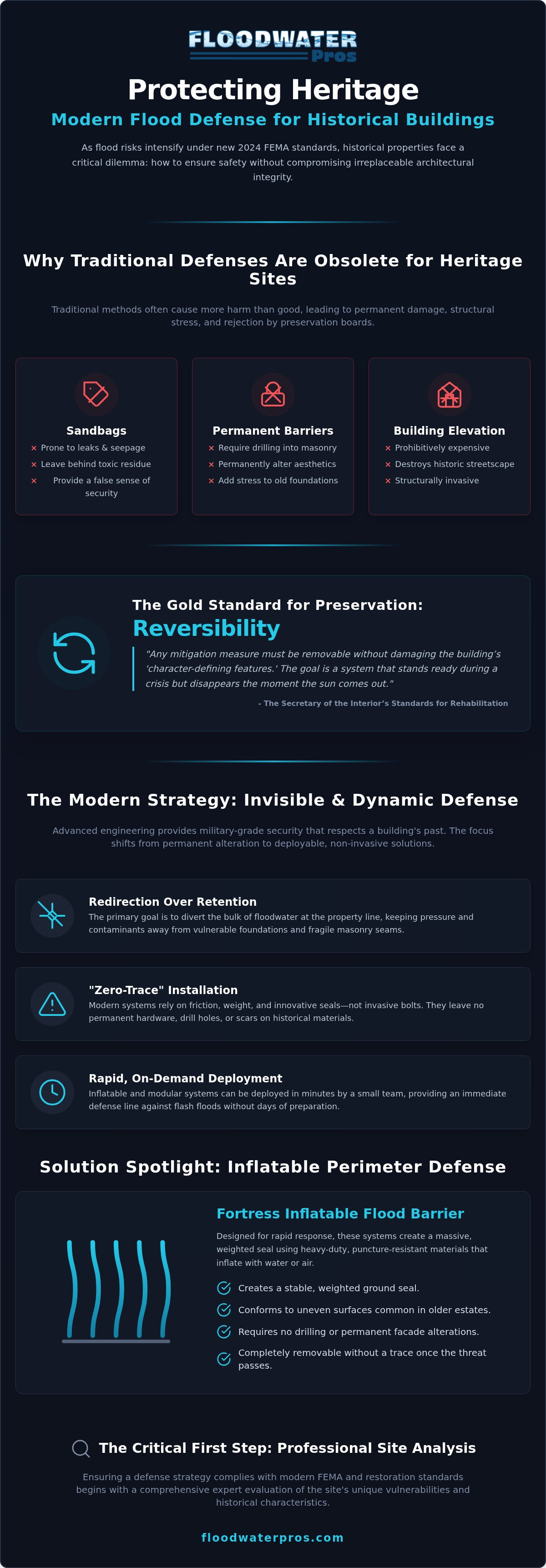
The National Park Service (NPS) sets the gold standard for rehabilitation. Their core requirement is simple: reversibility. Any mitigation measure must be removable without damaging the building’s "character-defining features." If a flood barrier requires drilling into original granite or obscuring a hand-carved facade, it risks the loss of historical designation. Modern engineering has finally caught up to these strict rules. We no longer have to choose between a dry basement and a preserved porch. The goal is a system that stands ready during a crisis but disappears the moment the sun comes out. This ensures that the building's story remains intact for future generations.
Why Traditional Methods Often Fail Heritage Sites
Sandbags are the first instinct for many, yet they're a documented failure for heritage sites. They leak. They leave behind toxic residue. Most importantly, they provide a false sense of security while water seeps into the foundation. Other methods, like elevating a house, can cost hundreds of thousands of dollars and destroy the historic streetscape. There's also a psychological cost. Living behind permanent steel hardware feels like living in a bunker, not a landmark. Heavy hardware adds stress to fragile, settling foundations. The weight of traditional flood gates can cause structural shifting in old timber frames. True protection shouldn't feel like a compromise. It should feel like a guardian that respects the past while securing the future.
Evaluating Modern Defense—Beyond Sandbags and Elevation
Static defenses fail the preservation test. A permanent wall might stop a surge, but it permanently alters the landscape. Dynamic protection is different. It stays in storage until the clouds darken. This approach respects the building’s original profile while providing military-grade security. The National Park Service provides detailed Guidelines On Flood Adaptation For Rehabilitating Historic Buildings to help owners choose the right path. For many, the best flood protection for historical buildings is a system that can be deployed by a small team and removed without a trace.
The "Zero-Trace" requirement is non-negotiable. After the water recedes, the building must look as it did in the century before. This means avoiding any hardware that requires drilling into historical masonry or timber. Modern deployable systems rely on friction, weight, and innovative seals rather than invasive bolts. If you aren't looking at engineered defense options that prioritize structural integrity, you aren't truly protecting the heritage.
The Fortress Inflatable Flood Barrier: Rapid Response
Flash floods don't give you days to prepare. They give you minutes. The Fortress Inflatable Flood Barrier is designed for this exact window of time. It uses heavy-duty, puncture-resistant materials that inflate to create a massive, weighted seal against the ground. There is no drilling. There are no permanent tracks left on the facade. It conforms to uneven surfaces, which is common in older estates with settling foundations. When the threat passes, you simply deflate, dry, and store the system. It is a professional-grade shield that remains invisible until it is needed most.
Temporary Wall Systems for Large Historic Estates
Larger estates require a perimeter defense. Blocking the front door isn't enough if the water is allowed to saturate the entire site. Temporary wall systems, including L-shaped barriers and water-filled dams, act as a site-wide shield. These systems focus on redirection. By moving the water toward driveways or natural drainage areas, you keep the hydrostatic pressure away from fragile foundations. Finding the best flood protection for historical buildings often involves these modular perimeters. They allow you to defend the landscaping and outbuildings along with the main hall. This creates a "dry island" effect that protects the entire historical context of the property.
Invisible Fortification—The Role of Transparent Liquid Barriers
Historical stone is breathtaking. It is also dangerously porous. When floodwaters rise, they don't just hit the wall. They enter it. Most traditional sealants are thick, waxy, and visible. They ruin the natural patina and change how light hits the facade. The Fortress Transparent Liquid Paintable Flood Barrier changes the defensive equation. It offers an impenetrable shield that remains completely invisible to the naked eye. This is the best flood protection for historical buildings because it requires zero structural modification. You don't need brackets. You don't need bolts. You get pure, engineered resilience that preserves the past.
Preservationists often worry about breathability. If you seal a historic brick wall with the wrong material, you trap moisture inside. This leads to spalling, freeze-thaw damage, and internal rot. Modern transparent technology solves this problem. It creates a molecular bond that blocks liquid water from entering while allowing internal water vapor to escape. It acts as a one-way valve for your building’s structural health. You gain the security of a dry-floodproofed structure without the risk of long-term masonry decay. This ensures the best flood protection for historical buildings doesn't become a cause of secondary damage.
Sealing Doors and Windows Without Hardware
Entry points are the front lines of any flood event. In a historic hall, these are often hand-crafted wood or leaded glass. You cannot attach heavy metal shields without destroying the delicate frames. Applying liquid defense to these seams creates a custom, watertight gasket. It follows the natural contours of the architecture, sealing sill plates, mortar joints, and utility penetrations that traditional systems miss. You can paint over the barrier to match your existing trim or leave it clear. Either way, the original character remains untouched. You achieve military-grade sealing without turning your landmark into a bunker. It's protection that respects the craftsman's work.
Application and Longevity of Paintable Barriers
A historic site is not a DIY project. It is an irreplaceable asset that requires an engineering-led approach. Professional application ensures that the barrier reaches every microscopic gap in the masonry and every low-lying seam. This system is built to withstand sustained water pressure and the impact of floating debris during a surge. It isn't a temporary film. It's a durable fortification that stands up to the harshest environmental conditions. The Fortress Transparent Liquid Paintable Flood Barrier delivers total structural security while remaining completely undetectable to the human eye.
Strategic Site Diversion—Redirecting Threats Before Impact
Stop treating your building as the first line of defense. That's a reactive strategy that invites disaster. Historical foundations, often made of dry-laid stone or early brick, aren't designed to handle the crushing weight of saturated soil. Hydrostatic pressure is a silent killer of heritage sites. By the time you see water in the basement, structural shifting has likely already begun. The Fortress Flood Diversion System shifts the battlefield. It turns the tide by moving water away from the structure entirely. Choosing the best flood protection for historical buildings means stopping the threat at the property line before it can exert pressure on fragile masonry.
Redirection is superior to retention. A wall holds water back, but that water still sits against the barrier, exerting force. A diversion system steers the flow. It uses the natural lay of the land to guide surges toward streets, drainage ditches, or lower elevations. This keeps the ground immediately surrounding your historic hall dry. It preserves the soil's load-bearing capacity. You aren't just defending a wall. You're defending the ground that supports it. This "redirection over retention" philosophy is the gold standard for preserving irreplaceable assets.
Designing a Perimeter Defense Strategy
Every site has a path of least resistance. Our engineering-led approach identifies these entry points before the storm arrives. We calculate flow rates based on local topography to ensure the system handles the volume of modern flood events. This isn't simple landscaping; it's an engineered perimeter. We use diversion barriers to create a controlled corridor for floodwaters. This ensures the system isn't overwhelmed during a peak surge. It's a proactive shield that scales with the threat. To secure your entire property with a custom-engineered plan, consult with our flood defense experts today.
Protecting Historical Landscapes and Gardens
The setting of a historic building is part of its designation. Heritage plantings, ancient oaks, and original garden layouts are irreplaceable. Traditional flood walls often require deep trenching that kills root systems and alters the soil's chemistry. Diversion systems are different. They sit on the surface and require no permanent excavation. They prevent soil erosion and keep toxic flood contaminants out of your gardens. You protect the entire context of the property, not just the bricks and mortar. This multi-layered defense provides the profound relief of total security. It ensures your legacy remains intact from the property gate to the main hall.
The Fortress Strategy—Expert Installation for Irreplaceable Assets
Protecting a landmark is a mission. It is not a retail transaction. When you are managing a structure that has stood for centuries, you cannot rely on generic, off-the-shelf hardware. These systems often ignore the specific vulnerabilities of aged masonry and settling timber. The best flood protection for historical buildings isn't found in a catalog. It is engineered on-site. At FloodWater Pros, we don't just ship products. We deploy a comprehensive strategy built on the Fortress line of defense. Our process begins with a deep site analysis to identify every invisible threat before the next surge arrives.
Customization is the core of our approach. No two historical sites are identical. A colonial estate in a coastal plain faces different pressures than a brick textile mill along a river. We adapt the Fortress Transparent Liquid Paintable Flood Barrier and our diversion systems to the unique contours of your architecture. This ensures a perfect seal without compromising the building's aesthetic or structural health. We look at the long-term horizon. Our goal is to ensure your site is ready for the 500-year flood events that are becoming the new reality. We provide the peace of mind that comes from professional-grade readiness.
Engineering-First Flood Defense
Generic solutions often fail because they don't account for structural load-bearing capacity. If you place a heavy barrier against a fragile wall, the water pressure might not break the seal, but it could collapse the foundation. We analyze these risks before a single component is installed. Our engineering team ensures that every deployment meets strict local and national preservation codes. We bridge the gap between modern safety requirements and historical integrity. This methodical progression ensures that your defense is as robust as it is respectful. You gain a shield that is purpose-built for your specific history.
Your Next Step in Heritage Protection
The transition from vulnerability to security starts with a single decision. Inaction is the greatest threat to any historical asset. By choosing a strategic consultation, you move from hoping for the best to being prepared for the worst. You are not just buying a barrier. You are securing a legacy for the next generation. Our experts have seen the consequences of inadequate protection, and we are here to ensure your building isn't a statistic. The relief of total structural security is within reach. Defend your legacy with a Fortress engineered system and ensure your history remains standing for the next century.
Secure the Past to Protect the Future
Preserving a landmark shouldn't mean leaving it vulnerable to rising tides. You now understand that the best flood protection for historical buildings is a strategy of invisibility and redirection. We've seen how the Fortress Transparent Liquid Paintable Flood Barrier creates a military-grade seal without leaving a single mark on original masonry. You've learned why the Fortress Flood Diversion System is the gold standard for keeping hydrostatic pressure away from ancient foundations. These systems provide the relief of security without the aesthetic cost of permanent alteration.
True fortification requires more than a product. It requires an engineering-led partner who understands the high stakes of heritage preservation. Every historical site is a unique challenge that demands a custom defensive plan. Don't wait for the next storm to test your building's integrity. Take a proactive step toward total structural peace of mind today. Expert installation ensures your defense is compliant, removable, and absolutely effective.
Secure Your Historical Asset: Request a Fortress Engineering Consultation
Your building has survived centuries of history. With the right defense, it'll stand strong for centuries more.
Frequently Asked Questions
Can I install flood barriers on a building listed on the National Register of Historic Places?
Yes, you can protect listed buildings as long as the methods are reversible and non-invasive. National Park Service guidelines require that any mitigation doesn't damage character-defining features. Using the best flood protection for historical buildings involves choosing systems like invisible coatings or temporary barriers. These options provide a military-grade shield without the permanent structural changes that could lead to a loss of historical designation.
Are there flood barriers that don't require drilling into historic stone or brick?
Modern engineering has eliminated the need for invasive anchor bolts and hardware. Inflatable barriers and liquid-applied seals provide the best flood protection for historical buildings by relying on weight and molecular bonding. These systems create a watertight perimeter without a single drill hole. This preserves the structural integrity of fragile masonry while ensuring the building remains completely dry during a surge event.
How does the Fortress Transparent Liquid Paintable Flood Barrier affect the appearance of the building?
This barrier is engineered to be virtually undetectable once applied. It maintains the natural patina of historical stone and brick because it is crystal clear. If your building has specific trim colors, the barrier can be painted over to match the existing aesthetic. You get the relief of total security without changing how light hits the facade or ruining the original craftsman's work.
What is the most cost-effective way to protect a large historic estate from flooding?
Strategic site-wide diversion is the most efficient method for protecting expansive properties. By using a diversion system at the property line, you create a dry island that shields the main hall, outbuildings, and gardens at once. This perimeter approach is more effective than trying to seal every individual door and window. It keeps hydrostatic pressure away from your foundations and prevents costly soil erosion across the estate.
Can flood diversion systems be used to protect historical gardens and outbuildings?
Yes, the Fortress Flood Diversion System is specifically designed for perimeter defense. It sits on the surface of the landscape to guide water toward natural drainage or streets. This protects heritage plantings and ancient root systems from toxic flood contaminants. By defending the entire site context, you ensure that the historical setting of the property remains as intact as the main structure itself.
Do I need a professional engineer to install flood protection on an old building?
Historical structures require an engineering-led approach rather than off-the-shelf products. Old foundations have unique load-bearing limits and settling patterns that must be analyzed before deployment. A professional engineer ensures that the water pressure against a barrier won't cause the underlying masonry to collapse. This expert oversight is the only way to guarantee both absolute safety and compliance with strict preservation standards.
How long does it take to deploy an inflatable flood barrier during a storm?
Deployment is a rapid response process that typically takes minutes. These systems are built for the narrow window of time provided by flash flood warnings. A small team can position and inflate the barriers to create a heavy, weighted seal against the ground. This speed is critical when unpredicted surges threaten to overwhelm traditional drainage. When the sun returns, the system deflates and stores away without a trace.
Will these systems help lower my flood insurance premiums for a historic property?
Many insurance providers offer premium credits for properties with documented, engineered flood mitigation. While every policy is different, presenting a professional defense plan can significantly reduce your risk profile. You should consult with your agent about how non-permanent systems like the Fortress line impact your specific rates. Investing in professional fortification is a proactive step that protects your financial legacy along with your historical assets.


