

Your home shouldn't have to look like a bunker to survive a storm surge. For coastal estate owners, the threat of rising water is a high-stakes reality that demands more than just bulky gates or sandbags. You've likely felt the frustration of searching for the best flood barriers for coastal properties only to find solutions that compromise your home's aesthetic. You need a defense that's both impenetrable and elegant. Total structural security shouldn't come at the cost of your architectural vision.
Protecting what you've built is a duty. You'll discover how to defend your estate with engineered diversion and rapid-deployment barriers built for the most volatile maritime environments. This article previews the 2026 standards for coastal defense and explains why redirection beats simple retention. It's time to move from a state of concern to a state of total fortification. Peace of mind is possible even when the horizon turns dark.
Key Takeaways
- Coastal flooding is a kinetic force of debris and pressure. Learn why traditional sandbags fail against the violent energy of a storm surge.
- Redirection is superior to retention. Discover why the best flood barriers for coastal properties focus on diverting water's energy rather than trying to dam it.
- Speed matters when the tide rises. Compare modern rapid-response systems like inflatable shields and paintable barriers designed for high-stakes maritime environments.
- Preparation is your strongest defense. Master the "T-minus" framework to secure your estate 72 hours before the surge hits.
- Engineering meets aesthetics. See how proprietary Fortress systems provide military-grade protection without compromising the visual integrity of your coastal home.
The Coastal Threat: Why Standard Flood Defenses Fail
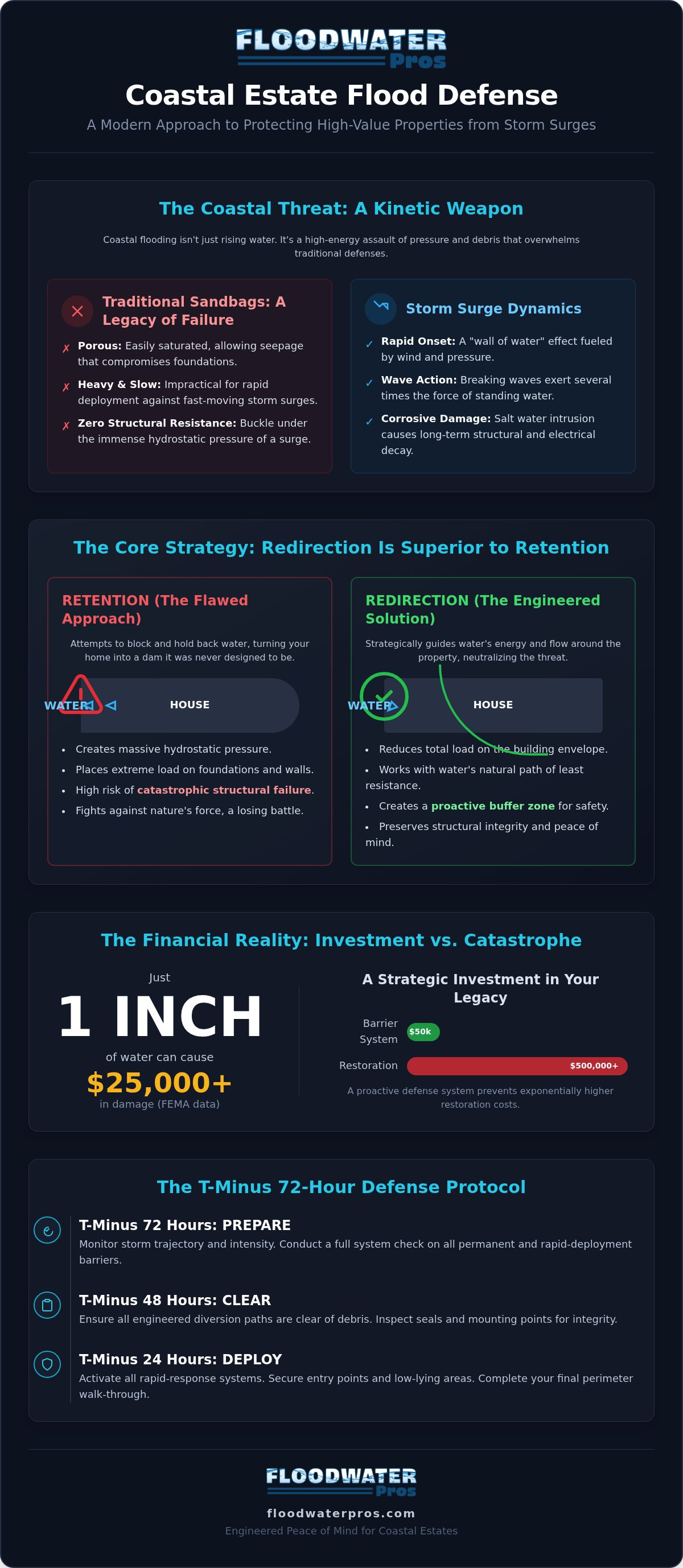
Coastal flooding is a kinetic weapon. It isn't just rising water; it is a combination of massive energy, floating debris, and relentless physical pressure. Traditional methods like sandbags are a legacy of failure in these high-stakes scenarios. They are porous. They are heavy. Most importantly, they offer zero structural resistance against the true killer of coastal homes: hydrostatic pressure. As water stacks against a wall, it exerts thousands of pounds of force. Standard foundations aren't designed to be dams. Without an engineered approach, the very walls of your estate can buckle under the weight.
This is why discerning owners look for a professional flood barrier system that prioritizes structural integrity. Coastal dry floodproofing is a structural-first approach. It doesn't just block water; it reinforces the building envelope to ensure total protection. Finding the best flood barriers for coastal properties requires moving beyond temporary fixes and toward permanent, military-grade engineering.
Understanding Storm Surge Dynamics
Inland flooding often involves a slow, predictable rise. Coastal storm surges are different. They are rapid-onset events fueled by wind and low atmospheric pressure. This speed creates a "wall of water" effect that inland defenses cannot handle. Coastal properties require significantly higher safety factors because of wave action. A single breaking wave can exert several times the force of standing water. If your barrier isn't anchored into the foundation, the ocean will simply move it aside.
The Vulnerability of High-End Coastal Architecture
Luxury homes often feature expansive entries and sliding glass doors. These are the primary weak links in modern design. While beautiful, they are not built to withstand the lateral load of a three-foot surge. Once the seal is broken, salt water enters. The damage is immediate and corrosive. Salt water accelerates the degradation of electrical systems and structural steel long after the water recedes. This leads to hidden mold and compromised structural integrity that standard insurance often fails to fully cover.
The financial reality is clear. FEMA data from 2026 indicates that just one inch of water can cause $25,000 in damage to a standard home. For a luxury estate, a $50,000 investment in the best flood barriers for coastal properties isn't just an expense. It is a strategic move to prevent $500,000 or more in restoration costs. Security is an investment in your legacy. When the horizon turns dark, you need a shield that has been engineered to stand its ground.
Redirection vs. Retention: The Science of Coastal Defense
Building a wall is the instinctive response to a flood. This is called retention. It attempts to hold the water back entirely. In a coastal environment, this approach is fundamentally flawed. It turns your residence into a dam. Dams are engineered to hold back millions of pounds of force; homes are not. When you use retention, you create a massive pressure differential between the outside and inside of your walls. This leads to catastrophic structural failure. Determining the best flood barriers for coastal properties involves assessing how a system handles kinetic energy rather than just static depth.
Diversion is the smarter alternative. Instead of fighting the ocean's energy, you work with it. You guide the water around your property. This reduces the total load on your building envelope. By analyzing the topography of your estate, experts can determine the natural path of least resistance. Exploring property-level flood barrier options reveals that diversion systems are often the most resilient choice for high-velocity zones. You don't want to stop the ocean. You want to tell it where to go.
Strategic perimeter defense keeps the threat at a distance. If you wait until water touches your siding, you've already lost the first line of defense. The best flood barriers for coastal properties create a buffer zone. This managed displacement ensures that water is moved toward low-impact areas or existing municipal drainage systems. It prevents the "trapped water" scenario that often leads to foundation collapse. A proactive shield is always more effective than a reactive one.
The Philosophy of the Fortress Flood Diversion System
The Fortress Flood Diversion System is built on the principle of controlled redirection. It doesn't rely on weight alone. It utilizes permanent, structural mounting points that are engineered into your landscape. This ensures the system remains immovable when the surge hits. Professional engineering is required to map the flow. You aren't just buying hardware; you're commissioning a defense strategy. If you're ready to secure your perimeter, consider an engineering-led assessment for your property.
Hydrodynamic Stability in High-Flow Areas
Speed is as dangerous as depth. During a storm surge, water moves with extreme velocity. Barriers that aren't hydrodynamically stable can become projectiles. We also manage the "scour" effect. This is where water speed erodes the ground beneath a barrier, causing it to tip or sink. Proper placement ensures the water's energy is dissipated before it can do harm. Diversion engineering is the strategic redirection of hydraulic energy to neutralize structural threats while maintaining property integrity.
Comparing Modern Coastal Flood Barrier Systems
Selecting the right hardware is a matter of strategic alignment. You must weigh deployment speed against structural permanence. The best flood barriers for coastal properties don't just stop water; they integrate with your lifestyle. Some owners require a rapid-response shield that can be deployed in the hours before a hurricane. Others demand an invisible defense that preserves the architectural purity of their estate. Modern engineering offers solutions for both scenarios. It's about matching the level of fortification to the specific vulnerabilities of your landscape.
Fortress Inflatable Flood Barrier: Speed of Deployment
When a surge is imminent, time is the only currency that matters. The Fortress Inflatable Flood Barrier is designed for the 72-hour window. It goes from a compact storage state to a fortified perimeter in minutes. Unlike standard water tubes that puncture easily, this system utilizes heavy-duty construction to resist debris impact. Floating logs or broken docks are common during surges. You need a barrier that won't fail when it's hit. It's a reusable, high-performance asset that offers the flexibility of a temporary shield with the strength of an engineered wall.
Invisible Defense: Fortress Transparent Liquid Paintable Flood Barrier
Aesthetic preservation is a priority for high-end coastal architecture. You shouldn't have to hide your home behind ugly steel gates. The Fortress Transparent Liquid Paintable Flood Barrier provides an invisible defense. It creates a watertight seal on porous surfaces like stone, brick, and stucco. This coating is transparent by design. It allows the natural beauty of your home's exterior to remain visible while providing military-grade protection against intrusion. It is the ideal choice for areas where traditional barriers would disrupt the visual flow of the property. You get the relief of security without the frustration of bulky traditional flood gates.
Rigid Diversion Systems: The Heavy-Duty Choice
High-frequency flood zones require a more permanent posture. The Fortress Flood Diversion System is the heavy-duty answer for properties that face repeated threats. These rigid systems are engineered to manage the most extreme hydrostatic loads. They are often the primary choice for estates with vulnerable low-lying perimeters. While they require professional installation, they provide the highest level of certainty. You aren't just reacting to a storm; you're maintaining a permanent state of readiness. For those seeking the best flood barriers for coastal properties, these systems represent the pinnacle of structural security.
Actionable Guidance: Strategic Deployment for Storm Surges
Owning the best flood barriers for coastal properties is only half the battle. Success in a storm surge scenario is 90% preparation and 10% execution. When the sky darkens, you don't want to be reading an instruction manual. You need a drilled protocol. A structural defense is only as strong as its weakest seal. Even the most advanced Fortress system requires a disciplined approach to deployment to ensure total property security. This is where engineering meets action.
Professional installation is the only way to guarantee structural integrity. While some competitors claim a quick setup, they often ignore the logistics of a full-perimeter defense. Coastal storm surges involve massive kinetic force. If your barrier isn't anchored into professionally engineered mounting points, it will fail. You need a system that's been integrated into your estate's foundation by experts who understand hydraulic loads. To ensure your home is truly fortified, you should schedule a professional engineering consultation today.
The T-minus Framework: Your Timeline for Defense
Time is your most valuable asset during a hurricane warning. Use this readiness framework to manage your deployment:
- T-minus 72 Hours: Monitor surge projections and inspect all mounting hardware. Clear debris from the perimeter.
- T-minus 24 Hours: Full deployment of the Fortress Flood Diversion System or Inflatable Barriers. Secure all entry points.
- T-minus 6 Hours: Final seal verification. Ensure the barrier-to-ground interface is free of sand or silt that could compromise the seal.
Step-by-Step: The Deployment Protocol
Start with your lowest elevation points. This is where the water will strike first. Inspect every perimeter seal for salt corrosion; even high-grade materials can suffer in maritime environments. Once the barriers are in place, perform a final visual check. You're looking for a seamless connection between the barrier and the structural mounting points. This interface is the line between a dry home and a catastrophic loss.
Post-Storm Recovery and Maintenance
The danger doesn't end when the rain stops. Safe removal is critical to avoiding a back-flood scenario where trapped water suddenly rushes into areas it shouldn't. Once the surge has fully receded, clean your barriers immediately. Salt remediation is essential for long-term health. Salt crystals can degrade gaskets and seals over time. Finally, request a professional inspection. Verifying structural integrity after a major event ensures you're ready for the next one. Vigilance is a year-round commitment.
Fortifying Your Legacy: The Fortress Protection Suite
Your coastal estate is more than a structure. It's a legacy built through years of investment and vision. Protecting that value requires more than a generic barrier found in a distributor's catalog. FloodWater Pros operates as a vigilant guardian for high-stakes properties. We don't just sell parts; we provide total structural security. We engineer, manufacture, and professionally install proprietary Fortress systems designed for the most volatile maritime environments. This full-service path ensures that your defense is never compromised by third-party errors or inadequate hardware.
The 2026 flood landscape is changing. With FEMA updating Flood Insurance Rate Maps across the country, properties in areas like Harris County or Santa Barbara face new, high-risk designations. Relying on a distributor who doesn't own the engineering of their product is a gamble you can't afford. The best flood barriers for coastal properties are those built with a deep understanding of hydraulic energy and structural resistance. We take responsibility for every seal and every anchor. This is the Fortress advantage.
Why Engineering Matters More Than the Material
There is a critical difference between a flood "product" and a flood "system." A product is a one-size-fits-all solution that often fails at the seams because it wasn't designed for your specific foundation. A Fortress system is a site-specific defense. We tailor our systems to your unique architectural footprint, ensuring that expansive glass entries and porous stone facades are fully protected. Professional on-site installation is the final, essential step. It eliminates the risk of human error during deployment and ensures that the best flood barriers for coastal properties perform exactly as they were designed when the surge hits.
Next Steps: Your Professional Coastal Assessment
Moving from a state of concern to a state of action is the only way to achieve true peace of mind. Our process begins with a comprehensive engineering evaluation. We don't just look at doors and windows. We analyze the topography of your estate, identify natural drainage paths, and assess the structural integrity of your perimeter. This data-driven approach allows us to design a defense that is as invisible as it is impenetrable. You deserve the relief that comes from knowing your property is ready for whatever the horizon brings.
Don't wait for a surge warning to test your defenses. A proactive investment in engineered protection saves your property's value and your family's history. You can secure your coastal property with a Fortress engineered system today and ensure your legacy remains standing for generations.
Securing Your Horizon: The Path to Total Fortification
The ocean doesn't negotiate. You've seen why redirection is the only viable strategy for surviving high-stakes maritime surges. Retention turns your home into a dam. Diversion protects your structure by managing hydraulic energy. By choosing the best flood barriers for coastal properties, you're investing in military-grade resilience that respects your home's aesthetic. Proprietary Fortress engineering ensures that your defense is a bespoke system, not just a generic product.
Our national professional installation team stands ready to transform your vulnerability into impenetrable security. We provide custom, aesthetic-friendly solutions that blend into your architecture while standing firm against the tide. It's time to move from a state of concern to a state of total readiness. Your legacy deserves a vigilant guardian. You can take the first step toward permanent peace of mind right now.
Request Your Professional Coastal Engineering Assessment
The horizon may be uncertain, but your security doesn't have to be. You've built something remarkable. Let's ensure it stays that way for generations to come.
Frequently Asked Questions
What is the best flood barrier for a house on the coast?
The best flood barriers for coastal properties are engineered diversion systems that prioritize redirection over simple retention. Redirection is superior because it manages the kinetic energy of a surge instead of turning your home into a dam. The Fortress Flood Diversion System is specifically designed to guide water around your estate, which reduces the total hydrostatic load on your foundation.
Can flood barriers withstand a hurricane storm surge?
Yes, properly engineered barriers can withstand a hurricane storm surge if they're designed for kinetic force and wave action. Success depends on the system's ability to handle debris impact and the rapid-onset nature of coastal events. Standard temporary barriers often fail because they lack the structural anchoring and military-grade durability found in professional Fortress installations.
Are there flood barriers that don't ruin my home's curb appeal?
You don't have to sacrifice aesthetics for safety. The Fortress Transparent Liquid Paintable Flood Barrier provides an invisible seal on porous surfaces like stone, brick, and stucco. This allows your home to maintain its architectural integrity while remaining fully fortified. It's an ideal solution for luxury estates where traditional, bulky flood gates would disrupt the visual flow of the property.
How much does a professional flood barrier system cost for a coastal home?
The investment in a professional system varies based on the perimeter size and specific engineering requirements of your estate. While the initial outlay is a strategic investment, it's a fraction of the cost of total restoration. FEMA reports that just one inch of water can cause $25,000 in damage to a home. A foot of water can lead to damages exceeding $72,000, making prevention a high-ROI decision.
Do I need a professional to install my flood barriers?
Professional installation is essential for high-stakes coastal defense. A barrier is only as strong as its connection to your home's foundation or the surrounding terrain. Experts ensure that mounting hardware is properly anchored to resist the massive pressure exerted by rising coastal waters. Professional installation also eliminates the risk of human error during the critical hours before a storm hits.
What is the difference between a flood barrier and a flood diversion system?
A standard flood barrier acts as a dam to hold water back, which creates a dangerous pressure differential. A flood diversion system is a strategic tool that redirects the flow toward natural drainage or low-impact zones. Diversion engineering is the smarter approach because it works with the water's energy rather than fighting it, which protects your building envelope from collapse.
How quickly can I deploy an inflatable flood barrier?
The Fortress Inflatable Flood Barrier can be deployed in minutes once the initial engineering is complete. It's designed for the 72-hour hurricane warning window, allowing for rapid response without heavy labor. This speed ensures you can secure a full perimeter quickly, providing immediate peace of mind when a surge warning is issued for your area.
Are Fortress flood barriers FEMA and insurance compliant?
FEMA doesn't certify specific products, but they establish performance standards through the National Flood Insurance Program. Fortress systems are engineered to meet these rigorous criteria for coastal dry floodproofing. Using a professionally installed, engineered system helps satisfy local building codes and demonstrates a proactive commitment to risk management that insurance providers value.


