

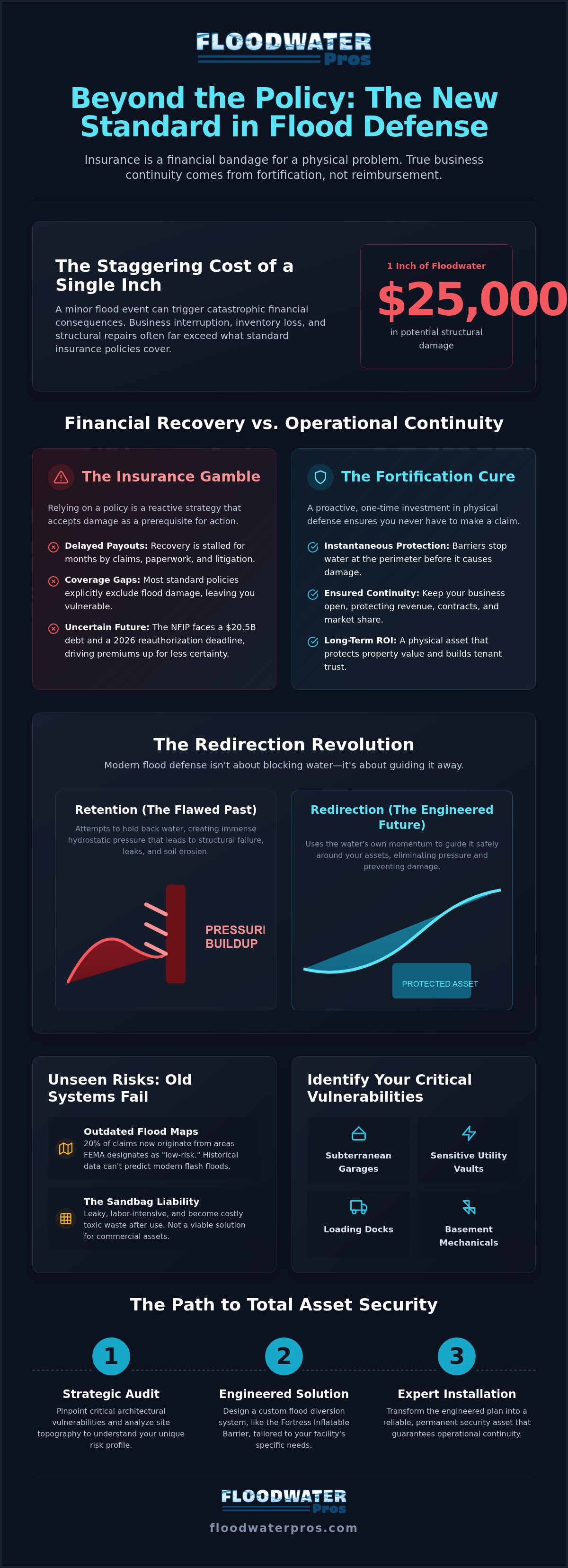
Just one inch of floodwater in a commercial building can cause up to $25,000 in structural damage. It's a staggering figure that insurance rarely covers in full. As the NFIP reauthorization deadline of September 30, 2026, approaches, the risk of a coverage gap is a reality you can't ignore. You shouldn't have to wait for a payout while your assets sit underwater. Effective commercial flood mitigation strategies must prioritize physical defense over financial reimbursement. Insurance is a bandage. Fortification is the cure.
You've seen the premiums rise. You've felt the anxiety of every storm warning. It's a heavy burden to carry alone. This guide provides a clear path to total asset security and long-term ROI. We'll show you how to defend your property with engineered physical diversion systems that stop water at the perimeter. We'll explore the latest 2026 standards and the specific Fortress systems designed to keep your business operational. It's time to stop managing the aftermath and start preventing the damage. Your business deserves a shield that actually holds.
Key Takeaways
- Understand why insurance is merely a financial bandage and how physical fortification provides the only true guarantee of business continuity.
- Discover why the most effective commercial flood mitigation strategies are shifting from water retention to active redirection.
- Pinpoint critical architectural vulnerabilities in your facility, ranging from subterranean garages to sensitive utility vaults.
- Compare advanced engineered solutions, such as the Fortress Inflatable Flood Barrier, to find the right defense for your specific risk profile.
- Learn why professional engineering and expert installation are vital to transforming a physical barrier into a reliable security asset.
Beyond the Policy-Why Insurance Is No Longer Enough
Insurance is a financial safety net. It's not a shield. Many business owners believe a standard commercial policy protects them from the rising tide. It doesn't. Most general liability policies explicitly exclude flood damage. This leaves a massive insurance gap that can swallow a business whole during a catastrophic event. Relying solely on a policy as your primary commercial flood mitigation strategies is a gamble with your structural integrity. You're betting your future on a payout that might not arrive until it's too late.
The National Flood Insurance Program (NFIP) is currently facing unprecedented instability. With a debt load exceeding $20.5 billion, its authority to issue new policies faces a critical reauthorization deadline in September 2026. Premiums are skyrocketing under FEMA's Risk Rating 2.0. You're paying more for less certainty. A one-time investment in structural fortification provides a definitive answer that a fluctuating policy never can. Beyond the physical damage, business interruption losses often exceed the value of the building itself. Insurance rarely covers the full cost of lost contracts, employee turnover, or the permanent loss of market share that follows a prolonged shutdown.
The Failure of Traditional Flood Maps
FEMA zones A and V are based on historical data. They don't account for the 2026 climate realities of urban flash flooding. In fact, 20% of flood claims now originate from areas designated as low-risk. Relying on these maps leads to a false sense of security. Effective comprehensive flood management requires looking beyond the lines on a government map. Residual risk is the flood threat that remains even after all regulatory standards and insurance requirements have been met. Urban environments are particularly vulnerable as paved surfaces prevent natural drainage, turning city streets into rivers in minutes.
Financial Recovery vs. Operational Continuity
Insurance payouts take time. Claims adjusters, paperwork, and litigation can delay your recovery for months. Physical protection is instantaneous. A Fortress system stops the water before it touches your inventory or specialized equipment. You can't easily replace custom machinery or sensitive data servers with an insurance check. Proactive defense also builds vital tenant trust. When business owners see you've invested in physical barriers, they know their operations are safe. It's the difference between hoping for a payout and ensuring you never need one. True resilience is measured by the hours you stay open, not the dollars you eventually recover.
The Redirection Revolution-Why Redirection Beats Retention
Most traditional commercial flood mitigation strategies rely on retention. They attempt to hold water back using temporary dams or barriers. This is a flawed strategy. Water is heavy. It is relentless. If you try to dam it, the pressure eventually finds a point of failure. Modern engineering has shifted toward a more sophisticated approach. We call it redirection. Instead of fighting the weight of the water, we use its own momentum to guide it away from your assets. It is the difference between an immovable object and a strategic guide.
Traditional sandbags are a significant liability for high-value commercial properties. They leak. They require massive amounts of manual labor to deploy. Once the water recedes, they often become toxic waste that is expensive to dispose of properly. A professional perimeter requires a more permanent solution. The Fortress philosophy centers on creating an impenetrable line of defense. The Fortress Flood Diversion System is designed to act as a vigilant guardian. It ensures that when the environment becomes hostile, your building remains an island of safety.
The Mechanics of Flood Water Redirection
Diversion systems are built on the laws of physics. They use the kinetic energy of the flood to move it along a path of least resistance. By guiding the flow around your structure, you drastically reduce hydrostatic pressure. This is the specific force that causes basement walls to buckle and foundations to crack. Site topography is a critical component of this design. Our engineers analyze the natural slope and drainage patterns of your land. We ensure that water is moved toward safe discharge zones rather than pooling against your exterior walls.
Long-Term Structural Benefits of Diversion
Retention systems often leave standing water against a building for days. This leads to severe soil erosion and foundation undermining. Redirection keeps the ground surrounding your property dry. This protects the structural integrity of loading docks and basement mechanical systems that are often the first to fail. It also eliminates the moisture that drives expensive mold and biohazard remediation. If you want to move beyond reactive fixes, it's time to consider how engineered diversion systems can provide a permanent shield for your investment. True protection is about keeping the threat at a distance, ensuring your operations never have to stop.
Assessing Vulnerabilities-A Strategic Commercial Audit
FEMA maps are a historical record. They aren't a future forecast. Effective commercial flood mitigation strategies require a physical audit that anticipates the extreme. The upcoming 2027 International Building Code (I-Codes) acknowledges this reality. It expands design requirements to the 500-year floodplain. This sets a new, high-stakes baseline for structural safety starting in September 2026. You must look at your facility through the lens of a 500-year event. Subterranean parking and utility vaults are your most vulnerable assets. Gravity is a relentless enemy. Once water enters a below-grade vault, it stays there. It destroys critical electrical switchgear. It renders your entire building uninhabitable.
Don't ignore your surroundings. The 'Neighbor Effect' is a silent threat. When an adjacent property installs a retention wall or paves a new lot, they change the local hydrodynamics. This redirects thousands of gallons of runoff. It flows directly into your perimeter. You aren't just defending against the weather. You're defending against the redirected flow from your neighbor's property. Most municipal sewers are designed for 100-year thresholds. A 500-year event overwhelms them instantly. This capacity gap is where most structural damage occurs as drainage systems reverse and become liabilities.
Entry Points and Peripheral Weaknesses
Water finds the invisible gaps. Conduits, vents, and floor drains are often overlooked during a casual walkthrough. These small openings become high-pressure jets during a flood. Storefront glass is another critical failure point. It isn't designed to withstand the lateral weight of a flood surge. You need reinforced door systems and loading bay barriers that lock into the building's structural frame. A barrier is only as strong as its weakest seal. Focus on sealing every penetration that sits below the 500-year flood elevation to ensure your perimeter remains impenetrable.
Operational Risk and Asset Mapping
Every building has a hierarchy of value. Server rooms and electrical switchgear are the heart of your operations. Protecting them is non-negotiable. Map the path of least resistance on your property. Where does the water want to go? Once you know the path, you can deploy systems like the Fortress Inflatable Flood Barrier to cut off the flow. A rapid-response plan ensures your team knows exactly where to deploy these barriers before the first drop of rain falls. Security isn't a reaction. It's a calculated position. You must move from a state of concern to a state of total readiness. Your business continuity depends on the physical fortification of your most critical assets.
Engineered Barriers-Selecting the Right Line of Defense
Selecting the right hardware is a strategic decision. You need a solution that fits your operational rhythm. Permanent systems offer a constant shield. Deployable systems provide flexibility. The best commercial flood mitigation strategies often combine both to create a multi-layered defense. You shouldn't have to choose between a fortress and a functional storefront. Modern engineering allows you to maintain professional aesthetics while building a perimeter that is practically impenetrable. It's about matching the tool to the specific vulnerability of your asset.
Permanent systems, like the Fortress Flood Diversion System, are the gold standard for high-risk zones. They work 24/7 without human intervention. However, many urban commercial sites require a more adaptable approach. This is where deployable and invisible technologies become vital. You need a system that responds to the speed of a flash flood. You also need a solution that doesn't alienate your customers or tenants. Security should be felt, not necessarily seen. By diversifying your physical defenses, you ensure that no single point of failure can compromise your business continuity.
The Invisible Shield-Fortress Transparent Liquid Paintable Flood Barrier
Aesthetics matter in commercial real estate. A heavy metal gate might protect a loading dock, but it ruins a retail storefront. The Fortress Transparent Liquid Paintable Flood Barrier solves this conflict. It's a high-performance sealant that creates an impenetrable, clear film over porous masonry, stone, and glass. It stops water infiltration at the molecular level without changing the look of your building. This is essential for historical properties or high-end offices where curb appeal is a primary business asset. Application is straightforward and provides a long-term, low-maintenance seal against driving rain and rising surges.
Heavy-Duty Deployment-Fortress Inflatable Flood Barrier
Flash floods wait for no one. When the warning sounds, you need a system that deploys in minutes, not hours. The Fortress Inflatable Flood Barrier uses advanced material science to create a heavy-duty wall of protection. It's designed specifically for industrial perimeters and large corporate campuses. Facility management teams can store these systems compactly and deploy them with minimal staff. It scales to meet the threat, providing a formidable barrier that traditional sandbags can't match. It's a rapid-response asset that ensures your team is never caught off guard.
The right defense is the one that's ready when the environment turns hostile. You can explore our full range of Fortress systems to find the exact configuration for your site. Don't wait for the water to test your resolve. Build your defense now. Your assets are too valuable to leave to chance. Invest in a system that offers both structural integrity and the peace of mind you deserve.
Implementing a Fortress-From Engineering to Installation
DIY is a disaster. It's a fundamental truth in high-stakes flood defense. A sandbag wall or a generic barrier might look sufficient on a sunny day. It won't hold when the pressure rises. Professional engineering is the only way to guarantee structural integrity. We've seen too many businesses lose everything because of a failed home-grown solution. Effective commercial flood mitigation strategies require a level of precision that only seasoned experts can provide. When the water rises, you don't want a prototype. You want a proven shield.
Our methodology is built on a foundation of expert design. We don't just ship boxes; we provide a complete defensive strategy. Our team integrates these systems directly into your existing facility management workflows. This ensures that your staff knows exactly how to maintain and activate your defenses without friction. You get a turnkey solution that removes the burden of uncertainty. It's the profound relief of knowing a vigilant guardian has secured your perimeter. Your assets are safe. Your continuity is guaranteed. This isn't just a purchase. It's a strategic partnership for long-term resilience.
The Professional Installation Workflow
It starts with the ground. Our engineering team conducts a deep dive into your site's specific hydraulics and soil conditions. We design custom barriers that account for every entrance, vent, and utility vault. This bespoke approach ensures no gap is left unprotected. Once the design is finalized, we move to precision manufacturing. Every Fortress system is built to site-specific requirements using military-grade materials. Finally, our experts handle the on-site installation. We don't leave until every seal is tested and every barrier is proven under simulated pressure. It's a rigorous process designed for total impenetrability.
Next Steps for Facility Guardians
The climate is changing. Your 2026 flood risk profile is likely more severe than it was just five years ago. You need a partner who understands the high stakes of commercial asset protection. Don't wait for the next storm to expose your weaknesses. A professional site assessment is the first step toward comprehensive commercial flood mitigation strategies. We identify your critical failure points and provide a roadmap for fortification. Taking action today ensures your business remains an island of stability in a volatile world. Protect what you've built with a system that won't fail when it matters most.
Secure your commercial assets with FloodWater Pros today.
Securing Your Operational Future
Relying on insurance payouts is a gamble with your company's survival. As we move into 2026, the only way to ensure total asset security is through the physical fortification of your perimeter. You've learned that redirection is the superior engineering approach. It moves the threat away instead of merely holding it back. By implementing professional commercial flood mitigation strategies, you transform your facility into an impenetrable shield against environmental volatility. This isn't just about saving a building. It's about preserving your operational continuity and the people who depend on it.
FloodWater Pros brings national commercial expertise to every project. We provide a full-service solution that includes custom engineering and professional installation of our proprietary Fortress technology. Don't wait for a catastrophic breach to discover the gaps in your defense. You can choose a path of unwavering readiness today. Fortify your business assets with an engineered Fortress system. Your legacy deserves the protection of a vigilant guardian. Take the decisive step toward total peace of mind and keep your business standing strong.
Frequently Asked Questions
Is flood risk management mandatory for commercial properties?
Compliance is often mandatory under the International Building Code and FEMA regulations. New 2027 standards will expand flood-resistant design requirements to include the 500-year floodplain. Adopting robust commercial flood mitigation strategies isn't just a best practice; it's a legal necessity for properties in high-risk zones. Failure to meet these structural requirements can lead to severe fines or the loss of occupancy permits. Physical fortification ensures your asset remains compliant and structurally sound.
How do engineered flood barriers affect commercial insurance premiums?
Engineered barriers can significantly reduce your financial risk profile. FEMA's Risk Rating 2.0 now prices insurance based on individual property variables like elevation and structural defense. By installing a Fortress Flood Diversion System, you provide a definitive answer to potential damage. Private insurers often offer better terms to businesses that prioritize physical protection over simple policy coverage. These systems act as a permanent shield, securing your long-term ROI and reducing the likelihood of catastrophic losses.
Can I install a flood diversion system on a historical commercial building?
Protecting historical assets requires a specialized, non-invasive touch. We use the Fortress Transparent Liquid Paintable Flood Barrier to secure these sensitive properties. It creates an impenetrable film on porous stone and masonry without altering the historical facade. This invisible shield meets strict preservation standards while providing high-stakes protection. You can defend your building's heritage and its future value simultaneously. It's the perfect solution for storefronts where visual integrity is just as important as structural defense.
What is the difference between flood redirection and flood retention?
Retention attempts to stop the water, which creates massive hydrostatic pressure against your walls. Redirection is the strategic choice to move the threat away entirely. The Fortress Flood Diversion System guides the water's energy along a path of least resistance. This prevents the foundation undermining and soil erosion that occur when water pools against a structure. By focusing on redirection, you eliminate the primary cause of structural failure and minimize the need for expensive post-flood remediation.
How long does it take to deploy a Fortress Inflatable Flood Barrier?
Speed is the ultimate advantage during a flash flood. The Fortress Inflatable Flood Barrier can be deployed in minutes by your existing facility management team. It's stored compactly and expands rapidly to form a heavy-duty wall of protection. This system is designed to scale across large industrial perimeters or corporate campuses with minimal labor. It's a professional-grade asset that replaces the slow, ineffective use of sandbags. You can move from a state of vulnerability to total security almost instantly.
Do paintable liquid barriers leave a visible residue on storefronts?
The Fortress Transparent Liquid Paintable Flood Barrier is engineered to be completely clear. It leaves no visible residue or sheen on your storefront. This allows you to maintain high-end curb appeal while building a molecular-level seal against water infiltration. It's ideal for retail environments where glass and masonry must remain pristine. You get a permanent, low-maintenance shield that protects your inventory without alienating your customers. Security should be felt through your continuity, not seen on your walls.
What maintenance is required for a permanent flood diversion system?
Permanent systems are built for unwavering readiness with minimal upkeep. We recommend an annual professional inspection to verify the integrity of all seals and diversion paths. Your facility team should ensure that the redirection zones remain free of debris and sediment to allow for maximum flow capacity. Because FloodWater Pros handles the design, manufacture, and installation, we provide a specific maintenance protocol for your site. This ensures your Fortress system remains a reliable guardian for decades to come.
Can FloodWater Pros systems handle flash floods with no warning?
Our systems are engineered for the reality of sudden, high-intensity events. The Fortress Flood Diversion System provides a permanent perimeter that defends your property 24/7 without manual activation. For areas requiring flexible protection, the Fortress Inflatable Flood Barrier offers the fastest deployment logistics available. These commercial flood mitigation strategies ensure your assets are shielded even when flash floods occur with zero warning. You can rest easy knowing your business is fortified against the most unpredictable environmental threats.


