

A single inch of floodwater can cause $25,000 in damage to a commercial facility. That's not just a repair bill. It's the price of lost operations, ruined inventory, and shattered client trust. You've likely seen insurance premiums climb while the threat of business interruption looms larger every season. Standard coverage isn't a shield; it's a safety net that doesn't prevent the fall. You need a proactive defense that protects your physical assets and your professional peace of mind.
Mastering the commercial flood barrier installation cost requires a shift from retail thinking to engineered precision. This 2026 guide handles the complexities of defense budgeting, from hardware selection to professional site management. You'll learn how to build a defensible budget for stakeholders that prioritizes structural integrity and FEMA compliant protection. We'll break down the variables that drive costs and explore the long term ROI of professional fortification. By the end, you'll have a clear path toward securing your facility against the unpredictable with a system built for total resilience.
Key Takeaways
- Shift your perspective from temporary fixes to structural investments. Learn why diverting water force is more effective than simply trying to block it.
- Master the variables behind the commercial flood barrier installation cost. We reveal why professional engineering is the foundation of every defensible budget.
- Protect your business aesthetic with innovative solutions. Explore how the Fortress Transparent Liquid Paintable Flood Barrier secures your property without altering its professional appearance.
- Evaluate the technical factors that dictate your project quote. Understand how hydrostatic loads and soil integrity impact the long term success of your installation.
- Secure a high ROI by prioritizing professional fortification. Discover why expert installation provides the peace of mind that retail products cannot match.
Defining Commercial Flood Protection — More Than Just a Barrier
Commercial flood defense is a structural fortification. It's not a weekend project or a temporary fix. It's a strategic asset. When you evaluate the commercial flood barrier installation cost, you aren't just buying hardware. You're investing in the survival of your enterprise. Residential solutions like sandbags or thin panels fail in high-traffic retail or industrial zones. They lack the mass and engineering to handle the hydrodynamic forces of a real surge. A single breach leads to catastrophic asset loss and months of business interruption. You need a shield that stands firm when the environment turns hostile.
The stakes are higher for a business than a home. A flooded warehouse means ruined inventory and broken contracts. A submerged retail space results in lost foot traffic and long-term brand damage. Professional protection recognizes that water is a physical force. It requires an engineered response that accounts for the specific vulnerabilities of your site. This is why a professional flood barrier is a non-negotiable requirement for any facility located in a high-risk zone.
The Fortress Philosophy: Redirection vs. Retention
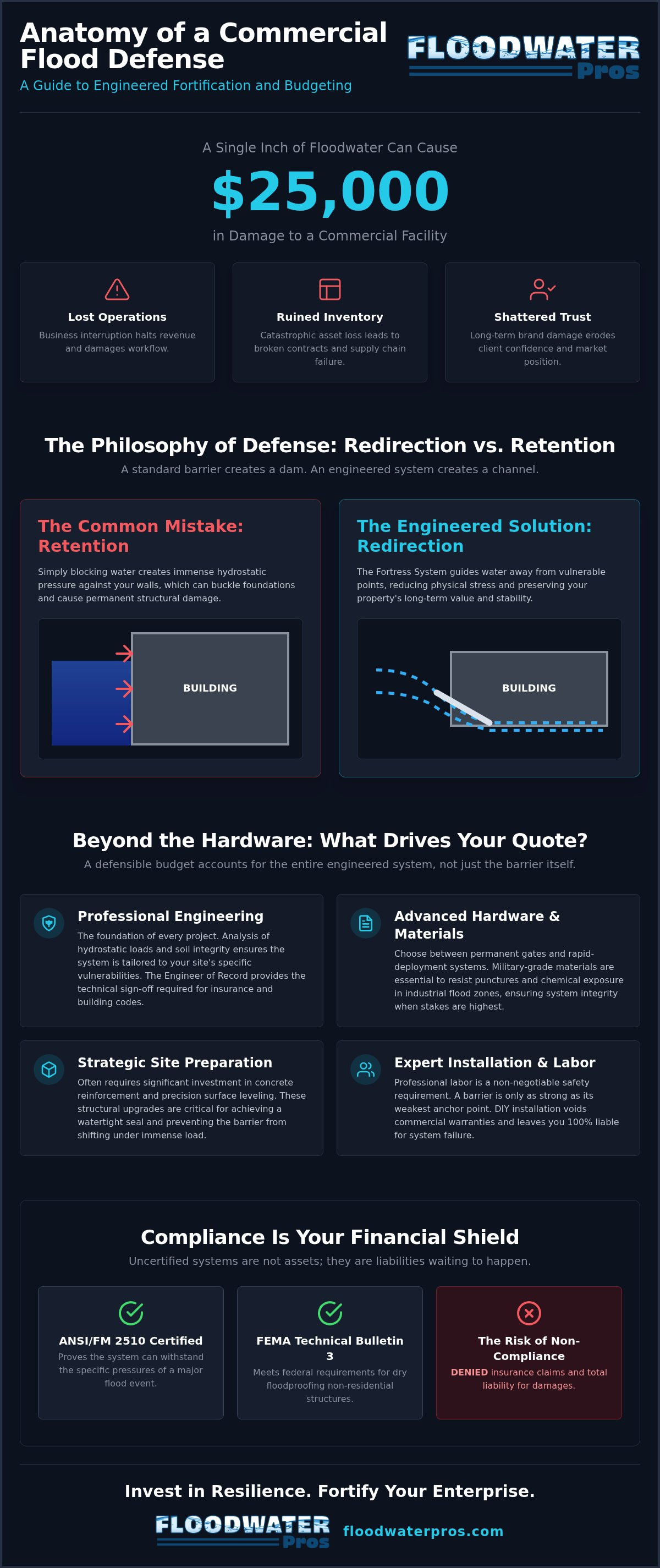
Traditional thinking suggests we must block water. We believe we must lead it. A standard barrier acts like a dam; it creates massive hydrostatic load against your walls. This pressure can buckle foundations and cause permanent structural damage. The Fortress Flood Diversion System prioritizes redirection. By guiding water away from vulnerable points, we reduce the physical stress on your building. This approach offers superior protection. It turns a static defense into a dynamic solution that preserves your property's value. Redirection is safer for the building's long-term health. It ensures the ground beneath your feet remains stable even as the water rises.
Commercial Standards and Regulatory Compliance
Facility managers must look beyond the price tag to the fine print of compliance. Professional insurance underwriting often requires systems that meet ANSI/FM 2510 testing standards. This isn't just red tape. These certifications prove the system can withstand the specific pressures of a flood event. FEMA Technical Bulletin 3 outlines the requirements for dry floodproofing non-residential structures. If your barriers aren't certified, you risk more than just water damage. You risk denied insurance claims and total liability. When calculating your commercial flood barrier installation cost, remember that professional installation is the only way to ensure your defense meets these rigorous legal and safety benchmarks. A certified system is a defensible asset; an uncertified one is a liability waiting to happen.
Hardware is only the first line item on your budget. Engineering is the foundation. When you assess the commercial flood barrier installation cost, you're investing in a managed system, not just a product. Professional labor is a non-negotiable safety requirement. It ensures that every seal and anchor point can withstand the massive pressure of a surge. A barrier is only as strong as its weakest point of contact with the ground.
Site preparation often requires significant investment. You may need concrete reinforcement to handle the weight of the water. Surface leveling is critical for achieving a watertight seal. These structural upgrades prevent the barrier from shifting under load. The Total Cost of Ownership (TCO) tells the real story. It includes storage, maintenance, and the speed of deployment. A system that requires a large crew and several hours to set up may cost more in the long run than an automated or rapid-response solution.
Hardware Selection and Material Grade
Choosing between permanent gates and deployable systems is a strategic decision. Permanent gates offer constant readiness but involve higher upfront construction costs. The Fortress Inflatable Flood Barrier provides a high-value alternative for rapid response. It's designed for quick deployment with minimal personnel. Military-grade materials are essential for these systems. They resist the punctures and chemical exposure common in industrial flood zones. High-grade materials cost more initially; however, they ensure the system doesn't fail when the stakes are highest.
Professional Installation and On-Site Management
The role of the Engineer of Record is vital in commercial projects. They provide the technical sign-off required for insurance and building codes. DIY installation is a risk you can't afford. It almost always voids commercial product warranties and leaves you liable if the system fails. Professional on-site management ensures that the installation follows the exact specifications of the engineering plan. For a national-scale deployment, you need a professional flood defense partner who understands the logistical challenges of protecting multiple facilities simultaneously. This expertise ensures your defense is ready before the first drop of rain falls.
Aesthetic and Strategic Variables — Balancing Form and Function
Curb appeal is a commercial asset. You shouldn't have to choose between a secure facility and an inviting storefront. When calculating the commercial flood barrier installation cost, many managers overlook the strategic value of aesthetics. A property that looks like a fortress can deter customers and lower market value. Modern engineering allows for invisible defense systems that protect your investment without compromising its visual identity. This balance is critical for retail environments where customer perception directly impacts the bottom line. Professional fortification shouldn't be an eyesore; it should be a silent guardian.
Invisible Defense for Retail and Urban Storefronts
The Fortress Transparent Liquid Paintable Flood Barrier represents a breakthrough in urban defense. It offers a clear cost-benefit advantage over bulky metal gates that require significant storage and manual labor. These coatings provide military-grade protection while remaining virtually undetectable to the naked eye. You maintain full accessibility for your customers and staff. Application requires precision labor from certified technicians. It's not a simple paint job. It's a technical application that ensures every pore of the building envelope is sealed against rising water. By choosing an invisible solution, you avoid the recurring labor costs associated with deploying and removing heavy panels every time a storm warning is issued. This long-term operational efficiency is a key factor in the total ROI of your defense strategy. This invisible shield provides profound relief without the visual weight of traditional barriers.
Strategic Perimeter Diversion for Large Estates
Strategic perimeter diversion is the preferred approach for large estates and corporate campuses. You're protecting the land, not just the building. By integrating the Fortress Flood Diversion System into existing landscaping, you guide water away from critical infrastructure. This method reduces the pressure on individual structures. It prevents the "island effect" that often traps employees or emergency vehicles during a surge. This strategy also safeguards expensive exterior assets like HVAC units, backup generators, and parking facilities. The commercial flood barrier installation cost for multi-unit buildings depends on the total linear footage and the complexity of the terrain. Professional fortification at the perimeter is often more efficient than trying to seal every single point of entry. It creates a managed environment where the threat is neutralized long before it reaches your doors. This proactive stance ensures that your operations continue while others are still assessing the damage.
Factors That Drive Your Quote — Site Specifics and Load Requirements
Every commercial quote begins with the cold physics of your site. The commercial flood barrier installation cost is fundamentally driven by the weight of the threat. Water is heavy; it exerts a relentless pressure that can crush unprepared structures. Hydrostatic and hydrodynamic loads dictate the grade of materials required to keep your facility dry. You aren't just paying for a wall. You're paying for the engineering that prevents that wall from becoming a liability under the crushing weight of a storm surge.
Soil composition is a silent factor in foundation integrity. If the ground is soft or porous, permanent installations require deep structural reinforcement to prevent shifting. This is a critical variable in your final estimate. Municipal code compliance and permitting add another layer of complexity. These costs ensure your system is legal, compliant, and fully insurable. Meeting ANSI/FM 2510 standards requires documented proof of performance. It is a rigorous process that protects you from denied insurance claims. Professional fortification accounts for these "hidden" costs long before the first shovel hits the dirt.
Load Calculations and Engineering Depth
The force of water is not linear. Three feet of water creates exponentially more pressure than a single foot. Engineering for a 100-year flood event requires Finite Element Analysis (FEA). This documentation provides the structural certainty that stakeholders and board members demand. It proves that the system will remain impenetrable when the environment turns hostile. Over-engineering is a strategic choice; it is an insurance policy against the catastrophic failure of your building envelope. Precision engineering ensures that the Fortress Flood Diversion System handles the load without compromising your foundation.
Logistics: Storage, Training, and Readiness
Deployment logistics impact your bottom line long after the initial setup. Storing deployable barriers on-site requires dedicated, climate-controlled space to preserve material integrity. Facility staff training is a vital component of the installation process. Your team must be ready to act with military precision when a warning is issued. Regular maintenance schedules ensure your investment works when it counts. Seals must be inspected; mechanical components must be tested. Readiness is a recurring cost of security that pays for itself during the first hour of a surge. You can get a professional site assessment to determine your specific load requirements and engineering needs today. Expert consultation turns uncertainty into a clear, actionable plan for total facility protection.
Securing the Future — The Path to Professional Fortification
Professional protection changes your perspective. You move from the constant anxiety of vulnerability to the profound relief of security. The commercial flood barrier installation cost is a strategic investment in the continuity of your business. In the face of a rising surge, the "cheapest" option often becomes the most expensive mistake you'll ever make. A bargain barrier that fails during a hydrodynamic event doesn't just let water in; it creates a false sense of security that prevents you from taking other defensive measures. Real fortification requires an engineered pedigree and a partner who understands the high stakes of commercial failure.
Choosing a national partner ensures that your defense is consistent across every facility you manage. You need an expert who has seen every environmental challenge and mastered the solution. Professional consultation is a strategic partnership. It turns your facility into an impenetrable asset. This process moves through a methodical progression: from identifying a universal threat to presenting a definitive concept of fortification. It's the only way to safeguard what is valuable with unwavering readiness. When the water rises, you won't be questioning your budget; you'll be grateful for your foresight.
The Audit: Identifying Your Structural Weak Points
A professional flood risk assessment is a deep dive into your building’s envelope. We don't just look at doors. We map the entire diversion path to determine exactly where the water will go. Understanding how these weak points affect the commercial flood barrier installation cost allows for a more accurate and defensible budget. Off-the-shelf products are a risk in commercial settings because they don't account for the unique hydrostatic loads of your specific site. Customization is the only way to ensure total protection. During the audit, we analyze soil integrity and foundation strength to ensure your defense stands firm. We identify every vulnerability before the environment has a chance to exploit it.
Executing the Defense: Final Installation and Testing
Execution is where engineering meets reality. The final walkthrough is a rigorous inspection. We ensure every seal is impenetrable and every anchor point is secure. This isn't just a delivery; it's a deployment of military-grade security. Post-installation support and the Fortress guarantee provide the long-term peace of mind you deserve. Your investment is protected by a system built for total transformation. It's time to act with decisive momentum to secure your facility's future. Protect your commercial assets with a professional site assessment.
Fortify Your Enterprise: The Path to Total Resilience
You've identified the risks. Now you have the strategic roadmap to neutralize them. Protecting your facility isn't just about purchasing hardware. It's about a managed, engineered response that prioritizes structural integrity above all else. By shifting your focus from temporary fixes to permanent redirection, you safeguard both your physical assets and your brand's future. Professional fortification is the only way to turn vulnerability into absolute readiness.
Navigating the commercial flood barrier installation cost is simpler when you partner with experts who understand the high stakes of business interruption. Our national engineering and installation teams utilize proprietary Fortress Diversion Technology to create FEMA-compliant structural solutions tailored to your site. This professional approach ensures your defense is ready before the environment turns hostile. You don't have to face the next storm with uncertainty. Secure your legacy today. Peace of mind is the ultimate return on investment. Take the first step toward a resilient future.
Consult with a FloodWater Pros specialist for an engineered defense plan.
Frequently Asked Questions
How much does it cost to install a commercial flood barrier system?
The total commercial flood barrier installation cost is determined by variables like linear footage, hydrodynamic load requirements, and site preparation needs. While hardware is a primary factor, engineering and professional labor are the foundations of a defensible budget. A project requiring concrete reinforcement or custom fabrication for large openings will naturally see higher costs than a standard point of entry installation. Every quote reflects your facility's specific structural vulnerabilities.
Are professional flood barriers better than sandbags for businesses?
Professional flood barriers are significantly more effective than sandbags for commercial applications. Sandbags are labor intensive, prone to seepage, and often fail under high water pressure. In contrast, engineered systems like the Fortress line offer military grade reliability and rapid deployment. While sandbags are a one time use expense that creates hazardous waste, a professional barrier is a long term asset. It provides repeatable, certified protection for your inventory and infrastructure.
Does commercial flood barrier installation reduce insurance premiums?
Many insurance providers offer premium reductions for businesses that implement certified dry floodproofing measures. While the initial commercial flood barrier installation cost is an upfront investment, it can lead to long term savings by demonstrating a proactive commitment to risk mitigation. Systems that meet ANSI/FM 2510 testing standards prove to underwriters that you have lowered the probability of a catastrophic loss. Consult with your provider to confirm how these fortifications impact your policy.
How long does it take to install a Fortress Flood Diversion System?
The installation timeline for a Fortress Flood Diversion System varies based on facility scale and terrain complexity. A standard commercial deployment involves an initial site audit, engineering design, and the physical installation phase. While the physical setup of hardware might take a few days, the entire pipeline ensures every seal is impenetrable. National coverage ensures your project moves with decisive momentum from the first consultation to the final walkthrough.
What is the difference between dry floodproofing and wet floodproofing?
Dry floodproofing aims to keep water out of the building entirely by sealing the envelope and using barriers. This is the standard for retail and office spaces where inventory must remain dry. Wet floodproofing allows water to enter specific uninhabited areas, like crawlspaces, through vents to equalize pressure. For most commercial entities, dry floodproofing with a Fortress system is the preferred strategy. it prevents the business interruption and asset loss caused by internal water damage.
Can I install a commercial flood barrier myself to save on costs?
Attempting a DIY installation for commercial grade protection is a high stakes risk that often voids product warranties. Professional installation is the only way to ensure the system performs under the massive hydrostatic loads of a real surge. Mistakes in anchoring or sealing can lead to total system failure and denied insurance claims. Investing in expert on site management ensures your defense meets engineering standards and provides the structural integrity required for high traffic environments.
Are there invisible flood barriers for commercial storefronts?
Yes, the Fortress Transparent Liquid Paintable Flood Barrier provides a virtually undetectable shield for aesthetic conscious businesses. This innovation allows you to protect your storefront without the visual weight of bulky metal panels. It's an ideal solution for urban retail environments where customer perception and curb appeal are vital assets. The application requires precision labor to ensure a watertight seal, offering profound relief without altering the professional appearance of your building.
What maintenance is required after the installation of a flood barrier?
Regular maintenance is essential to ensure your investment remains ready for action. This includes inspecting seals for degradation, testing mechanical components, and conducting staff training drills. For deployable systems, proper storage in a climate controlled environment is critical to preserve material integrity. A consistent maintenance schedule prevents the catastrophic failure of your defense. It ensures that every component of your fortification works with military precision when the water begins to rise.


