

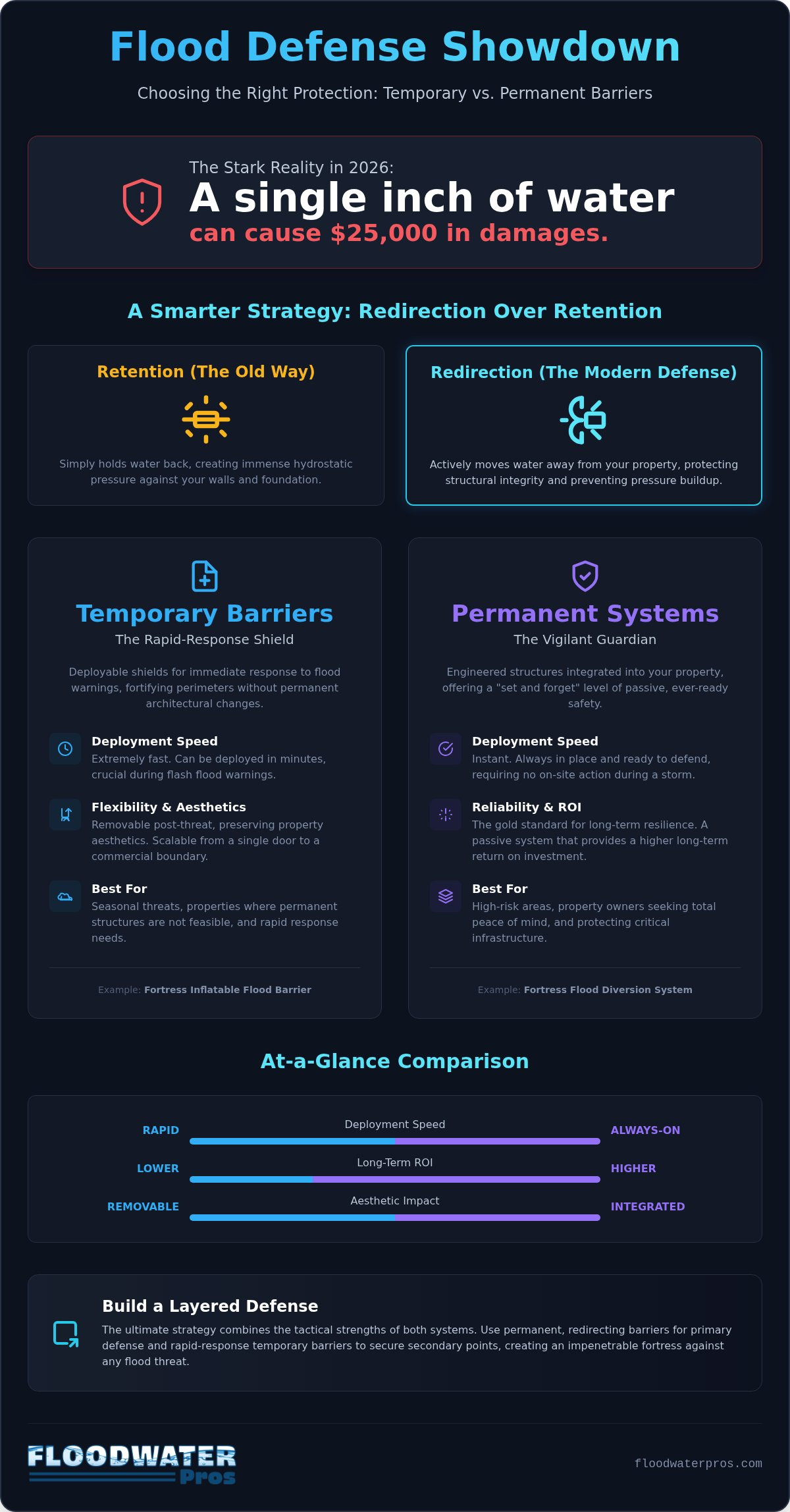
A single inch of water inside your property can trigger $25,000 in structural damages in 2026. This stark reality forces every homeowner and facility manager to confront the debate of temporary vs permanent flood barriers before the next storm surge arrives. It's natural to feel a sense of vulnerability when facing environmental threats that seem to grow more frequent each year. You want a solution that offers total security without turning your architecture into an eyesore.
We understand the frustration of bulky gates and the anxiety that comes with deployment speed during a flash flood warning. You need a shield that acts as a vigilant guardian for your investment. This article will help you discover the critical differences between rapid-response inflatable tools and engineered permanent systems. We'll explore how to build an impenetrable defense that prioritizes redirection over simple retention. By the end, you'll have a clear strategy for choosing a system that provides both physical robustness and the profound relief of long-term security.
Key Takeaways
- Compare the tactical strengths of temporary vs permanent flood barriers to align your defense strategy with the specific topography and risk profile of your land.
- Discover how rapid-response inflatable barriers provide an immediate, military-grade shield when surge warnings leave no room for delay—protecting perimeters without permanent alterations.
- Evaluate the long-term ROI of permanent diversion systems—the gold standard for those seeking a passive, "set and forget" guardian against the rising waters of 2026.
- Learn to build a layered defense that prioritizes redirection over simple retention—ensuring water is moved away from your structure rather than just held back.
- Explore aesthetic-first options like transparent paintable barriers that offer high-stakes protection without sacrificing your property’s architectural integrity or visual appeal.
Defining the Battle Lines: Temporary vs. Permanent Protection
Choosing a shield for your property is a high-stakes decision that dictates your resilience for years. The debate over temporary vs permanent flood barriers isn't just about cost or convenience. It's about survival. In the first half of 2026, the U.S. faced 12 billion-dollar climate disasters that resulted in at least $31.9 billion in damages. These numbers prove that the environment is becoming more aggressive. Your defense must evolve to match it. Traditional sandbags and plywood are no longer enough to safeguard your investment.
The fundamental choice rests between readiness and permanence. Most property owners focus on retention, which is the act of holding water back. We prioritize redirection. This engineering philosophy changes everything. Instead of allowing water to exert massive hydrostatic pressure against your walls, we move it away. A standard flood barrier might stop a surge, but a diversion system protects the structural integrity of the entire site. It's the difference between a plug and a path.
Strategic defense requires a balance of deployment speed and structural strength. Temporary systems offer flexibility for seasonal threats. Permanent systems provide a passive, vigilant guard that never sleeps. Both have a place in a modern fortification strategy. The goal is to eliminate the fear of structural failure during a surge and replace it with the profound relief of total security.
What Are Temporary Flood Barriers?
These are deployable shields designed for rapid response. When a flash flood warning arrives, minutes are the only currency that matters. Temporary systems allow you to fortify a perimeter quickly without making permanent changes to your architecture. The Fortress Inflatable Flood Barrier represents the peak of this technology. It's a military-grade tool that transforms from a compact storage unit into an impenetrable line of defense. It's the ideal choice for those who need to protect large perimeters against seasonal storm surges without the need for year-round construction.
What Are Permanent Flood Systems?
Permanent systems act as the vigilant guardian of your property. They are engineered structures that offer a "set and forget" level of safety. Modern innovation has moved beyond the era of bulky, ugly flood gates. The Fortress Flood Diversion System redefines permanent protection by integrating directly into your property’s landscape. These systems are always ready. They don't require you to be on-site when the clouds break. By choosing a permanent diversion system, you're investing in a long-term strategy that redirects water flow automatically, ensuring your home or business remains dry and secure regardless of the forecast.
Temporary Barriers—The Rapid Response Shield
Speed is the only currency that matters when a surge is imminent. In 2026, the cost of flood damage has skyrocketed. FEMA estimates a single inch of water causes $25,000 in losses. This makes the debate of temporary vs permanent flood barriers a matter of immediate financial survival. Deployment speed defines the success of a temporary system. You don't have hours to stack heavy sandbags. You have minutes to secure your perimeter. High-stakes situations require a shield that responds as fast as the weather changes.
Government agencies often deploy temporary flood barriers when permanent infrastructure isn't feasible or permitted. These systems offer a high level of scalability. You can protect a single door or a mile-long commercial boundary with the same technology. Because they are removable, they preserve the aesthetic value of your property during the dry season. Storage is simple. Most systems fold down into compact units that wait silently until the next warning siren.
Maintenance is straightforward but vital. Reusable systems must be inspected for punctures and stored in climate-controlled environments to prevent material degradation. However, every shield has its limit. When hydrostatic pressure reaches extreme levels, a deployable barrier may struggle to remain anchored without a permanent foundation. This is where the heavy-duty engineering of a permanent system becomes the necessary answer for long-term resilience.
The Fortress Inflatable Flood Barrier Advantage
The Fortress Inflatable Flood Barrier provides military-grade durability. It's engineered to withstand the impact of floating debris and heavy currents. Traditional sandbags are labor-intensive and prone to seepage. Our rapid inflation technology allows for deployment in a fraction of the time. Whether you're securing a garage door or an entire estate, these barriers offer a flexible, high-strength solution. You can explore our Fortress Inflatable Flood Barrier options to see how we prioritize your peace of mind.
When to Rely on Temporary Defense
Temporary defense is the primary choice for leased commercial spaces. If you don't own the building, structural modifications are often prohibited. These barriers provide a professional-grade shield that leaves no trace once the water recedes. They also serve as a critical secondary layer for high-value residential estates. Even if you have a permanent wall, a deployable barrier adds redundant protection for vulnerable entryways. 2026 weather patterns are erratic. Having a rapid-response tool on standby ensures you're never caught off guard.
Permanent Barriers—The Vigilant Guardian
Permanent barriers represent the ultimate evolution of property fortification in 2026. They offer the profound relief of a "set and forget" strategy. You don't have to monitor weather apps with trembling hands or rush home to deploy equipment. These systems are passive. They're always ready. They provide a level of structural integration that temporary solutions cannot match. While the debate of temporary vs permanent flood barriers often centers on upfront costs, the long-term ROI of a permanent guardian is found in the total elimination of human error. If you aren't there to inflate a barrier, a permanent system still stands its ground.
Engineering a permanent defense is a science of redirection. Most property owners think of floodwalls as simple plugs. We view them as channels. By moving water safely around your structure, we protect the foundation from the silent threat of hydrostatic pressure. This pressure can crack concrete and shift soil, leading to catastrophic structural failure even if no water enters the building. A permanent system is a vigilant guard that manages these forces 24/7. You can learn more about the nuances of Temporary vs. Permanent Flood Barriers to see how passive systems fit your risk profile.
The Fortress Flood Diversion System
This system is the gold standard for high-stakes protection. It isn't just a barrier; it's an engineered redirection plan. Our professional installation teams ensure every inch of the perimeter is structurally sound. We analyze the topography of your land to determine exactly where the water wants to go. Then we provide the path. This proactive approach ensures the energy of the surge is dissipated safely away from your property’s most vulnerable points. It's a permanent answer to an increasingly volatile climate.
The Invisible Guardian: Fortress Paintable Flood Barrier
Security shouldn't come at the cost of beauty. Many property owners fear that permanent protection means bulky, industrial-looking gates. The Fortress Transparent Liquid Paintable Flood Barrier shatters this assumption. It uses advanced transparent liquid technology to seal cracks and porous surfaces. It's an invisible shield. This is the ideal solution for historic estates or modern architectural masterpieces where aesthetic integrity is non-negotiable. You get military-grade sealing that the eye cannot see, ensuring your property remains both beautiful and impenetrable.
The Strategic Choice: Evaluating Your Risk Profile
Selecting the right shield isn't just about budget. It's about physics. The decision between temporary vs permanent flood barriers must be rooted in a clinical assessment of your property’s specific vulnerabilities. In 2026, climate volatility means "once-in-a-century" floods are now seasonal events. You must evaluate your terrain, the frequency of threats, and your own ability to respond when the clouds break. A failed defense is more than a financial loss. It's a compromise of your sanctuary.
Step 1: Assessing the Hydrostatic Threat
Terrain determines water behavior. If your property sits in a low-lying basin, water depth is your primary enemy. If you're near a drainage channel, current velocity becomes the threat. Shallow, slow-moving surges are often manageable with deployable shields. However, deep water demands the structural weight of a permanent, anchored system. Hydrostatic pressure is the relentless physical force that collapses unprotected walls under the weight of standing water. Without the structural reinforcement of a permanent diversion system, your foundation remains at risk of catastrophic failure.
Step 2: Determining Deployment Capability
A barrier is only effective if it's in place before the water arrives. You must be honest about your deployment capability. If you travel frequently or manage an absentee property, relying on manual setup is a high-stakes gamble. Human error and "deployment fatigue" are real risks during a storm. Passive systems remain the gold standard for high-value assets because they require zero human intervention. While inflatable systems offer rapid response, they still require someone to be on-site. Permanent systems are vigilant guardians that never take a day off.
Step 3: Factoring in Long-Term ROI
Look beyond the initial price tag. Temporary barriers involve hidden costs like climate-controlled storage and eventual material degradation. Permanent diversion systems are long-term investments that enhance property equity. Professional installation managed by engineers ensures your defense is structurally sound from day one. In many cases, these engineered systems can help mitigate the rising costs of flood insurance by proving to providers that your risk profile is actively managed. You can contact our engineering team to begin your property assessment and secure a clear strategy for redirection.
The Fortress Solution: Integrating Your Defense
True resilience isn't found in a single product. It's found in a layered strategy. The debate over temporary vs permanent flood barriers often presents a false choice between one or the other. In 2026, the most effective defense is a hybrid one. You need a system that redirects the massive energy of a surge while sealing the specific entry points that threaten your interior. This is the FloodWater Pros philosophy. We don't just hold water back. We move it. We ensure it follows a path of our choosing, not yours.
A layered defense provides redundant security. The Fortress Flood Diversion System acts as your primary shield. It's designed to manage the heavy hydrostatic pressure of the main surge. But water is persistent. It seeks out every crack and low-lying vent. This is where the Fortress Inflatable Flood Barrier becomes essential. These rapid-response tools seal the vulnerable gaps that permanent structures might miss. By integrating both, you create an impenetrable perimeter that accounts for every physical variable.
Designing Your Custom Perimeter Defense
Designing a custom perimeter defense requires a deep understanding of water behavior. We look at the topography of your land to see where the water wants to go. Then we use the Fortress Diversion System to make it go there. This system handles the heavy lifting. It's the gold standard for permanent protection. We supplement this with Inflatable Barriers for dynamic areas. If you have a driveway that needs access until the last possible minute, the inflatable barrier is your tactical answer. It provides the flexibility you need without sacrificing the strength of your primary defense. Professional engineering is the backbone of this high-stakes environment. Our team analyzes hydraulic loads to ensure every component works in perfect unison.
Securing Your Legacy in 2026
Property is more than an asset. It's a legacy. The psychological relief of knowing your home or business is truly fortified is immeasurable. You no longer have to fear the sound of rain on the roof or the glow of a weather alert on your phone. You have a vigilant guardian standing watch. FloodWater Pros is the national partner for those who refuse to compromise on safety. We provide a clear path from engineering consultation to professional installation. Our experts handle the complexity so you can enjoy the security. Secure your legacy and your peace of mind before the next storm season begins. Secure your property with a professional Fortress installation.
Fortifying Your Future: The Path to Absolute Resilience
The climate of 2026 demands a shift from reactive panic to proactive fortification. You've learned that the choice between temporary vs permanent flood barriers isn't just a matter of convenience. It's a strategic decision based on your property's unique topography and your own capacity to respond. Whether you deploy rapid inflatable shields or invest in the vigilant, passive guard of an engineered diversion system, the objective is clear. You deserve total peace of mind when the sirens sound.
FloodWater Pros provides serious protection for high-value assets through our proprietary Fortress diversion technology and national engineered installation. We don't just sell products; we engineer survival. Your property is your sanctuary, and it's time to build an impenetrable defense that redirects threats away from your foundation forever.
Take the first step toward a secure, dry future today. Request Your Professional Fortress Defense Consultation and gain the relief that only professional-grade security can provide. Your legacy is worth the investment.
Frequently Asked Questions
Is it better to have a permanent flood wall or removable barriers?
The ideal choice depends on your specific risk profile and property ownership status. Permanent systems provide 24/7 passive protection without the need for human intervention when a storm hits. Removable barriers offer essential flexibility for leased commercial spaces or properties where aesthetic preservation is a priority. When evaluating temporary vs permanent flood barriers, owners of high-value estates often prefer permanent diversion systems to eliminate the risk of being away during a surge.
Can a temporary flood barrier handle high-velocity currents?
Yes, provided they are engineered with military-grade durability like the Fortress Inflatable Flood Barrier. Standard sandbags often fail or wash away under heavy flow. Our inflatable systems use the weight of the water itself to create a massive, stable anchor against the ground. This allows them to resist debris impact and lateral forces. However, for extreme velocity in deep channels, we recommend the structural reinforcement found in permanent diversion systems.
How much does a professional flood diversion system cost to install?
The total investment for an engineered solution depends on the linear footage of your perimeter and the unique topography of your land. Professional installation managed by engineers ensures that your defense is structurally sound to handle the volatile climate patterns of 2026. While we don't provide flat-rate estimates without a site assessment, the ROI is measured against the $25,000 in damage caused by just one inch of water inside your facility.
What happens if a flood barrier fails during a major storm?
Failure typically occurs due to improper installation or exceeding the system's rated hydrostatic limit. This is why our engineering philosophy prioritizes redirection over simple retention. If a barrier merely holds water instead of moving it, the pressure can cause catastrophic structural collapse. Our systems are designed to dissipate energy safely. We recommend a layered defense strategy to ensure that even if a primary line is breached, secondary seals remain intact.
Do I need a permit to install a permanent flood diversion system?
Most jurisdictions require permits for permanent structural modifications to ensure compliance with FEMA's "no-rise" rule. This regulation prohibits earth-moving activities that could cause water levels to rise for neighboring properties. Our engineering team manages the technical documentation for these requirements. We ensure your fortification is legally sound and meets the higher ASCE 24-24 standards adopted by many local governments in 2026. Professional oversight eliminates the risk of regulatory fines.
How long does it take to deploy the Fortress Inflatable Flood Barrier?
A standard residential entryway can be secured in under ten minutes using our rapid inflation technology. This is significantly faster than the hours of backbreaking labor required to stack hundreds of heavy sandbags. For larger commercial perimeters, the deployment time depends on the total length of the run and the number of personnel available. Speed is the critical advantage of this shield when flash flood warnings leave no room for delay.
Can the paintable flood barrier really stop water from entering through bricks?
Yes, the Fortress Transparent Liquid Paintable Flood Barrier creates an impenetrable chemical bond that seals porous materials like brick and stone. Brick is naturally permeable and allows water to seep into your property’s structural envelope. This transparent technology fills those microscopic gaps to create a waterproof shield. It provides high-stakes protection for historic estates where bulky gates would ruin the architectural integrity. It's an invisible guardian for your legacy.
Which system is best for protecting a commercial storefront?
Commercial storefronts often require a hybrid approach to maintain accessibility while ensuring total security. We recommend the Fortress Flood Diversion System for the main building perimeter and the Fortress Inflatable Flood Barrier for specific customer entryways. This combination allows your business to remain open until a surge is imminent. When evaluating temporary vs permanent flood barriers for retail, our transparent paintable solutions ensure that your curb appeal remains intact while your inventory stays dry.


