

The barrier that looks strongest may still be the wrong defense for your property. Similar-sounding systems can work in very different ways, so comparing flood barrier technologies means looking beyond labels: does your site need to block water, redirect it, or protect a vulnerable surface? The right choice depends on the building, the route water may take, and how the protection is intended to operate.
This guide explains the main technology families and their practical trade-offs. You’ll compare permanent walls, demountable panels, and deployable barriers, including systems that need to be set up and approaches designed around installed protection. You’ll also learn how water pathways, property layout, access, and operating needs can help narrow your options.
FloodWater Pros designs, manufactures, and installs flood protection systems, including the Fortress Flood Diversion System, Fortress Inflatable Flood Barrier, and Fortress Transparent Liquid Paintable Flood Barrier. A sound plan begins with understanding your site, then matching the protection approach and installation to its conditions.
Key Takeaways
- Identify whether water needs to be blocked at an opening, redirected away from a structure, or addressed at a surface.
- When comparing flood barrier technologies, consider how each system works, along with its placement, storage, visibility, and operating needs.
- Map likely water pathways and exposed openings before narrowing options. Property use and access also affect the decision.
- Compare each system with the conditions and limits that matter at your site, rather than assuming one barrier suits every flood pathway.
- Site-specific design and professional installation connect a selected protection approach to the property.
Comparing Flood Barrier Technologies Starts with the Water and the Site
A flood barrier is a system designed to block, redirect, or reduce water entering a property. Those approaches address different problems. Water may approach from a street, collect against a building, or move across a site toward an opening. Start by tracing the likely source and direction of water, then identify where protection needs to act.
That is why comparing flood barrier technologies should begin with the property, not a product label. A physical barrier may close off a doorway or another route into a building. A diversion system aims to guide water away from a structure. A liquid treatment takes a different approach by treating a surface, with suitability depending on the surface and project conditions. For a broad overview of barrier types, see flood barrier technologies.
Choose a barrier based on the water pathway and site conditions, not just the name of the system.
What should a property assessment establish first?
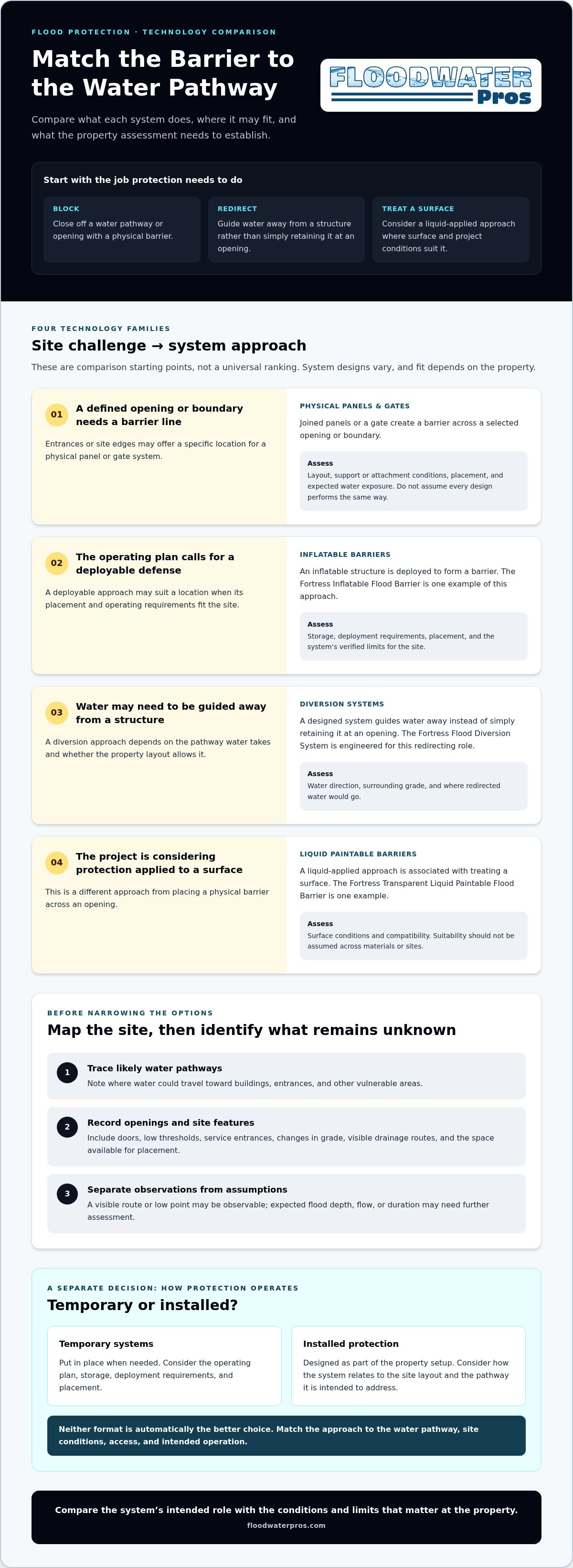
Trace where water could travel toward buildings, entrances, and other vulnerable areas. Note openings such as doors, low thresholds, and service entrances. Record changes in grade and visible drainage routes that could direct water. Also note the surface and available space where a barrier may need to sit, since placement is part of the site assessment.
Separate observations from assumptions. You may be able to identify a low point or visible route, while expected flood depth, flow, or duration may require further assessment. Write down what is known and what remains uncertain before comparing systems. This makes it easier to identify which design questions need answers.
Blocking, redirecting, and sealing are different strategies
Blocking places a physical barrier across a water pathway or opening. Redirecting guides water away from a structure rather than simply holding it at the point where it arrives. FloodWater Pros’ Fortress Flood Diversion System is engineered to redirect water away from structures. Liquid barrier treatments are different: they are applied to a surface, so the intended surface and project conditions matter.
Protection may also be temporary or installed. Temporary systems are put in place when needed; installed protection is designed as part of the property setup. Neither is automatically the better choice. Consider the water pathway, site layout, and how the system is intended to operate. Once those factors are clear, compare what each approach can address.
Four Flood Barrier Technology Families, and How Each Works
Flood barriers use different principles, so compare them using the same questions: What does the system do? Where could it fit? How is it put into operation? What site-specific limits need assessment? The table is a starting point for comparison, not a universal ranking.
| Technology | How it works | Typical context | What to assess |
|---|---|---|---|
| Physical panels and gates | Joined panels or a gate create a barrier across a chosen opening or boundary. | Selected entrances or site edges where a defined barrier line is possible. | Layout, attachment or support conditions, placement, and expected water exposure. Systems vary; don’t assume every design performs the same way. |
| Inflatable barriers | A deployable barrier uses an inflatable structure to form a defense. | Locations where a deployable approach may suit the site and operating plan. | Storage, deployment requirements, placement, and the system’s verified limits for the site. |
| Diversion systems | A designed system guides water away from a structure instead of simply retaining it at an opening. | Sites where the water pathway and layout allow for a considered diversion approach. | Water direction, surrounding grade, and where redirected water would go. |
| Liquid paintable barriers | A liquid-applied barrier approach is associated with treating a surface. | Project-specific surfaces where this approach is being considered. | Surface conditions and compatibility. Suitability should not be assumed across all materials or sites. |
Physical panels, gates, and modular barrier systems
Removable panels or gates create a physical barrier at a selected location. Their practicality depends on more than the opening’s width. The surrounding layout, support or attachment conditions, and expected exposure all matter. Permanent floodwalls are another type of physical barrier, but they relate to the property differently from removable systems. Neither format should be assumed to be watertight or interchangeable with every other design.
Inflatable, diversion, and liquid barrier approaches
An inflatable system is deployable; a diversion system is designed around guiding water away from a structure. FloodWater Pros’ Fortress Flood Diversion System is engineered for that redirecting role. The Fortress Inflatable Flood Barrier is a deployable approach, while the Fortress Transparent Liquid Paintable Flood Barrier is a liquid paintable approach. A system’s name does not establish its fit or limits. Compare its intended role with the site conditions and operating needs. Explore FloodWater Pros’ flood protection systems.
Flood Barrier Trade-Offs: Deployment, Site Fit, and Protection Limits
No barrier type is right for every property or flood pathway. A system that suits a frequently used entrance may be impractical if people cannot prepare it in time. An installed system may reduce some readiness demands, but that alone does not show whether it addresses the site’s exposure. Compare technologies by how they fit the property and how protection needs to operate.
Look beyond the barrier’s main function. Consider how it affects daily access, where equipment would be stored if it needs deployment, who would set it up, and how visible it is. Assess whether installation changes the property or depends on particular conditions at the chosen location. These are decision factors, not a scorecard where one approach always wins.
Temporary deployment versus professionally installed protection
Deployable systems require a plan for access, storage, and setup before flood conditions arise. Their practicality depends partly on who can put them in place and whether there is enough warning time. Installed protection follows a different planning path, with design and on-site implementation shaping its fit. Neither approach is inherently weaker or automatically sufficient. The key question is whether its operating demands match the property’s needs.
A technology’s operating principle describes how it works; a site-specific assessment helps establish how it may perform at a particular property.
The objection: will any barrier stop every flood?
No generic product description establishes protection for every flood condition. Expected water depth and movement matter, as do duration, debris, and site geometry. These conditions can affect whether a barrier’s design and placement are appropriate. Comparing flood barrier technologies responsibly means treating unknowns as questions to resolve, not filling gaps with broad claims.
Use documented system limits and project-specific design information to guide the comparison. The barrier’s intended role should match the exposure being addressed, and its location should make sense in relation to the building and surrounding site. FloodWater Pros connects system engineering with professional on-site installation, carrying the selected approach into implementation based on the project.
- Readiness: Can the system be put into operation as planned?
- Site fit: Does its placement suit access, layout, and surface conditions?
- Evidence: Are relevant design limits established for the expected exposure?
How to Match Flood Barrier Technologies to Your Property
A clear selection process turns site observations into a practical comparison. Use these five steps to narrow the options before committing to a design.
A five-step site-first selection process
- Document water pathways. Record where water has entered before and where it could move across the property. Note visible slopes, low points, and routes toward structures.
- Map vulnerable points and operating needs. Mark doors, service entrances, and other openings, then identify the people, equipment, and stored assets that need protection. Note access needs and whether protection must be deployed or can be installed.
- Compare approaches to the exposure. Consider whether the challenge calls for blocking an opening, redirecting water, or a liquid paintable approach. For broader home-system context, explore modern residential flood protection systems. To examine redirection in more detail, see flood diversion system design.
- Identify what remains unknown. Separate visible site conditions from assumptions about water depth, movement, or duration. These details may need assessment before a suitable approach can be established.
- Assess the design requirements. Consider placement, property layout, intended operation, and documented system limits together. Site-specific design connects the technology choice to real conditions.
For a home, the decision may center on a particular entrance, daily access, and household belongings. A single opening presents a different challenge from water approaching across a wider perimeter or needing to be directed away from the structure. If you are considering a deployable approach, explore inflatable flood barriers for homes.
Commercial properties may need to weigh access and continuity of building use alongside assets at risk. A barrier across one entrance may not address water moving across a broader site. A wider protection plan also needs to account for how people and operations use the property. In either setting, comparing flood barrier technologies works best when the decision follows the observed water pathway and the site’s operating needs.
Turn your site observations into a project plan with FloodWater Pros’ flood protection design and installation.
From Technology Comparison to a Flood Protection Plan
A useful comparison ends with a plan grounded in the property, not a guess based on product labels. Match the approach to the water pathway, site constraints, intended operation, and documented system limits. Then connect those findings to a design and installation plan suited to the building.
What a project-specific design should bring together
Design turns site observations into practical requirements. The location of vulnerable openings, the route water may take, and the barrier’s intended function all shape the approach. Blocking, redirecting, and liquid paintable protection are distinct strategies. Each needs to be considered in relation to the property and the conditions it is meant to address.
FloodWater Pros brings system design and manufacturing together with professional on-site installation. This process carries a selected approach from engineering into implementation, with the property layout and intended barrier function central to the project. The Fortress Flood Diversion System is engineered to redirect water away from structures. The Fortress Inflatable Flood Barrier is an inflatable approach, and the Fortress Transparent Liquid Paintable Flood Barrier is a liquid paintable approach. These categories do not guarantee performance in every condition.
A clear next step toward engineered protection
Before moving from comparison to planning, gather the observations that will inform the project:
- Where water has entered or may travel across the site.
- Which openings, areas, or assets need protection.
- How the barrier is intended to operate and what site conditions may affect placement.
- Which flood conditions or system limits still need to be established.
These details help connect the property assessment to a suitable protection approach and the planning needed for installation. They also help distinguish a known site feature from an assumption about flood depth, movement, or duration. Project-specific design should account for those conditions without promising an outcome beyond the evidence available.
Comparing flood barrier technologies is the first step. The next is turning what you’ve learned about water pathways, vulnerable locations, and intended operation into a considered plan. Explore FloodWater Pros flood protection solutions to take the next step toward protection tailored to your property.
Turn Your Comparison Into a Clear Protection Plan
The right flood defense starts with the water pathway and the property, not a product label. As you finish comparing flood barrier technologies, focus on three essentials: where water may travel, which areas need protection, and whether the system’s intended operation and documented limits fit the site.
FloodWater Pros brings engineering, manufacturing, and professional on-site installation together to move a project from assessment toward implementation. Its approaches include the Fortress Flood Diversion System, engineered to redirect water away from structures, as well as inflatable and transparent liquid paintable barriers. Each serves a distinct category, and site-specific design helps connect the approach to the property’s conditions.
Start with what you know about your site, then turn those observations into a considered protection plan. Explore FloodWater Pros flood protection solutions.
Frequently Asked Questions
What are the main types of flood barrier technologies?
Main types include permanent walls, removable panels or gates, deployable barriers such as inflatable systems, water-diversion systems, and liquid-applied barrier treatments. They work differently: some block water at a boundary or opening, while others redirect it or treat a surface. Comparing flood barrier technologies means looking at operating principles alongside property layout, intended use, and system limits, rather than assuming categories are interchangeable.
Is one flood barrier technology best for every property?
No single technology is best for every property or flood pathway. A removable barrier may suit a particular opening, while water approaching across a wider area may call for a different strategy. Consider how water reaches the building, which areas need protection, available space, operating needs, and verified system limits. Site-specific design connects those conditions to an appropriate approach.
How do I compare temporary and permanent flood barriers?
Compare how each option fits the property and how protection will be put into operation. Temporary barriers may require storage, access, preparation, and people available to deploy them. Permanent protection involves installation planning and becomes part of the site. Consider building access, visible changes, installation requirements, and how much warning or preparation is practical. Neither type is automatically stronger or more suitable; fit depends on the project.
Can an inflatable flood barrier protect a home?
An inflatable flood barrier is one approach to residential flood protection, but suitability depends on the home, likely water pathway, and the system’s documented limits. Assess where it would be placed, how it would be stored and deployed, and which openings or areas it is intended to protect. FloodWater Pros offers the Fortress Inflatable Flood Barrier, and site-specific design helps relate the system to the property.
Does a liquid flood barrier replace panels or gates?
Not automatically. A liquid paintable barrier is different from a physical panel or gate, which creates a barrier across a selected opening or boundary. Suitability depends on the project and surface conditions; compatibility should not be assumed for every material. The Fortress Transparent Liquid Paintable Flood Barrier is FloodWater Pros’ liquid paintable approach. Compare each option by its intended function and site fit.
What happens if floodwater exceeds a barrier system’s design limits?
If flood conditions exceed a system’s documented design limits, its intended protection may be compromised. Water could overtop the barrier, pass around it, or enter through another route, depending on the system and site. That is why expected water depth, movement, duration, debris, and site geometry matter during assessment. Use project-specific design information and verified limits rather than relying on broad claims or assuming any barrier can stop every flood.
How do I choose between blocking floodwater and redirecting it?
Choose based on how water reaches the property and what the site allows. Blocking places a physical barrier across an opening or pathway. Redirection aims to guide water away from a structure, so consider where the water would go and how the site is laid out. FloodWater Pros’ Fortress Flood Diversion System is engineered to redirect water away from structures. A site assessment helps clarify which function fits the exposure.


