

Can a clear coating protect a foundation when water pressure, surface condition, and below-grade exposure all matter? A transparent liquid barrier for building foundations may have a role, but its suitability depends on the site, the substrate, and the type of moisture the building faces. A coating alone should not be assumed to solve every water-intrusion problem.
A discreet layer of protection can be appealing, but choosing a product that does not match the foundation can waste effort. This guide explains what to assess before choosing a liquid barrier, including concrete and masonry surfaces, existing finishes, water exposure, and the difference between dampproofing and waterproofing.
A coating can form part of a broader flood-protection plan, rather than carrying the full burden on its own. FloodWater Pros offers the Fortress Transparent Liquid Paintable Flood Barrier and manages project solutions from engineering through professional installation. Use the steps below to make a decision based on site conditions and a coordinated plan for foundation protection.
Key Takeaways
- A transparent liquid barrier for building foundations is a coating-based approach, not a complete drainage system or an automatic fix for every source of water.
- Match the barrier to the foundation material and exposure by reviewing product documentation before deciding whether it suits the application.
- Distinguish moisture resistance from protection against water pressure, and do not assume a coating repairs structural issues.
- Before choosing a product, map likely water-entry points and assess surfaces, finishes, joints, penetrations, and drainage.
- Consider the Fortress Transparent Liquid Paintable Flood Barrier as part of a site-specific foundation-protection plan, using its product documentation to guide the application.
What a Transparent Liquid Barrier for Building Foundations Can, and Cannot, Do
A transparent liquid barrier for building foundations is a coating-based layer. Its role depends on the substrate, where it is applied, and the water exposure described in the product documentation. It may protect a suitable surface, but it is not a complete foundation drainage system or a universal answer to water intrusion.
The water pathway matters. Water running over an exposed surface presents a different challenge from seepage through a crack, leakage at a joint or penetration, or pressure-driven water reaching a buried wall. Do not assume a coating addresses these pathways unless its documentation supports the intended use. For general background on building moisture protection and methods, see Waterproofing.
How a clear liquid barrier differs from other foundation measures
A surface-applied barrier acts where it is applied. Drainage systems manage water around or away from a foundation; joint treatments focus on seams and transitions; structural repairs address damage to the building itself. These measures serve different purposes. A coating should not be treated as a substitute for drainage, a leaking-joint repair, or work on a damaged foundation. Depending on the site, several measures may need to be planned together.
Which foundation conditions matter before considering a coating?
Start by identifying the surface and tracing the water pathway. Is the foundation exposed to rain or splash, or buried against soil? Does water appear across a broad area or at a crack, joint, or pipe entry? Note visible cracking, loose material, damp areas, and existing finishes. These observations help define the problem, but they do not establish that a particular coating is suitable.
Concrete and masonry are not automatically interchangeable application surfaces. Review the product documentation for the specific substrate, location, surface preparation, and exposure it supports. If the documented uses do not cover the conditions at the property, do not assume compatibility or performance. In particular, below-grade use or resistance to water pressure requires documentation that directly addresses those conditions.
For the Fortress Transparent Liquid Paintable Flood Barrier, use its product documentation alongside an assessment of the site to plan a foundation application. The words “transparent” or “barrier” alone do not establish suitability. A sound plan starts by identifying the route water takes and matching each measure to that route. For a broader view of coordinated property defenses, see the property flood mitigation solutions guide.
How Foundation Material and Water Exposure Affect Barrier Selection
Choose a product based on documented substrate compatibility and the water exposure it is intended to address. A coating designed for one surface or condition may not suit another. Concrete and masonry are useful examples, but neither should be assumed compatible without product-specific documentation.
Use this comparison to identify what to review before choosing a transparent liquid barrier for building foundations:
| Substrate or condition | Exposure | Assessment question | Documentation to review |
|---|---|---|---|
| Concrete | Exposed to rain or splash | Does the product support this concrete surface and exposure? | Substrate compatibility, application location, preparation, and limitations |
| Masonry | Exposed or partially buried | Does the documentation identify the specific masonry type and use? | Approved substrates, surface requirements, and below-grade guidance, if relevant |
| Previously coated surface | Runoff or damp conditions | Can the barrier be applied over the existing finish? | Compatibility with existing coatings and any removal or preparation steps |
| Cracks, joints, or penetrations | Seepage or concentrated entry | Is water entering through a detail the coating is meant to address? | Instructions for cracks, joints, transitions, and penetrations |
Match the barrier to concrete, masonry, and existing finishes
Porosity, texture, residue, and deterioration can affect how a surface should be assessed and prepared. A sound wall with an existing coating raises different questions from exposed, rough masonry or cracked concrete. Transparency alone does not guarantee that the underlying finish will look unchanged after application. Follow the product’s documented compatibility and preparation requirements for the actual surface.
Distinguish runoff, seepage, and pressure-driven water
Runoff contacts an exposed wall; seepage may enter through a crack, joint, or penetration; pressure-driven water pushes against a foundation, often below grade. These are different exposures. Drainage, grading, joints, and penetrations each affect how water reaches or moves around the structure. Do not infer pressure resistance from a coating’s appearance or general waterproofing language. Look for evidence that addresses the specific application. The International Residential Code foundation requirements offer a reference point for foundation provisions, but they do not establish that a particular coating suits a particular site.
FloodWater Pros coordinates protection planning from engineering through installation. Explore FloodWater Pros’ foundation protection planning as you consider how a liquid barrier can fit alongside other measures.
Is a Transparent Liquid Barrier Enough for Foundation Flood Protection?
Not in every situation. A transparent liquid barrier for building foundations may have a role when its product documentation supports the surface, location, and exposure involved. But a coating should not be treated as a fix for every route water can take into a building. A surface layer and a complete flood-protection plan address different problems.
Water passing over an exposed wall differs from seepage through a crack or joint. Pressure against a buried foundation raises another question. Active leaks, structural cracks, drainage concerns, and pressure-driven intrusion need assessment. A coating’s name or appearance does not prove it can address them.
When a coating may fit, and when another measure may be needed
A coating may suit an application when its documented instructions match the project conditions. Drainage measures manage water around the structure, while joint treatments and structural work address other pathways or conditions. These approaches can be coordinated, but one should not be assumed to replace the others.
Use this comparison to weigh potential benefits against limits without assuming undocumented product performance:
| Consideration | Potential value if documentation supports it | Limit to keep in view |
|---|---|---|
| Surface application | A coating may provide a barrier on a documented substrate and application area. | That does not establish protection at joints, penetrations, or buried surfaces. |
| Transparent appearance | It may suit a project where a clear coating is desired. | Transparency alone does not prove the finished appearance or performance. |
| Flood protection role | It may form one element of a broader, site-specific plan. | Do not assume it resists hydrostatic pressure, repairs damage, or stops every source of water. |
What evidence supports a foundation-protection claim?
Read the product-specific instructions and limitations, not just broad marketing language. Look for clear statements about compatible substrate types, approved application locations, surface preparation, and the exposure the product is designed to address. Claims about below-grade use or hydrostatic pressure need supporting evidence for that product and application. Likewise, do not treat a coating as structural repair unless that role is explicitly documented.
FloodWater Pros offers the Fortress Transparent Liquid Paintable Flood Barrier as a component for project-specific protection. Base its role in a foundation plan on product documentation and site conditions, alongside measures that address other water pathways. For a broader whole-property view, explore residential flood protection systems.
How to Evaluate a Transparent Foundation Barrier Before Buying
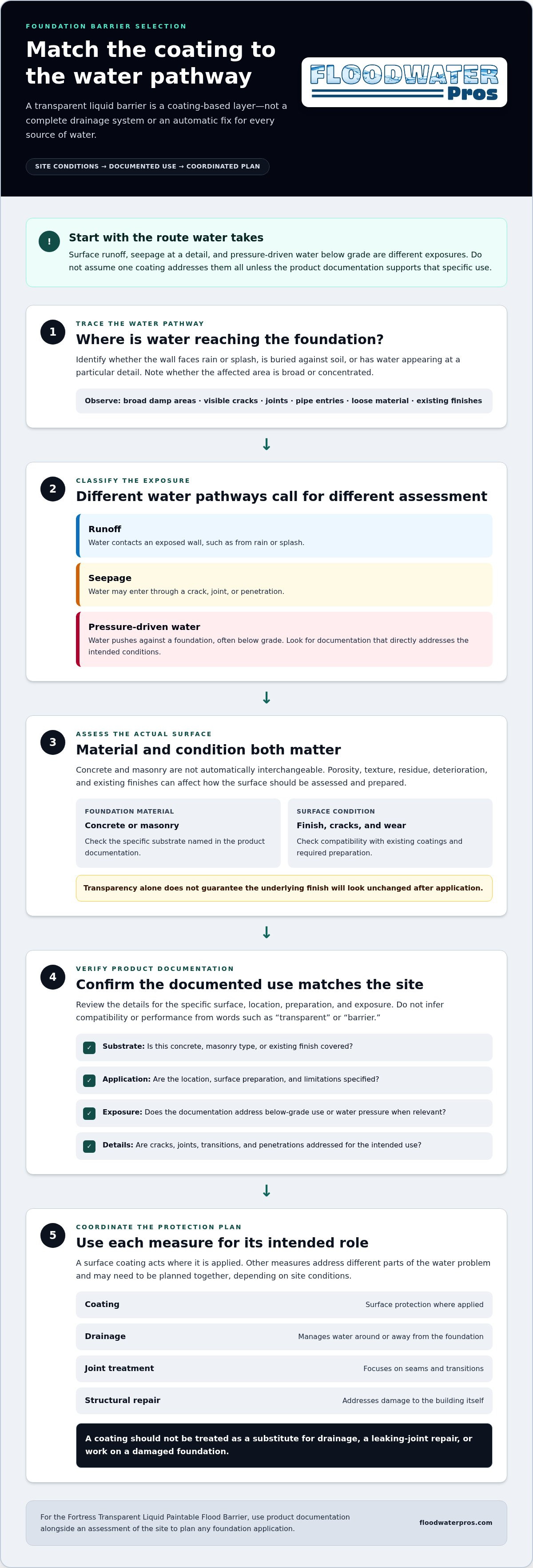
A sound decision starts with the site, not the label. Before selecting a transparent liquid barrier for building foundations, trace where water reaches the structure, identify the surfaces involved, and compare those conditions with the product’s written instructions. This process helps reveal when a coating may fit and when the wider water-management plan needs attention.
Five questions to answer during project assessment
- Where does water reach the foundation? Note whether it runs over exposed walls, collects near the base, or appears at a specific entry point. Identify which surfaces are exposed and which are buried.
- What is the substrate? Record whether the surface is concrete, masonry, or another material. Look for that substrate in the product documentation rather than assuming the barrier suits it.
- What is already on the surface? Identify existing paint, coatings, sealers, or other finishes. Note visible cracks, loose or damaged areas, joints, penetrations, and transitions.
- What exposure must the product address? Distinguish surface runoff from seepage or pressure against the foundation. Review the product instructions for its intended application and stated limitations.
- What preparation and installation conditions apply? Follow the product’s directions for surface preparation and application. Avoid relying on generic assumptions about what a foundation needs.
Use this checklist to record the essentials before comparing options:
- Substrate type and visible condition
- Existing finishes and their compatibility
- Cracks, joints, penetrations, and transitions
- Exposed versus buried application area
- Likely water pathway and exposure
- Nearby drainage and where runoff is directed
Plan preparation and installation around the site
Preparation requirements depend on the product instructions and the condition of the surface. A previously coated wall, a damaged area, and an exposed section of foundation raise different planning questions. Check product-specific guidance instead of applying a general preparation method.
Include joints, pipe or utility penetrations, wall transitions, and nearby drainage in the project review. These details can affect how water reaches the foundation, even if the main wall surface appears suitable for a coating. If directing water away from the structure is part of the plan, explore flood diversion system design as a related planning consideration.
FloodWater Pros manages solutions from engineering through professional on-site installation. Plan foundation protection around your site conditions, considering the Fortress Transparent Liquid Paintable Flood Barrier as one potential component of a coordinated approach.
The Fortress Transparent Liquid Paintable Flood Barrier: Plan Foundation Protection
The Fortress Transparent Liquid Paintable Flood Barrier is a FloodWater Pros product for consideration in a project-specific foundation protection plan. Its name identifies the product, but does not establish which foundation surfaces or exposure conditions it is designed for. Use its product documentation and the conditions at the property to guide the application.
That distinction matters. Do not choose a transparent liquid barrier for building foundations based only on appearance or a general expectation that coatings stop water. Before planning a foundation application, review the product’s documented substrate compatibility, intended application locations, preparation requirements, and stated limitations. Below-grade use or protection against pressure-driven water requires product-specific support, not assumption.
What to understand about the Fortress liquid barrier
Foundation suitability starts with matching the documented use to the actual site. A visible wall surface, a buried foundation section, and an area with cracks or joints present different project conditions. Product information should guide whether the proposed application aligns with those conditions and what preparation is required. Do not treat a product name as evidence of durability, pressure resistance, or structural repair capability.
Move from foundation concern to a project plan
Organize the decision around four points:
- Define the exposure: Identify where water reaches the foundation and whether the concern involves runoff, seepage, or pressure against a buried surface.
- Assess the substrate: Record the surface material, existing finishes, visible condition, and details such as joints and penetrations.
- Review application limits: Compare the site with the product documentation, including intended use and preparation requirements.
- Plan the installation: Coordinate the proposed coating application with other measures needed to manage water around the property.
FloodWater Pros designs and manufactures flood-protection products and provides professional on-site installation. Engineering and installation help coordinate a project around its conditions; they do not guarantee a particular performance outcome. A sound plan accounts for the product’s documented role and the other routes water may take.
Ready to move from evaluation to planning? Explore foundation flood protection with FloodWater Pros and consider how the Fortress Transparent Liquid Paintable Flood Barrier can fit into a coordinated approach.
Make Foundation Protection a Site-Specific Plan
A transparent liquid barrier for building foundations may be one part of a protection strategy, but the right fit depends on the substrate, water exposure, and product application limits. Start by tracing where water reaches the foundation, then assess the surface and related details such as joints, penetrations, existing finishes, and drainage.
Keep the roles clear. A coating is not automatically a drainage solution, a structural repair, or proof against pressure-driven water. Match each concern with a measure intended to address it, and coordinate those measures around the conditions at the property.
FloodWater Pros designs and manufactures proprietary flood-protection products, including the Fortress Transparent Liquid Paintable Flood Barrier, and manages projects from engineering through professional on-site installation. This process brings site observations into a considered protection plan without treating any single product as a guarantee.
Ready to plan foundation protection? Explore foundation flood protection with FloodWater Pros.
Frequently Asked Questions
Is a transparent liquid barrier suitable for building foundations?
It may be suitable when the product documentation supports the foundation’s substrate, application location, and water exposure. A transparent liquid barrier for building foundations is not a universal fix for water intrusion. First identify whether water reaches an exposed surface, enters through a crack or joint, or collects against a buried wall. Then compare those conditions with the product’s intended use, application instructions, and stated limitations.
Can a transparent liquid barrier stop hydrostatic pressure?
Do not assume a surface coating resists hydrostatic pressure. That performance requires product-specific testing and application documentation relevant to the site conditions. Water running over an exposed wall differs from pressure against a buried foundation. If pressure-driven intrusion is a concern, assess the broader foundation strategy, including drainage or other engineered measures, rather than treating surface exposure as proof of pressure protection.
Can a liquid flood barrier be applied to concrete or masonry foundations?
Compatibility depends on the product and surface condition. Concrete and masonry can differ in porosity, texture, and preparation needs, so check the product documentation for the specific substrate and intended application. Existing coatings, cracks, joints, and penetrations also affect the assessment. Do not assume a product suits every concrete or masonry foundation just because it is described as a liquid barrier.
Can a transparent liquid barrier be used below grade?
Use a product below grade only when its instructions explicitly cover that application and the site conditions. A buried foundation can face different moisture exposure and water pressure than an exposed wall. A transparent finish alone does not establish below-grade suitability. Review the product’s stated limits and consider how drainage, joints, penetrations, and other water-management measures fit the project.
Does a transparent foundation coating replace drainage or foundation repairs?
No. A surface coating should not automatically replace drainage or structural repairs because these measures address different conditions. Drainage manages water around the structure; cracks or failed joints may need separate assessment. Start by identifying where water enters and evaluating the foundation’s condition. A coating may be one component of a coordinated plan when its documented use fits the surface and exposure, not a complete system by default.
What should I check before buying a transparent liquid foundation barrier?
Identify the foundation material, visible condition, existing finish, and likely water exposure first. Then review the product’s documented uses, compatible substrates, preparation instructions, application limits, and any tested performance claims. Check nearby joints, penetrations, and drainage, and note whether the surface is exposed or below grade. These details help you judge whether the proposed application fits the site without assuming unverified compatibility or protection.


