

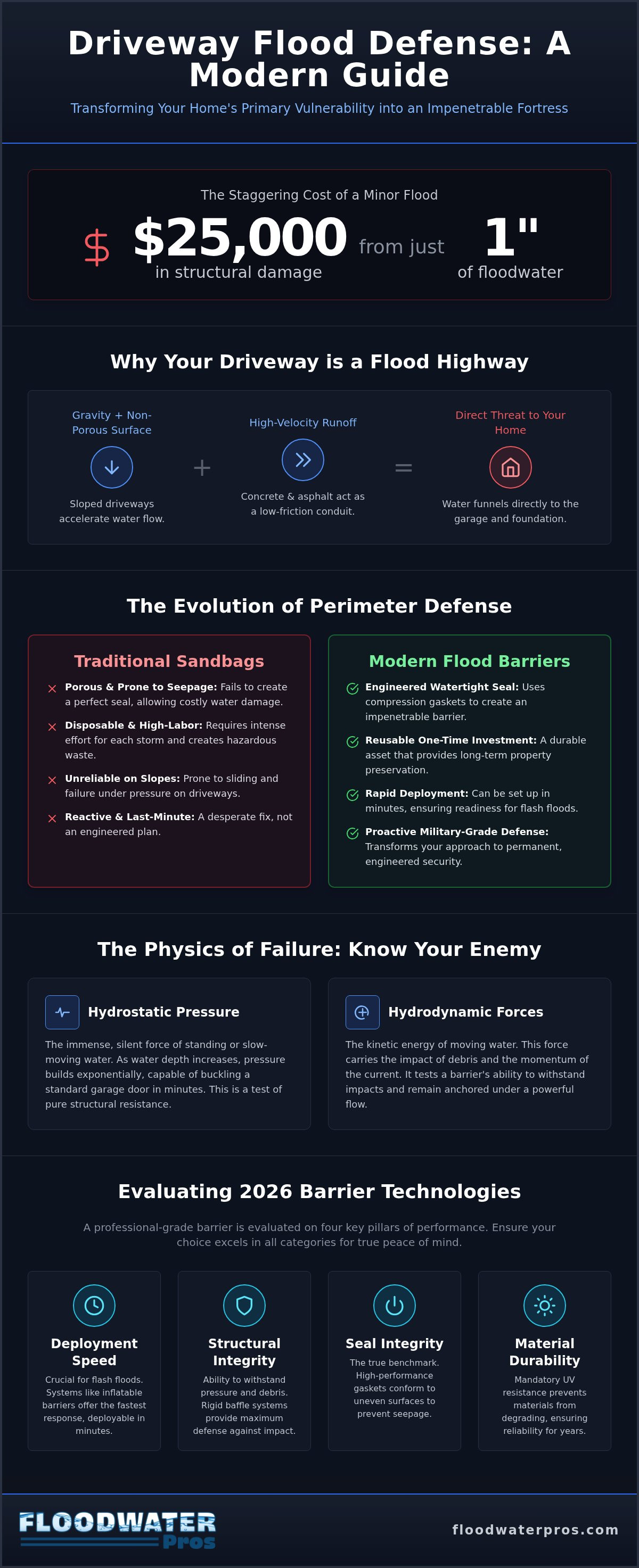
A single inch of floodwater can trigger $25,000 in structural damage. For many homeowners, the driveway acts as a literal highway for this destruction, funneling torrents directly toward the garage and foundation. Traditional sandbags frequently fail when the pressure mounts, leaving you anxious and vulnerable during every heavy rain cycle. You need a professional-grade driveway flood barrier that transforms your vulnerable entrance into a point of absolute resilience.
It's exhausting to watch the horizon with a sense of dread, wondering if the next storm will be the one that breaches your perimeter. You deserve the relief that comes from engineered preparedness rather than desperate, last-minute fixes. We will help you master the engineering of perimeter defense to ensure your property remains an impenetrable fortress against rising tides. This guide provides the strategic roadmap you need to move from vulnerability to total security.
We'll explore the transition from temporary patches to reusable, high-performance systems that safeguard your investment. You will learn how to evaluate structural integrity and select a solution that preserves your property value while providing total peace of mind during the most severe weather events.
Key Takeaways
- Learn why your driveway acts as a high-velocity funnel and how to neutralize this primary vulnerability before the next storm hits.
- Understand the critical engineering difference between merely holding water back and actively redirecting it to safer zones.
- Master the specific site analysis techniques needed to select and install a professional driveway flood barrier for your unique perimeter.
- Evaluate the latest 2026 barrier technologies based on deployment speed, structural integrity, and long-term property preservation.
- Transform your approach from reactive emergency response to a permanent, engineered standard of military-grade security.
The Driveway Vulnerability: Why Your Entrance is a Flood Highway
A driveway flood barrier is more than a simple obstruction. It's a specialized perimeter defense system designed to intercept and redirect high-velocity surface water before it reaches your home's foundation. Most driveways are engineered with a subtle slope to prevent pooling. During a catastrophic rain event, this design backfires. The smooth, non-porous surface of concrete or asphalt acts as a low-friction conduit. It accelerates water directly toward your garage door and foundation, turning a functional entrance into a flood highway. Leaving this area undefended isn't just a risk; it's an invitation for structural failure.
The danger to your garage and foundation is immediate. While walls are built to withstand wind, garage doors are notoriously weak against the weight of rising water. Once a breach occurs, the damage spreads rapidly to internal framing and electrical systems. Many homeowners adopt a "plug" mindset, trying to block water at the last second. A true professional strategy focuses on perimeter defense. This means stopping the water at the edge of your property, long before it has the chance to exert force on your home's primary structure.
The Physics of Driveway Flooding
Velocity is your primary enemy. Gravity pulls water down the slope of your driveway, building momentum that can easily bypass standard door seals. As water accumulates against a flat surface, it creates immense pressure. In the context of flood defense, hydrostatic pressure is the physical force exerted by standing or slow-moving water against a barrier or garage door, which increases as the water level rises. This force can buckle a standard garage door in minutes. If the water is moving, you also face hydrodynamic forces, which carry the weight of debris and the energy of the current. You need a system built to withstand both.
Beyond Sandbags: The Evolution of Perimeter Defense
Sandbags are a relic of a reactive past. They're porous, heavy, and prone to sliding on sloped driveway surfaces. Because they don't create a perfect seal, they often allow seepage that can lead to $25,000 in damage from just one inch of water. Modern flood barrier technologies have evolved into engineered, reusable synthetic systems. These professional-grade tools offer a significantly higher ROI. Unlike disposable bags that require intense labor and create hazardous waste, a high-quality driveway flood barrier is a one-time investment in property preservation. It provides a reliable, military-grade seal that can be deployed in minutes, ensuring your home remains an impenetrable fortress during every storm cycle.
Evaluating Driveway Flood Barrier Technologies in 2026
The landscape of perimeter defense has shifted. In 2026, property owners no longer rely on guesswork or retail-grade tubes that roll away under pressure. A professional driveway flood barrier is now evaluated through the lens of structural integrity and deployment speed. Modern systems are engineered to prevent floodwaters from bypassing the seal, even when facing the high-velocity runoff common on sloped entrances. You must choose between systems that act as temporary interceptors and those that provide a permanent, structural answer to rising water.
Seal integrity is the true benchmark of a defensive system. Asphalt and concrete are rarely perfectly flat; they contain micro-fissures and textures that allow water to seep under inferior barriers. High-performance systems utilize industrial-grade gaskets and compression seals to neutralize these gaps. Material durability has also reached a new standard. In 2026, UV resistance is a mandatory requirement, ensuring that your investment doesn't degrade or become brittle after exposure to the sun. You need a system that remains as resilient on its tenth deployment as it was on its first.
Temporary vs. Deployable Systems
Inflatable barriers offer the fastest response for flash flood scenarios. These systems utilize air or water to create a heavy, ground-conforming seal across large spans. For sustained rising water, rigid baffle systems provide maximum structural defense. These baffles are built to withstand heavy debris impact and extreme hydrostatic pressure. Reliability depends on maintenance. You should inspect your seals annually and store your components in a dry, temperature-controlled environment to ensure they're ready when the alarms sound.
The Rise of Invisible and Liquid Barriers
Aesthetic-first solutions are transforming luxury residential protection. You no longer have to compromise your property's curb appeal for the sake of security. The Fortress Transparent Liquid Paintable Flood Barrier acts as a secondary line of defense, creating a microscopic, waterproof seal over porous surfaces without changing their appearance. When you combine these liquid seals with rigid barriers, you achieve absolute protection. This layered approach ensures that even if the primary barrier faces extreme pressure, the structural substrate remains dry. If you're ready to move beyond basic protection, consider a professional-grade fortification that integrates seamlessly with your property's design.
Redirection vs. Retention: The Engineering of Diversion
Most homeowners view a flood barrier as a "plug." They believe the goal is simply to hold water back until the storm passes. This is a dangerous misconception. Retention creates extreme pressure points against the structure of your home. When you stop water entirely, it accumulates and builds weight. This increases the hydrostatic load on your garage door and foundation, often leading to structural failure. A professional-grade driveway flood barrier should function as a diversion system. It doesn't just block water; it dictates where that water travels. You're not just stopping a flood; you're managing a fluid dynamic.
Strategic redirection moves water toward designated safe zones. These are areas engineered to handle high volumes, such as natural swales, drainage basins, or municipal storm systems. By using L-shaped barriers, you can guide the flow of water away from vulnerable entry points. This geometry utilizes the water's own momentum to slide along the barrier's surface rather than crashing directly into it. It transforms a direct assault into a controlled bypass, preserving the integrity of your property's perimeter.
The Fortress Philosophy: Redirection as Defense
Angled barriers are the foundation of engineered defense. When a driveway flood barrier is placed at a strategic angle, it reduces the force of impact from rushing water. You're creating the path of least resistance away from your assets. Your property's topography plays a critical role here. An expert assessment identifies the natural "fall" of your land. We use this data to position barriers so that gravity works for you, not against you. It's the difference between fighting nature and mastering it. By aligning the system with the land's natural contours, you ensure the water moves efficiently toward a safe discharge point.
Managing the "Downstream" Impact
Diversion is an effective strategy, but it requires responsibility. You must consider the legal and ethical implications of where you send diverted water. Flooding your neighbor's property isn't a solution; it's a liability. Effective systems integrate seamlessly with existing landscape drainage, such as French drains or catch basins. A professional hydrologic assessment is essential to ensure your diversion strategy complies with local regulations and manages water flow without causing secondary damage to surrounding structures. This level of engineered preparedness protects your property and your peace of mind. It ensures your defense doesn't become someone else's disaster.
Strategic Implementation: Selecting and Installing Your Barrier
Selecting a driveway flood barrier requires more than a retail purchase. It demands a tactical assessment of your property's unique vulnerabilities. You must follow a rigorous implementation protocol to ensure your perimeter remains impenetrable. Begin with a comprehensive site elevation and flow analysis. You cannot defend what you don't measure. Use 100-year flood data to determine your required barrier height. As of 2026, many local governments are adopting ASCE 24-24 standards. These require dry floodproofing to meet higher certification levels, such as ANSI/FM 2510. Match your material to your substrate. Asphalt requires different compression seals than smooth concrete. Professional installation ensures these seals are watertight under extreme hydrostatic pressure. Finally, execute regular deployment drills. A system is only effective if you can deploy it before the water arrives.
Professional Site Assessment Framework
We measure the "critical height" of your property entrance. This is the exact point where water transitions from a nuisance to a structural threat. Surface irregularities, such as micro-cracks, oil stains, or uneven paving, can compromise even the strongest barrier. We evaluate whether your property requires permanent ground anchors for maximum stability or modular, weighted systems for rapid, non-invasive deployment. Every driveway has a unique grade. We map this topography to ensure the barrier doesn't just block water but guides it away from the foundation. This level of precision is the difference between a dry garage and a catastrophic breach.
The Installation Advantage
DIY installation often leads to catastrophic seal failure. When the pressure of a rising storm mounts, minor gaps become major breaches. Professional installation provides the structural integrity needed to resist both hydrostatic and hydrodynamic forces. Liquid barriers require surgical precision during application to ensure porous surfaces are fully neutralized. We follow the "Minutes to Midnight" rule. Every second counts during a flash flood. Our systems are designed for rapid deployment, ensuring you move from vulnerability to security in minutes. For a comprehensive defense strategy that meets the highest engineering standards, schedule an expert site consultation to secure your perimeter.
The Fortress Standard: Professional-Grade Driveway Protection
Real protection isn't found in a retail aisle. It's engineered. The Fortress standard represents a shift from reactive panic to tactical preparedness. A professional driveway flood barrier from our line ensures your property doesn't just survive a storm; it repels it. We act as your strategic partner, delivering solutions that are both formidable and deeply reliable. Our full-service model covers everything from initial engineering to professional on-site installation. This isn't just a product purchase. It's a total property shield.
Fortress Flood Diversion System: The Structural Edge
The Fortress Flood Diversion System is our flagship answer to high-velocity runoff. Most systems fail because they try to stop the water's entire weight at a single point. We redirect it. Our proprietary design focuses on the physics of flow, using the momentum of the water to guide it away from your garage and toward safer drainage zones. These systems are built for resilience and long-term durability.
- Proprietary design focused on high-velocity redirection rather than simple retention.
- Materials built to withstand heavy debris impact and extreme hydrostatic force.
- Scalability for wide estate driveways and complex commercial entrances.
For large spans that require rapid deployment, the Fortress Inflatable Flood Barrier offers heavy-duty defense. It creates a ground-conforming seal across massive widths in minutes. These barriers are engineered to resist the same hydrostatic forces that buckle standard garage doors. It's the ideal choice for properties that need high-speed protection without permanent structural changes. Measured defense. Total security.
Fortress Invisible Defense
Aesthetics matter. Luxury properties shouldn't look like disaster zones when the clouds gather. The Fortress Transparent Liquid Paintable Flood Barrier solves the utility versus beauty conflict. It creates a microscopic, waterproof seal over thresholds and porous surfaces without altering their appearance. You won't see it; you'll only see the results when the water fails to penetrate your substrate. This is the expert's choice for preserving curb appeal while maintaining an impenetrable perimeter.
This high-performance sealant is applied by our experts to ensure long-term integrity. It neutralizes the micro-fissures in concrete and stone that traditional barriers miss. Combined with our rigid systems, it provides a secondary line of defense that is virtually impenetrable. Your property remains elegant. Your home remains dry. We've seen what happens when homeowners rely on luck. We prefer a plan.
Don't wait for the next storm cycle to test your current setup. Secure your perimeter with a system built on seasoned wisdom and unwavering readiness. Consult with a Fortress expert for your custom defense plan to ensure your home is protected by the highest engineering standards available today.
Secure Your Perimeter: From Vulnerability to Absolute Resilience
The driveway is the most vulnerable point in your property's defense. It acts as a natural funnel for surface water, but it doesn't have to be a highway for destruction. You've learned that effective protection relies on redirection rather than simple retention. By mastering the engineering of diversion, you neutralize the hydrostatic pressure that threatens your garage and foundation. A professional-grade driveway flood barrier provides the structural integrity needed to withstand high-velocity currents while preserving your home's curb appeal.
True security requires precision. DIY solutions often fail when the pressure mounts because they lack the military-grade seal of an engineered system. We provide the seasoned wisdom and technical expertise to transform your entrance into an impenetrable fortress. Our systems are engineered for high-velocity redirection and structural integrity. Professional on-site installation by flood protection specialists ensures your ground seals remain watertight under the most extreme conditions.
Secure your property with a Fortress Flood Diversion System today. You deserve the profound relief that comes with total preparedness. Take the decisive step toward safeguarding your investment and reclaiming your peace of mind before the next storm arrives.
Frequently Asked Questions
How much does a professional driveway flood barrier system cost?
Professional systems vary based on driveway width, required height, and chosen technology. While off-the-shelf gates can start around $949, a custom-engineered system involves site analysis and professional installation. These factors ensure a military-grade seal that retail products cannot match. Your investment reflects the value of the assets you are protecting. It's about property preservation rather than a temporary purchase. We focus on long-term resilience for your perimeter.
Can I install a flood barrier on a sloped driveway?
Yes, you can install a barrier on a slope, but it requires specialized engineering. Sloped surfaces accelerate water velocity, which increases the hydrodynamic force against your defense. A professional driveway flood barrier must be anchored or weighted to prevent sliding. We assess the specific grade of your entrance to ensure the ground seal remains watertight. Redirection is critical here to move high-speed runoff toward safe drainage basins.
How long does it take to deploy an inflatable flood barrier?
Deployment typically takes between five and fifteen minutes depending on the span's length. These systems use air or water to create a heavy, ground-conforming seal. Speed is essential when facing flash floods or sudden storm surges. You don't have time for complex assembly when the water is rising. Our inflatable barriers are designed for rapid response, allowing you to move from vulnerability to security before the first breach occurs.
Do driveway flood barriers work against hurricane-force storm surges?
Engineered systems are designed to resist significant hydrostatic and hydrodynamic forces, but storm surges present extreme challenges. Success depends on the barrier's height and the structural integrity of its anchors. A professional system is far more effective than sandbags, which often wash away. We analyze local 100-year flood data to ensure your barrier meets the necessary certification standards for your specific risk zone and environmental threats.
Will a flood barrier damage my driveway or landscaping?
Professional installation is designed to be non-invasive or utilize discreet permanent anchors. Modular and inflatable systems leave no lasting mark on your asphalt or concrete. Our liquid barriers are transparent and don't alter the aesthetics of your stone or pavers. We prioritize property preservation. Your defense shouldn't cause the very damage it was built to prevent. Strategic placement ensures water is diverted into existing drainage without eroding your landscape.
What is the difference between a flood gate and a flood diversion system?
A flood gate acts as a static plug, holding water back in a single location. This creates immense pressure points that can lead to structural failure. A flood diversion system is an engineered strategy that redirects water to safer zones. Instead of just blocking the flow, you dictate its path. This reduces the load on your foundation and prevents water from accumulating in dangerous volumes at your entrance or garage door.
How do I maintain my flood barrier system for long-term use?
Long-term reliability requires an annual inspection of all seals and gaskets. You should check for UV damage, cracks, or debris that could compromise the airtight or watertight seal. Store your components in a dry, temperature-controlled environment when they aren't in use. Regular deployment drills are also essential. These drills ensure your team knows exactly how to respond when every second counts. Readiness is the foundation of professional resilience.
Are there invisible flood protection options for residential driveways?
Yes, invisible protection is possible through liquid-applied barriers. The Fortress Transparent Liquid Paintable Flood Barrier creates a microscopic, waterproof shield over porous surfaces. It seals thresholds and masonry without changing their appearance. This technology is ideal for luxury properties where curb appeal is a priority. When combined with deployable systems, it provides a secondary line of defense that remains completely hidden until a storm arrives, ensuring total peace of mind.


