

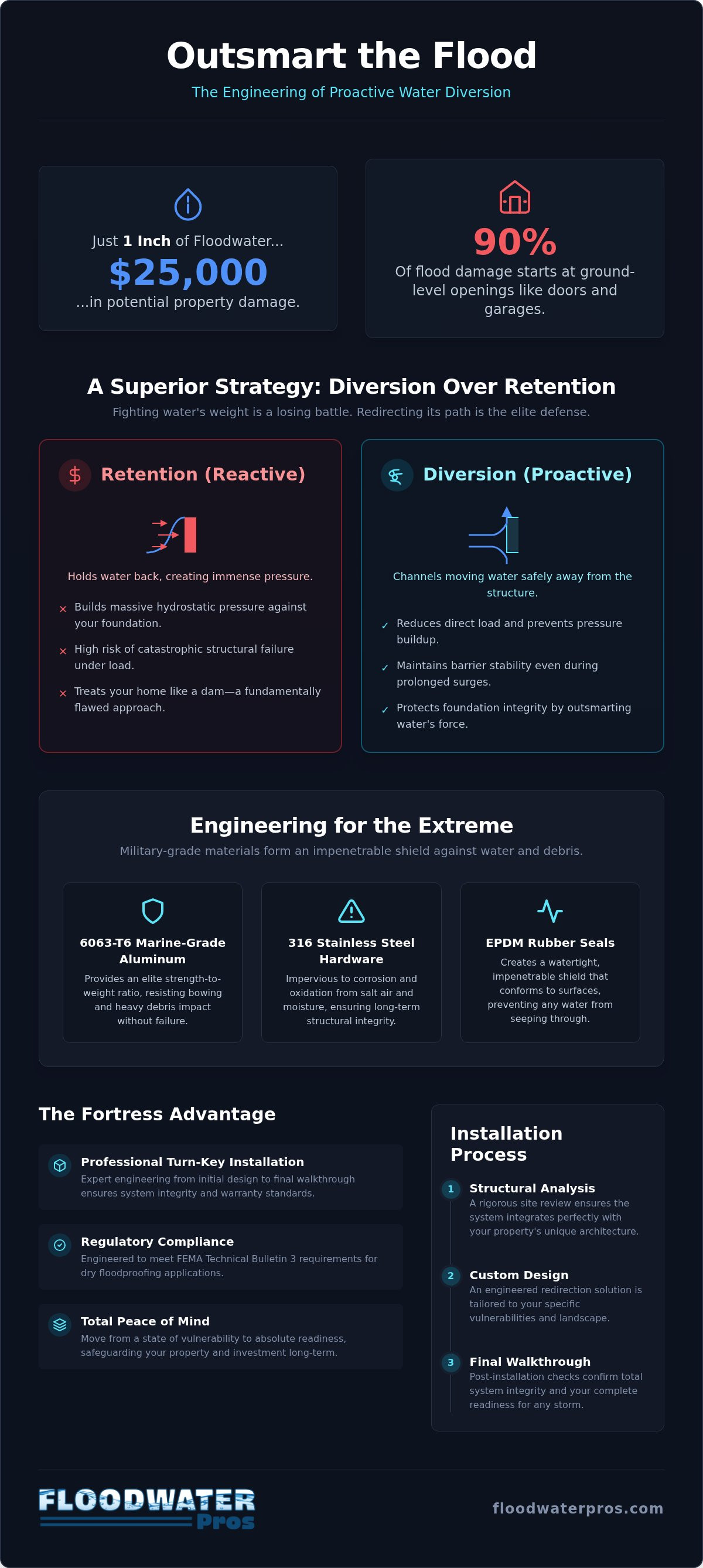
One inch of floodwater is enough to cause $25,000 in damage to your property. It's a staggering reality for anyone living in a high-risk zone. You've likely felt that familiar dread as storm clouds gather. You know that 90% of flood damage starts at ground-level openings like your front door or garage. Many homeowners search for Fortress Flood Diversion System reviews because they're tired of temporary barriers that fail when the stakes are highest. You want a solution that doesn't just hold water back; you need a system that actively commands it to go elsewhere.
This definitive engineering analysis will show you why redirection is the ultimate defense for your home. Discover why redirection engineering outperforms traditional retention in this comprehensive review of the Fortress Flood Diversion System. We're going to examine the 6063-T6 marine-grade aluminum construction and the EPDM rubber seals that create an impenetrable shield. By the end of this guide, you'll understand how a professional, turn-key installation provides the total peace of mind you need to face the next storm season with confidence. It's time to stop reacting to the water and start outsmarting it.
Key Takeaways
- Master the distinction between diversion and retention. Moving water away from your foundation is the elite strategy for preventing catastrophic structural failure.
- Examine the military-grade materials behind the defense. Marine-grade aluminum and stainless steel components ensure your barrier withstands heavy debris and extreme hydrostatic pressure.
- See how professional, turn-key installation secures your investment. Expert engineering from design to final walkthrough is critical for maintaining system integrity and warranty standards.
- Analyze Fortress Flood Diversion System reviews to understand the long-term value. Proactive protection is a strategic choice that safeguards your property and your peace of mind.
- Align your property defense with the latest regulatory standards. The Fortress system is engineered to meet FEMA Technical Bulletin 3 requirements for dry floodproofing applications.
The Science of Diversion: A Critical Review of the Fortress System
Traditional flood walls are reactive. They wait for the water to arrive and then fight it. This approach is fundamentally flawed for modern estates. When you read Fortress Flood Diversion System reviews, you'll see a recurring theme: the shift from retention to redirection. Retention involves holding water in place. This creates massive hydrostatic pressure against your home's foundation. The water arrives. The pressure builds. Eventually, the structure fails. Diversion, however, is a proactive engineering choice. It moves the threat.
The Fortress Flood Diversion System is not just a barrier. It is an engineered redirection solution. By guiding water around your property, it prevents the build-up of force that typically causes structural failure. This is critical because 90% of damage occurs when water finds a way through ground-level openings. Protecting an estate requires more than a temporary stopgap; it requires a strategic shield. Understanding different flood management strategies helps property owners realize that fighting the water's weight is a losing battle. Fortress changes the equation.
Why Redirection is the Superior Strategy
Static water is heavy. For every foot of depth, water exerts significant pressure on every square foot of a submerged wall. If you try to hold that water back, you're essentially turning your home into a dam. Most retention systems fail because the pressure exceeds the barrier's capacity. Redirecting the flow changes the physics. By keeping the water moving, the system reduces the direct load on the panels. This ensures the barrier remains stable even during prolonged surges. The Diversion Principle is the engineering directive to channel rising water away from structural vulnerabilities rather than merely containing its volume.
The Fortress Design Philosophy: Protection Without Compromise
Resilience is the cornerstone of this system. It isn't a sandbag or a plastic sheet; it's a permanent fortification. Every installation begins with a rigorous structural analysis. This ensures the system integrates perfectly with the existing architecture of your estate. You don't have to choose between safety and beauty. The Fortress system provides a sleek, professional appearance that remains unobtrusive until it's needed. It's about total transformation. You move from a state of vulnerability to a state of absolute readiness. This is why Fortress Flood Diversion System reviews often highlight the relief owners feel. They know their property is defended by a system that outsmarts the environment.
Engineering Breakdown: Material Strength and Structural Integrity
Water is a relentless force. When it surges against a building, it carries more than just liquid weight; it brings battering rams of debris. Many viral videos show standard flood barriers buckling or snapping under pressure. This isn't just bad luck. It's a failure of materials. Property owners reading Fortress Flood Diversion System reviews often focus on the visible panels, but the true strength lies in the metallurgical specifications. Defense requires absolute rigidity. Fortress utilizes 6063-T6 marine-grade aluminum to ensure the system doesn't just stand; it holds.
Built for the Surge: Material Analysis
The choice of 6063-T6 aluminum is deliberate. This material offers an elite strength-to-weight ratio. It provides the tensile strength needed to resist bowing even when hydrostatic pressure reaches peak levels. Coastal environments are notoriously harsh on metal. Salt air and constant moisture lead to rapid corrosion in inferior systems. Fortress counters this with 316 stainless steel hardware. These components are impervious to the oxidation that weakens standard bolts and brackets over time. This level of resilience is why Fortress Flood Diversion System reviews consistently praise the system's ability to withstand heavy debris impact without losing structural integrity.
As State-level flood mitigation policies become more stringent, the demand for certified, high-performance materials has never been higher. The Fortress system is engineered to handle extreme weather cycles. It won't degrade after a single season of sun exposure or freeze-thaw cycles. You can explore these specifications further at floodwaterpros.com to see how they apply to your specific property. The goal is a permanent defense that remains as reliable in year ten as it was on day one.
The Fortress Seal: Engineering Zero-Leakage
A barrier is only as good as its weakest point. For most systems, that point is the ground-level interface. Seepage is the enemy of dry floodproofing. Fortress solves this through advanced EPDM rubber seals. This isn't standard weatherstripping. EPDM is a high-density synthetic rubber known for its incredible durability and resistance to environmental stressors. It remains flexible in the cold and doesn't crack in the heat. The Fortress Seal acts as a multi-layered defense mechanism that utilizes high-grade compression to block every possible path for rising water. When the panels are locked into place, the gaskets create a watertight bond with the mounting tracks. This ensures that even under sustained hydrostatic load, your interior remains dry. It is the difference between a temporary stopgap and a professional engineering solution.
Diversion vs. Retention: Why Redirection is the Elite Strategy
Retention is a high-stakes gamble. Most property owners view flood defense as a battle of strength, but water always wins a direct confrontation. Traditional flood walls are designed for retention. They attempt to hold the full weight of a surge in place. This creates a catastrophic failure point. When you analyze Fortress Flood Diversion System reviews, the distinction becomes clear. You aren't just building a wall. You're implementing a strategic redirection. It's the difference between standing in the way of a stampede and opening a gate to lead it elsewhere.
The Retention Trap: Why Walls Fail
Traditional walls fail because they ignore the physics of hydrostatic load. As water depth increases, the pressure against a vertical surface grows exponentially. This force doesn't just push against the barrier; it seeks the path of least resistance. Often, that path is straight down. Retention systems lead to extreme ground saturation. This water infiltrates the soil beneath your foundation, leading to "undermining" where the earth literally washes away from under your home. The sandbag myth further complicates this. Relying on manual labor and porous materials isn't a scalable solution for high-value estates. It's a temporary fix for a permanent threat.
The Diversion Advantage: Strategic Flow Control
Diversion is about command. Instead of fighting the surge, the Fortress system utilizes your property's natural topography to guide water away. This minimizes the footprint of the flood event on your actual structure. By keeping water in motion, you drastically reduce the pressure exerted on the panels. This isn't just a physical barrier; it's a hydraulic management tool. Many Fortress Flood Diversion System reviews note that the system provides a sense of security that walls cannot match because the water never has a chance to pool and press against the building's core.
- Structural Load: Retention systems face 100% of hydrostatic pressure. Diversion reduces this by maintaining constant flow.
- Foundation Risk: Retention causes ground saturation and undermining. Diversion keeps water away from the foundation line entirely.
- Reliability: Walls have a single, static failure point. Diversion systems are engineered to handle varying volumes through active redirection.
- Long-term Value: Redirection acts as a permanent insurance hedge by preventing the root causes of structural damage rather than just blocking surface water.
Investing in a diversion system is a calculated move to protect your property's equity. It moves you beyond the cycle of repair and into a state of permanent fortification. You're choosing a system that outsmarts the environment rather than one that simply tries to survive it. Redirection is the only strategy that addresses the reality of modern environmental threats with professional precision.
Deployment and Professional Installation: From Design to Defense
Defense is an active process. It requires more than just high-grade materials. It requires professional execution. Many Fortress Flood Diversion System reviews overlook the critical engineering phase that precedes the physical barrier. You're not just purchasing a product; you're commissioning a custom-engineered defense. This process moves you from a state of vulnerability to absolute readiness through a methodical, full-service model. It's a transformation that begins with data and ends with a permanent shield.
The Engineering Phase: Custom-Fit Protection
Every property has a unique hydrological profile. You cannot rely on a generic solution for a high-value estate. FloodWater Pros acts as your strategic engineering partner. We perform a comprehensive hydrological site assessment to map exactly how water moves across your land. This ensures the system redirects flow without creating new vulnerabilities elsewhere on your property. Custom fabrication follows this analysis. The system is built to integrate perfectly with your existing architecture. It is a bespoke shield that protects your structure while maintaining its aesthetic integrity.
Professional Installation: The Guardian Standard
DIY attempts are a liability in high-stakes flood zones. A single miscalculation during installation can lead to a catastrophic breach when the surge arrives. Professional installation is the only way to ensure the guardian standard of protection. Our teams handle the precision of ground-anchor installation and rigorous seal testing. This isn't just about peace of mind. It's about structural certainty. We provide a final certification to ensure the system is ready for the next 100-year storm. This professional oversight is also essential for maintaining your system warranty and ensuring the long-term viability of the installation.
When the storm breaks, speed is your greatest ally. The Fortress system is designed for rapid deployment. Once the mounting tracks are professionally secured, the panels can be activated in minutes. It's a turn-key solution that replaces the frantic labor of sandbagging with a disciplined, engineered response. Maintenance is straightforward but vital for 20-year readiness. You'll need to inspect the EPDM seals and clear debris from the mounting tracks annually. This small investment in time ensures the system remains impenetrable for decades. Secure your property with a professional Fortress installation today to ensure your defense is ready before the next clouds gather.
The Fortress Advantage: Is it the Right Investment for Your Property?
Choosing a flood defense system is a high-stakes decision. You aren't just buying hardware. You're securing the future of your estate. Many Fortress Flood Diversion System reviews highlight the same dilemma: the cost of inaction versus the cost of professional protection. When a single inch of water creates $25,000 in damage, the math is simple. The Fortress system isn't an expense. It is a strategic hedge against environmental uncertainty. It's the difference between a total loss and a minor weather event. The Value Equation of this system is built on three pillars: military-grade materials, the physics of redirection, and professional engineering. It is a comprehensive answer to a universal threat.
Protecting Asset Value: The ROI of Resilience
Permanent flood mitigation does more than keep interiors dry; it preserves the actual market value of your property. Buyers in high-risk zones look for structural certainty. A professionally installed Fortress system provides that evidence. It signals that the estate is a fortress, not a liability. This level of preparation can have a potential impact on flood insurance premiums and deductible savings over time. You're investing in the long-term equity of your home. You're choosing a solution that commands the environment rather than one that merely reacts to it.
There is also a significant emotional return. The relief of security is profound. You can face hurricane season without the frantic dread of temporary barriers or the physical labor of sandbagging. You know your perimeter is held by marine-grade aluminum and engineered seals. This peace of mind is a luxury that traditional, reactive systems can never provide. You're choosing to be the expert who is always prepared. It's about duty toward safeguarding what is valuable to you and your family.
Conclusion: The Strategic Choice for Serious Defense
We've analyzed the engineering. We've compared the strategies. The verdict is clear. Redirection is the elite choice. While traditional walls wait to fail under pressure, the Fortress system commands the water to move. It protects the foundation from undermining. It preserves the architecture from hydrostatic collapse. It stands alone in the market as a turn-key, engineered solution for those who refuse to compromise on safety. Fortress Flood Diversion System reviews confirm that when the water rises, redirection is the only strategy that truly holds the line.
For estate owners and commercial managers, the choice is logical. Don't wait for the next surge to test a sub-par barrier. Move from vulnerability to action with a partner who understands the high-stakes nature of property defense. Take the decisive step toward total property fortification today. Secure your perimeter with a Fortress consultation and ensure your property remains a sanctuary, no matter what the environment demands. It's time to build your shield.
Command the Surge Before the Storm Breaks
Environmental threats are evolving. Your defense must evolve with them. You've seen why traditional walls fail under the weight of a rising tide. You now understand that true protection lies in proprietary redirection technology. By choosing a system engineered for high-velocity storm surges, you move from a state of hope to a state of structural certainty.
When evaluating Fortress Flood Diversion System reviews, the evidence points to a single truth: redirection is the only strategy that addresses the physics of a surge. You aren't just blocking water; you're commanding its path. With our full-service national engineering and installation model, you have a strategic partner at every step. We ensure your perimeter is impenetrable and your foundation remains secure.
Don't leave your estate's future to chance. It's time to act with the authority of a seasoned expert. Fortify your property with the Fortress Flood Diversion System today. You have the power to turn the tide. Your sanctuary is worth the investment.
Frequently Asked Questions
How does a diversion system differ from a standard flood barrier?
Diversion moves water while standard barriers simply hold it. Standard barriers face the full hydrostatic load of a surge, which often leads to structural failure or foundation undermining. The Fortress system uses hydraulic principles to channel flow away from your structure. This reduces the pressure exerted on the barrier and your home. It is a proactive engineering strategy that ensures your property doesn't act as a dam.
Can the Fortress Flood Diversion System be installed on any property type?
The system is custom-engineered for residential estates and commercial buildings. Every installation begins with a hydrological site assessment to ensure the system integrates with your property's unique topography. Whether you have a historic home or a modern glass-fronted office, the mounting tracks are custom-fabricated to fit your specific openings. This bespoke approach ensures that the defense is as effective for a garage as it is for a main entryway.
How long does it take to deploy the system when a storm is approaching?
The system can be activated in minutes once the mounting tracks are professionally installed. Because the panels are made from 6063-T6 aluminum, they are lightweight enough for rapid handling. You don't need a large crew or heavy machinery to secure your perimeter. This speed is critical when storm surges approach quickly. It allows you to transition from a state of vulnerability to total fortification with minimal physical effort.
Is professional installation required for the Fortress system?
Professional installation is mandatory to ensure system integrity and maintain the warranty. Accurate ground-anchor placement and seal testing are high-stakes tasks that require engineering precision. DIY attempts often lead to seal failure or structural instability under pressure. When reading Fortress Flood Diversion System reviews, owners emphasize that the turn-key service provided by our national installation teams is what provides their ultimate peace of mind during hurricane season.
What kind of maintenance does the Fortress Flood Diversion System require?
The system requires minimal but essential annual maintenance to ensure 20-year readiness. You should inspect the EPDM rubber seals for any signs of environmental wear and clear the mounting tracks of dirt or obstructions. Rinsing the aluminum panels after exposure to saltwater surges prevents long-term residue buildup. These simple steps ensure that the proprietary sealing technology remains watertight and ready to perform when the next environmental threat emerges.
Will the diversion system affect the aesthetic appeal of my estate?
The Fortress system is designed to be unobtrusive and maintain the architectural integrity of your estate. Mounting tracks can be color-matched to your building or even concealed within door frames. Unlike bulky permanent walls, the diversion panels are only visible when they are deployed for a storm. This allows you to enjoy your property's design without the visual burden of constant fortification. It provides military-grade security without compromising luxury.
How does the system handle floating debris or high-impact surges?
Military-grade 6063-T6 aluminum construction allows the panels to withstand high-velocity impacts from floating debris. Standard barriers often buckle when struck by logs or heavy waste carried by floodwaters. The structural rigidity of the Fortress system, combined with 316 stainless steel hardware, ensures the barrier doesn't bow or snap. It is specifically engineered to handle the chaotic environment of a 100-year storm surge where impact resistance is just as vital as water resistance.
Does the Fortress system help with flood insurance requirements?
The Fortress Flood Diversion System reviews often note its engineering alignment with FEMA Technical Bulletin 3 requirements for dry floodproofing. While we don't provide insurance brokerage, implementing certified mitigation measures can influence your property's risk profile. Documenting a professional installation of an engineered diversion system shows insurers that you have taken proactive steps to prevent damage. This investment in resilience often leads to more favorable terms and reduced deductible exposure.


