

A flood barrier is only as strong as the ground it stands on. You've likely felt that knot of uncertainty when looking at your lawn or driveway. Will the seal hold? Will the water find a way underneath? It's a high-stakes question. Most homeowners focus on the hardware, but the real victory happens during flood barrier site preparation. This is where engineering meets your specific terrain to create an impenetrable seal. Without the right foundation, even the most advanced system is just a temporary fix.
We understand the weight of protecting what you love. You want a solution that doesn't just block water but redirects it entirely without destroying your curb appeal. This guide provides a clear roadmap for site readiness. It gives you the confidence that your defense will hold under extreme pressure. We'll explore critical soil compaction standards, the difference between concrete and earth foundations, and the precise steps to ensure your property is ready for a fortress-level defense. It's time to move from concern to total structural certainty.
Key Takeaways
- Understand how minor terrain gaps create lethal bypass points that can compromise even the most advanced flood defense systems.
- Master the essential engineering steps of flood barrier site preparation to ensure a seamless, watertight seal against rising water.
- Learn to identify soil vulnerabilities like sandy erosion or clay shifts to choose the right fortification strategy for your land.
- Discover the specific foundation needs for different systems, including the Fortress Flood Diversion System and the Fortress Inflatable Flood Barrier.
- Follow a professional five-step perimeter checklist to achieve the critical "Flat-Zone" required for total structural impenetrability.
Why Site Preparation Dictates Flood Barrier Success
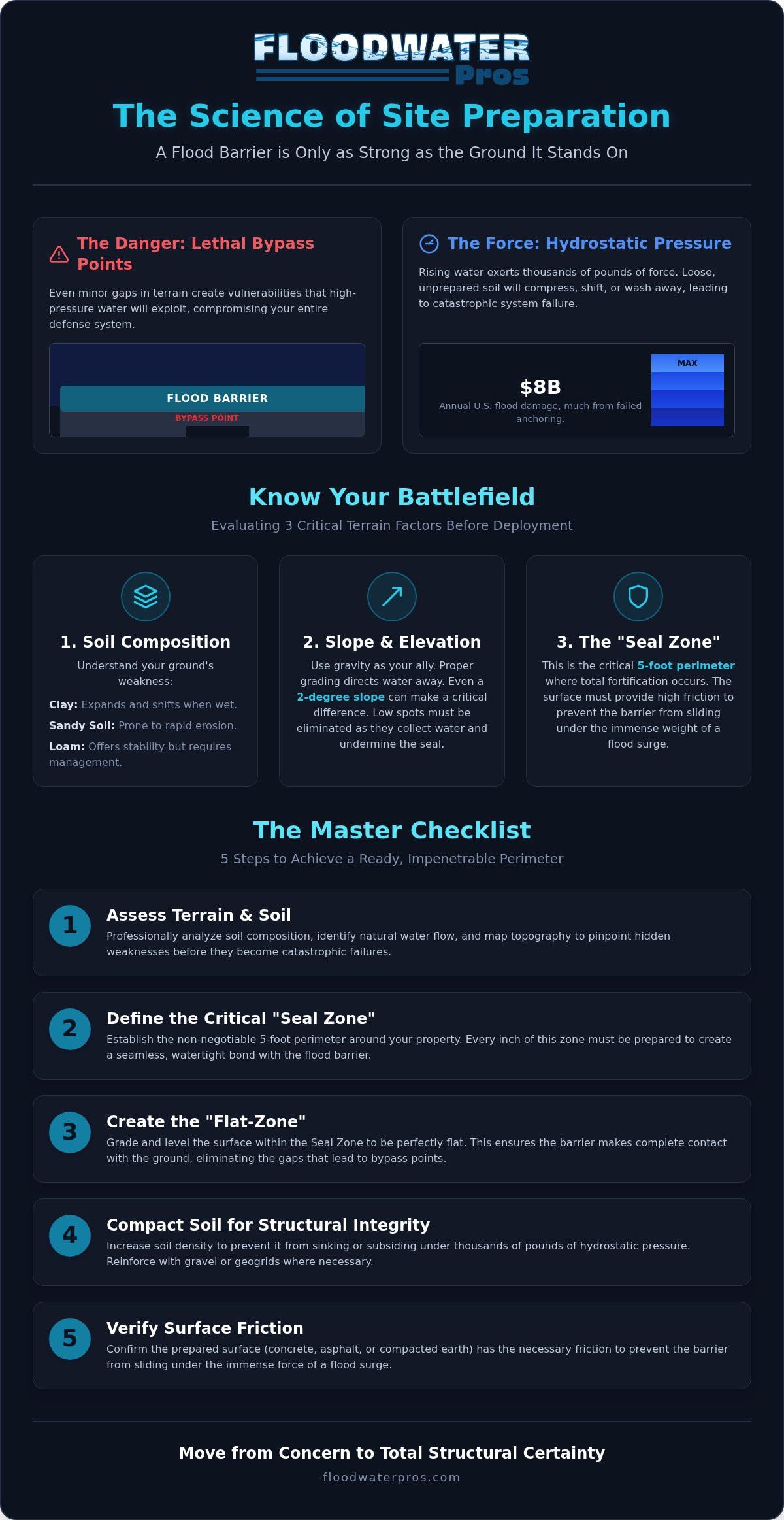
A flood barrier is a promise. It's a promise that your home will stay dry while the world outside is underwater. That promise breaks the moment the ground fails. Water doesn't negotiate; it exploits every weakness. If your terrain is uneven, you've created lethal bypass points. These tiny gaps are where the defense crumbles. Rigorous flood barrier site preparation transforms your property into a shield. It ensures the barrier and the earth act as a single, impenetrable unit. You aren't just placing a wall. You're anchoring a fortress.
Many homeowners focus only on the hardware. This is a dangerous mistake. The ground must withstand the same crushing pressure as the barrier itself. Shortcuts lead to shifting foundations. Shifting foundations lead to total structural failure. When the foundation yields, the barrier is no longer a defense; it's a liability. The annual cost of flood damage in the U.S. reaches nearly $8 billion. Much of this loss stems from systems that weren't properly anchored to the terrain. The cost of a shortcut is measured in the profound loss of what you value most.
The Role of Hydrostatic Pressure
Water weight is a relentless physical reality. It exerts hydrostatic pressure that grows with every inch of rising floodwater. This force pushes directly against the seal where the barrier meets the earth. Loose soil is the primary enemy of any diversion strategy. It compresses under load; it washes away. You must calculate the load before the storm arrives. A standard flood event can exert thousands of pounds of force against your perimeter. Different types of flood barriers have unique surface requirements to maintain their grip. If the site isn't ready, the water won't just hit the barrier. It will move it.
Site Readiness: A Strategic Imperative
Move from reactive placement to engineered fortification. This is a strategic shift that moves you from hope to certainty. Professional flood barrier site preparation identifies vulnerabilities like sandy pockets or hidden voids. It's the first line of defense. There's a profound relief in knowing your perimeter is secure. It's the peace of mind that comes from expert assessment. You aren't just buying a product; you're investing in a system verified for your specific terrain. At FloodWater Pros, we prioritize this assessment because we've seen the consequences of inaction. We build for the worst-case scenario so you can experience total tranquility.
Evaluating Terrain—Soil, Slope, and Structural Integrity
The ground is your first opponent. Before any hardware is deployed, you must understand the earth beneath your feet. Professional flood barrier site preparation begins with a cold, hard look at soil composition. Clay expands when wet, potentially shifting your barrier. Sandy soil is prone to rapid erosion, which can hollow out the foundation mid-storm. Loam offers better stability but still requires careful management. You need to map the natural flow of water across your topography before trying to change it. Mapping ensures you aren't fighting nature but directing it.
The "Seal Zone" is your field of battle. This is the critical 5-foot perimeter around your property where total fortification happens. Within this zone, surface friction is everything. Concrete and asphalt provide high-grip surfaces for mechanical seals. Grass and dirt require more intensive prep to prevent the barrier from sliding under the weight of a surge. If the friction coefficient is off, the defense fails. To ensure your property meets the necessary technical design parameters, every square inch of this zone must be accounted for. Precision here prevents disaster later.
Soil Compaction and Stability
Sinking is a silent killer of flood defenses. If the soil density is too low, the thousands of pounds of water pressure will drive your barrier into the mud. Soil compaction is the process of increasing soil density by removing air voids to ensure it can support the massive load-bearing requirements of a flood surge. We test for this density to prevent structural subsidence. When the perimeter is unstable, we reinforce it. Using gravel or geogrids creates a "hard" floor for the system. It turns soft earth into a military-grade foundation.
Managing Slope and Elevation
Gravity is a tool if you use it correctly. Proper grading ensures the Fortress Flood Diversion System directs water away from your structure rather than letting it pool. Even a 2-degree slope can dramatically change diversion dynamics. It alters where the water wants to go. Low spots are vulnerabilities; they are where water collects and undermines the seal. We address these dips during the grading process to ensure a smooth, predictable path for runoff. You can learn more about how we analyze these risks at FloodWater Pros to keep your site secure.
Preparing for Different Systems: Diversion vs. Inflatable Barriers
Not all flood defenses are created equal. Most systems on the market focus purely on retention; they attempt to hold back the surge with a static wall. This creates massive pressure points and increases the risk of a catastrophic breach. The Fortress Flood Diversion System operates on a different principle. It redirects the energy of the water. This strategic shift changes your flood barrier site preparation requirements. You aren't just building a dam. You're creating a bypass. This requires a deeper understanding of your property's footprint and the specific hardware you've chosen to stand guard.
Fortress Flood Diversion System Requirements
Diversion is an active defense. It requires a clear, unobstructed path for water to flow away from your structure. You must clear all debris and vegetation along the intended diversion line. Roots and shrubs create hidden channels that allow water to seep under the system. We focus on establishing a continuous structural seal. This often means clearing a specific "hard" contact zone where engineered diversion anchors can secure the system to the earth. If the redirection path is blocked by secondary structures or ornamental landscaping, the water will back up. It will find a way through. We ensure the runway is clear before the first drop falls.
Fortress Inflatable Flood Barrier Deployment Zones
Speed is the ultimate advantage of an inflatable system. However, speed is useless if the surface isn't ready. We enforce a "Zero-Debris" rule for the Fortress Inflatable Flood Barrier. A single sharp stone or a cluster of wet leaves can compromise the seal or cause a puncture under pressure. You need to prepare driveways and walkways by removing oils, moss, and loose gravel. These contaminants reduce the friction and suction needed to keep the barrier in place. Your site must also allow for rapid access. If you can't roll out the defense in minutes because of poor storage placement or blocked paths, the system's primary benefit is lost. Strategic preparation turns a temporary tool into a permanent shield.
For structures with complex entry points, the Fortress Transparent Liquid Paintable Flood Barrier offers a different path. This system requires surgically clean surfaces to ensure the liquid bond is absolute. Dirt, old paint, and masonry dust prevent the barrier from becoming part of the building's skin. Many homeowners now opt for a hybrid approach. They use permanent site preparation for diversion paths while maintaining clean zones for rapid inflatable deployment. This multi-layered strategy ensures that no matter how the storm evolves, your perimeter remains impenetrable. You are ready for anything.
The Master Checklist—5 Steps to a Ready Perimeter
Execution is the bridge between a plan and a fortress. High-performance flood barrier site preparation follows a methodical, five-step progression to ensure the hardware never meets a point of failure. This isn't just about tidying up a yard. It is about engineering a defense that remains stable when the environment becomes chaotic. You must treat your property line as a structural foundation. If the preparation is flawed, the diversion will be too.
- Step 1: Perimeter Clearing. You must remove the "invisibles" like buried roots and loose organic matter that can rot and create hollows under pressure.
- Step 2: Surface Leveling. Achieving the critical "Flat-Zone" ensures the barrier makes total contact with the ground without gaps.
- Step 3: Drainage Verification. You need to test how the site handles redirected flow to prevent secondary flooding in unprotected areas.
- Step 4: Structural Reinforcement. This involves securing anchor points and reinforcing soft soil with gravel or geogrids to handle the weight of the water.
- Step 5: Professional Calibration. A final engineer-led walkthrough confirms that every inch of the perimeter meets the required defensive standards.
Clearing the Path for Protection
The first stage of fortification is the removal of anything that could break the seal. Roots, stones, and organic debris are more than just eyesores. They are structural liabilities. Organic matter decomposes over time, creating hidden voids that water will eventually exploit. You need a clean sweep before every storm season. Existing landscaping must be evaluated. If a flower bed or a decorative stone wall sits in the diversion path, it must be modified. You are clearing a runway for the water to exit your property safely. This isn't the time for aesthetics; it's the time for resilience.
Final Leveling and Grading
Precision is your best ally against hydrostatic pressure. We use laser levels to identify even the slightest deviations in your terrain. A perfectly horizontal seal is the goal. Voids in masonry or cracks in concrete driveways are points of entry that must be filled before deployment. The Level-Seal protocol eliminates vertical variance to ensure maximum hydrostatic resistance against rising surges. When the ground is flat, the barrier can do its job. If you want to ensure your property is ready for the next surge, you can schedule a professional site assessment with our engineering team today. We turn vulnerable perimeters into impenetrable shields.
Professional Execution: How FloodWater Pros Secures Your Site
A barrier is just hardware. The real defense is the engineering that supports it. At FloodWater Pros, we go beyond the physical wall. Our approach is engineering-first. We don't just sell products; we design systems of total structural impenetrability. This begins with rigorous flood barrier site preparation. We match our Fortress products to your specific terrain to ensure every anchor point and seal is optimized for the unique challenges of your land. Whether you are installing the Fortress Flood Diversion System or an inflatable solution, the foundation must be absolute.
The "Fortress Protocol" is our methodical path from initial survey to final installation. It's a standard of excellence that ensures no detail is overlooked. We manage the entire process. This includes the heavy lifting of site prep that competitors often skip. By the time the barrier is deployed, the ground has already been transformed into a hardened foundation. This creates long-term resilience. We don't just prepare for the next storm; we build for a decade of defense. Regular site-prep reviews ensure your perimeter remains as formidable in year five as it was on day one. We identify shifting soil or new drainage patterns before they become vulnerabilities.
Engineering Your Peace of Mind
Geotechnical calculations are complex. We handle them so you don't have to. Our team analyzes soil strength and hydrostatic load with scientific precision. As a national partner, we bring local terrain expertise to every project. We've seen how different climates affect soil stability across the country. Professional installation is the only way to guarantee the performance of our systems. When the water rises, you need to know the math was done correctly. You need the confidence of an expert who has seen it all. Our installation teams act as your vigilant guardians during the entire setup process.
Your Next Step Toward Fortification
The consultation process is direct and purposeful. During your initial site visit, we map your property's vulnerabilities. We identify the natural flow of water and the necessary "Seal Zones." The best time to prepare is before the clouds gather. Waiting for a storm warning is a gamble with your property's future. Proactive flood barrier site preparation is the difference between a minor inconvenience and a total loss. It's time to move from a state of concern to a state of action. Secure your perimeter with a professional site assessment from FloodWater Pros. We are your strategic partner in protection. Let us build the foundation of your fortress.
Secure Your Perimeter: Build for the Ultimate Surge
The storm doesn't wait for your site to be ready. Water is a relentless force that exploits every gap and every weak foundation. As we've explored, the success of your defense is decided long before the first drop of rain falls. It's decided during flood barrier site preparation. By mastering soil compaction, surface friction, and the critical "Flat-Zone," you transform a vulnerable yard into a hardened fortress. You aren't just blocking water. You're controlling it.
True security comes from a professional, engineering-first approach. Proprietary Fortress Engineering ensures that your system redirects water to protect your foundation from the crushing weight of a surge. Our national installation experts handle the complex calculations so you can experience total tranquility. Don't leave your property's future to chance or poor ground contact. It's time to take the decisive next step. Fortify your property with the Fortress Flood Diversion System today. You have the knowledge and the tools to stay dry. Your home is worth the investment in professional protection.
Frequently Asked Questions
Do I need to remove my landscaping for a flood barrier installation?
Selective clearing is required to maintain structural integrity. You don't need to strip your entire yard, but the diversion path must be clear of obstructions. Roots, dense shrubs, and decorative rocks create hidden channels for water to bypass the seal. We focus on the specific footprint where the barrier meets the earth. This ensures an impenetrable bond. Strategic removal of vegetation within the deployment zone is a small price for total perimeter security.
Can a flood barrier be installed on a sloped driveway?
Installation on a slope is possible but requires precise calibration. Standard driveways often have a pitch for drainage that can affect diversion dynamics. We assess the angle to ensure the system doesn't slide or allow water to undercut the barrier. In some cases, minor grading or specialized anchors are necessary to maintain a level seal. Professional flood barrier site preparation identifies these elevation challenges before the surge arrives, ensuring the redirection path remains effective.
What is the best ground surface for the Fortress Inflatable Flood Barrier?
Hard, non-porous surfaces like concrete or asphalt provide the best grip and suction. These surfaces allow the system to create a vacuum-like seal that resists hydrostatic pressure. If you are deploying on grass or dirt, the ground must be compacted and cleared of all organic debris. Sharp stones or loose twigs are lethal to the seal. The goal is a surgically clean "deployment path" that maximizes surface friction and prevents the barrier from shifting.
How much space is needed around my house for site preparation?
We typically require a 5-foot "Seal Zone" around the perimeter of your structure. This space is necessary for clearing debris, leveling the ground, and securing the hardware. It also provides a buffer for the water to be redirected without backing up against your walls. Proper flood barrier site preparation ensures this zone is free of "invisibles" like buried roots. This clearance allows our team to perform the final engineer-led walkthrough and calibrate the system for maximum defense.
Can I do the site preparation myself or do I need a professional?
You can handle basic clearing, but technical fortification requires an expert. Removing surface debris is a great first step for any homeowner. However, geotechnical calculations and laser leveling are critical for a system that must withstand thousands of pounds of pressure. Professionals identify soil vulnerabilities and structural voids that the untrained eye might miss. Entrusting the foundation to experts is the only way to guarantee the performance of a fortress-level defense.
Will the site preparation affect my property's curb appeal?
Most preparation steps are designed to be low-profile or entirely invisible. Leveling a specific zone or reinforcing soil with buried geogrids doesn't ruin your aesthetic. It enhances your property's value by adding a layer of engineered resilience. Compare a slightly modified landscape to the catastrophic damage of a flooded interior. We work to integrate the defense into your existing terrain. You gain the profound relief of security without sacrificing the beauty of your home.
How often should I re-evaluate my site's readiness for flood season?
You should conduct a site-readiness review at least once a year. The best time is before the local flood season begins. Soil is dynamic; it shifts, settles, and erodes over time. New landscaping or nearby construction can also change how water flows across your property. A quick annual inspection ensures your "Flat-Zone" remains level and your anchor points are secure. Vigilance is the price of an impenetrable perimeter.
What happens if my soil is too soft for a heavy-duty diversion system?
Soft soil is reinforced with structural materials like gravel or geogrids to prevent sinking. If a soil density test reveals low PSI, we harden the ground to create a stable floor for the system. This prevents the barrier from subsiding under the massive load of a flood surge. We turn unstable earth into a military-grade foundation. This reinforcement ensures that even the heaviest diversion systems stay anchored while the water is redirected away from your home.


