

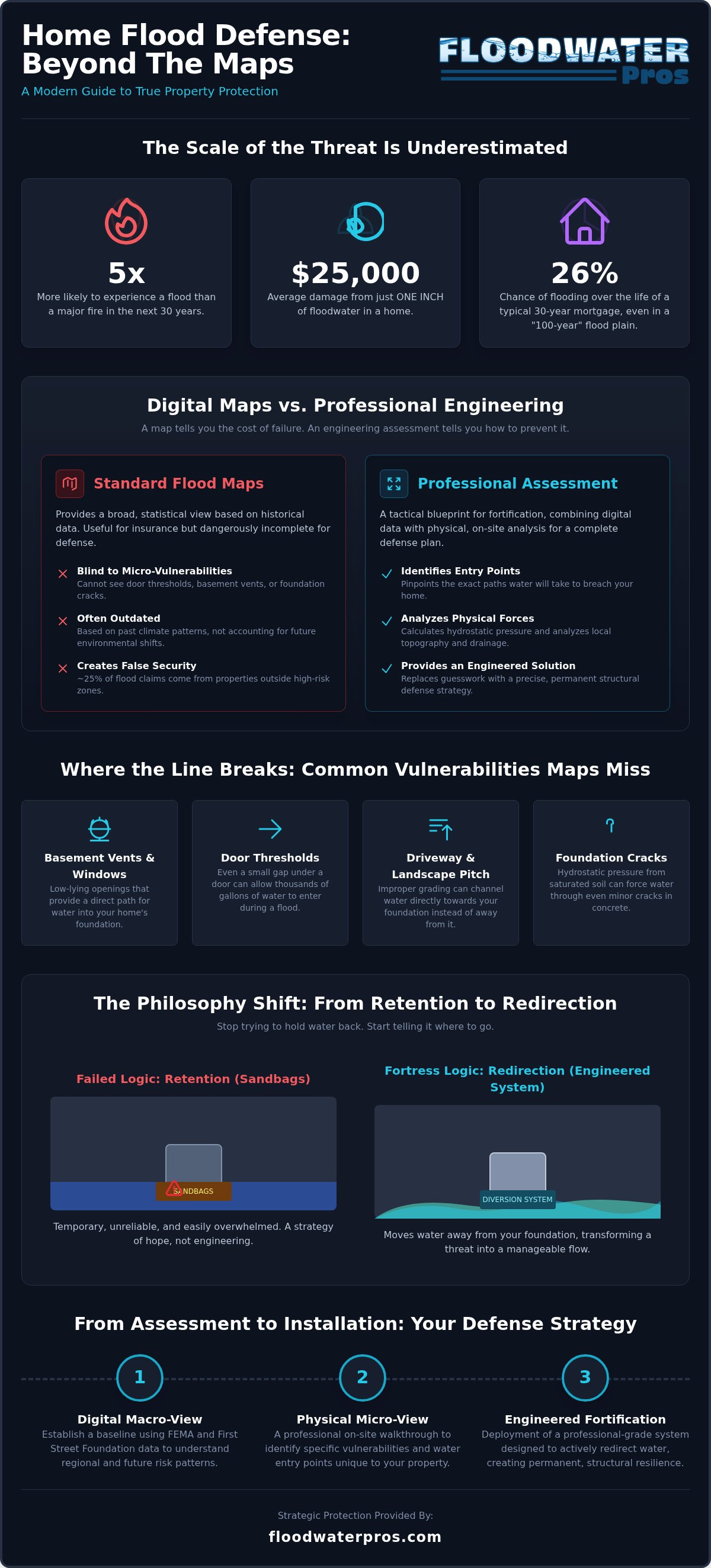
You're five times more likely to experience a flood than a fire over the next 30 years. Most properties remain dangerously under-prepared. Relying on outdated maps or the hope that it won't happen to you is a gamble with your greatest asset. A comprehensive flood risk assessment for homeowners is the only way to move past the confusion of conflicting ratings. You need to see the ground for what it is: a potential battlefield. Just one inch of water can cause $25,000 in damage. Stop reacting to the weather. Start dictating the terms of your home's defense.
It's frustrating to stare at a flood map and feel more uncertain than when you started. You deserve a shield, not a list of confusing statistics. This guide will help you master the art of identifying property vulnerabilities. You'll learn how to translate high-stakes data into a definitive fortification strategy. We'll explore the shift from temporary fixes to engineered protection. We'll cover everything from site-specific diagnostics to the deployment of professional-grade systems. Peace of mind isn't found in a sandbag; it's built through strategic, structural resilience.
Key Takeaways
- Understand why a professional flood risk assessment for homeowners must bridge the gap between digital GIS mapping and physical site realities.
- Learn to identify hidden structural vulnerabilities, such as basement vents and door thresholds, that regulatory flood maps often overlook.
- Master the philosophy of redirection to move water away from your foundation rather than relying on the failed logic of retention.
- Transition from passive observation to active fortification by identifying the specific paths of least resistance on your property.
- See how professional engineering and expert installation transform high-stakes data into a permanent, impenetrable defense strategy.
The Anatomy of a Flood Risk Assessment for Homeowners
A true defense strategy begins with intelligence. You can't fight an invisible enemy. To understand your property's real danger, you must look at What is a Flood Risk Assessment through a dual-lens approach. It combines digital macro-mapping with granular, physical site analysis. A professional flood risk assessment for homeowners isn't just a document you file for insurance compliance. It's a tactical blueprint for site fortification. It identifies where the water wants to go and how your home stands in its way. This diagnostic phase is the foundation of any engineered defense.
Relying on traditional 100-year flood maps is a dangerous relic of the past. By 2026, climate patterns have rendered these historical models insufficient. What was once a rare event is now a recurring threat. FEMA's Risk Rating 2.0 recognizes this by shifting toward property-specific variables, but even these updates can't see the specific cracks in your foundation. Insurance offers a financial safety net, but it's a false sense of security. A payout covers the cost of materials; it doesn't replace the time, memories, or the structural integrity lost to a catastrophic event. Engineered protection is the only logical evolution of home defense.
Digital Mapping: The Macro View
Your baseline data starts at the FEMA Flood Map Service Center. This tool provides the regulatory framework for your area. Most homeowners fixate on the 1% annual chance designation, often misinterpreted as the 100-year flood myth. In reality, this means there's a 26% chance of flooding over the life of a 30-year mortgage. For a more forward-looking perspective, data from the First Street Foundation is essential. They model future environmental shifts, accounting for rising sea levels and intensifying rainfall that government maps may not yet reflect. These digital tools provide the "what," but they lack the "how" of physical protection.
Site-Specific Analysis: The Micro View
Digital maps are broad brushes. They don't account for why two houses on the same street face different fates. Your specific risk profile depends on local topography and how your neighbor's drainage affects your soil saturation. A professional walkthrough identifies these micro-vulnerabilities before they become points of failure. Experts look for low-lying entry points and historical water lines that GIS data misses. Hydrostatic pressure is the resting pressure exerted by standing water against your home's foundation, which can cause basement walls to bow or crack under the weight of saturated earth. Understanding these physical forces is the first step toward deploying a Fortress Flood Diversion System.
Digital Maps vs. Professional Engineering: Choosing Your Shield
A map tells you the cost of failure. An engineering assessment tells you how to prevent it. Most homeowners stop at the regulatory stage. They look at a color-coded zone and assume they're either safe or doomed. This is a strategic error. A comprehensive flood risk assessment for homeowners must be tactical, not just administrative. It's the difference between buying an insurance policy and building a fortress. One pays for the wreckage; the other ensures there is no wreckage to pay for. You're shifting from a passive victim of geography to an active commander of your home's perimeter.
The FEMA Map Limitation
Regulatory maps serve insurers and mortgage lenders. They provide a broad statistical view of a region based on historical data. However, GIS data is blind to the specific geometry of your property. It cannot see your door thresholds. It doesn't register the basement vents that sit three inches above the soil line. Even if you're in a "low-risk" zone, poor municipal drainage or a new construction project next door can redirect thousands of gallons toward your foundation. Statistics from 2025 indicate that approximately 25% of flood insurance claims come from properties outside of designated high-risk zones. You can use FEMA flood risk tools to establish a baseline, but don't let a "Zone X" rating lull you into a state of vulnerability. Maps are a starting point, but they're not a shield.
The Fortress Engineering Advantage
True fortification requires a transition from general data to specific physics. A professional flood risk assessment for homeowners identifies the exact water entry points that a satellite cannot detect. We look at the pitch of your driveway. We analyze the permeability of your landscaping. This level of detail allows for precise barrier selection. If a storm surge is calculated at eighteen inches, a twelve-inch temporary fix is a recipe for disaster. Engineering removes the guesswork. It replaces the anxiety of "what if" with the certainty of a structural answer. When you move from simply knowing your risk to actively fortifying against it, you regain control of your home’s future. Peace of mind comes from knowing your defenses are built for the reality of your land. For those ready to move beyond maps, a professional site consultation is the first step toward a permanent, engineered defense.
Identifying Vulnerabilities: Where the Line Breaks
A flood risk assessment for homeowners isn't complete until you walk the perimeter with clinical focus. You must learn to think like the water. Water doesn't look for a challenge; it looks for the path of least resistance. The "Weak Link" theory is the cold reality of property defense. A home is a chain. One unsealed air vent or a slightly recessed garage door can compromise the entire structure. While government maps provide a broad view, checking your property's Flood Factor reveals how your specific lot interacts with the surrounding environment. This intelligence is the first step toward building a true site fortification strategy.
Your curb appeal might be your greatest liability. Decorative retaining walls or sloped flower beds often act as unintended funnels. They direct runoff straight toward your foundation rather than away from it. This realization is critical. You aren't just a victim of the weather; you are a manager of your site's hydrology. The psychological shift from feeling vulnerable to being vigilantly prepared happens when you stop seeing rain as a threat and start seeing it as a test of your engineering. Preparation replaces fear with a sense of duty toward your property's survival.
Entry Points and Structural Seams
Analyze your thresholds with precision. Garage entries are primary breach points because they often lack the structural seal of a standard entry door. Look closer at your brickwork. Weep holes are designed for ventilation but serve as open invitations for rising water. Utility penetrations for AC lines or internet cables are frequently overlooked "back doors" for flooding. For porous masonry that absorbs moisture like a sponge, the Fortress Transparent Liquid Paintable Flood Barrier provides an invisible, impenetrable seal. It protects the substrate without sacrificing the home's aesthetics. Defense must be total to be effective.
Hydrostatic Pressure and Basement Integrity
Water doesn't just come through the front door. It often comes through the floor. As the ground becomes saturated, hydrostatic pressure builds against your foundation walls. You might see signs of structural stress like fine cracks, white powdery efflorescence, or walls that have begun to bow inward. These aren't just cosmetic issues. They are warnings of imminent failure. The Fortress Flood Diversion System reduces wall pressure by redirecting the water flow away from the foundation before it can accumulate. This proactive redirection preserves the integrity of your basement and ensures your home remains a dry sanctuary during the storm.
Strategic Redirection: The Fortress Philosophy of Defense
Retention is a desperate tactic. Traditional methods like sandbags are a gamble. You're trying to hold back the crushing weight of rising water with a temporary, leaking wall. It rarely works. A comprehensive flood risk assessment for homeowners reveals a superior path: redirection. Instead of fighting the water, you outmaneuver it. You dictate the flow. This philosophy shifts the burden from your foundation to the landscape. It's the difference between a dam and a bypass. One breaks under pressure. The other thrives by removing it. This is the logical evolution of home defense. You aren't just hoping for the best; you're engineering a specific outcome.
The Power of Diversion
Perimeter diversion systems create a tactical "dry zone" around your structure. The Fortress Flood Diversion System is engineered to manage heavy runoff by guiding it toward safe discharge points. This is essential for estates or properties with significant acreage where water volume can quickly become unmanageable. By controlling the trajectory of the water, you protect the structural integrity of the main residence. Moving water is safer than holding it back because it doesn't build the same crushing hydrostatic pressure against your walls. You aren't just surviving a storm. You're managing a site's hydrology with professional-grade precision. This method is particularly effective for managing the flash floods that have become more frequent in the 2026 climate cycle. It turns your entire lot into a shield.
Modern Barrier Technology
The era of the heavy, leaking sandbag is over. Modern defense requires agility and resilience. The Fortress Inflatable Flood Barrier provides rapid deployment when minutes matter. It's a reusable, high-strength solution that creates a physical seal against rising tides. For areas where aesthetics are paramount, the Fortress Transparent Liquid Paintable Flood Barrier offers invisible protection. It seals architectural seams and porous surfaces without altering your home's appearance. Homeowners often fear that fortification means living in a bunker, but modern engineering prioritizes the visual integrity of your estate. These systems are designed to be either invisible or easily stowed when the threat passes. This ensures your property value remains intact while your defense remains impenetrable. Reusable, engineered tech is the new standard for the vigilant homeowner. It provides a level of readiness that sandbags simply can't match. You can't rely on luck when a storm surge is imminent. You need a system that's ready to deploy at a moment's notice. If you're ready to deploy a high-stakes defense, contact us for a professional site assessment today.
Executing Your Defense: From Assessment to Installation
Intelligence is only as good as the action it triggers. A flood risk assessment for homeowners provides the tactical data, but professional execution provides the actual shield. Knowing your vulnerability is meaningless without a high-stakes response. You've mapped the terrain and understood the philosophy of redirection. Now, you must translate that blueprint into a physical defense. This isn't a project for the uninitiated. It's a structural mandate. Selecting the correct Fortress components requires a seasoned expert who understands how water behaves under pressure. Whether you're deploying a Fortress Flood Diversion System or sealing architectural seams, every millimeter matters. You're not just buying a product. You're commissioning a permanent security infrastructure.
Professional On-Site Installation
DIY solutions often collapse under the weight of real-world events. Water is a relentless auditor that finds every oversight. A single gap in a liquid barrier or a poorly anchored diversion channel can compromise your entire perimeter. FloodWater Pros manages the engineering-to-installation pipeline to eliminate these points of failure. This process ensures that products like the Fortress Transparent Liquid Paintable Flood Barrier are applied to a perfectly prepared substrate. We don't just sell products; we install peace of mind. Our engineering experts handle the precision anchoring required for diversion systems, ensuring they remain steadfast when a storm surge hits. Professional installation isn't just about convenience. It's about structural certainty. We verify the load and ensure the seal is impenetrable.
Your Blueprint for Security
A permanent flood defense system offers a long-term ROI that insurance simply can't match. Consider the financial reality. With the average NFIP claim payout reaching approximately $69,000 in 2026, the cost of inaction is staggering. Recurring damage destroys more than just drywall; it erodes the resale value and structural integrity of your estate. During a FloodWater Pros consultation, we perform a forensic walkthrough of your perimeter. We look at the pitch of your soil and the height of your vents. This data allows us to recommend the precise mix of Fortress systems for your specific risk level. The result is a "Storm Ready" checklist tailored to your site:
- Verification of all entry points and structural seams.
- Deployment protocols for Fortress Inflatable Flood Barriers.
- Clearance of all diversion channels and discharge points.
- Annual inspection of liquid-applied seals and substrate integrity.
You'll gain the confidence of knowing your home is a dry sanctuary regardless of the weather cycle. You've moved from a state of anxiety to a position of seasoned wisdom and unwavering readiness. Secure your legacy; schedule a professional Fortress consultation today.
Securing Your Legacy: From Vulnerability to Victory
Awareness is only the beginning. Action is the definitive end. You've seen how a flood risk assessment for homeowners transforms vague environmental fear into a tactical plan for survival. By moving beyond the limitations of digital maps and identifying your site's physical entry points, you've already outpaced the average property owner. You now understand that redirection is the only logical path forward. The era of relying on sandbags and hope is over. You have the blueprint; now you need the shield.
It's time to build your defense. Our proprietary Fortress technology is specifically engineered for high-impact storm surges. We provide professional nationwide installation to ensure every anchor and seal is truly impenetrable. Don't leave your home's integrity to the whims of the next storm cycle. You've done the hard work of identifying the threat. Now, let us provide the engineered answer. Fortify your property with the Fortress Flood Diversion System and claim the profound relief that comes with total security. Your home is your greatest asset. Protect it with the authority it deserves.
Frequently Asked Questions
What is the most accurate flood risk assessment tool for a homeowner?
FEMA's Map Service Center is the standard for regulatory data, but it lacks the granular detail of a physical audit. A professional site-specific engineering assessment is the most accurate tool available. It identifies structural weak points like basement vents and door thresholds that digital GIS data cannot see. Combining digital macro-mapping with a physical walkthrough creates a definitive defense strategy for your specific lot.
Does my standard homeowners insurance cover the cost of flood barriers?
No, standard homeowners insurance typically excludes flood damage and the cost of mitigation systems. It's a common misconception that leads to catastrophic loss. You must secure a separate flood policy through the NFIP or a private insurer. While the national average NFIP premium in 2026 ranges between $818 and $926, these policies focus on recovery rather than prevention. Investing in engineered barriers is a proactive step that safeguards your equity.
What is the difference between a FEMA flood zone and a 'Flood Factor' rating?
FEMA flood zones are administrative tools used to determine insurance requirements and building codes. They are based on historical data that may not reflect current 2026 climate patterns. Flood Factor uses peer-reviewed models to predict future risk based on rising sea levels and intensifying rainfall. A flood risk assessment for homeowners should use both to build a complete picture of present and future danger. One looks back; the other looks forward.
How can I tell if my home is at risk for a flash flood if I'm not near water?
Approximately 25% of flood insurance claims originate from properties outside designated high-risk zones. This data from 2025 highlights the danger of flash flooding in areas far from bodies of water. Urban runoff and saturated soil can create a crisis in minutes. Identifying these risks requires a professional flood risk assessment for homeowners that looks at local topography and municipal drainage capacity rather than just proximity to a river or coast.
Are the Fortress Flood Diversion Systems permanent or temporary?
The Fortress Flood Diversion System is a permanent engineered solution for ongoing site hydrology. It works 24/7 to redirect water flow away from your foundation. In contrast, the Fortress Inflatable Flood Barrier is a deployable system meant for active storm response. This layered approach ensures your property is protected against both slow-moving saturation and sudden, high-impact surges. It's the ultimate evolution of home defense, providing a hybrid shield that is always ready.
Can I install a Fortress Inflatable Flood Barrier by myself during an emergency?
You can deploy the Fortress Inflatable Flood Barrier quickly without professional assistance during an emergency. It's designed for rapid response when minutes matter. The system is lightweight and reusable, providing a high-strength seal against rising water. While the initial diversion system requires professional anchoring, these inflatable barriers give you the agility to protect specific entry points as a storm approaches. It's a critical component of a modern, vigilant defense mindset.
How does the Fortress Transparent Liquid Paintable Flood Barrier work on brick?
The Fortress Transparent Liquid Paintable Flood Barrier works by creating an impenetrable, hydrophobic seal within the brick's pores. Brick is naturally porous and can absorb thousands of gallons during a storm. This liquid-applied defense stops water from migrating through the walls without changing the appearance of your home. It's an essential component for protecting architectural seams and utility penetrations that traditional barriers might miss. It provides military-grade security with a completely invisible finish.
What should I look for in a professional flood protection installation company?
You must prioritize engineering expertise and proprietary technology. A professional installation company should offer a full-service solution from the initial flood risk assessment for homeowners to the final deployment. Look for a team that understands the physics of hydrostatic pressure and provides professional on-site installation. Avoid companies that rely on generic, one-size-fits-all solutions. True protection requires a strategic partner that can engineer a site-specific defense and ensure every anchor is steadfast.


