

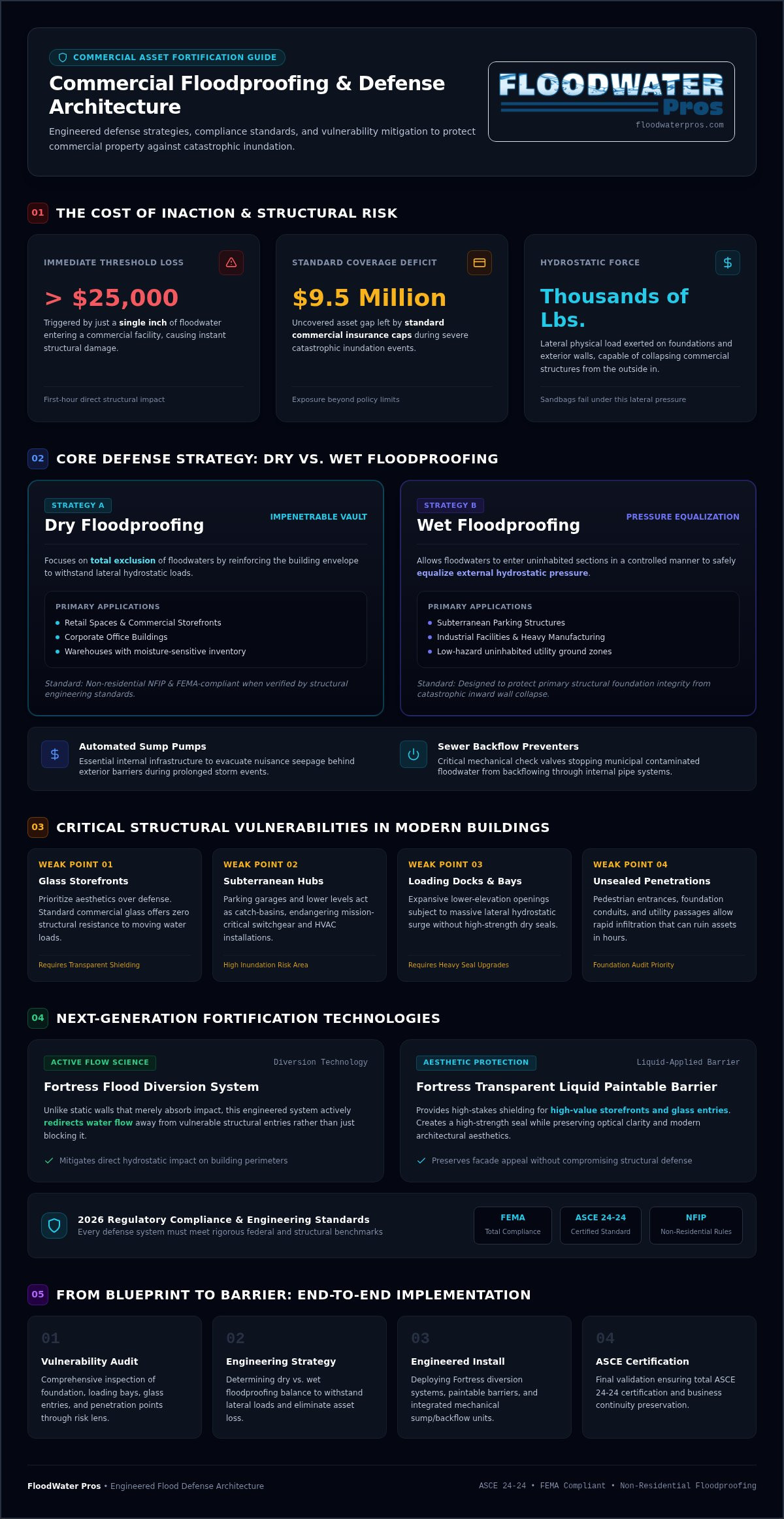
A single inch of floodwater inside your facility can trigger over $25,000 in immediate structural damage. For most commercial enterprises, that cost is just the beginning of a financial crisis. When you factor in the $9.5 million asset gap left by standard insurance caps and the catastrophic loss of business continuity, the math becomes clear. Effectively flood proofing commercial building assets requires more than hope or heavy sandbags that fail under pressure. You need a proactive, engineered defense that treats your property like the high-stakes investment it is.
We understand the weight of rising premiums and the vulnerability of operating in a high-risk zone. It's time to move beyond temporary fixes toward a permanent strategy that ensures you stay operational, no matter the weather. In this guide, you'll discover how to utilize 2026-ready technologies like invisible barriers, liquid-applied shields, and rapid-deployment diversion systems. We'll show you how to achieve total FEMA compliance and ASCE 24-24 certification while securing the absolute peace of mind that comes from a fortified, resilient structure.
Key Takeaways
- Replace high-risk, temporary measures like sandbags with engineered defenses to avoid the catastrophic financial and operational costs of even minor inundation.
- Understand when to deploy dry floodproofing to create an impenetrable seal versus wet floodproofing to safely equalize external hydrostatic pressure.
- Adopt a modern strategy for flood proofing commercial building assets by using the Fortress Flood Diversion System to redirect water flow rather than just blocking it.
- Protect high-value storefronts and glass entries using the Fortress Transparent Liquid Paintable Flood Barrier for a high-stakes shield that preserves your building’s aesthetic.
- Ensure total compliance with 2026 building codes by partnering with experts who manage the entire process from initial engineering to final professional installation.
The Cost of Inaction-Why Commercial Buildings Fail During Floods
The 2026 climate landscape has rewritten the rules of asset management. What used to be a 100-year flood is now a recurring annual threat to your bottom line. Relying on outdated maps or luck is no longer a viable business strategy. When water reaches your threshold, the failure of a single seal can trigger a cascade of structural and financial ruin. For the modern enterprise, the stakes include more than just wet carpet. They involve the total loss of inventory, the destruction of mission-critical data, and the potential for permanent closure.
Many property managers still rely on sandbags as their primary defense. In reality, these are a liability of hope. They don't stop seepage. They certainly don't counter hydrostatic pressure. This physical force can exert thousands of pounds against your foundation, literally collapsing commercial walls from the outside in. Effective temporary and permanent flood barriers must be engineered to withstand these specific loads. Without professional intervention, you aren't defending your building; you're just watching it fail. Proper flood proofing commercial building assets requires moving beyond reactive measures toward a strategy of total fortification.
Quantifying the Risk to Business Assets
A flood doesn't end when the water recedes. Direct structural damage is often eclipsed by the grueling cost of professional mold remediation and electrical replacement. Beyond the physical, your reputation is on the line. If a flood-related closure severs your supply chain, client trust evaporates instantly. In the context of flood resilience, Business Continuity is the ability of an organization to maintain essential functions during and after a disaster event through pre-engineered fortification and rapid-deployment defense systems.
The Structural Vulnerability of Modern Architecture
Modern commercial design often prioritizes aesthetics over defense. Large glass storefronts and urban retail spaces are uniquely at risk. They offer zero resistance to the weight of moving water. Subterranean parking garages and utility hubs act as massive basins, inviting water to destroy mission-critical switchgear and HVAC systems. Flood proofing commercial building assets starts with identifying these weak points. You must audit your foundation, loading bays, and pedestrian entrances through the lens of vulnerability. Every unsealed penetration is a path for total inundation that can bankrupt a business in hours.
Choosing Your Defense Strategy-Dry vs. Wet Floodproofing
The decision between dry and wet strategies defines the future of your facility. It isn't a matter of preference. It's a matter of structural survival. FEMA and the National Flood Insurance Program (NFIP) allow non-residential structures to utilize dry floodproofing, provided they meet strict engineering standards. This choice dictates how you manage the immense pressure of rising water and determines your path to business continuity. The strategy is binary: you either keep the water out or you control how it enters.
No defense is complete without internal infrastructure management. Even the most robust dry seal can experience minor seepage during prolonged events. Automated sump pumps are essential for removing nuisance water from behind your barriers. Simultaneously, sewer backflow preventers stop contaminated water from entering your facility through the pipes. A truly resilient strategy for flood proofing commercial building assets integrates these mechanical defenses with external barriers to ensure total protection.
When Dry Floodproofing is the Superior Choice
Dry floodproofing is the gold standard for retail, offices, and warehouses where inventory must remain dry. The goal is total exclusion. You create an impenetrable shield that keeps every drop away from your assets. This requires upgrading the flood resistance of the building envelope to handle lateral hydrostatic loads. High-strength seals at loading docks and pedestrian entries are non-negotiable. It's a comprehensive approach that turns your building into a watertight vault. If you're unsure which strategy fits your specific site, consulting with the experts at FloodWater Pros can clarify your engineering requirements.
The Case for Wet Floodproofing in Industrial Contexts
Industrial contexts and subterranean levels often require a different tactic. Wet floodproofing allows water to enter uninhabited spaces like parking levels, crawl spaces, or unfinished basements. This seems counterintuitive. However, it serves a vital purpose: pressure equalization. When external water heights exceed the design limits of your walls, internal water weight prevents a catastrophic structural blowout. Engineered flood vents are the key here. They allow water to flow in and out automatically, protecting the structural integrity of the foundation while minimizing repair costs. This strategy is often the only viable path for flood proofing commercial building foundations that weren't originally designed to withstand massive lateral loads.
The Science of Redirection-Deploying the Fortress Flood Diversion System
Static resistance is an invitation for failure. When you try to simply block thousands of pounds of water, you're fighting a losing battle against physics. The Fortress Flood Diversion System changes the game. It doesn't just hold water back. It turns the path of least resistance in your favor. By redirecting the flow, you strip the flood of its kinetic energy before it even touches your primary structure. This is the difference between a building that survives and one that is crushed under the weight of an inundation. It transforms a direct impact into a manageable, predictable flow.
This approach creates a critical buffer zone around your entire facility. Instead of relying solely on point-of-entry protection, you defend the perimeter. This significantly reduces the total hydrostatic load on your building’s foundation. Effective flood proofing commercial building projects must prioritize this reduction of force. If you don't manage the pressure, you risk structural cracking, slab uplift, or total wall failure. It's about taking control of the environment before the environment takes control of your assets. You need a defense that works with the physics of water, not against it.
Strategic Redirection for Large Commercial Perimeters
Large facilities have unique challenges. You have to protect more than just the main entrance. Critical infrastructure like HVAC units, external generators, and cooling towers are often the first to fail, leading to weeks of downtime. By using the natural topography of your site alongside our engineered diversion systems, we can steer water toward existing municipal drainage or designated low-lying areas. This isn't just about setting up barriers. It's about precision engineering that works with the land. For a deeper dive into the technical mechanics of this process, explore our guide on Flood Diversion System Design: Engineering the Path of Resistance.
The Fortress Advantage in High-Flow Scenarios
Velocity is the silent killer during flash flood events. Fast-moving water carries debris and exerts immense hydrodynamic force that static walls weren't designed to handle. Our diversion system is built for these high-stakes moments. It integrates seamlessly with your existing runoff systems to ensure water moves away as quickly as it arrives. Static resistance fights the flood, while engineered redirection masters it. This transformation of energy is what ensures your facility remains standing while others succumb to the current. It's a proactive shield that guarantees business continuity through superior physics. You aren't just surviving the storm. You're outmaneuvering it.
Maintaining Business Continuity-Invisible and Rapid-Response Barriers
High-stakes protection shouldn't compromise your brand's image. A retail storefront that looks like a bunker drives away foot traffic long before the rain starts. True resilience is invisible. It's about maintaining a welcoming facade while possessing the hidden strength to repel a surge. Effectively flood proofing commercial building assets involves balancing this curb appeal with military-grade security. You need systems that allow your doors to stay open for customers until the final hour of preparedness. This ensures that business operations continue without the psychological weight of a looming disaster.
The goal is a seamless transition from daily commerce to total fortification. When a storm breaks, your defense must be ready to deploy without requiring a construction crew. We focus on systems that integrate into your existing architecture. This approach prevents the 'fortress look' while providing a robust shield against inundation. It's about professional empathy for the business owner who needs to protect their investment without sacrificing the customer experience. You can secure your storefront today with a defense system that works as hard as you do.
Invisible Defense for Retail and Urban Storefronts
Standard flood panels often require unsightly permanent tracks or bulky hardware. The Fortress Transparent Liquid Paintable Flood Barrier eliminates this compromise. This advanced coating creates a hermetic seal over porous masonry and door frames without altering the building’s appearance. It's a transparent shield that preserves the envelope’s integrity. This technology ensures that even high-end glass entries remain protected from seepage without looking like a construction site. For a look at how these aesthetic-first strategies apply across different property types, see our guide on Modern Residential Flood Protection Systems.
Rapid Deployment for Flash Flood Preparedness
Flash floods don't give you days to prepare. They give you minutes. The Fortress Inflatable Flood Barrier is engineered for these exact high-pressure scenarios. These systems deploy in a fraction of the time required for traditional barriers. They are lightweight, easy to store, and simple enough for your on-site staff to activate during an emergency. This removes the 'human element' of delay. Training your team for rapid deployment ensures that your defense is as agile as the weather is unpredictable. These barriers stay tucked away in storage until the moment they're needed, ensuring your facility remains accessible and attractive throughout the year. Consistent maintenance and seasonal drills guarantee that when the water rises, your team is ready to act with total confidence.
From Blueprint to Barrier-The Professional Installation Process
Execution is the final line of defense. You can invest in the most advanced technology available, but if the installation fails, your assets remain vulnerable. A barrier is only as effective as the seal it creates against your foundation. General contractors often lack the specialized hydraulic engineering knowledge required to manage massive hydrostatic loads. They might understand construction, but they don't always understand the physics of water. Choosing a specialized partner for flood proofing commercial building projects ensures that every anchor point and compression seal is tested to military-grade standards. It's the difference between a dry interior and a total loss.
The ROI of professional installation extends far beyond the storm. Certified systems are often a requirement for significant insurance premium reductions and municipal compliance. By securing a professional sign-off, you're proving to insurers that your risk is mitigated. This proactive stance preserves your property value and prevents the devastating business interruption that follows an inundation. Maintenance is equally vital. We emphasize annual inspections and seal testing to ensure that environmental degradation hasn't compromised your shield. Readiness isn't a one-time event. It's a continuous state of vigilance.
The Engineering and Site Assessment Phase
Every successful fortification begins with data. We start by analyzing updated flood maps, local hydrology, and your structure’s specific load capacities. We don't believe in one-size-fits-all solutions. The Fortress system is customized to the exact footprint of your commercial building to ensure there are no weak points. This phase involves calculating the anticipated water height and the lateral pressure your walls must withstand. When you are consulting on commercial flood barriers for long-term strategic planning, this engineering foundation is what guarantees the system will perform under pressure. We transform raw data into a structural blueprint for survival.
Precision Installation and Final Certification
The transition from blueprint to barrier is a meticulous process. Our team manages the step-by-step installation of heavy-duty anchors and the rigorous testing of all perimeter seals. We don't just leave the hardware behind; we ensure your team knows how to use it. This includes comprehensive staff training on how to activate and store the Fortress Inflatable Flood Barrier during a flash event. Once the physical work is complete, we provide the final certification required for insurance and municipal compliance. You receive more than just a barrier. You receive a fully commissioned defense system and the profound relief of knowing your business is impenetrable. Your assets are shielded. Your continuity is guaranteed.
Fortifying Your Future Against Environmental Uncertainty
Asset fortification is no longer a luxury. It's a prerequisite for operational survival. We've detailed how engineered redirection and invisible barriers provide a defense that matches the gravity of modern environmental threats. A comprehensive strategy for flood proofing commercial building assets moves your business from a state of vulnerability to a state of impenetrable readiness. This is about more than just hardware. It's about protecting the continuity of your legacy and ensuring your doors stay open when others are forced to close.
Our team offers full-service engineering and installation across the nation. We utilize proprietary Fortress technology to ensure your facility meets the highest standards of resilience and compliance. You don't have to face the next storm with uncertainty. By choosing a partner with seasoned wisdom and unwavering readiness, you gain the profound relief of true security. Secure your commercial assets-Consult with our Flood Diversion Experts today. Take the decisive step toward total protection and lasting peace of mind.
Frequently Asked Questions
Is dry floodproofing better than wet floodproofing for commercial buildings?
Dry floodproofing is the preferred choice for retail, office spaces, and warehouses where inventory must remain completely dry. It creates a watertight seal around the building envelope to exclude all water. Wet floodproofing is a strategic alternative for industrial sites or subterranean levels. It allows water to enter specifically to equalize pressure, which protects the foundation from collapsing under intense hydrostatic loads. Your choice depends on structural load capacity.
Can flood barriers be installed on existing commercial structures?
Yes, most existing commercial structures can be retrofitted with advanced defense systems. Professional flood proofing commercial building projects often involve custom engineering to adapt barriers to current entry points and foundations. Whether you need a perimeter diversion system or point-of-entry shields, the installation process is designed to integrate with your current architecture. This ensures a robust defense without requiring a total structural overhaul or compromising your building's integrity.
How much does a commercial flood diversion system typically cost to install?
Total investment for a diversion system depends on specific engineering requirements and the total perimeter length of your property. Factors like hydrostatic head ratings and foundation anchoring will influence the final project scope. While we don't provide flat rates, the National Institute of Building Sciences reports that every dollar spent on mitigation saves an average of six dollars in future disaster costs. Professional installation ensures you avoid the catastrophic financial loss of system failure.
What is the difference between a flood gate and a paintable flood barrier?
A traditional flood gate is a visible, mechanical barrier used to block specific openings like loading docks. In contrast, the Fortress Transparent Liquid Paintable Flood Barrier is an invisible coating applied to porous surfaces and glass storefronts. It provides a hermetic seal without altering the aesthetic of your building. This allows retail businesses to maintain curb appeal while possessing a high-stakes shield that repels water intrusion at a microscopic level.
Will installing a flood barrier lower my commercial insurance premiums?
Many insurers provide premium credits or discounts for buildings that implement engineered flood mitigation. By meeting ASCE 24-24 standards and achieving FEMA compliance, you demonstrate a significantly reduced risk profile to your provider. This proactive fortification can lead to long-term savings on your National Flood Insurance Program policy. It's important to consult with your insurance representative once the professional installation and certification process is complete to verify your specific eligibility for these reductions.
How long does it take to deploy an inflatable flood barrier during an emergency?
The Fortress Inflatable Flood Barrier is engineered for high-velocity deployment in minutes, not hours. Unlike sandbags or heavy mechanical gates that require significant labor and time, these systems can be activated quickly by on-site staff. This rapid response is critical during flash flood events where every second counts. Its lightweight design and simple activation process ensure that your facility is protected long before the water reaches your threshold.
Are Fortress flood systems FEMA and NFIP compliant?
Yes, Fortress systems are engineered to meet and exceed current FEMA Technical Bulletin 3 requirements and NFIP standards. Our products are designed for compliance with the latest ASCE 24-24 building codes. This ensures that your commercial property meets the rigorous testing protocols required for dry floodproofing certification. Professional engineering and site-specific sign-offs are provided to guarantee that your defense system stands up to both environmental pressure and regulatory scrutiny.
What maintenance is required for professional flood barrier systems?
Professional systems require annual inspections to ensure every component remains in peak condition. This includes testing compression seals for elasticity and checking gaskets for any UV-related degradation or wear. We also recommend periodic deployment drills for your staff to maintain operational readiness. Regular maintenance prevents minor wear from becoming a critical failure point. A well-maintained barrier is a reliable shield that provides total peace of mind during extreme weather events.


