
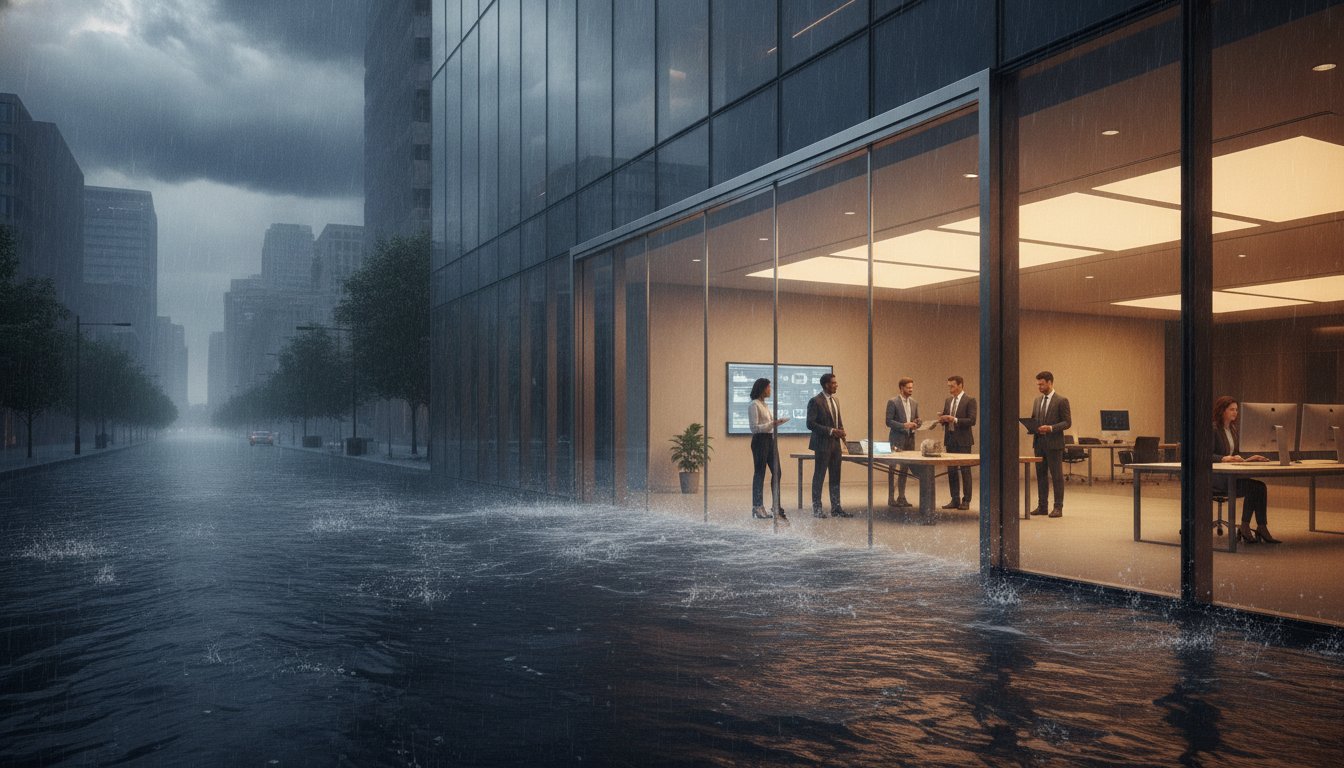
Annual flood losses in the U.S. now average more than $45 billion per year. For a business leader, these figures represent more than just data. They represent the threat of ruined inventory, months of forced downtime, and the weight of rising insurance premiums. You've spent years building your legacy. You shouldn't have to watch it wash away. It's frustrating to think that your only choices for commercial flood barriers are unsightly sandbags or total vulnerability. You need a solution that protects your assets without compromising your professional image.
This guide provides the blueprint for evaluating and integrating engineered flood defenses that work. We'll examine how the 2026 ASCE 24-24 standards redefine your flood hazard area. You'll learn to identify ANSI/FM 2510-certified products that lower liability and satisfy modern building codes. From paintable liquid barriers to rapid-deployment diversion systems, we're mapping out the path to total facility resilience.
What You Will Learn
- Understand why modern commercial flood barriers are the only thing standing between operational continuity and total asset loss.
- Master the engineering shift from water retention to energy diversion. Blocking water is a start. Redirecting it is a strategy.
- Compare specialized technologies like the Fortress Inflatable Flood Barrier and the Fortress Transparent Liquid Paintable Flood Barrier.
- Move beyond buying products to implementing a structural system. You'll learn to identify every weak point in your building envelope.
- Safeguard your facility's aesthetic and value. Real protection doesn't have to compromise your premium storefront's curb appeal.
The High Stakes of Commercial Flooding — Continuity and Asset Defense
A single flood event isn't just a weather report. For a business, it's a structural and financial assault. Most facilities are unprepared for the sheer volume of water modern storms deliver. Traditional methods like sandbags are relics of a reactive past. They're heavy, porous, and often fail when pressure peaks. Modern commercial flood barriers represent a shift toward engineered resilience. These aren't just blocks; they're sophisticated systems designed to maintain the integrity of your building envelope under extreme hydrostatic load.
The 2026 climate reality has rewritten the rules of risk. With annual flood losses in the U.S. now exceeding $45 billion, "waiting and seeing" is no longer a viable business strategy. A professional flood barrier system acts as a hard perimeter. It transforms a vulnerable storefront or warehouse into an impenetrable fortress. This proactive defense prevents the cascading failures that follow water ingress: electrical fires, mold colonization, and the total loss of specialized inventory.
Defining the Commercial Threat Landscape
Not all water behaves the same way. Flash floods in urban environments create sudden, high-velocity surges that can shatter glass and buckle doors. In contrast, slow-rise riverine flooding exerts mounting pressure over days. Effective commercial flood barriers must account for both. Urban centers face the added threat of sewer backups and street-level runoff. Managing these dynamics requires a deep understanding of the ASCE 24-24 standards. These regulations now include the 500-year floodplain. This forces businesses to defend against scenarios previously considered "once in a lifetime."
The ROI of Professional Fortification
The financial argument for fortification is clear. Insurance companies are increasingly labeling certain zones as uninsurable or applying massive deductibles. Installing a certified defense system can mitigate these costs and preserve your property's valuation. Beyond the balance sheet, there's the human element. Protecting critical infrastructure like data centers, HVAC units, and inventory hubs ensures your team can return to work the moment the clouds part. Professional systems provide a clear path to recovery.
- Reduced liability: Lower the risk of structural collapse and hazardous material leaks during a surge.
- Operational continuity: Avoid the months of downtime required for deep-core drying and reconstruction.
- Brand integrity: A well-defended facility signals stability to tenants, investors, and customers.
Peace of mind is your most valuable asset. When the alerts sound, you shouldn't be wondering if your building will survive. You should already know it will. Fortification isn't just an expense. It's a commitment to the future of your enterprise.
Retention vs. Diversion — The Engineering Evolution of Flood Defense
Water is a relentless architect of destruction. Most traditional approaches to commercial flood barriers focus on a single, flawed goal: stopping water in its tracks. This creates a damming effect. When you stop water, you're forced to absorb its kinetic energy and its mounting weight. Stagnant floodwater exerts massive hydrostatic force against your foundation; it's a silent killer that can buckle reinforced concrete and compromise structural integrity long before the water ever reaches the interior.
The Fortress philosophy represents a fundamental shift in strategy. We move from retention to redirection. Instead of acting as a static wall that waits to be hit, the Fortress Flood Diversion System acts as a strategic guide. It channels the energy of the flood away from your building's most vulnerable points. A comprehensive review of floodwall technologies confirms that managing flow is often superior to static resistance, especially in high-velocity urban environments where debris and surges are common.
The Science of Water Redirection
L-shaped diversion barriers utilize a brilliant principle of physics. The rising water actually sits on the horizontal base of the barrier. This means the flood's own weight anchors the defense system to the pavement. The higher the water rises, the more pressure it applies to the seal, making the barrier even more secure. You aren't fighting the flood; you're using its own mass to protect your assets. This allows you to steer the flow toward existing municipal drainage or lower-impact areas of your property, keeping the "line of battle" safely away from your facility's walls.
Retention Barriers: When to Block
Diversion is the primary strategy, but retention still plays a critical role at specific points of entry. You can't divert water that is already at your front door or loading dock. In these scenarios, you need an impenetrable seal. These are your "last stand" locations. The Fortress Inflatable Flood Barrier is engineered for these high-stakes gaps, providing a rapid-response seal that stops water ingress where redirection isn't an option. The most effective defense strategies don't choose between these methods. They integrate both into a layered perimeter.
By integrating these two approaches, you create a system that protects both the contents of your building and the building itself. If you're ready to move beyond temporary fixes, consider engineering a custom perimeter defense that respects the laws of physics. True resilience isn't about hope. It's about high-stakes engineering that leaves nothing to chance.
Comparing Commercial Barrier Technologies — Inflatables, Coatings, and Diversions
Choosing the right commercial flood barriers isn't just about stopping water. It's about matching the defense to the facility's specific DNA. A high-end boutique on a luxury corridor has different needs than a logistics hub in a coastal flood zone. We categorize modern technology into three pillars: rapid response, invisible protection, and structural diversion. Each serves a distinct purpose in your fortification strategy. You shouldn't have to choose between a secure facility and a beautiful one. Modern engineering ensures you can have both.
Durability is the benchmark of a professional system. Unlike consumer-grade products, these technologies are engineered for repeated deployments over decades. They resist UV degradation, chemical exposure, and the intense physical impact of flood debris. This long-term viability transforms a purchase into a permanent business asset.
Rapid Deployment with Inflatable Barriers
When flash floods strike, time is your greatest enemy. The Fortress Inflatable Flood Barrier serves as a tactical first responder. These systems are lightweight and compact when deflated. This allows for easy storage in small utility closets or loading dock corners. Once a warning is issued, your team can move from a vulnerable state to total perimeter defense in under 30 minutes. They're exceptionally versatile. They create a reliable seal on uneven terrain and around complex architectural corners where rigid, mechanical planks often fail to maintain integrity.
Invisible Defense: Paintable Liquid Barriers
For premium storefronts and historic buildings, aesthetics are non-negotiable. Traditional barriers can degrade curb appeal and signal distress to customers before a single drop of rain falls. The Fortress Transparent Liquid Paintable Flood Barrier solves this conflict. It's a breakthrough in invisible fortification. You apply this coating to glass entries and porous facades to create a 100% watertight seal. It remains virtually undetectable to the naked eye, preserving the professional image of your brand. After the threat passes, the coating peels away quickly. It leaves no residue and won't damage your building's substrate. It's the ideal solution for high-stakes retail environments that demand protection without the "fortress" look.
- Fortress Inflatable Flood Barrier: Best for rapid response and irregular perimeters.
- Fortress Transparent Liquid Paintable Flood Barrier: Best for glass entries and maintaining curb appeal.
- Fortress Flood Diversion System: Best for high-velocity structural redirection.
Success depends on selecting the right tool for the specific risk. A warehouse might prioritize the structural redirection of the Fortress Flood Diversion System. A luxury hotel might lean on the invisible shield of a liquid barrier. By understanding these technologies, you can build a layered defense that protects your inventory, your structure, and your reputation.

Facility Integration — Planning Your Perimeter Defense Strategy
Stop thinking about flood defense as a simple purchase. It is a structural integration. A pile of hardware sitting in a warehouse will not save your facility. You need an engineered system. Professional commercial flood barriers require a deep understanding of your building's envelope. Every door, vent, and utility conduit is a potential failure point. We do not just provide products. We design perimeters that stand as a unified shield against environmental chaos.
The transition from vulnerability to resilience begins with a granular site assessment. This process identifies exactly where water will attempt to breach your defenses. It is about more than just the front door. We look at the loading docks, the basement vents, and the parking garage entries. By mapping these weaknesses, we ensure your defense strategy is comprehensive and leaves no gap for a surge to exploit.
The Engineering Phase: Customizing the Defense
Topography dictates the behavior of a flood. Water will always follow the path of least resistance. If you do not map your lot's elevation, your barrier might simply move the problem to another wall. We use topography mapping to predict how water will behave on your specific land. This data determines the required height and length of your system. Under the new ASCE 24-24 standards, we now account for the 500-year floodplain and future sea level changes in coastal zones. Professional installation is mandatory for structural diversion systems. These units must be anchored precisely to handle the massive energy of a high-velocity surge without shifting or buckling.
Logistics and Deployment Management
Speed saves assets. A multi-unit commercial building cannot afford confusion when the sky turns dark. You need a dedicated Rapid Response manual for your facility staff. This document assigns specific roles and ensures every seal is checked before the first drop of rain falls. Storage is the next hurdle. Your commercial flood barriers should be stored in high-priority zones that remain accessible even during power outages. We recommend climate-controlled storage to preserve the integrity of seals and gaskets over decades. Annual testing is non-negotiable. We conduct pressure tests and seal inspections to ensure your defense is ready for the 2026 storm season.
A system is only as strong as its weakest link. Regular maintenance protocols guarantee your barriers perform when the pressure is at its peak. Do not wait for the first warning to discover a degraded seal. Secure a professional site assessment today and turn your facility's vulnerability into a strategic advantage.
The Fortress Advantage — Engineered Resilience for Modern Business
Choosing a partner for your facility's defense is a high-stakes decision. You aren't just buying hardware. You're securing the future of your operations. FloodWater Pros serves as a strategic guardian for national commercial accounts. We understand that generic solutions fail when the water rises. Our approach focuses on total structural integrity and operational continuity. By integrating specialized commercial flood barriers into a cohesive plan, we move your business from a state of vulnerability to one of unwavering readiness.
The Fortress Flood Diversion System is the cornerstone of this philosophy. It represents a masterclass in redirection engineering. Instead of fighting the immense pressure of a flood, this system channels that energy away from your foundation. This preserves the structural health of your building. We provide a full-service integration that begins with professional site engineering and ends with a precise installation. This ensures your defense is calibrated to the specific hydraulic risks of your location.
A Portfolio of Protection
True resilience requires a layered defense. We deploy a specific suite of proprietary technologies to cover every possible breach point. For rapid-response perimeter control, we integrate the Fortress Inflatable Flood Barrier. It's the ideal first line of defense for sudden surges. For urban storefronts where aesthetics are critical, we apply the Fortress Transparent Liquid Paintable Flood Barrier. This creates a 100% watertight seal without altering the building's professional appearance. For large-scale industrial sites, we custom-engineer the Fortress Flood Diversion System to manage massive volumes of high-velocity water. This combination ensures that no gap is left undefended.
Start Your Fortification Today
The path to security begins with an expert consultation. Our process is methodical and data-driven. We conduct a professional flood risk assessment to identify every weak point in your building envelope. We look at topography, historical surge data, and the latest 2026 building standards. With national reach, our team provides professional installation services across the United States. We ensure your system is deployed correctly and your staff is trained for action. Don't wait for the next storm to test your limits. Secure your facility with an expert consultation from FloodWater Pros and gain the peace of mind that comes with professional fortification.
Secure Your Legacy Through Engineered Resilience
The threat of environmental volatility is no longer a distant concern. It's a present reality that demands a structural response. Throughout this guide, we've explored how commercial flood barriers have evolved from simple blocks to sophisticated diversion systems. You've learned that true protection isn't about hope. It's about high-stakes engineering that redirects water energy and safeguards your building's foundation. These systems are the difference between a minor delay and a catastrophic loss.
Your facility deserves more than a temporary fix. It requires the proprietary Fortress technology suite and a perimeter designed by experts who understand the physics of a surge. Whether you need invisible coatings for a storefront or industrial diversion walls for a warehouse, the tools for total resilience are within reach. We provide full-service national engineering and installation to ensure your defense is ready before the clouds gather. Every component is calibrated to withstand the pressure of a changing climate.
Don't leave your continuity to chance. You can transform your facility's vulnerability into a strategic advantage today. Request a Professional Commercial Flood Risk Assessment to begin your fortification. You've spent years building your business. We're here to make sure it stays standing.
Common Questions About Commercial Flood Defense
How do commercial flood barriers differ from residential versions?
Commercial grade systems are built to meet rigorous standards like ANSI/FM 2510. They're engineered to withstand massive hydrostatic pressure and repeated deployments over decades. Residential products often lack the structural certifications required for high-stakes business assets. A professional system acts as a military-grade shield. It protects the building envelope and specialized inventory that residential versions simply aren't designed to handle.
Can flood barriers be installed on uneven commercial surfaces like asphalt or gravel?
Flexible technology allows for protection on irregular terrain. The Fortress Inflatable Flood Barrier is specifically designed to conform to uneven asphalt or architectural gaps. While rigid diversion systems require a level concrete interface for a perfect seal, inflatable options provide a rapid, adaptable solution. This ensures that even difficult lots with varying elevations can maintain a secure, watertight perimeter during a surge.
What is the typical deployment time for an inflatable commercial barrier?
You can move from a state of vulnerability to total fortification in under 30 minutes. This rapid response is essential when flash flood warnings are issued in urban centers. The Fortress Inflatable Flood Barrier is lightweight and requires minimal staff to deploy. It eliminates the need for heavy machinery or external contractors, allowing your facility team to act decisively before the water reaches your doors.
Are there invisible flood protection options for retail storefronts?
High-end retail environments can utilize the Fortress Transparent Liquid Paintable Flood Barrier for invisible protection. This coating creates a 100% watertight seal on glass entries and porous facades. It remains undetectable to customers, preserving your storefront's premium curb appeal. Once the threat passes, the barrier peels away quickly. It leaves no residue and ensures your professional image remains intact throughout the storm season.
How do these systems impact commercial insurance rates?
Certified commercial flood barriers are a critical component in reducing liability and satisfying insurer requirements. While we aren't brokers, carriers often recognize ANSI/FM 2510-certified products as a major risk mitigation factor. Properties equipped with professional-grade defenses demonstrate a commitment to continuity. This proactive stance can lead to lower deductibles and more favorable terms in zones previously considered high-risk or uninsurable.
Do I need professional installation for a flood diversion system?
Professional installation is essential for structural systems like the Fortress Flood Diversion System. These units are engineered to redirect massive kinetic energy, which requires precise anchoring and seal calibration. Attempting a DIY setup on a commercial scale risks catastrophic failure during a surge. Expert technicians ensure the system integrates with your site's specific topography and meets all local building codes and ASCE 24-24 standards.
What maintenance is required for a commercial-grade flood wall?
Maintaining a professional-grade system requires annual seal inspections and deployment drills. You must verify that gaskets haven't degraded and that inflatable components remain airtight. Climate-controlled storage is recommended to preserve the integrity of the materials. Regular testing ensures that your defense is ready for the 2026 storm season. A proactive maintenance schedule transforms your equipment from a purchase into a reliable, long-term business asset.
Can these barriers withstand high-velocity debris during a storm surge?
Professional diversion systems are engineered to resist the impact of high-velocity debris. Unlike temporary sandbags, the Fortress Flood Diversion System utilizes structural physics to redirect the force of the surge. This prevents the barrier from shifting or buckling under the weight of floating objects. It's a high-stakes defense suite built for the chaotic reality of modern storm surges, ensuring your perimeter remains impenetrable.


