

Trying to hold back a flood is a losing battle against physics. When thousands of pounds of water press against a building, traditional containment methods like sandbags often fail. You've likely felt that familiar anxiety as the clouds darken, wondering if your current defenses will buckle under the weight of a surge. A high quality perimeter flood diversion barrier changes the math of protection. Instead of acting as a temporary dam, it functions as a strategic shield. It's time to stop fighting the water and start outsmarting it.
We understand the exhaustion that comes from relying on unreliable, temporary solutions. You deserve a professional, engineered defense plan that offers more than just a hope for dry floors. This 2026 guide reveals how to move water away from your structure to ensure absolute security. We'll explore the latest advancements in redirection technology, including the Fortress Flood Diversion System and rapid response inflatable barriers. You're about to discover how proactive engineering provides the peace of mind you've been missing. It's the difference between hoping for the best and being ready for anything.
Key Takeaways
- Shift your strategy from containment to redirection. Moving water away from your foundation prevents the structural failure caused by intense hydrostatic pressure.
- Master the mechanics of a perimeter flood diversion barrier. These systems are engineered to intercept high velocity flows and reroute them toward safe municipal drainage zones.
- Choose the right defense for your specific risk level. Compare the permanent Fortress Flood Diversion System with the rapid response capabilities of the Fortress Inflatable Flood Barrier.
- Secure your property with professional installation. A truly resilient defense requires expert engineering and precise anchoring to withstand the force of a 500 year storm.
The Perimeter Mandate: Why Redirection Is the Ultimate Defense
Defense begins at the boundary. In a world of intensifying storms, relying on a simple door seal is a tactical error. A perimeter flood diversion barrier creates a structural perimeter that intercepts and reroutes high-velocity water before it ever touches your asset. This is the 2026 standard for high-value properties. You don't just wait for the water to arrive; you dictate where it goes. By defending the property line rather than the entrance, you preserve the landscape and the foundation alike. It's a proactive shift from passive resistance to active control.
Retention vs. Redirection: Understanding the Physics
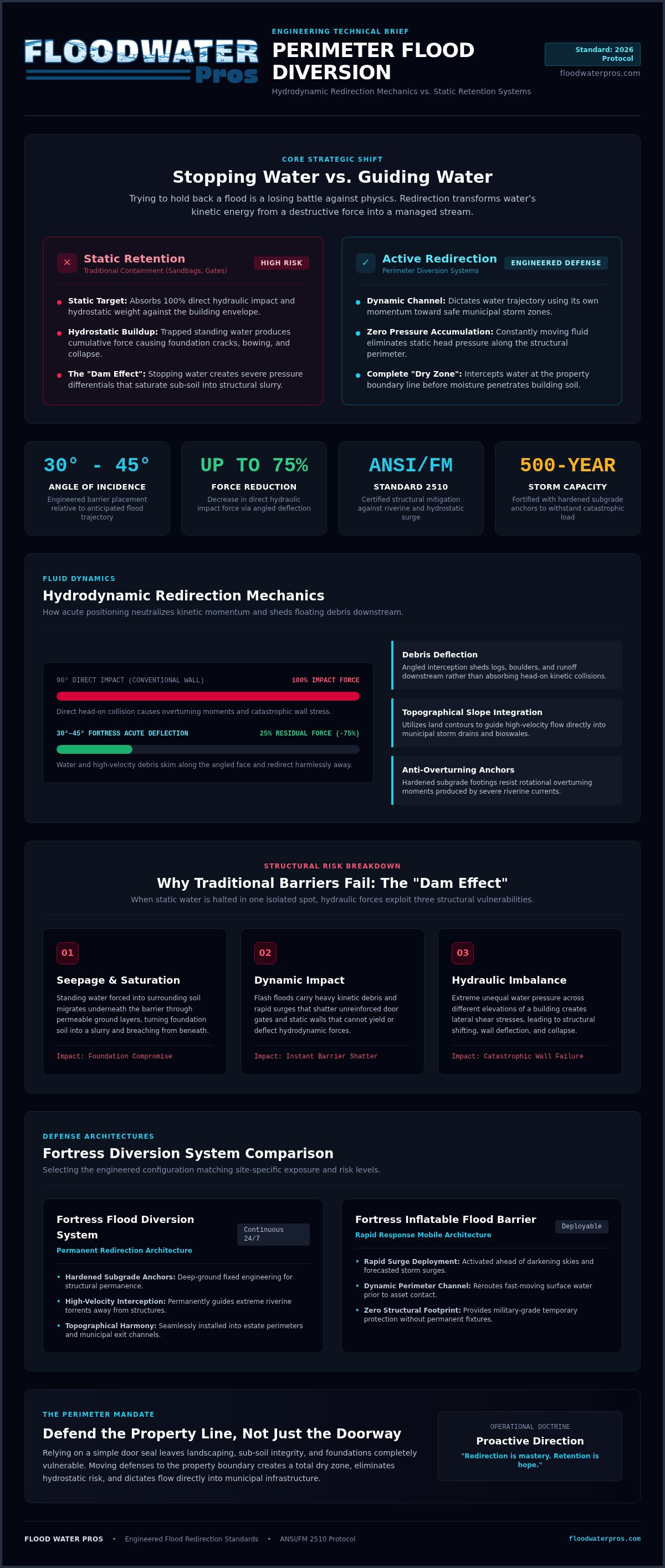
Retention walls are static targets. They absorb impact. They hold weight. Eventually, they fail. Redirection systems are dynamic. They use the water's own momentum to guide it toward safe exit points like municipal drains or designated basins. Hydrostatic pressure is the cumulative force exerted by standing water against a structure's foundation, often leading to cracks, bowing, or complete collapse as the fluid weight exceeds the wall's load-bearing capacity. By utilizing engineered flood barrier systems designed for redirection, you eliminate this pressure buildup entirely. It's the difference between a shield that breaks and a channel that leads.
Why Traditional Barriers Fail Under Surge
Traditional barriers often create a "Dam Effect." When you stop water in one isolated spot, you increase the hydraulic load on the surrounding soil and adjacent structures. This leads to several failure points that standard solutions ignore:
- Seepage and Saturation: Water forced into the soil can bypass the barrier through the ground itself, compromising the foundation from below.
- Dynamic Impact: Flash floods carry debris and high-velocity kinetic energy that can shatter unreinforced gates.
- Hydraulic Imbalance: Uneven pressure on different sides of a building can cause structural shifting or catastrophic wall failure.
A true perimeter flood diversion barrier ensures the entire property remains a "dry zone." It prevents the soil from turning into a saturated slurry. It keeps the structural integrity of your investment intact by keeping the water at a safe distance. This isn't just about keeping floors dry; it's about ensuring the ground beneath your feet stays solid.
Proactive protection is about controlling the environment. Redirection is a strategy of mastery; retention is a strategy of hope. For those who cannot afford the consequences of failure, the choice is clear. You must move the threat away from the asset's foundation to achieve absolute security. This is the Fortress philosophy. We don't just block the surge. We command it.
Redirection Mechanics: The Engineering Behind Diversion Barriers
Engineering a perimeter flood diversion barrier requires more than just raw mass. It requires a sophisticated understanding of fluid dynamics and topographical reality. We don't just place a barrier; we calculate where the water wants to go. The Fortress system is built on the principle of hydrodynamic flow. By positioning our barriers at an acute angle of incidence, usually between 30 and 45 degrees, we reduce direct impact force by up to 75 percent. This isn't just a wall. It's a precision instrument of redirection that sheds floating debris downstream and protects your foundation from catastrophic overturning moments.
To meet the highest safety benchmarks, our systems align with ANSI/FM 2510 flood mitigation certification standards. These protocols ensure that every component can withstand the brutal reality of hydrostatic loading and high-velocity riverine conditions. We focus on structural fortification, using hardened subgrade anchors to ensure the barrier stays rooted when the surge hits. It's about creating a definitive boundary that refuses to buckle under pressure.
The Path of Least Resistance
Topographical mapping is our first tactical move. We use the land's natural slope to move water toward strategic exit points, such as municipal bioswales or storm drains. We ensure that diverted water doesn't become a liability for your neighbors or downstream areas. It's about responsible, professional engineering. By integrating our barriers with existing landscape features, we maintain the aesthetic value of your property while providing military-grade security. Our team can help you design a custom layout through the Fortress line of products today.
Boundary Integrity and Foundation Safety
We establish a critical buffer zone between the barrier and your structure. This space allows for inspection and ensures that the building doesn't experience the crushing weight of standing water. Sub-surface sealing is mandatory to prevent under-barrier seepage, which often undermines traditional, unengineered defenses. Effective property flood mitigation solutions rely on this perimeter integrity to keep the building's dry zone truly secure. By sealing the boundary, we stop the soil from turning into a saturated slurry that could compromise your foundation's stability.
Material resilience is the final pillar of our defense strategy. We use proprietary composites that resist UV degradation and chemical corrosion. These aren't temporary fixes; they're permanent investments in your security. Every Fortress system includes professional installation as part of the service model. Our experts ensure every structural bolt is perfectly positioned to handle the hydrodynamic loads of a once-in-a-century storm. We don't leave your safety to chance.
Buying Guide: Comparing Diversion, Inflatable, and Liquid Barriers
Selecting a flood defense strategy isn't about buying a product. It's about deploying a solution that matches your risk profile. The 2026 landscape demands precision, and we've developed three distinct Fortress tiers to ensure every vulnerability is covered. The gold standard remains the Fortress Flood Diversion System. This is a permanent, professionally installed perimeter flood diversion barrier designed for high-risk zones where failure isn't an option. It stands ready 24/7; it requires zero setup time when the storm breaks. It's the definitive answer for those who prioritize absolute structural security.
For scenarios where warning times are short but the threat is temporary, the Fortress Inflatable Flood Barrier provides a tactical advantage. It's a rapid-deployment tool that transforms a vulnerable perimeter into a fortified boundary in minutes. Finally, for areas where architecture cannot be compromised, the Fortress Transparent Liquid Paintable Flood Barrier offers an invisible seal. This liquid coating provides essential protection for entry points without altering the visual character of the property. You don't have to choose between safety and style.
Permanent Fortification vs. Rapid Deployment
The decision between fixed and mobile systems often comes down to frequency and labor. You should choose the Fortress Flood Diversion System if your property faces recurring seasonal threats. It offers year-round readiness and eliminates the frantic rush of pre-storm preparation. Conversely, inflatable flood barriers for homes are ideal for hurricane season or areas with infrequent flash flood risks. While the inflatable system offers incredible flexibility, it requires a dedicated deployment team to ensure proper placement. The permanent system, while requiring an initial engineering and installation phase, provides the highest level of structural security with the least amount of operational friction.
Aesthetic Defense: The Invisible Shield
Security doesn't have to look like a bunker. Many high-value properties require protection that respects the existing architecture. This is where our transparent liquid coatings excel. These barriers are applied directly to porous surfaces, creating an impenetrable seal against rising water. They act as a critical secondary defense, complementing a primary perimeter flood diversion barrier by sealing the vulnerable gaps in your structure's exterior. By integrating these invisible shields into your defense plan, you protect your investment while maintaining its curb appeal. It's a sophisticated approach that balances military-grade resilience with aesthetic integrity.
Deployment Strategy: Assessing Your Property for Maximum Redirection
Strategy is the backbone of any resilient defense. A perimeter flood diversion barrier is only as effective as the engineering plan behind its placement. We begin every project with a rigorous site survey to identify your property's natural weaknesses. This process uncovers low-lying ingress points and maps the existing flow paths of the terrain. We don't guess where the water will go. We use hydraulic analysis to predict its behavior and position the barrier to intercept the surge at its most vulnerable entry point.
We calculate the Design Flood Elevation (DFE) specifically for your unique geography. This metric determines the necessary height and load capacity of your defense system. We then zone your defense into three layers. The primary perimeter stops the bulk of the surge. Secondary redirection guides the flow toward exit points. Tertiary sealing, often using the Fortress Transparent Liquid Paintable Flood Barrier, protects the structure's skin. Without an engineered DFE, you risk "over-topping," which occurs when water levels exceed the barrier's height. Professional engineering prevents this by sizing the system for extreme rainfall events.
The Anatomy of a Perimeter Defense Plan
We map the property boundary to establish a primary defense line that works with your landscape. This plan identifies "hard points" like driveways that require specialized, integrated gates. These elements must offer the same structural integrity as the main barrier. We also prioritize clear exit paths. Diverted water must have a designated route to leave the property safely. It's about total flow management to ensure that saving your building doesn't cause unintended damage elsewhere on the site.
Why DIY Is a Dangerous Gamble
Attempting a DIY installation is a high-stakes risk that often leads to failure. Incorrect anchoring is the most frequent point of failure. Under the weight of a surge, a poorly anchored barrier can detach and become a dangerous projectile. Hydraulic pressure calculations are complex; you can't guess the force of moving water without specialized engineering. A certified professional installation is the only way to ensure long-term reliability. Secure your property with a professional site survey to ensure your perimeter flood diversion barrier is ready for the next surge.
The Fortress Solution: Precision Engineering and Professional Installation
The Fortress philosophy is built on a single, unwavering truth. We don't just sell barriers; we install peace of mind. Every perimeter flood diversion barrier we deploy represents a complete structural transformation of your property's defense. We move beyond the "hope and pray" method of sandbags. We replace it with a calculated, military-grade strategy. This isn't a retail product you pick up at a store. It's a professional partnership designed to safeguard your most valuable assets against the rising uncertainty of the 2026 storm season.
Our end-to-end process is methodical and exhaustive. It begins with a deep-dive engineering analysis of your property’s specific hydrodynamic risks. We then transition from technical blueprints to on-site professional installation. Every component is handled by specialists who understand the high stakes of environmental threats. We don't leave the final structural bolt to chance. We ensure every anchor point is optimized to withstand the crushing weight of a surge. This level of precision is the only way to ensure the system holds the line when it matters most.
The Professional Installation Advantage
Precision is the difference between a dry interior and a catastrophic failure. We utilize laser-leveled placement to achieve zero-gap integrity across your entire property boundary. Even a minor misalignment can allow high-pressure water to bypass the system. Our crews use specialized anchoring systems specifically designed for your soil density or pavement type. Residential flood protection systems only work if installed by experts who can calculate the exact friction and ballast requirements for your site. We eliminate the guesswork that leads to DIY disasters.
Securing Your Legacy
Investing in an engineered defense is a strategic financial move. According to FEMA, just one inch of floodwater inside a structure can cause up to $25,000 in damage. The long-term ROI of the Fortress system is measured in the losses you never have to face. Beyond the numbers, consider the relief of total preparedness. You can finally experience the profound peace of mind that comes from knowing you are protected by a proactive shield. Don't wait for the next "once-in-a-century" storm to test your limits. Initiate your custom Fortress perimeter assessment today and take command of your property's future. Our team is ready to move you from a state of concern to a state of absolute security.
Command the Surge: Secure Your Structural Future
The transition from passive retention to active redirection is the most significant step you can take for your property's security. By choosing a perimeter flood diversion barrier, you aren't just blocking water; you're commanding its path. We've explored how proprietary Fortress engineering eliminates the crushing weight of hydrostatic pressure and why professional installation is the non-negotiable foundation of a successful defense. You now understand that a dry zone is only as reliable as the boundary that creates it.
The 2026 storm season won't wait for readiness. Our national professional installation network is prepared to deploy the industry's most resilient redirection-first defense philosophy on your behalf. It's time to replace the exhaustion of temporary fixes with the absolute relief of structural security. You have the knowledge to move from a state of vulnerability to a position of unwavering strength. Take the final step toward total peace of mind today. Your property is a legacy worth protecting with the highest level of engineered precision.
Secure Your Boundary—Request a Fortress Perimeter Assessment
Frequently Asked Questions
How does a perimeter flood diversion barrier differ from a standard flood wall?
A perimeter flood diversion barrier is designed to command the flow of water rather than simply blocking it. Standard flood walls act as dams. This often results in dangerous levels of hydrostatic pressure against the structure. By contrast, a diversion system uses hydrodynamic principles to reroute water toward safe exit points. This approach reduces the direct impact on your foundation and prevents the soil saturation that often causes traditional walls to fail.
Can a diversion system be installed on any type of property topography?
Most topographies can accommodate an engineered diversion system through careful site analysis. Our professional engineering team evaluates the natural slope and ingress points of your land to determine the most effective redirection path. Whether your property is flat or sloped, we customize the placement of the perimeter flood diversion barrier to utilize gravity and fluid dynamics. This ensures that water is moved efficiently toward municipal drainage systems or designated basins without creating new risks.
Is the Fortress Flood Diversion System a permanent or temporary installation?
The Fortress Flood Diversion System is a permanent, engineered solution designed for long term structural security. Unlike temporary sandbags or mobile gates, this system is a fixed perimeter defense that stands ready 24/7. It is anchored into the subgrade to withstand high velocity flows and extreme rainfall events. For those seeking a rapidly deployable but non-permanent option, we also offer the Fortress Inflatable Flood Barrier as a tactical alternative for flash flood scenarios.
Do I need professional engineering to install a perimeter barrier?
Professional engineering is mandatory for a successful and safe installation. Without a rigorous site survey and hydraulic calculations, a barrier may be improperly anchored or sized. This can lead to over-topping or even cause the barrier to become a projectile under heavy surge. FloodWater Pros manages the entire process from initial design through to professional on-site installation. This ensures your system meets the necessary hydrodynamic load capacities to protect your property legacy.
How do diversion barriers handle high-velocity water flow during a flash flood?
Diversion barriers handle high velocity water by utilizing an acute angle of incidence relative to the flow. This design choice reduces the direct dynamic impact force by up to 75 percent compared to a perpendicular wall. By shedding water and floating debris downstream, the system minimizes the overturning moment. This proactive redirection prevents the buildup of crushing fluid weight, ensuring that the structural integrity of your perimeter defense remains intact during a flash flood.
Will a perimeter barrier affect my property's drainage during normal rain?
A professionally engineered system is designed to integrate seamlessly with your property's existing drainage. During normal rainfall, the barrier doesn't impede the natural movement of water away from your structure. Our site survey identifies existing bioswales and storm drains to ensure that everyday runoff continues to flow as intended. The system is only activated as a defensive shield when flood levels reach critical heights, providing high stakes protection without disrupting daily landscape maintenance.
What maintenance is required for an engineered flood diversion system?
Maintenance for a Fortress system is straightforward but essential for 2026 readiness. We recommend periodic inspections to ensure that seals are intact and that anchoring points remain clear of debris. After any significant weather event, the barrier should be cleaned of silt or organic material to maintain its hydrodynamic efficiency. Because we provide professional installation, our team can guide you on the specific maintenance schedule required to preserve the long term resilience and structural integrity of your system.
Can these systems be integrated with existing landscaping and fences?
Yes, our systems are built to complement your existing architecture and landscape. We identify hard points such as gates and driveways to ensure the barrier integrates without sacrificing curb appeal. For areas where a visible barrier is not desirable, the Fortress Transparent Liquid Paintable Flood Barrier provides an invisible, impenetrable seal. This allows you to maintain the aesthetic value of your property while benefiting from a military grade perimeter flood diversion barrier that offers absolute security.


