
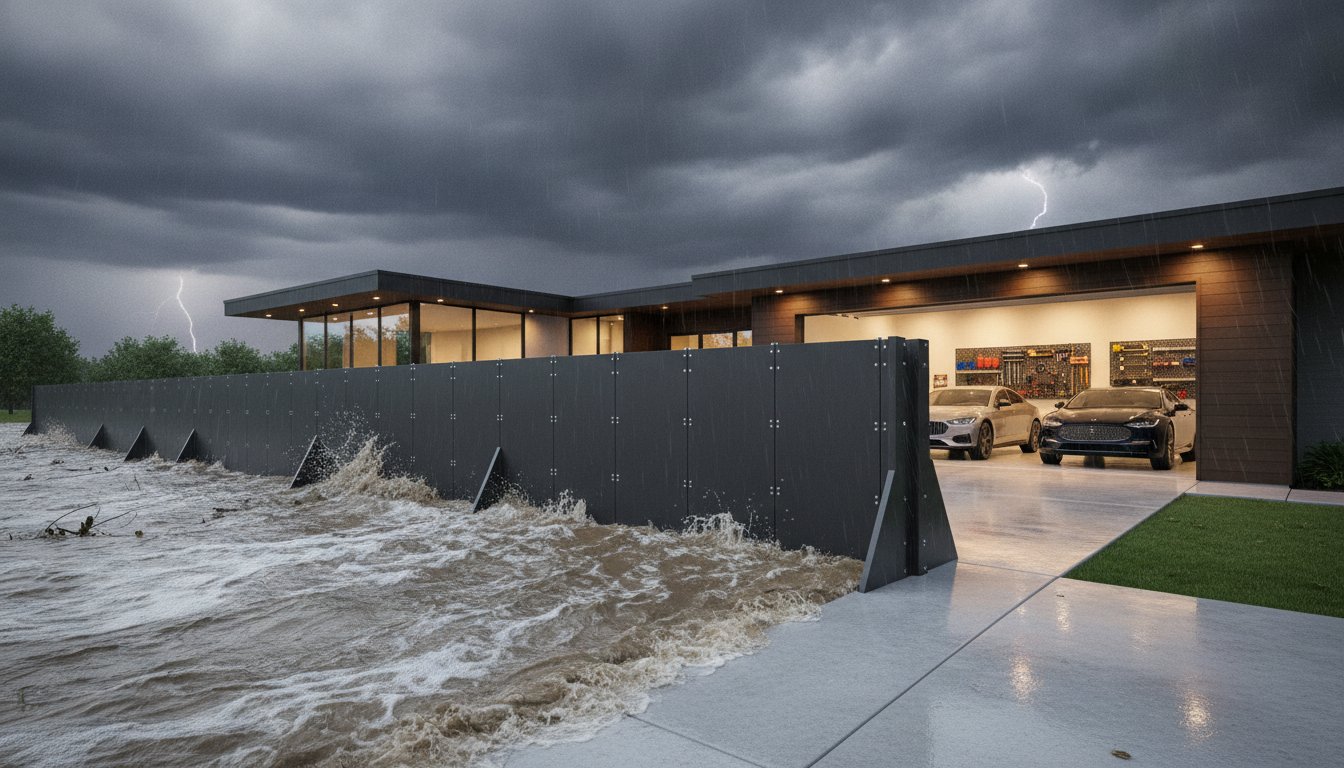
Your driveway isn't just a path for your car. During a heavy downpour, it becomes a high-speed hydraulic channel aimed directly at your garage and front door. Just one inch of water can cause approximately $25,000 in damage to your property. It's a terrifying reality for many homeowners. You've likely felt the exhaustion of hauling heavy, ineffective sandbags while watching the clouds darken. You need more than a temporary fix. You need a shield. This is where professional-grade driveway flood barriers change the game. They offer a definitive answer to the vulnerability of your home's entry point.
It's natural to feel anxious about the aesthetic impact of bulky gates or the complexity of installation. You want protection that works without turning your home into a construction site. This guide helps you master the science of driveway fortification. We'll show you how to deploy systems that neutralize flood threats in minutes, not hours. We're going to dive into the latest ANSI/FM 2510 standards and explore how to preserve your curb appeal while ensuring your home stays dry. From understanding local regulations to selecting the right deployment method, you're about to gain the seasoned wisdom needed to protect what you value most.
Key Takeaways
- Understand the "funnel effect" that turns paved surfaces into flood highways. Learn why driveways accelerate water velocity directly toward your garage.
- Shift from passive blocking to strategic diversion. Use the Fortress Flood Diversion System to protect your foundation from the crushing weight of hydrostatic pressure.
- Deploy advanced driveway flood barriers that activate in minutes. Compare high-capacity inflatable systems with transparent, paintable barriers that preserve your home's curb appeal.
- Master a 5-step defense plan to secure your entry. Learn to map historical high-water marks and calculate the precise span needed for an impenetrable shield.
- Recognize when to move beyond DIY solutions. Professional engineering ensures your defense system stands firm when environmental threats reach their peak.
The Vulnerable Entry — Why Driveways Are Flood Highways
Your driveway is a hydraulic funnel. Most homeowners don't realize that a paved surface offers zero friction to rising water. When heavy rain hits asphalt or concrete, it doesn't soak in; it gains velocity. This is the "Funnel Effect." Your driveway effectively captures every gallon of runoff from the street and accelerates it directly toward your garage. It's a high-speed delivery system for disaster. Without professional driveway flood barriers, your home sits at the end of a liquid barrel.
Once water reaches your garage door, the threat shifts from velocity to weight. This is hydrostatic pressure. It's a structural ticking clock. Standing water exerts immense force against any vertical surface. A few feet of water can exert thousands of pounds of pressure. Most garage doors aren't designed to be dams. They're designed to move. Under this load, tracks bend, panels buckle, and seals fail. It's not a matter of if the water gets in, but how much damage it does when the barrier finally snaps.
Traditional sandbags are a relic of the past. They're porous, heavy, and notoriously unreliable. They don't create a seal; they just slow the flow. As they saturate, they become breeding grounds for mold and bacteria. They shift under the weight of a current, leaving gaps that water finds instantly. Hauling them is backbreaking work that often happens too late. You're left with a heavy, contaminated mess to dispose of once the sun comes out. It's an exhausted solution for a modern problem.
Understanding your risk profile is the first step toward security. Every property is different. You must analyze your driveway's slope and the surrounding terrain. Does the street pitch toward your curb? Is your drainage system clear of debris? Even a slight incline can double the force of incoming water. Identifying these specific vulnerabilities allows you to move from reactive panic to strategic fortification.
The Physics of Driveway Infiltration
Water always seeks the path of least resistance. In most homes, that path leads straight through the garage seal. Standard weather stripping is designed to keep out drafts and insects, not a wall of water. It's powerless against the rising tide. Additionally, floodwaters carry silt and debris. This sludge clogs standard driveway drains in minutes, turning your primary defense into a liability. Once the drain fails, the water has nowhere to go but inside.
Beyond Sandbags: The Evolution of Defense
Modern protection has evolved. We've moved from burlap and dirt to engineered polymers and high-strength fabrics. A modern flood barrier represents a significant leap forward from ancient methods. These systems are designed for impenetrability and speed. The hidden costs of cheap solutions—like property devaluation and massive insurance hikes—make professional-grade driveway flood barriers a logical investment. It's about more than just staying dry; it's about the profound relief of knowing your home is secure. You're transitioning from a state of vulnerability to a position of strength.
Strategic Diversion vs. Passive Blocking — Mastering Water Flow
Stop thinking about your driveway as a battleground where you must hold back the tide. Passive blocking is a desperate struggle against physics. When you try to dam up water, you create a point of extreme pressure. This force eventually finds a weakness. Strategic diversion is different. It's about outsmarting the water. By using advanced driveway flood barriers, you change the rules of the engagement. You aren't just stopping the flow; you're taking control of it.
The Fortress Flood Diversion System is built on this principle. It doesn't just sit there. It engineers a path for water to follow. This is significantly safer for your home's foundation. When water is redirected, the hydrostatic pressure against your walls drops. You're no longer fighting the full weight of the flood. Instead, you're guiding it toward safer ground. Managing the "energy" of moving water is vital. By reducing its velocity, you prevent the soil erosion that often undermines driveways and walkways. It is a proactive approach that treats water as a force to be managed rather than an enemy to be fought.
The Logic of Redirection
Identifying "Safe Zones" on your property is the first priority. This might be a lower lawn area or a street drain located away from your structure. Diversion systems ensure that runoff never has the chance to accumulate against your garage. Flood diversion is the strategic redirection of water volume to prevent structural accumulation. While some homeowners consider permanent engineered floodwall barriers, these are often a massive undertaking. A flexible, deployable system provides the same protection without the permanent construction costs. Consulting with a specialist can help you map these high-velocity channels before the next storm hits.
Retention Barriers: When Blocking is Necessary
Redirection is the primary goal, but blocking remains a critical secondary layer. You want to create a dry "island" around your most vulnerable entry points. This requires a multi-layered defense. You use diversion to move the bulk of the water and retention barriers to seal the immediate area. The most important factor here is the ground-to-barrier interface. Without a watertight seal, the entire system fails. Modern driveway flood barriers utilize specialized seals that conform to the texture of your pavement. This ensures that even the smallest amount of seepage is neutralized. By combining these two strategies, you create a comprehensive perimeter defense that stands firm against environmental threats.
Evaluating Barrier Technologies — From Inflatables to Invisible Coatings
Your defense strategy is only as strong as the technology behind it. Selecting the right hardware is a critical decision. You need equipment that stands up to environmental violence. Heavy-duty driveway flood barriers are designed for resilience. Unlike single-use, water-activated bags that often fail under lateral pressure, professional systems are built for repeated deployment. They prioritize puncture strength and UV resistance. They ensure your investment doesn't degrade in the sun or tear on rough pavement. When the clouds gather, you don't want to wonder if your gear will hold. You want the certainty of engineered protection.
Chemical stability is another factor homeowners often overlook. Floodwater isn't just water. It's often a cocktail of oils, salts, and urban runoff. A professional barrier must resist these corrosive elements. The Fortress line is built with this reality in mind. It provides a level of structural integrity that generic alternatives simply can't match. You aren't just buying a product; you're commissioning a shield.
Inflatable Systems: High-Stakes Rapid Response
The Fortress Inflatable Flood Barrier is the heavy hitter of rapid response. It creates a stable, immovable wall using internal pressure. This system is a game-changer for long driveways. It covers wide perimeters that would otherwise require hundreds of sandbags and hours of backbreaking labor. Deployment is straightforward. You move from storage to full inflation in minutes. This speed is vital during flash flood warnings when every second counts. Because these systems use the weight of internal water or the tension of air, they conform perfectly to the ground. They eliminate the gaps that lead to seepage and catastrophic failure.
Invisible Defense: The Paintable Revolution
Luxury homes require a different approach. You shouldn't have to choose between safety and style. The Fortress Transparent Liquid Paintable Flood Barrier represents a revolutionary shift in floodproofing. It seals the microscopic "pores" of your driveway and garage entrance with a high-performance coating. This creates an invisible line of defense that stays active year-round. Transparency matters for high-end residential architecture. It preserves the clean lines of your entry while providing military-grade security. Maintenance is minimal. A simple reapplication every few years ensures the seal remains impenetrable. It's a proactive, permanent solution for the homeowner who values aesthetic preservation as much as structural integrity.
Choosing between these technologies depends on your specific risk profile. Inflatables offer high-capacity protection for extreme events. Paintable barriers provide constant, low-profile security. Often, the most effective residential plans involve a combination of both. You use the paintable coating for daily peace of mind and the inflatable system for high-stakes surges. This multi-layered approach ensures your threshold remains dry regardless of the storm's intensity.

Designing Your Defense — A 5-Step Driveway Protection Plan
Fortifying your home requires more than just high-end equipment. It requires a tactical plan. You cannot wait for the first raindrop to decide your strategy. A systematic approach ensures that when the environment turns hostile, your threshold remains impenetrable. By following a structured 5-step plan, you move from the vulnerability of "hoping for the best" to the confidence of engineered readiness. This is how you master the deployment of driveway flood barriers.
- Step 1: Map the high-water mark. Don't guess where the water will stop. Analyze historical flood data on your property. Look for waterlines on foundation walls or consult local floodplain maps. Understanding the maximum height of previous surges allows you to build a defense that won't be overtopped.
- Step 2: Calculate the span. Precision is your primary ally. Measure the total width of the defense line across your driveway. This measurement must include the anchoring points on either side of the pavement. Gaps at the edges are the most common cause of system failure.
- Step 3: Choose your tech. Match your barrier to the expected threat. High-velocity street runoff demands the structural mass of the Fortress Inflatable Flood Barrier. For high-end architectural preservation against rising seepage, the Fortress Transparent Liquid Paintable Flood Barrier is the superior choice.
- Step 4: Prepare the surface. A barrier is only as effective as the seal it makes with the driveway surface. Clear every pebble, leaf, and silt deposit from the deployment zone. Even a small piece of debris can create a pressurized bypass for water to enter your garage.
- Step 5: Practice deployment. Run a dry-drill before the storm hits. Speed is essential during a flash flood warning. Ensure every family member knows where the system is stored and how to lock it into place. A practiced defense is a successful defense.
Assessment and Measurement
A professional-grade property assessment requires more than a quick glance. Use a laser level to identify the lowest points of your driveway. These are the zones where water will accumulate first. You must also identify potential "leaks" in your perimeter, such as side gates, low curbs, or poorly positioned drains. If surge predictions suggest two feet of water, aim for a barrier height of at least three feet. This margin of safety protects you against the "wake effect" caused by passing vehicles or heavy wind. To ensure your measurements are exact, contact our engineering team for a professional consultation.
Deployment and Maintenance
Long-term reliability depends on how you treat your equipment between storms. Storage best practices are vital. Keep your systems in a cool, dry environment away from direct sunlight to prevent UV degradation. After a flood event, never pack your barriers away dirty. Wash them thoroughly with clean water to remove salts, oils, and silt. Inspect the seals for any punctures or abrasions. Proactive maintenance ensures that when the next high-stakes event arrives, your shield is ready to stand firm. You are a vigilant guardian of your property; your equipment should reflect that standard.
Beyond the Barrier — The Fortress Engineered Solution
A product is only a tool. A solution is a strategy. You can buy the best hardware in the world, but if the execution fails, the water wins. High-risk zones demand more than a weekend DIY project. They require an expert understanding of fluid dynamics and structural load. Professional-grade driveway flood barriers are most effective when they're part of a custom-engineered defense. You aren't just buying a piece of equipment; you're investing in a shield that has been calibrated for your specific property.
The FloodWater Pros approach begins long before the first clouds appear. It starts with an engineering design that considers the unique hydraulic profile of your home. We look at how water moves across your entire landscape, not just your driveway. By integrating specialized barriers into a total property protection strategy, we ensure that every entry point is a dead end for floodwaters. This comprehensive method transforms your home into a resilient structure capable of withstanding the next 100-year storm. It is the definitive move from reactive panic to seasoned readiness.
Professional Engineering vs. Retail Products
Every property has a unique topographical fingerprint. Your driveway's pitch, the surrounding soil's drainage capacity, and the street's curb height all dictate how water behaves during a surge. Retail products often ignore these variables. They offer a one-size-fits-all approach that frequently fails when subjected to extreme hydrostatic pressure. Professional installers handle complex topography and unique driveway shapes with precision. They ensure a perfect seal on irregular pavement and manage the transition zones where barriers meet structural walls. This expertise ensures compliance with local standards and ensures your system is actually certified to work as advertised. You aren't just placing a block; you're redirecting a force of nature.
The Fortress Guarantee of Preparedness
True security is more than physical. It's the emotional benefit of knowing you are protected. When you move from vulnerability to a state of total structural resilience, your relationship with the weather changes. You no longer need to monitor radar maps with a sense of dread. You can finally sleep through the storm, confident that your "Fortress" is standing guard. This peace of mind is the ultimate goal of every installation. Our systems are designed for those who refuse to leave their property's safety to chance. It's time to stop hauling sandbags and start deploying professional-grade armor. Secure your perimeter with the Fortress Flood Diversion System and ensure your home remains dry, secure, and resilient regardless of what the forecast holds.
Secure Your Threshold Against the Rising Tide
Environmental threats don't wait for your permission. Your driveway is a primary entry point that requires a strategic, engineered response. We've explored how shifting from passive blocking to active diversion preserves your foundation's integrity. Whether you deploy rapid-response inflatables or utilize invisible liquid coatings, the goal is total structural resilience. Professional driveway flood barriers are the difference between a dry garage and a catastrophic loss. You now understand the physics of infiltration and the 5-step plan required to neutralize it.
FloodWater Pros provides the proprietary Fortress Flood Diversion System technology needed for high-stakes residential and commercial defense. Our nationwide team handles professional engineering and installation to ensure your property is ready for the next 100-year storm. You don't have to face the next downpour with anxiety. It's time to replace the exhaustion of sandbags with the certainty of military-grade protection. Fortify your home with a professional flood assessment from FloodWater Pros. You have the tools and the strategy. Take command of your home's security and stand firm against the elements.
Critical Insights for Driveway Protection
Do driveway flood barriers actually work against fast-moving water?
Yes, professional driveway flood barriers are engineered to withstand significant lateral force. Unlike traditional sandbags that shift under pressure, systems like the Fortress Inflatable Flood Barrier use internal mass and tension to remain anchored. They're designed to resist the velocity of the "funnel effect" that occurs on paved surfaces. This structural integrity prevents the barrier from being swept away during high-velocity flash floods.
How long does it take to deploy a Fortress Inflatable Flood Barrier?
Full deployment typically takes less than ten minutes. Most residential systems reach operational pressure quickly using a standard pump. This rapid-response capability is vital during sudden environmental threats when every second counts. You can move from a state of vulnerability to total fortification with minimal physical exertion. It replaces hours of backbreaking labor with a streamlined, professional process.
Will a flood barrier damage my driveway or curb appeal?
No, modern defense systems are designed to protect both your structure and your property's aesthetic value. The Fortress Transparent Liquid Paintable Flood Barrier is virtually invisible once applied to your driveway and garage threshold. It provides a permanent, military-grade seal without altering your home's architectural lines. Removable systems leave zero footprint on your pavement once the storm passes and the gear is stored.
Can I leave a flood barrier out all season, or must it be removed?
The answer depends on the specific technology you choose. The Fortress Transparent Liquid Paintable Flood Barrier is a permanent solution that stays active year-round. However, inflatable or modular driveway flood barriers should be cleaned and stored after the flood threat subsides. This prevents unnecessary UV degradation and ensures your entryway remains clear for daily vehicle access. Proper storage is a key part of maintaining your shield's longevity.
What is the difference between a flood gate and a flood diversion system?
A flood gate acts as a passive block at a single entry point. In contrast, the Fortress Flood Diversion System is a comprehensive strategy that redirects water volume toward safe zones. Diversion is often safer for your foundation because it reduces the buildup of hydrostatic pressure against your walls. It manages the energy of the water rather than simply trying to hold back the entire weight of the tide.
How do I know what size barrier I need for my driveway?
You must measure the total width of your driveway and include the necessary anchoring points on either side. It's also critical to analyze historical high-water marks to determine the required height. A professional assessment identifies hidden "leaks" like low curbs or side gates that might bypass a standard barrier. Precision in measurement ensures that your defense line has no weak links when the surge arrives.
Are these barriers reusable after a major flood event?
Yes, professional-grade barriers are built for repeated deployment over many years. They feature high puncture strength and resistance to the corrosive chemicals often found in floodwater. After the water recedes, you simply wash away the silt and debris before storing the system. This durability makes them a much more cost-effective investment than single-use alternatives that require expensive disposal and replacement.
Do I need professional installation for a driveway flood barrier?
While many systems are designed for rapid deployment by the homeowner, professional installation ensures the highest level of security. Experts understand how to handle complex topography and irregular pavement textures that can compromise a DIY seal. A professional setup guarantees that your Fortress system is calibrated to your property's unique risk profile. It provides the profound relief that comes from knowing your defense is structurally sound.


