
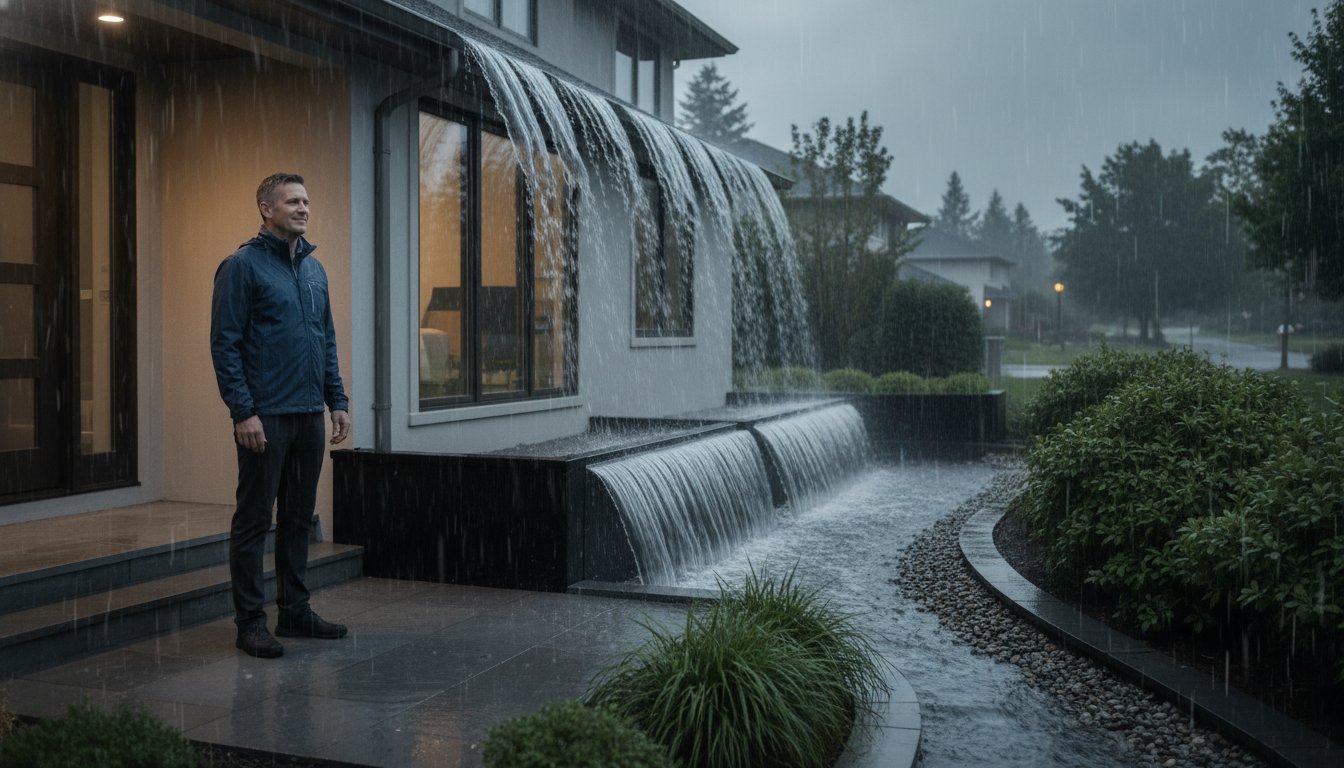
Did you know a single inch of rain on a 1,000-square-foot roof generates 562 gallons of runoff? That isn't just water. It's a heavy, relentless force capable of crushing your foundation and turning your basement into a reservoir. Learning how to redirect flood water isn't a weekend hobby. It's a strategic necessity for anyone serious about property defense. You've likely tried the traditional route. You've stacked sandbags until your back ached, only to watch seepage find the smallest cracks anyway. It's exhausting to feel like a spectator while your home's integrity hangs in the balance.
This guide transforms your approach from passive reaction to active fortification. You'll master the principles of water diversion to ensure a bone-dry foundation and the permanent peace of mind you deserve. We'll explore the logistics of swales, the structural impact of French drains, and the advanced deployment of the Fortress Flood Diversion System to secure your perimeter against the rising tide. It's time to stop managing the damage and start commanding the flow. Your property is your sanctuary. We'll help you build the shield it needs to stay that way.
Key Takeaways
- Shift your strategy from holding water to moving it. Master the mechanics of redirection to protect your foundation from the weight of rising tides.
- Fortify your terrain with a 5% grade and naturalistic swales. Discover how to redirect flood water by guiding runoff toward safe discharge points.
- Identify critical inflow points before the storm hits. Map your property's vulnerabilities to ensure doors, vents, and windows remain impenetrable.
- Compare traditional drainage to engineered Fortress systems. Learn why high-stakes defense requires professional-grade barriers over DIY methods.
- Secure long-term property safety and mental well-being. Replace the fear of basement seepage with the relief of a proven diversion strategy.
The Mechanics of Redirection: Why Retention Is Not Enough
Flood water isn't a guest you can politely turn away. It is an invasive, physical force that demands a tactical response. Redirection is the strategic movement of this water away from your most valuable assets. While many homeowners rely on retention methods like sandbags or temporary dirt mounds, these solutions often fail when the stakes are highest. Retention is a "hold it back" mentality. It creates a temporary standoff that the water eventually wins. Sandbags leak, shift, and degrade under the weight of a surge. A true defense requires a shift in thinking. You must stop trying to stop the water and start telling it where to go.
Effective Flood management strategies recognize the "path of least resistance" as a fundamental law of hydraulic engineering. Water will always find the easiest way down and out. If you don't provide a controlled path, the water will create its own through your basement windows, door seals, or foundation cracks. Learning how to redirect flood water is about mastering this energy. Your goal is to preserve the structural integrity of your foundation by ensuring that high volumes of water never have the chance to pool or press against your home's footprint.
Understanding Hydrostatic Pressure
Standing water is deceptively heavy. When flood water saturates the soil surrounding your home, it creates hydrostatic pressure. This is a constant, crushing force that pushes against your basement walls and floor slabs. This pressure doesn't just stay outside. Concrete is naturally porous. Through a wicking effect, your foundation can absorb this moisture like a sponge. This leads to internal dampness, mold, and eventually, structural bowing or cracks. Strategic redirection reduces this hydraulic load. By moving the surge away from the perimeter, you ensure the soil remains a stable support rather than a liquid threat. You're effectively removing the weight from your home's structural shield.
Diversion vs. Retention: A Strategic Shift
There is a critical tipping point where standard drainage systems fail. Most gutters and yard drains are built for typical rainfall, not flood surges. When the volume exceeds capacity, these drains back up and contribute to the problem. This is why redirection is superior to containment. A diversion strategy requires less maintenance because it uses the water's own momentum to carry it toward a safe discharge point. You aren't constantly fighting to keep a barrier dry. Instead, you are guiding the flow. This proactive approach ensures that even when the volume of water is overwhelming, your home remains a dry island in the middle of the storm.
Landscape Fortification: Utilizing Swales and French Drains
Your property’s first line of defense isn't a wall. It is the ground beneath your feet. Proper landscape grading is the fundamental starting point for any defense strategy. To effectively Prevent Water and Flood Damage, your land must maintain a minimum 5% grade away from the foundation. This means the soil should drop at least six inches over the first ten feet of distance. Without this slope, water pools against your walls and begins its slow, destructive infiltration. Understanding how to redirect flood water starts with this basic geometry. Relying on simple trenches isn't enough. You need a coordinated system that manages volume and velocity simultaneously.
A single inch of rain on a 1,000-square-foot roof produces 562 gallons of runoff. During a heavy storm, that volume can quintuple in minutes. Landscape fortification is about managing that mass before it reaches your structural footprint. While these methods are highly effective for seasonal rain, they have physical limits. During 100-year storm events, the ground becomes saturated and natural systems can overflow. This is why a layered defense is essential. Combining natural grading with professional diversion systems ensures your home remains protected even when the environment becomes extreme.
The Art of the Swale
A swale is more than a ditch. It is a shallow, vegetated channel designed to guide runoff toward a safe discharge point. To master how to redirect flood water using swales, you must calculate the capacity based on your roof’s square footage and local peak rainfall data. These channels should be positioned at least ten feet away from your foundation to prevent seepage. In areas where water moves at high speeds, lining the channel with riprap or river stone prevents soil erosion. This ensures the channel remains deep and functional during back-to-back storms rather than washing away.
Subsurface Defense: French Drains and Catch Basins
When surface diversion reaches its limit, subsurface systems take over. A high-capacity French drain uses a perforated pipe surrounded by clean gravel and wrapped in filter fabric to intercept water before it reaches your basement walls. Placing catch basins at the lowest points of your perimeter provides an immediate exit for pooling water. However, these systems aren't permanent fixes without maintenance. Silt buildup and root intrusion are common failure points that can render a subsurface drain useless during a surge. Regular inspections are the only way to ensure your underground shield remains intact and ready for the next tide.
Engineered Diversion: Comparing Traditional Drainage to Flood Barriers
Landscape solutions have physical limits. When a flash flood surges, even the best-graded soil saturates instantly. You need a system built for massive volume. Traditional drainage moves water through percolation. Engineered diversion moves it through deflection. It's the difference between a sponge and a shield. Understanding how to redirect flood water at scale requires professional-grade equipment designed to handle the energy of a moving surge. While strategies to Flood-Proof Your House often include green infrastructure, high-stakes scenarios demand structural reinforcements that can be deployed in minutes rather than months of excavation.
The primary advantage of engineered systems is speed and reliability. Permanent drainage like French drains are excellent for daily runoff, but they can't be "scaled up" when a river breaches its banks. Temporary barriers provide an adaptable perimeter. They allow you to create a custom defense line based on the specific direction of the incoming threat. The Fortress Inflatable Flood Barrier is built for this exact purpose. It transforms a chaotic environmental surge into a managed, redirected flow. This isn't just about blocking water. It's about commanding it. By choosing engineered systems, you move from a state of vulnerability to a position of strategic control.
The Sandbag Myth: Why Modern Tech Wins
Sandbags are a relic of the past. They are heavy, labor-intensive, and notoriously permeable. Under prolonged pressure, water seeps through the gaps between bags, rendering the effort useless. There are also hidden costs. Sandbags often become contaminated with biohazards during a flood, making disposal a toxic and expensive nightmare. Professional systems offer a far better ROI. They are reusable, easy to store, and provide a continuous, impenetrable seal. You aren't just buying a product. You're investing in a permanent capability to defend your property year after year.
High-Capacity Diversion Barriers
Stability is the greatest challenge in fast-moving water. Modern barriers solve this by using the water's own weight to pin the system to the ground. L-shaped barriers are particularly effective at turning a surge 90 degrees away from your assets. The critical point of any system is the seal integrity at the ground interface. The Fortress Flood Diversion System is engineered to maintain this seal even on uneven surfaces. This ensures that the redirection is total. No seepage. No failure. Just a dry foundation and the peace of mind that comes from a professional-grade defense.

Tactical Deployment: Creating a Perimeter Diversion Strategy
Tactical defense is a game of inches. You can't wait for the clouds to break before deciding where your line starts. A true perimeter strategy is built on data and observation. It is the bridge between owning equipment and actually surviving a surge. To master how to redirect flood water, you must treat your property like a fortress under siege. Strategy is your most powerful tool; gear is simply the execution of that plan.
The deployment process follows a rigid, five-step protocol designed for maximum efficiency:
- Identify Inflow Points: Locate exactly where water breaches your property line. It's often a driveway, a low curb, or a neighbor’s sloped lawn.
- Map Critical Protection Zones: Pinpoint the softest entries. Basement windows, garage doors, and air vents are the primary targets for infiltration.
- Establish a Discharge Point: You must have a destination. Ensure your redirected flow leads to a storm drain or a lower natural clearing. Never divert water directly into a neighbor’s structure. This creates legal and ethical liability.
- Select the Right Arsenal: Match the tool to the threat. Use high-capacity barriers for long perimeters and specialized coatings for fixed vents.
- Execute a Dry Run: Deploy your system on a clear day. Timing is everything. You need to know exactly how long it takes to reach full fortification before the pressure is real.
Mapping Your Property's Hydrology
You can't fight what you don't understand. Spend time observing your land during a moderate rain event. Watch for bottlenecks where water begins to pool against the foundation. These are the areas where hydrostatic pressure will be highest. If you have access to topographical maps, use them to find the natural exit routes for flood water. Your goal is to align your diversion efforts with the land's existing geometry. It's about working with gravity, not against it. Identifying these patterns early allows you to place barriers where they are most effective, not just where they are most convenient.
Securing the Perimeter
When the surge arrives, coverage must be absolute. Strategic placement of the Fortress Flood Diversion System is the key to total protection. Redirection is binary; it either works or it doesn't. A single 1-inch gap in your barrier can ruin an entire diversion plan. Water is relentless and will exploit the smallest oversight. For utility inlets and low-lying vents that can't be blocked by a physical wall, use the Fortress Transparent Liquid Paintable Flood Barrier. This creates a seamless, military-grade seal on irregular surfaces. Don't leave your home's safety to chance. Fortify every inch before the first drop falls.
The Fortress Solution: Professional Systems for High-Stakes Defense
DIY methods provide a baseline. But when the water level rises fast, you need more than a shovel and a prayer. The Fortress Flood Diversion System is the ultimate tool for those who refuse to leave their property’s safety to chance. It bridges the gap between basic drainage and total impenetrability. Learning how to redirect flood water effectively means moving beyond guesswork. It means deploying a system engineered to withstand the specific pressures of a localized surge. You need a solution that is as relentless as the tide itself. This isn't just a project. It is a strategic defense of your most valuable asset.
Professional engineering offers a level of reliability that homemade solutions cannot match. While a gravel trench might handle heavy rain, it won't stop a flash flood from hammering your basement walls. Fortress systems act as a military-grade shield. They transform your perimeter into a strategic defense line. For doors and low vents, the Fortress Transparent Liquid Paintable Flood Barrier provides an "Invisible Defense." It seals gaps without altering your home's aesthetic. This ensures that every entry point is fortified against the pressure of a rising surge. This is about more than moving water. It's about the profound relief of knowing your sanctuary is safe.
Engineered for Extreme Conditions
Material science is the backbone of the Fortress brand. Our barriers are designed for durability and resilience in the most punishing environments. These systems don't just block water; they manage its energy. The Fortress Inflatable Flood Barrier allows for rapid deployment when time is the enemy. You can secure a large perimeter in minutes, not hours. Professional installation ensures that every component functions as a single, cohesive unit. It eliminates the "weak links" that often cause DIY projects to fail during a surge. You get a no-fail performance when the stakes are highest. It is professional empathy turned into physical protection.
Taking the Next Step in Property Security
A professional consultation is the first step toward a dry home. It allows you to move from a state of concern to a state of action with minimal friction. You'll understand exactly how to redirect flood water based on your property's unique topography. Engineered systems offer long-term value that far exceeds the cost of recurring water damage. They provide a permanent solution to an environmental threat. They also offer potential insurance benefits by reducing the risk of a total loss. Take control of your property's future today. Don't wait for the water to reach your door. Secure your property with a professional diversion system.
Command the Surge: Secure Your Perimeter Today
Environmental threats don't wait for permission. You've learned that the true secret of property defense isn't holding water back; it's moving it along. By mastering how to redirect flood water through tactical swales and high-capacity barriers, you've taken the first step toward absolute security. Your home's foundation is no longer a target for hydrostatic pressure. It's a fortified sanctuary. Passive defense is a gamble you can't afford. Professional-grade protection requires more than sandbags and hope.
Real security demands proprietary Fortress engineering and a system built for high-velocity surges. With our national professional installation, you can transition from a state of vulnerability to a position of unwavering readiness. The rising tide is a certainty. Your safety should be too. Don't let the next storm dictate your home's future. Take the initiative now to build a shield that provides permanent peace of mind.
Defend Your Home with the Fortress Diversion System
Frequently Asked Questions
Is it legal to redirect flood water away from my property?
Legality depends on your local municipality, but the general rule is that you cannot divert water in a way that damages adjacent properties. Most states require permits for projects that alter natural surface water flow or involve significant earthmoving. It's about strategic defense, not transferring the threat to your neighbor. Always check with your local building department to ensure your diversion plan follows regional water management regulations.
What is the fastest way to divert water during a flash flood?
Deploying a Fortress Inflatable Flood Barrier is the most efficient response to a sudden surge. These systems can be positioned and activated in minutes, providing an immediate shield when time is your greatest enemy. Unlike digging trenches or filling sandbags, inflatable barriers offer rapid deployment and military-grade security. Speed is the difference between a dry basement and a total loss when the tide rises without warning.
Do French drains work for actual flood events?
French drains are excellent for subsurface runoff, but they often fail during high-volume surges. During a flood, the soil becomes saturated and the drainage pipes reach capacity almost instantly. They are a vital part of landscape fortification, yet they aren't a standalone solution for flash floods. You need surface-level diversion to manage the actual energy and volume of a moving surge before it reaches your foundation.
How do I redirect water if my yard is flat?
Flat terrain requires you to create artificial elevation through strategic grading. You must ensure the land maintains a 5% grade, dropping at least six inches over the first ten feet away from your foundation. Understanding how to redirect flood water on flat land involves creating a controlled path toward a lower discharge point. If gravity isn't enough, engineered barriers can guide the flow toward a designated storm drain or clearing.
Are inflatable flood barriers better than sandbags?
Inflatable barriers are vastly superior to sandbags in every metric of performance. Sandbags are permeable, labor-intensive, and prone to biohazard contamination during a storm. In contrast, the Fortress Inflatable Flood Barrier provides a continuous, impenetrable seal that uses the water's own weight for stability. It is reusable, easy to store, and offers a significantly higher ROI for homeowners facing recurring environmental threats.
How much water can a Fortress Diversion System actually handle?
The Fortress Diversion System is engineered specifically for high-velocity surges that overwhelm standard residential drainage. While capacity depends on your specific configuration, these systems are built to withstand extreme volumes that would crush traditional barriers. They provide a structural answer to high-stakes environmental threats. This professional-grade equipment ensures your home remains a dry island even when the surrounding environment becomes a reservoir.
Can I install a flood diversion system myself or do I need a pro?
Simple landscape changes like shallow swales can be DIY projects, but high-stakes defense requires a professional. National professional installation ensures that your Fortress system is deployed without gaps or weak points. A single oversight can lead to foundation failure under pressure. Trusting an expert provides the seasoned wisdom and unwavering readiness necessary to secure your property's integrity and your own peace of mind.
What happens to the water once it is redirected?
Redirected water must flow toward a safe, pre-determined discharge point. This is typically a public storm drain, a dry well, or a natural clearing at a lower elevation. Simply moving water away from your foundation is only half the battle. You must ensure the exit route is clear and capable of handling the volume. A proper diversion strategy prevents the water from simply pooling elsewhere on your land.


