
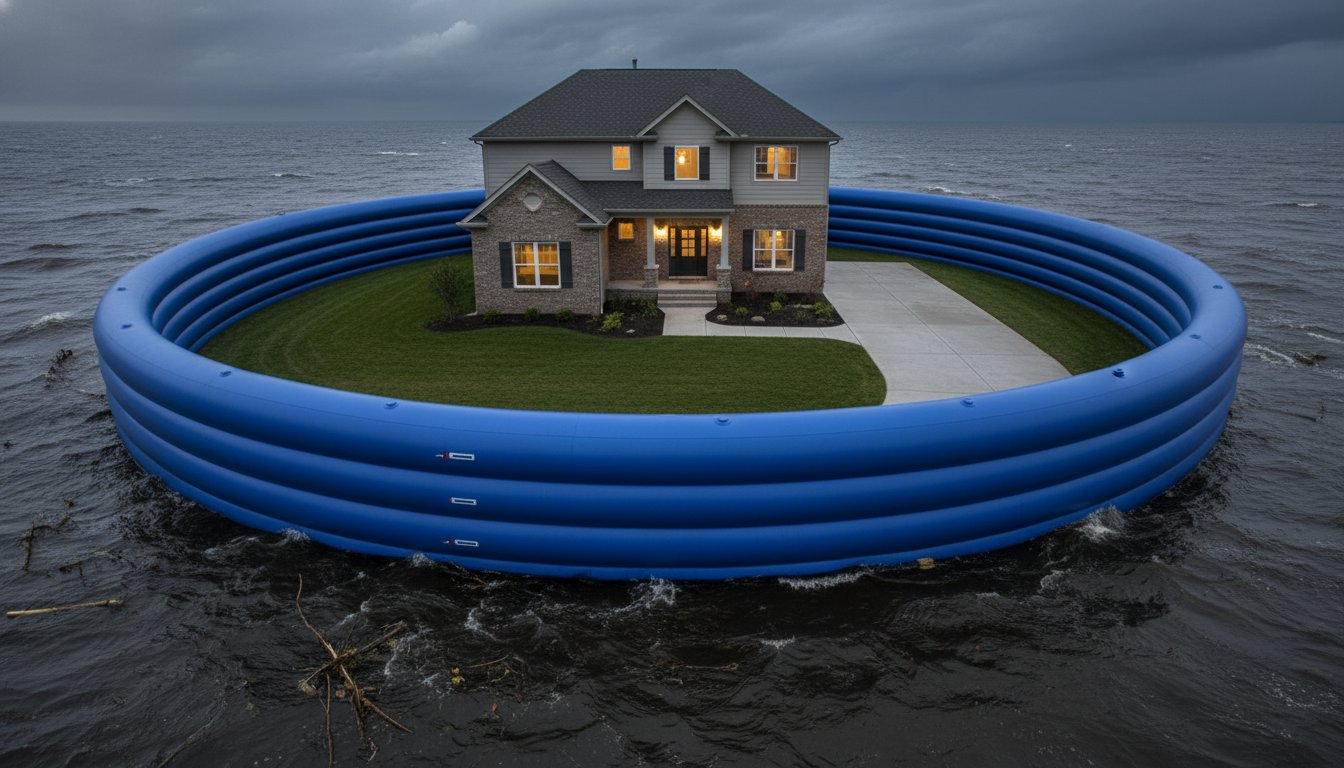
A single inch of floodwater can strip $25,000 from your home's value in a matter of hours. For many, the response is frantic sandbagging or a desperate trip to a big-box retailer for flimsy plastic sheets. You know these stop-gap measures aren't enough. The labor is back-breaking. The results are often devastating. When the storm surge approaches, you need more than a DIY experiment. You need a tactical defense. High-performance inflatable flood barriers for homes have evolved into military-grade solutions that offer a definitive answer to rising waters.
We understand the anxiety that comes with every heavy rain event. You deserve a reusable system that provides total peace of mind without the sweat equity of traditional methods. This 2026 guide explores how to select and deploy engineered systems like the Fortress Inflatable Flood Barrier to safeguard your investment. You'll learn the technical standards required for true protection and how to maintain a defense that keeps your property value secure. It's time to stop reacting to the weather and start commanding your home's perimeter.
Key Takeaways
- Move beyond the back-breaking labor of sandbags to adopt a reusable, professional-grade defense that won't fail when the water rises.
- Understand the physics of stabilization and material strength that turn a simple barrier into a military-grade shield for your property.
- Learn to calculate your 100-year flood elevation to ensure your inflatable flood barriers for homes provide the necessary clearance.
- Master the dry-run deployment process to identify and seal vulnerabilities before the storm surge hits your perimeter.
- Discover why a professional site assessment is the critical foundation for any high-performance flood diversion strategy.
Beyond Sandbags: The Evolution of Inflatable Flood Barriers for Homes
Sandbags are a relic of a reactive past. For decades, homeowners relied on heavy, porous bags that offered little more than a false sense of security. Today, the landscape of defense has changed. Modern inflatable flood barriers for homes represent a massive leap in engineering. These are not merely temporary fixes; they are high-strength, reusable perimeter defense systems designed to divert water with surgical precision. The shift from industrial-grade cofferdams to residential fortification means you now have access to military-grade protection for your private property.
The secret lies in the concept of hydrostatic balance. Unlike rigid walls that can crack or sandbags that seep, modern barriers use internal pressure and material flexibility to create an impenetrable seal. This evolution ensures that the barrier doesn't just sit on the ground. It integrates with it. This technology has moved from large-scale construction sites directly to the front lines of your driveway and foundation. It's a proactive shift from merely blocking water to strategically diverting it away from your home's most vulnerable points.
Why Traditional Methods Fail the Modern Homeowner
Traditional sandbagging is a logistical nightmare. It requires hundreds of bags and hours of grueling labor to protect a single entryway. Most households don't have the manpower or the time when a storm surge is imminent. Beyond the physical toll, sandbags are often a health hazard. They act as sponges for contaminated floodwaters, absorbing toxins and sewage. Once the water recedes, you're left with thousands of pounds of hazardous waste that is difficult and expensive to discard. Under prolonged hydrostatic pressure, sandbags eventually settle and leak. They are a one-time-use gamble that frequently fails to deliver the security you need.
The Core Advantage: Reusability and Rapid Deployment
Speed is your most valuable asset during a weather event. Professional temporary flood barriers can be deployed in a fraction of the time it takes to fill and stack sand. What used to take a team of workers all day now takes a single person less than an hour. This rapid response is the difference between a dry basement and a total loss.
Storage is equally critical. A system capable of protecting a 50-foot perimeter can be deflated and stored in a small, manageable crate. It stays ready in your garage, not taking up space, until the moment it's needed. When you invest in a system like the Fortress Inflatable Flood Barrier, you're securing a long-term ROI. One professional system outlasts a decade of sandbags. It provides a reliable defense that pays for itself after the very first storm. It's a tactical deployment, not a commodity purchase.
Engineering the Line: How Inflatable Barriers Deflect the Surge
True defense is built on the laws of physics. It isn't enough for a barrier to be tall; it must be immovable under extreme pressure. When you deploy inflatable flood barriers for homes, you're creating a structural line of defense that relies on hydrostatic pressure to succeed. Most retail-grade systems fail because they don't account for buoyancy. A barrier filled only with air acts like a life vest; it wants to float as the water rises. Professional engineering solves this through weight-based stabilization. By using the floodwater's own mass to fill the internal chambers, you create a heavy, dense anchor that presses down into the terrain with thousands of pounds of force.
The sealing skirt is the unsung hero of this design. This flap of material extends toward the oncoming water, acting as a foundational gasket. As the surge reaches the barrier, the weight of the floodwater pins the skirt firmly to the ground. This creates a vacuum-like seal that prevents under-barrier seepage. Without this feature, water finds the path of least resistance, eroding the foundation of your defense from beneath. If you're comparing options, looking at home flood barrier reviews can help you identify which models prioritize this critical sealing technology to ensure the perimeter remains dry.
Water-Filled vs. Air-Filled Systems
Air-filled systems are portable and fast. They work well for minor nuisance flooding or as a quick perimeter for shallow puddles. However, they lack the ballast required for a true storm surge. Water-filled barriers turn the threat into the solution. By filling the internal chambers with water, the barrier achieves a density that air simply cannot match. High-performance models often include internal baffles. These structural dividers prevent the water inside from sloshing or rolling. This keeps the barrier upright and stable even when hit by wave action or heavy debris. It's the difference between a floating tube and a temporary levee.
Material Integrity and Burst Strength
Cheap, thin PVC is a liability. It lacks the tensile strength to hold thousands of gallons of water and often shears under the stress of a surge. Real protection requires industrial-grade geotextiles or reinforced PVC. These materials are engineered for puncture resistance against floating branches or sharp urban debris. UV resistance is another non-negotiable factor. Sun exposure can degrade inferior plastics in a single season, making them brittle and prone to bursting when you need them most. A professional-grade Fortress Inflatable Flood Barrier utilizes treated polymers that maintain their integrity for years. Understanding these technical specifications is the first step in building a resilient home defense that actually stands its ground.
The 2026 Buying Guide: Critical Features for Home Defense
Selecting inflatable flood barriers for homes isn't a commodity purchase. It's a tactical decision. You aren't just buying a product; you're commissioning a defense line. To be effective, your choice must account for the specific topography of your property and the historical behavior of local waterways. A barrier that is too short or too thin will fail exactly when you need it most. You must match the system to the threat level of your specific zip code.
Start with the 100-year flood elevation data provided by local authorities. This is your baseline. However, baseline protection is rarely enough. You need "freeboard." This is the extra height required to account for wave action, wind-driven surges, and unexpected peaks. If your flood map predicts two feet of water, you should prepare for three. Performance also depends on your terrain. While asphalt provides a clean seal, grass and gravel surfaces require barriers with aggressive sealing skirts to fill the gaps in uneven soil. Modularity is your final priority. A single break in the line is a total failure. Look for industrial connection systems that lock units together to ensure the perimeter remains a single, unified wall.
Sizing Your Defense System
The 1:3 rule is a non-negotiable standard for stability. For every foot of vertical protection, the barrier's base must be at least three feet wide. This wide footprint provides the friction and mass needed to resist the lateral force of moving water. Measure your perimeter based on vulnerable entry points. Decide if you're protecting just the garage or the entire foundation. If your flood risk exceeds three feet, inflatable systems may reach their mechanical limit. At that stage, you must transition to structural diversion or permanent floodwalls to maintain safety.
Deployment Speed and Labor Requirements
In a flash flood, every second is a liability. High-performance systems like the Fortress Inflatable Flood Barrier are designed for one-person deployment. This is vital if you're home alone when the alerts go out. However, the barrier is only as fast as your pump. High-volume pumps are mandatory. They must move hundreds of gallons per minute to fill the system before the surge arrives. Pay close attention to connection joints. These are the traditional weak points. Ensure your system uses heavy-duty manifolds and reinforced hoses that won't kink or leak under extreme pressure. A secure connection is the only way to maintain the integrity of your perimeter.

Tactical Deployment: Ensuring Your Perimeter Remains Impenetrable
Deployment is a tactical operation. It requires more than just unrolling a product. To ensure inflatable flood barriers for homes function as intended, you must execute a precise sequence of actions before the clouds darken. A dry-run installation is your most powerful tool. It allows you to identify logistical bottlenecks and uneven terrain without the pressure of rising water. You wouldn't wait for a fire to test an extinguisher. Don't wait for a surge to test your perimeter.
Ground clearance is the foundation of a successful defense. Water is relentless. It seeks the path of least resistance. Even a small accumulation of mulch, gravel, or yard debris can lift the edge of your barrier, allowing high-pressure seepage to begin. Clear the deployment zone down to the bare substrate. When the barrier meets a permanent structure, such as a brick wall or garage door frame, the seal must be absolute. Use high-compression gaskets or specialized diversion plates to bridge the gap. If you aren't sure how to secure these transition points, contact a specialist for a professional site assessment to review your property's specific vulnerabilities.
The Criticality of Ground Seal
A ground seal is binary. It either works or it doesn't. In high-velocity environments, the weighted skirt of a system like the Fortress Inflatable Flood Barrier is essential. This skirt uses the weight of the oncoming flood to pin the material to the earth. However, if there's a dip in your driveway or a gap in the turf, the seal is compromised. Filling these voids with sand or non-porous clay before deployment is a critical step. Remember, a 99% seal is a 100% failure in residential defense. Once water finds a breach, the hydrostatic pressure will rapidly widen it, undermining the entire system.
Maintenance and Long-Term Storage
The battle doesn't end when the water recedes. Floodwater is often black water, laden with sewage, chemicals, and silt. Your barriers must undergo a rigorous decontamination protocol before storage. Use a mild surfactant and plenty of fresh water to scrub the entire surface. Mold is the silent enemy of industrial polymers. Every square inch must be bone-dry before you fold it. Store the system in a cool, dark place to avoid UV degradation. Your annual inspection should include a pressure test of the valves and a close-up look at the seams. Vigilance during the off-season ensures your defense is ready when the next alert sounds.
The Fortress Advantage: Why Professional Installation Trumps DIY
A commodity purchase provides a product. A professional partnership provides a defense. While many retailers sell inflatable flood barriers for homes as standalone tubes, the Fortress approach treats them as the front line of a comprehensive diversion strategy. Self-installation often leads to a false sense of security. If you miss a single foundation crack or miscalculate a slope, the entire system is compromised. Professional site assessment is the only way to ensure your property's unique topography is fully accounted for. We look for the vulnerabilities that a homeowner might miss, such as hydrostatic lift or subsurface seepage points. It's the difference between a temporary fix and a permanent security plan.
The liability of a failed DIY system is immense. When you install a system yourself, you assume all the risk of a breach. A professional installation shifts that burden to experts who understand the physics of water movement. We don't just provide a barrier; we provide a structural guarantee of integrity. This level of oversight ensures that your home remains dry even when the surrounding environment is under extreme stress. You are investing in seasoned wisdom and unwavering readiness, not just a piece of equipment.
Engineered Diversion vs. Simple Retention
Retention is a passive struggle against physics. Diversion is an active command of the environment. The Fortress Inflatable Flood Barrier doesn't just hold water back. It works in tandem with the Fortress Flood Diversion System to move the surge toward natural drainage points or lower elevations. This reduces the hydrostatic pressure on the barrier itself. By strategically placing the line, we protect the structural integrity of your foundation rather than just blocking a doorway. It's about controlling where the water goes, not just hoping it stays out. This proactive positioning ensures that even if a surge lasts for days, the pressure on your home's perimeter remains manageable.
Full-Service Security from Design to Deployment
Engineering is the difference between a guess and a guarantee. When you choose a professional installation, you're gaining an expert witness level of protection for your estate. We design the system to meet the specific hydraulic loads your home will face. This includes training you on the exact deployment sequence so you are ready when the sirens sound. You won't be reading a manual in the rain. You'll be executing a proven plan. DIY solutions often fail because of human error during the stress of a storm. We eliminate that variable through rigorous design and hands-on preparation. It is time to stop gambling with your property value.
Secure your perimeter with a Fortress consultation
Command Your Defense with Engineered Precision
The era of reactive sandbagging has ended. You've seen why reusability and material integrity are non-negotiable for modern estates. High-performance inflatable flood barriers for homes are no longer just an option. They're a tactical necessity. By prioritizing engineered diversion over simple retention, you aren't just blocking water. You're commanding it. This guide has detailed the physics of stability and the importance of a professional site assessment. These are the foundations of a dry home and a preserved property value.
True security requires more than a product. It requires a partner who understands the high stakes of environmental threats. Our proprietary Fortress material technology is specifically engineered for high-velocity diversion. We include professional on-site installation to ensure every transition point and ground seal is absolute. You deserve the profound relief that comes with a verified defense system. Fortify your home with the Fortress Inflatable Flood Barrier.
Don't wait for the next siren to test your readiness. Take control of your property's future today. You've worked hard to build your estate. We're here to act as its vigilant guardian. Peace of mind is possible even in the face of rising waters. Let's build your fortress together.
Frequently Asked Questions
How long do inflatable flood barriers for homes last?
Professional grade barriers typically last 10 to 15 years when maintained with precision. This lifespan depends heavily on decontamination after every deployment and protection from prolonged UV exposure. Cheap PVC alternatives often degrade within a single season. The Fortress Inflatable Flood Barrier utilizes reinforced industrial polymers to ensure long term resilience. Regular inspections of valves and seams are essential to maximize the service life of your defense system.
Can one person deploy a 50-foot inflatable flood barrier alone?
Yes, a single adult can deploy a 50-foot Fortress Inflatable Flood Barrier in under an hour. The system is designed for rapid response when manpower is limited. While the unrolled weight is manageable for one person, the use of high volume pumps is critical to meet deployment timelines. This speed ensures your perimeter is secure before the first wave of a flash flood reaches your property. It's the definitive answer for solo homeowners.
Do inflatable barriers work on sloped driveways or uneven ground?
Inflatable barriers are engineered to conform to uneven surfaces, but steep slopes require strategic anchoring. The flexible nature of the tube allows it to mold into small depressions in asphalt or gravel. For significant inclines, you must use the weight of the water to create a friction lock. Professional site assessments help determine if your specific topography needs additional diversion plates to prevent the barrier from shifting under extreme pressure.
What happens if a floating object punctures the inflatable barrier?
High performance barriers are built with multiple internal chambers to prevent total failure from a single puncture. If a sharp object pierces the outer layer, the remaining compartments maintain the structural integrity of the wall. Most professional systems include industrial grade patch kits for immediate field repairs. The reinforced material used in the Fortress system is specifically designed to resist the impact of floating debris and sharp urban waste.
Are inflatable flood barriers covered by homeowners insurance?
Standard homeowners insurance policies usually don't cover the cost of flood defense equipment. You should check with your NFIP or private flood insurance provider to see if they offer premium credits for installing inflatable flood barriers for homes. While the upfront cost is a private investment, the potential savings from preventing a single inch of water damage often exceed $25,000. Protecting your property value is a proactive financial decision.
How much water is needed to fill a standard residential flood tube?
A standard 50-foot residential barrier can require between 500 and 2,000 gallons of water depending on its height and diameter. This mass provides the necessary ballast to resist a storm surge. You should use a high volume pump connected to a reliable water source to ensure the system reaches its full defensive weight quickly. Proper filling is the only way to achieve the hydrostatic balance required for total protection against rising waters.
Can these barriers be used for hurricane storm surges?
Inflatable barriers are effective against storm surges up to their engineered height limit, typically three feet. They are designed to withstand the lateral force of moving water and wave action. However, they are not a substitute for evacuation orders in extreme hurricane events. When used as part of a Fortress Flood Diversion System, they provide a formidable shield against the initial surge and the destructive receding tidal waters.
What is the difference between a flood dam and a diversion system?
A flood dam is a passive retention tool meant to hold water in place. A diversion system is an active engineering strategy that moves water away from your foundation. Diversion reduces the total hydrostatic pressure on your perimeter by directing the flow toward natural drainage points. This proactive approach ensures that water doesn't just sit against your home. It is strategically rerouted to safer ground to prevent foundation compromise.


