
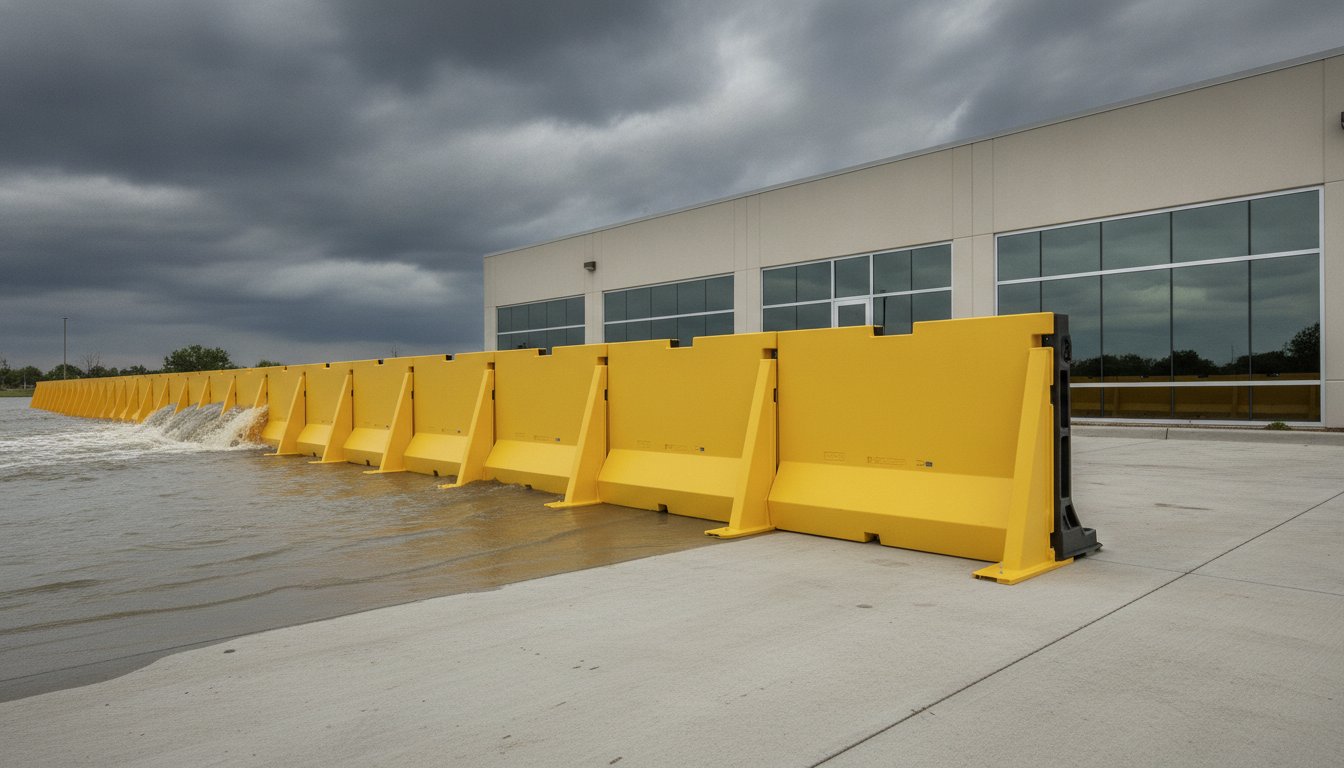
The weight of a flash flood is usually your building's greatest enemy. With the right engineering, that same pressure becomes your strongest ally. An l shaped flood barrier uses the physics of self-anchoring to turn the crushing force of rising water into a downward stabilizing weight. It's a radical departure from the back-breaking labor of traditional sandbagging. You don't have to fight the water's mass when you can make it work for you.
We understand the exhaustion that comes from stacking hundreds of sandbags only to worry they'll shift when the surge hits. You need a system that offers both speed and structural certainty. This guide will show you how L-shaped geometry provides a "bookend" effect that secures your perimeter in minutes. We'll explore the specific physics of self-anchoring and explain when to choose these barriers over diversion systems. By the end, you'll have the confidence to select a rapid-deployment defense that stands firm under pressure.
Key Takeaways
- Master the physics of self-anchoring. Learn how an l shaped flood barrier converts rising water pressure into a downward, stabilizing force.
- Evaluate the strategic benefits of modular systems. Save time, labor, and storage space compared to the exhaustion of traditional sandbags.
- Pinpoint the most effective deployment zones. Secure driveways and garages to create a complete perimeter defense before the surge arrives.
- Determine when to upgrade your protection. Transition from temporary walls to a professional-grade Fortress Flood Diversion System for high-risk estates.
What is an L-Shaped Flood Barrier?
Rising water is a relentless force. It seeks every gap in your perimeter. An l shaped flood barrier provides a portable, freestanding defense that stops the surge in its tracks. These systems are engineered for rapid deployment. You can secure a property in minutes rather than the hours required for traditional methods. The genius lies in the 90-degree profile. It looks like a bookend, and it functions with similar logic. By placing the base of the "L" toward the incoming water, the system transforms a threat into a stabilizer.
This design is a specialized type of flood barrier that requires no permanent fixtures. It stays upright without being bolted to the ground. This makes it ideal for protecting garage doors, driveways, and commercial storefronts where permanent alterations aren't possible. It is a temporary fortification that offers permanent-grade peace of mind. Protection shouldn't be a gamble. It should be a calculation. The l shaped flood barrier is a masterclass in hydraulic engineering. It proves that you don't need massive weight to stop a flood. You just need to know how to use the water's own mass against it.
The Anatomy of the L-Shape
Every component of the barrier serves a defensive purpose. The Vertical Wall is your primary shield. It serves as the dam that blocks the horizontal flow of water. Its height determines your level of protection. The Horizontal Foot is the anchor. It sits flat on the ground, extending toward the flood. As water rises, its weight sits on this foot, pinning the barrier to the floor. Sealing Gaskets are the silent guardians. These rubberized strips prevent water from creeping underneath the unit. They ensure the seal remains tight even on slightly uneven surfaces.
Common Materials and Build Quality
Materials define the mission. High-strength ABS plastics are common for residential use. They are lightweight and easy to store. For industrial zones, marine-grade aluminum provides a higher level of impact resistance against debris. Some specialized systems use reinforced flexible membranes. These are often seen in hybrid designs that combine the L-shape with inflatable tech. Regardless of the material, the goal remains the same: total impenetrability. A barrier is only as good as its weakest joint. Look for reinforced ribbing on the vertical wall to prevent bowing under pressure.
These units are often modular. They interlock to create a continuous wall of defense. This allows you to customize the length of your barrier to fit the unique contours of your property. Whether you are sealing a single doorway or a sprawling warehouse loading dock, the principle of the 90-degree angle remains the same. The deeper the water gets, the more downward pressure it applies. This is why these barriers are often called "self-anchoring." They become more stable as the situation becomes more dire.
The Science of Self-Anchoring: How Physics Defends Your Property
Water is heavy. One cubic foot weighs over 62 pounds. In a flood, that weight usually destroys everything in its path. An l shaped flood barrier flips this script. It uses the weight of the water to hold itself in place. This is the core of self-anchoring technology. You don't need bolts. You don't need heavy machinery. You just need physics. By utilizing the very force that threatens your property, these barriers create a lockdown that is nearly impossible to breach.
This isn't a static defense. It's a dynamic one. Most traditional barriers become more vulnerable as water rises. Sandbags can wash away or shift. Plywood can snap under the strain. The L-shaped design reaches its peak performance when the pressure is highest. The vertical wall resists the lateral push, while the horizontal foot absorbs the vertical weight. This balance of forces ensures the structure remains impenetrable. It is a calculated response to a chaotic environment.
Hydrostatic Pressure and Downward Force
The horizontal base of the barrier extends toward the flood. As water levels rise, the pressure pushes down on this base with increasing intensity. The system is designed to harness the natural force of the water. It turns the flood's own mass into a locking mechanism. This creates a massive downward force that pins the barrier to the ground. The higher the water gets, the more stable the barrier becomes. It functions like a bookend. Just as books hold a vertical support in place, the water weight secures the horizontal foot. This prevents the vertical wall from tipping or shifting under the lateral pressure of the flow.
Friction and Surface Interaction
Friction is the second line of defense. The base of an l shaped flood barrier isn't just a flat surface. It features specialized rubber gaskets. These seals serve two purposes. First, they prevent seepage. Second, they create a high-friction grip. On smooth surfaces like concrete or asphalt, the weight of the water creates a vacuum-like seal. This prevents the barrier from sliding. If you are dealing with slightly uneven terrain, the flexibility of these gaskets is vital. They conform to the ground to maintain the integrity of the anchor. A solid seal is the difference between a dry interior and a total loss.
Understanding the mechanics of water is the first step toward total protection. If you are ready to move beyond temporary fixes, consider how the Fortress Flood Diversion System can provide a more permanent layer of security for your estate. This system builds on the same principles of hydraulic resistance to ensure your property remains a sanctuary even during the most severe weather events.
L-Shaped Barriers vs. Traditional Sandbags: A Strategic Comparison
Sandbags are a relic of a reactive past. They represent a labor-intensive approach that often fails when the stakes are highest. While they remain the default for many, the hidden costs are staggering. Stacking thousands of pounds of sand is a grueling task. It requires a large team and hours of preparation. When a flash flood warning is issued, you don't have hours. You have minutes. An l shaped flood barrier changes the math of disaster response. It replaces brute force with intelligent design.
The strategic shift from sand to modular panels is about more than just speed. It is about reliability. Sandbags are prone to seepage and structural shifting. They are only as strong as the person stacking them. In contrast, an l shaped flood barrier provides a consistent, engineered seal every time it is deployed. It removes the element of human error from your defense strategy. You aren't just building a wall. You are deploying a precision instrument designed to withstand hydraulic pressure.
Deployment Speed and Labor Requirements
Time is the only currency that matters during a flood. A 50-foot perimeter of sandbags can require a crew of four to six people working for several hours. This includes filling, transporting, and stacking hundreds of individual bags. An l shaped flood barrier allows a single person to secure that same 50-foot line in less than fifteen minutes. The panels are lightweight and interlock with ease. This rapid-deployment capability is vital for properties in flash-flood zones. Once the threat subsides, removal is just as efficient. You don't need a construction crew to clear your driveway. You simply unlock the panels and stack them away.
Long-Term ROI and Environmental Impact
The true cost of a defense system is measured over years, not days. Sandbags are one-time use assets. After a flood, they often absorb toxic runoff, oils, and sewage. This turns them into biohazards that require expensive, specialized disposal. You cannot simply dump them in a landfill. Over a 10-year flood cycle, the cost of repeatedly purchasing sand and paying for disposal far exceeds the initial investment of a professional system. L-shaped panels are multi-year assets. They are made from durable materials like ABS plastic or aluminum that don't rot or degrade. You wash them down, dry them, and store them in a compact footprint. This reusability makes them a superior financial and environmental choice for the modern estate owner.

Strategic Implementation: When and Where to Deploy
Strategy determines survival. It isn't enough to own the right equipment. You must know where to place it to intercept the threat. An l shaped flood barrier works best when it is deployed along specific flow paths. You aren't just blocking water. You are managing it. This involves identifying critical entry points like garage thresholds and low-lying doorways where water naturally pools during a surge. By intercepting the flow before it reaches your foundation, you maintain the structural integrity of your property.
Urban environments are the primary theater for these systems. Paved surfaces like concrete driveways and asphalt streets provide the ideal texture for the barrier's gaskets. In rural settings, the application is more specific. While they can work on packed dirt, their effectiveness peaks on hard, non-porous ground. It's about the seal. Without a firm surface, the self-anchoring mechanism cannot reach its full potential. You must evaluate your terrain before the clouds gather.
Every defense has a breaking point. These barriers are designed for rising water, not for heavy wave action or high-velocity debris. If your property is on a beachfront or in the direct path of a mountain torrent carrying boulders, you need a different tier of protection. For standard flash flooding and urban runoff, however, the l shaped flood barrier is an elite choice. It provides a level of speed and reliability that few other portable systems can match.
Residential Entry Point Defense
Protecting a standard two-car garage is often the highest priority for homeowners. You can deploy a full line of panels across a 16-foot opening in under ten minutes. This creates an immediate seal that prevents water from entering the structure and destroying vehicles or stored assets. Front entryways are equally vital. You can secure these without permanent modifications to your home's facade. Beyond the building itself, consider your utilities. Creating a small perimeter around exterior HVAC units or electrical boxes can prevent thousands of dollars in mechanical damage and long-term repair costs.
The Importance of Ground Surface
The surface is the foundation of your defense. Hard, flat surfaces like concrete are ideal. They allow the rubber gaskets to compress fully under the weight of the water. This creates the vacuum-like grip required for stability. Challenges arise with permeable pavers, gravel, or grass. On these surfaces, water can seep underneath the barrier. This equalizes the pressure and negates the self-anchoring effect. Pre-storm preparation is mandatory. You must clear away leaves, sticks, and loose rocks. Even a small piece of debris can break the seal and compromise the entire line. Clean ground is a prerequisite for a dry interior.
Success depends on the right equipment for the right threat. If you need a comprehensive strategy for a high-risk property, explore the Fortress Flood Diversion System to build a professional-grade perimeter that stands firm against the rising tide.
Beyond the L-Shape: The Fortress Diversion Advantage
A portable l shaped flood barrier is a vital tool for immediate defense. It stops the surge. It secures the threshold. But for high-risk estates facing recurring threats, a temporary wall is often just the first step. You need to move from reactive blocking to proactive redirection. This is the transition from DIY preparedness to professional engineering. While an l shaped flood barrier is an elite rapid-response asset, a comprehensive strategy requires a system that manages the entire volume of a flood event.
Every property has a unique topography. Water follows the path of least resistance. If your defense only blocks the water without giving it somewhere to go, you risk creating new vulnerabilities elsewhere. Professional fortification involves analyzing the grade, the soil, and the surrounding drainage infrastructure. It is the difference between surviving a storm and mastering the environment. You deserve a solution that is as permanent as the threat itself.
The Fortress Flood Diversion System
The Fortress Flood Diversion System is engineered to redirect water flow rather than just providing a static block. It is a professional-grade solution for estates that cannot afford a single point of failure. Unlike temporary panels, this system is designed to handle the high-velocity redirection of massive water volumes. It maintains its structural integrity during catastrophic events that would overwhelm standard portable units. We integrate these systems directly into your existing landscaping. You get military-grade security that remains aesthetically pleasing. It is a permanent, invisible shield that stands ready 24/7.
Professional Engineering vs. DIY Preparedness
DIY solutions are about survival in the moment. Professional engineering is about long-term risk mitigation. A site-specific flood diversion plan is the ultimate insurance for a high-value property. It removes the guesswork from your defense. Off-the-shelf barriers are excellent for general use, but they cannot account for the specific hydraulic pressures unique to your driveway or foundation. This is where expert consultation becomes a necessity. We identify the exact flow paths and install a system tailored to your land.
FloodWater Pros manages your risk from the initial design phase to the final installation. We act as your strategic partner in property fortification. We have seen the consequences of inaction, and we know how to prevent them. Don't wait for the next flash flood warning to test your defenses. Take a proactive stance today. Fortify your property with the Fortress Flood Diversion System and experience the profound relief of total security.
Mastering the Environment: Your Path to Total Security
The l shaped flood barrier represents a fundamental shift in hydraulic defense. It proves that you don't need massive weight to stop a surge when you can use the water's own mass to anchor your perimeter. You've seen how these systems outperform sandbags in speed and reliability. You've learned that strategic placement on hard surfaces is the key to a watertight seal. Now it's time to move from understanding to action. Strategy determines survival. Your property deserves a shield that is as resilient as the threats it faces.
Protecting a high-stakes estate requires more than just off-the-shelf tools. It requires an engineered strategy. We provide national professional installation for our proprietary Fortress Flood Diversion System. These systems are engineered for high-stakes property protection. They redirect catastrophic flows before they ever reach your doorstep. Don't leave your legacy to chance. Request a Professional Flood Risk Assessment today. Take the first step toward total security. Your peace of mind is worth the investment.
Frequently Asked Questions
Do L-shaped flood barriers need to be bolted to the ground?
No, these systems don't require permanent bolts or fasteners. An l shaped flood barrier utilizes the weight of the rising water to pin itself to the ground. This self-anchoring mechanism creates a massive downward force on the horizontal foot. The more water that presses against it, the more stable the unit becomes. It's a tool for rapid response that leaves no damage to your driveway or walkway.
How high can an L-shaped barrier effectively hold back water?
Most commercial units are designed to manage water depths between 20 and 40 inches. In early 2026, the Florida Division of Emergency Management issued guidance recommending that temporary barriers for residential buildings protect for a water depth of no more than 3 feet. Always check the specific height rating of your unit. For deeper or more catastrophic surges, an engineered diversion system is a more reliable choice.
Can I use an L-shaped barrier on a grass or dirt lawn?
You should avoid deploying these barriers on permeable or soft surfaces like grass or gravel. The effectiveness of the l shaped flood barrier depends on a watertight seal between the rubber gaskets and the ground. On dirt or lawns, water can seep underneath the base. This negates the downward pressure and causes the barrier to float or shift. Stick to hard surfaces like concrete or asphalt for total security.
How long does it take for one person to set up an L-shaped barrier?
A single person can typically secure a 50-foot perimeter in less than 15 minutes. The panels are lightweight and designed to interlock with minimal effort. This speed is a critical advantage during flash flood warnings when every second counts. Unlike sandbags, which require a team and hours of labor, these modular panels allow for immediate fortification without the need for external assistance.
Are L-shaped barriers reusable after a major flood event?
Yes, these systems are multi-year assets designed for repeated use. After the water recedes, you simply wash the panels with clean water to remove silt or contaminants. Once they're dry, they stack together for compact storage in a garage or shed. They don't rot or degrade like sandbags. This reusability makes them a cost-effective long-term investment for any property owner in a high-risk zone.
What happens if the water level exceeds the height of the barrier?
If the water level rises above the vertical wall, it will begin to overtop the system. While the barrier will likely remain pinned to the ground due to the downward hydrostatic pressure, it will no longer prevent water from entering the protected area. You must monitor local forecasts and select a barrier height that accounts for the maximum predicted surge in your specific flood zone.
How do L-shaped barriers compare to inflatable flood tubes?
L-shaped panels are best for rapid deployment on hard surfaces. They don't require pumps or a water source to fill. In contrast, systems like the Fortress Inflatable Flood Barrier are highly versatile and can conform to more varied terrain. While L-shapes offer the fastest setup for driveways, inflatable barriers provide a flexible alternative for uneven ground where a rigid seal is harder to achieve.
Can L-shaped barriers handle high-velocity current or waves?
No, these barriers are engineered for rising water and static pressure. They are not designed to withstand the impact of high-velocity currents or breaking waves. Strong moving water can carry heavy debris that may puncture or shift the panels. If your property is in a high-velocity flow zone, you should consider a more permanent solution like the Fortress Flood Diversion System.


