

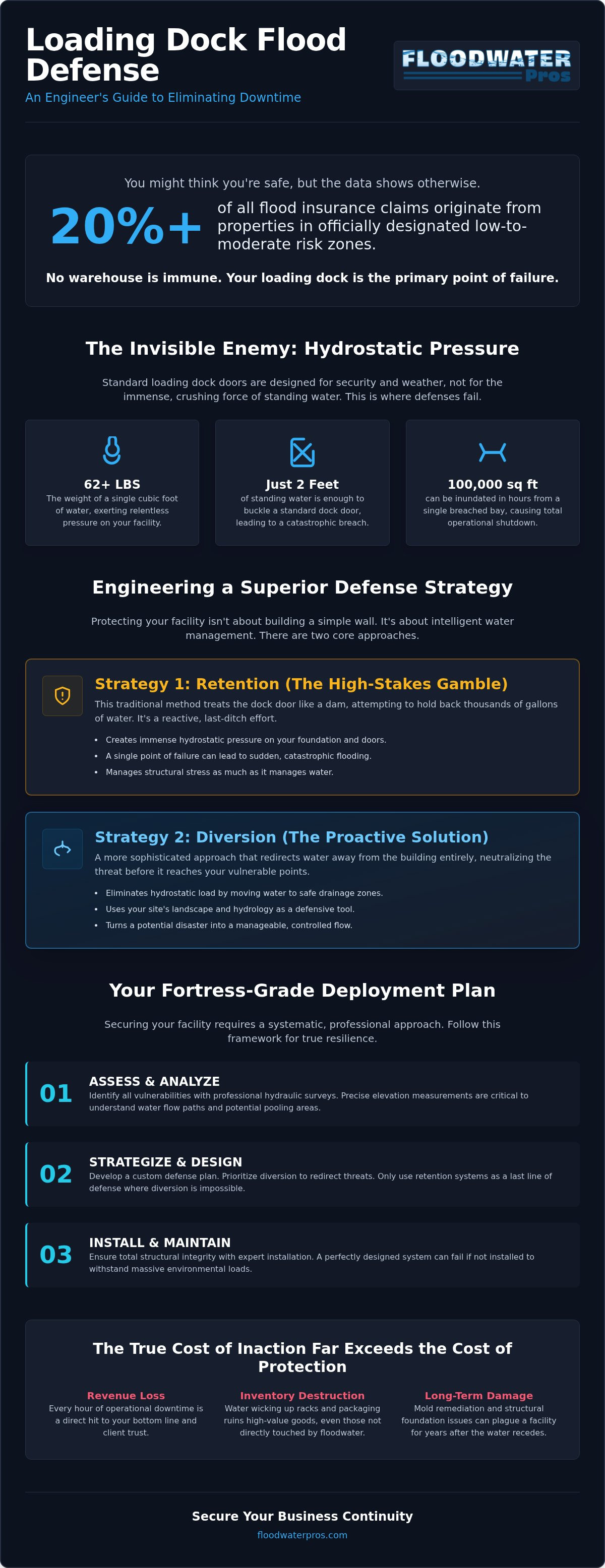
Over 20% of all flood claims occur in areas considered low-to-moderate risk. This statistic proves that no warehouse is truly safe from the next surge. Your loading dock is the most vulnerable entry point in your entire facility. It's the gateway for your revenue. It's also a direct path for rising water. You know the high cost of operational downtime. You've felt the anxiety of watching a storm cloud gather over low-lying bays. Implementing robust loading dock flood protection is the only way to stop reacting and start resisting.
This guide helps you master the art of loading dock defense to eliminate flood-related downtime for good. We'll show you how to protect your facility’s most exposed gaps without compromising daily shipping operations. You'll discover how to create a deployment-ready plan that your staff can execute in minutes. From engineered diversion systems to inflatable barriers, we'll cover the strategies needed to keep your inventory dry and your insurance premiums low. It's time to build your fortress. Let's secure your business continuity together.
Key Takeaways
- Identify why loading bays attract runoff. Learn how hydrostatic pressure destroys standard dock doors.
- Move beyond simple retention. Discover how to redirect threats using engineered diversion strategies.
- Select the right loading dock flood protection. Match barrier speed to your facility's shipping schedule.
- Build a deployment-ready plan. Use professional hydraulic surveys and precise elevation measurements.
- Ensure total structural integrity. Trust expert installation to withstand massive environmental loads.
The Vulnerability of the Envelope: Why Loading Docks are Flood Magnets
Loading docks are designed for high-speed efficiency, but that same design makes them natural basins for storm runoff. They are almost always the lowest points of your facility. When heavy rain falls, gravity directs every gallon toward your bays. A standard overhead door offers a sense of security, but it is often a dangerous illusion. These doors are built to stop wind and debris. They are not designed to withstand the relentless force of standing water.
Hydrostatic pressure is the invisible enemy of the warehouse manager. Water weighing over 62 pounds per cubic foot exerts massive force against any vertical surface. Without dedicated loading dock flood protection, a mere two feet of water can buckle a standard door track. Once the seal breaks, the domino effect begins. A single breached bay can inundate a 100,000 sq. ft. facility in hours. This destroys equipment, ruins inventory, and renders the entire building envelope useless. Effective loading dock flood protection is not a DIY project. It is an engineered shield that transforms a vulnerability into a point of resilience. It acts as a guardian for your facility's most exposed gaps.
The True Cost of Business Interruption
Every hour your shipping hub sits idle represents a catastrophic loss in revenue and client trust. The damage isn't limited to the water on the floor. You must account for the wicking effect in warehouse racking. Moisture climbs up cardboard packaging, ruining high-value inventory that never even touched the flood. Long-term impacts are even more severe. Mold remediation and structural foundation damage can haunt a facility for years after the storm passes. The cost of recovery always dwarfs the cost of fortification.
Common Failure Points in Standard Docks
Pit-style levelers are the most dangerous subterranean water conduits. They create a direct path for water to bypass the building's exterior and enter from beneath the floor. Gaps in side seals and brush seals, while excellent for temperature control, invite high-velocity ingress during a surge. Understanding the latest Flood Barrier Technologies is the first step in building a defense that actually holds. A single inch of water across your warehouse floor can trigger a total operational shutdown by compromising sensitive electronics and turning polished concrete into a lethal liability for forklift operators.
Diversion vs. Retention: Engineering a Superior Defense Strategy
Most facility managers view loading dock flood protection as a battle at the threshold. They focus on retention. This strategy treats the dock door like a dam, holding back thousands of gallons of rising water. While necessary in some scenarios, retention is a high-stakes gamble. Every inch of water held against your building exerts massive hydrostatic pressure on the foundation and the door frame. If the seal fails, the breach is sudden and catastrophic. You aren't just managing water; you're managing a ticking clock of structural stress.
Diversion offers a more sophisticated path to resilience. The Fortress philosophy centers on redirection. Instead of simply blocking the flow, we move the water away from the building envelope entirely. By changing the path of the runoff, we eliminate the hydrostatic load before it ever reaches your dock seals. This proactive approach turns a potential disaster into a manageable flow. It's the difference between a desperate stand and a calculated victory. Selecting the right strategy requires a deep understanding of your site's specific hydrology and slope. A dry facility is the result of engineering, not luck.
The Fortress Flood Diversion System Advantage
The Fortress Flood Diversion System is designed to act as your facility's first line of defense. It doesn't wait for water to reach your doors. Instead, it uses strategic placement to redirect rising water to safe drainage zones or retention ponds. We use the landscape to your advantage. In many high-risk installations, we've successfully moved water around corners and away from low-lying bays. This prevents the "basin effect" that often traps water in loading wells. If you're ready to move beyond simple blocking, you can consult with our engineering team to map your facility's water flow paths.
When Retention is Necessary
There are environments where the site's footprint or extreme proximity to flood sources makes total diversion impossible. In these cases, retention becomes your essential "last line" of defense. Heavy-duty flood gates and professional loading dock flood protection systems secure the actual door opening against high-velocity ingress. A truly impenetrable perimeter often integrates both methods. Diversion handles the bulk of the storm volume, while retention barriers provide the final, military-grade seal. This multi-layered defense ensures that even if one system is tested, your internal operations remain bone-dry and fully functional. We don't just provide products; we provide a structural shield against uncertainty.
The Selection Framework: Matching Barrier Tech to Dock Dynamics
Choosing the right loading dock flood protection requires more than measuring the width of an opening. You must evaluate how a barrier interacts with your existing infrastructure. Your loading dock is a complex ecosystem of levelers, bumpers, and seals. Standard barriers often fail because they don't account for these mechanical gaps. Pit levelers, in particular, create subterranean voids that can channel water directly into your facility. Your selection should depend on three critical factors: deployment speed, aesthetic requirements, and the frequency of flood threats in your region.
- Deployment Time: Can your staff secure the perimeter in minutes, or do they need hours of lead time?
- Operational Impact: Does the barrier hardware interfere with daily shipping and receiving?
- Environmental Load: Is the system designed to withstand high-velocity impacts from floating debris?
Fortress Inflatable Flood Barriers for Rapid Response
The Fortress Inflatable Flood Barrier is the gold standard for high-stakes preparedness. These systems utilize water or air to create a heavy-duty, flexible seal against the pavement. They're ideal for flash-flood prone areas where warning times are non-existent. You gain the ability to deploy a military-grade perimeter in minutes without permanent hardware obstructing your forklift paths. This speed is vital as the global market for inflatable flood barriers was valued at USD 760.7 million in 2026 and is projected to reach USD 1,784.4 million by 2036. Businesses are rapidly moving away from sandbags toward these fast-acting, reusable systems.
Invisible Defense: Fortress Transparent Liquid Paintable Barrier
Some facilities can't afford the industrial look of traditional gates. Retail-facing docks or historic warehouses often require an invisible shield. The Fortress Transparent Liquid Paintable Barrier provides a sophisticated solution that seals porous concrete and door frames without altering the building’s appearance. This advanced coating acts as a proactive layer of protection that remains active at all times. It is particularly effective for protecting storefront-style docks where bulky hardware would be a liability. Regular maintenance and re-application ensure the defense stays impenetrable against high-velocity ingress.
Hardened Barriers: Aluminum and Steel Systems
For environments facing extreme hydrostatic loads, structural integrity is the only metric that matters. Aluminum and steel barriers offer the highest level of resistance against high-velocity water and debris. You can choose between pivoted gates for instant closure or removable panels for seasonal threats. In chemical or hazardous material storage facilities, the absolute seal of a hardened barrier is non-negotiable. It prevents toxic runoff from escaping and keeps floodwaters from triggering a secondary environmental disaster. These systems are the ultimate loading dock flood protection for high-risk industrial zones.
Implementing Your Defense: A Step-by-Step Deployment Guide
Execution is the bridge between a theoretical plan and a dry facility. You've selected your technology; now you must integrate it into the physical reality of your shipping hub. A successful loading dock flood protection strategy follows a rigorous, engineered sequence. It begins long before the clouds gather. We don't guess where water will go. We use data to dictate our defense. This methodical approach ensures that when the pressure rises, your perimeter remains an impenetrable shield.
- Step 1: Conduct a hydraulic survey. Identify every water flow path across your lot. You need to know exactly how runoff will pool in your loading wells during a 100-year storm event.
- Step 2: Measure the Flood Protection Elevation (FPE). Set a definitive high-water line for every bay. This measurement determines the necessary height of your barriers and diversion systems.
- Step 3: Evaluate leveler interference. Check for clearance requirements around pit-style levelers. Ensure your barriers don't obstruct mechanical movement while still providing a total seal.
- Step 4: Design the Fortress perimeter. Integrate diversion systems with hardened barriers. This creates a multi-layered defense that redirects the bulk of the water and blocks the remainder.
- Step 5: Professional installation and training. Expert technicians must secure the hardware to your foundation. Your staff needs hands-on training to execute the deployment under high-stress conditions.
Secure your facility's future by scheduling a professional loading dock flood assessment today.
Measuring for Success
Precision is survival in flood mitigation. We follow the 1/8-inch rule; a gap smaller than a fingernail can allow hundreds of gallons to bypass your seal under pressure. You must account for uneven concrete and "dock creep," which is the subtle shifting of your foundation over years of heavy use. We map the "Dry Zone" for your most critical warehouse equipment. This ensures that even if the lot is submerged, your sensitive electronics and high-value inventory remain untouched by moisture. A dry floor isn't an accident. It's the result of millimetric accuracy.
The Deployment Drill
A barrier is only as effective as the team deploying it. You need a clear Standard Operating Procedure (SOP) that triggers the moment a storm warning is issued. Stage your inflatable barriers and removable panels in designated zones for maximum efficiency. Every second counts when a flash flood is inbound. Conduct a full-scale deployment test at least once a year to verify seal integrity and staff readiness. This drill transforms anxiety into a professional routine. It ensures that your facility is a proactive fortress rather than a reactive victim.
Fortress-Grade Security: Professional Installation and Long-Term Resilience
A flood barrier is only as strong as its connection to the ground. Professional installation represents the critical line between a bone-dry facility and a total warehouse loss. You can't afford a weak link when the stakes are this high. Between 1980 and 2024, the United States faced 403 billion-dollar weather and climate disasters. These events prove that standard building envelopes are not enough. Every loading dock flood protection system must be anchored into the structural slab with millimetric precision. If the anchors fail under the weight of a surge, the barrier becomes a liability instead of a shield. We ensure your defense is part of the building's own strength.
Engineering is the silent engine of resilience. We don't just install a gate; we calculate the exact hydrostatic loads your facility will face. This involves analyzing the weight of standing water and the impact of floating debris. Our systems are built to withstand these forces without buckling or leaking. Long-term security also demands a commitment to maintenance. You must regularly inspect seals, valves, and structural anchors to ensure they haven't degraded over time. FloodWater Pros acts as your strategic partner in this process. We provide the seasoned wisdom and unwavering readiness needed to keep your perimeter impenetrable year after year.
The Full-Service Fortress Approach
We provide a comprehensive, engineered solution that spans from design to deployment. We don't just ship parts. We manage the entire lifecycle including manufacturing and on-site professional installation. Our national reach allows us to secure facilities across the United States regardless of location. We specialize in custom engineering for non-standard dock configurations. If your bays are oversized or your lot has a unique slope, we build a defense that fits your specific footprint. This turnkey approach removes the burden from your team and places it in the hands of experts who have seen it all.
Your Next Step Toward Fortification
There is a profound sense of relief in knowing your facility is prepared. You can't control the weather, but you can control your response. This security provides mental well-being for you and your staff. It transforms the fear of inventory loss into the confidence of a prepared guardian. Remember that NFIP commercial coverage limits are capped at $500,000 for building and $500,000 for contents. For many warehouses, this barely scratches the surface of a total loss. Scheduling a professional site assessment is the first step toward true financial and physical protection. Our experts will evaluate your vulnerabilities and design a plan that eliminates uncertainty. Secure your facility with a Fortress Flood Diversion System today and ensure your business continuity remains unbroken.
Secure Your Perimeter: The Path to Unbroken Continuity
Business continuity is not a matter of chance; it is a result of intentional structural fortification. You have seen how vulnerable your loading bays are to the basin effect and relentless hydrostatic pressure. By choosing engineered diversion over simple blocking, you protect your building's foundation and your bottom line. Effective loading dock flood protection requires a strategy that matches your facility's specific hydrology and daily operational flow. You don't have to face the next environmental threat with uncertainty.
FloodWater Pros offers the expert guidance needed to transform your facility into a resilient fortress. Our proprietary Fortress engineering and full-service design-to-install management ensure your defense is built to last. With national US installation coverage, we bring military-grade security to your doorstep. Don't wait for the next storm to test your limits. Fortify your loading dock with an engineered Fortress system; Get a Quote today. You have the power to stay dry, operational, and ahead of the storm. Your facility deserves a vigilant guardian and the peace of mind that comes with total readiness.
Frequently Asked Questions
Can I still use my dock levelers with a flood barrier installed?
Yes, you can continue daily operations with a properly engineered barrier system. Our designs account for the specific clearance requirements of pit-style and edge-of-dock levelers. We ensure the barrier hardware doesn't obstruct mechanical movement or forklift paths. This allows your facility to remain productive until the moment deployment is required. Professional design ensures that your infrastructure and your defense work in harmony.
How fast can the Fortress Inflatable Flood Barrier be deployed?
You can deploy the Fortress Inflatable Flood Barrier in just a few minutes. These systems are designed for rapid response during flash flood events where you have minimal warning. Your staff can quickly position and activate the barrier to create a heavy-duty seal against the pavement. This speed is a critical advantage over traditional, labor-intensive methods. It transforms a chaotic emergency into a controlled, professional procedure.
Do these barriers provide protection against hazardous chemical spills?
Yes, these systems provide an effective secondary containment shield for hazardous materials. They prevent toxic runoff from escaping your facility during an internal spill. They also stop external floodwaters from entering sensitive storage areas and triggering environmental disasters. This dual-purpose defense is vital for chemical and industrial warehouses. It protects both your inventory and the surrounding environment from catastrophic contamination.
Is the Transparent Liquid Paintable Barrier truly invisible?
The Fortress Transparent Liquid Paintable Barrier is designed to be virtually undetectable once it has been applied. It preserves the aesthetic integrity of storefront-style docks and high-end commercial buildings. The coating seals porous concrete and door frames without the need for bulky hardware. You get a proactive shield that remains active at all times without altering your facility's professional appearance. It is the ultimate choice for invisible fortification.
What is the difference between flood diversion and a standard flood gate?
Diversion focuses on redirecting water flow away from the building envelope while standard gates block water at the opening. Standard gates provide retention by holding water directly against the door. Diversion systems reduce the hydrostatic load on your foundation by moving the threat to safe drainage zones or retention ponds. A comprehensive loading dock flood protection plan often uses both strategies to ensure total perimeter security.
How do I know what height of flood protection my loading dock needs?
The required height is determined through a professional hydraulic survey and the calculation of your Flood Protection Elevation (FPE). We analyze local topography and historical flood data to identify your specific risk level. This ensures your defense is tall enough to withstand a 100-year storm event without being unnecessarily over-engineered. Precision in height calculation is the difference between a dry floor and a breached perimeter.
Will installing professional flood barriers lower my commercial insurance premiums?
Many insurance providers offer reduced premiums for facilities that implement proven, engineered flood mitigation strategies. Professional barriers demonstrate a proactive commitment to risk reduction and business continuity. By protecting your high-value inventory and structural integrity, you lower the likelihood of expensive claims. You should consult with your insurance broker to see how these specific loading dock flood protection systems impact your policy rates.
Does FloodWater Pros provide national installation services for large-scale warehouses?
Yes, we provide full-service professional installation across the entire United States. Our team manages every phase of the project from the initial site design to the final on-site setup for large-scale industrial facilities. We ensure that your barriers are anchored correctly to your foundation for maximum resilience. You receive a consistent, high-quality defense regardless of where your facility is located. We are your national partner in structural protection.


