

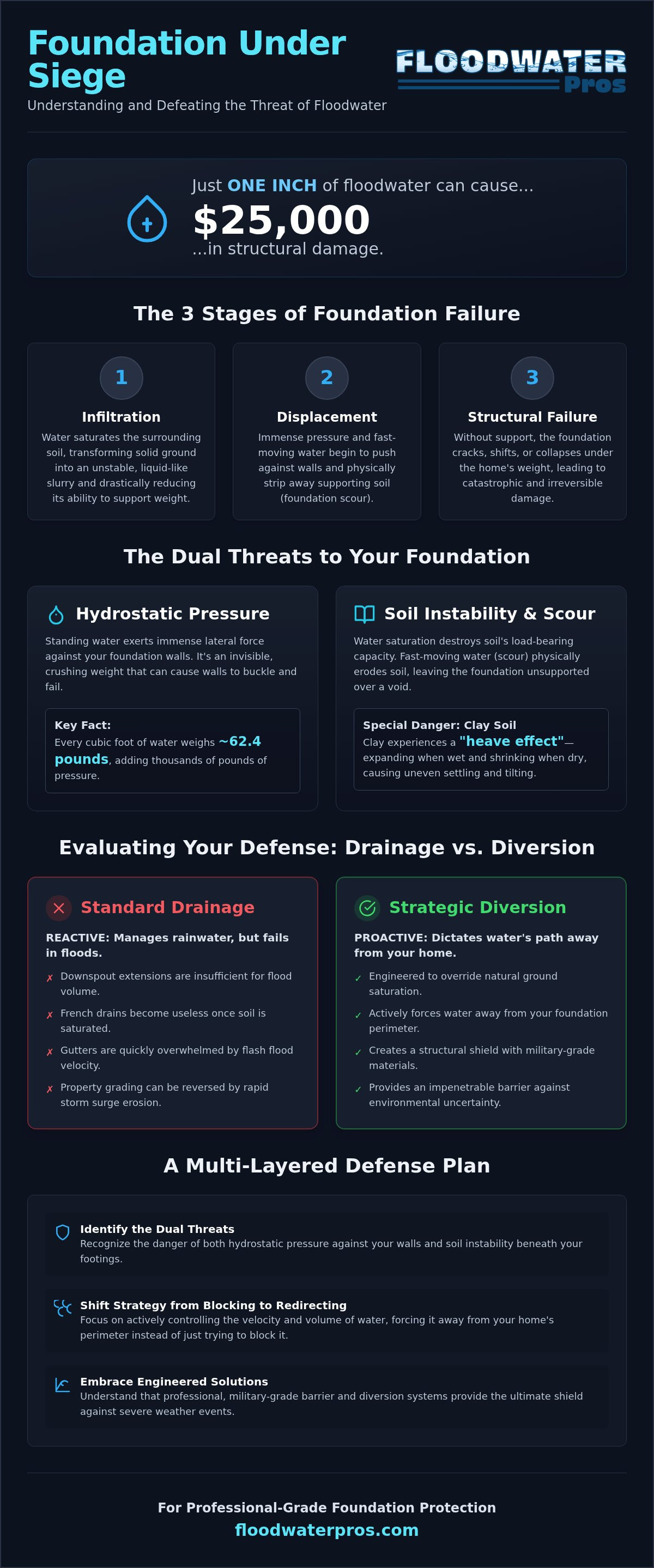
Just one inch of floodwater can trigger up to $25,000 in structural damage. It's a staggering reality. For many homeowners, the true fear isn't just a wet basement; it's the high-stakes mission of avoiding foundation damage from flood water. You know that your home's integrity rests on its base. When heavy rain hits, that foundation becomes the front line of a silent war. It's exhausting to watch the forecast with a knot in your stomach.
You don't have to be a victim of the next storm. We're going to show you how to master the strategic methods to redirect flood water and shield your home’s most critical structural component. This is about more than just drainage. It's about engineered fortification. We'll preview a prioritized checklist for your perimeter defense and explain how to align your property with the latest building code standards for maximum resilience. Peace of mind isn't a luxury. It's the result of a solid plan.
Key Takeaways
- Identify the dual threats of hydrostatic pressure and internal soil instability that lead to catastrophic structural failure.
- Differentiate between simple rain drainage and professional flood diversion to ensure your home remains standing when the water rises.
- Implement a multi-layered defense plan for avoiding foundation damage from flood water by identifying natural water inlets on your property.
- Shift your strategy from merely blocking water to actively redirecting its velocity and volume away from your perimeter.
- Gain clarity on how engineered, military-grade barrier systems provide the ultimate shield against environmental uncertainty.
The Mechanics of Destruction: How Flood Water Erodes Your Foundation
Your foundation is the anchor of your home. It's the silent guardian that keeps everything level and secure. Once this anchor is compromised, the entire structure follows. Flood water doesn't just make things wet; it attacks the very ground your home stands on. By understanding flood dynamics, you can see that water creates a dual threat. It delivers crushing external pressure while simultaneously causing internal soil instability. This is why avoiding foundation damage from flood water requires a strategic defense rather than a reactive cleanup.
One of the most dangerous elements of this process is foundation scour. This occurs when fast-moving water physically removes the supporting soil from beneath or around your footings. It's an aggressive form of erosion that leaves your house suspended over a void. Without that earth for support, the concrete eventually snaps. This destruction typically happens in three distinct stages:
- Stage 1: Infiltration. Water saturates the soil, turning solid ground into a soft, unstable slurry.
- Stage 2: Displacement. Hydrostatic pressure and scour begin to move soil and push against walls.
- Stage 3: Structural Failure. The foundation cracks, shifts, or collapses under the weight of the home.
Soil Saturation and the Loss of Load-Bearing Capacity
Oversaturated soil is a foundation's worst enemy. When the ground becomes waterlogged, it loses its ability to support weight. It turns from a solid support into a liquid-like state. This is especially dangerous in clay-rich environments. Clay undergoes a heave effect when wet. It expands with incredible force, pushing upward against your floor slabs and outward against your walls. When the water finally recedes, the soil shrinks back down. This cycle leads to uneven settling. Your home doesn't just sink; it tilts. This creates catastrophic stress on the framing and roof. It's a slow-motion disaster that begins long before the first crack appears.
Hydrostatic Pressure: The Invisible Weight Against Your Walls
Standing water isn't just sitting there. It's heavy. Every cubic foot of water weighs about 62.4 pounds. When floodwater builds up against your home, it exerts thousands of pounds of lateral force. This is hydrostatic pressure. Basement walls are often the first to buckle because they weren't designed to hold back a lake. Beyond lateral force, there's the role of buoyancy. As the water table rises, it tries to lift your house like a boat. This upward pressure can literally pop a concrete slab foundation off its base. Protecting your home from these invisible weights is essential for avoiding foundation damage from flood water during a major storm surge.
Strategic Diversion vs. Standard Drainage: Evaluating Your Defense
Drainage is for rain. Diversion is for floods. This distinction is the difference between a dry home and a total loss. Most homeowners rely on standard hardware store solutions. They assume a few plastic tubes will save them. They are wrong. When you are serious about avoiding foundation damage from flood water, you must stop managing water and start dictating its path. Standard systems are reactive; engineered systems are proactive.
Consider the common 10-foot downspout extension. In a typical afternoon shower, it works perfectly. During a major flood event, it is insufficient. When the yard is underwater, that extension is simply dumping water into an existing lake. It provides no relief. Similarly, French drains have a hard limit. Once the water table is capped and the soil is saturated, these drains have nowhere to discharge. They become useless pipes buried in mud. You need a system that overrides natural saturation and forces water away from your perimeter.
The Failure Point of Traditional Gutters and Grading
Standard residential gutters are designed for volume, not velocity. In a flash flood, they bypass their capacity in minutes. Water cascades over the sides, pooling directly at your foundation. Even worse is the threat of municipal back-flow. When city storm drains reach capacity, they don't just stop taking water; they can push it back toward your property. Your grading won't save you either. Heavy storm surges cause rapid soil erosion. This can reverse your carefully planned slope in a single hour, turning a protective incline into a funnel that directs water straight into your crawlspace or basement.
Engineered Diversion: The Professional Standard
True fortification requires the Fortress Flood Diversion System. This isn't a drainage pipe; it is a structural shield. It is engineered to create an impenetrable perimeter. By using military-grade materials, this system ensures that floodwater never even touches your footings. The ROI is clear. The cost of professional installation is a fraction of the $35,000 you might pay for foundation piering after a structural failure. If you want to protect your investment, look into advanced diversion technologies that offer total redirection. Avoiding foundation damage from flood water is about physics. It requires controlling the volume and the speed before it becomes a threat. This is how you achieve permanent peace of mind.
How to Fortify Your Perimeter: A Step-by-Step Defense Plan
Fortification is a multi-layered strategy. It starts at the property line, not the doorstep. To succeed in avoiding foundation damage from flood water, you must view your land as a tactical environment. The first step is a topographic assessment. You need to find the natural water inlets where storm surge will gather. This isn't just about looking at the grass. It involves analyzing the grade and soil composition of your entire estate. You are looking for the path of least resistance. Water follows gravity. If your neighbor's runoff or a nearby creek has a direct line to your crawlspace, that is your primary vulnerability. Identifying these inlets allows you to position your defenses where they matter most.
Standard maintenance is reactive. Real protection is proactive. This plan moves from immediate response to permanent resilience. It ensures your home remains a dry sanctuary regardless of the forecast. Once you've mapped the terrain, you can deploy a sequence of barriers that work in tandem to neutralize the threat.
Deploying Rapid-Response Inflatable Barriers
Flash floods wait for no one. When the rain intensifies, you need a defense that deploys in minutes. Fortress Inflatable Flood Barriers create a temporary levee around your foundation. Unlike heavy, porous sandbags, these systems are reusable and highly effective. They act as a mobile wall. You should strategically place them to block driveways and low-lying entry points. These are the areas where water gains momentum. By stopping the flow here, you prevent the hydrostatic pressure described earlier from ever building against your walls. It is a fast, decisive way to gain control during an emergency.
Sealing the Gaps with Paintable Liquid Defense
Even with a perimeter wall, moisture is persistent. Cracks as small as a hair can lead to foundation weeping. This is where internal instability begins. The science of Fortress Transparent Liquid Paintable Flood Barrier coatings offers a solution that doesn't ruin your curb appeal. This is an invisible defense. You apply it directly to brickwork, vents, and door frames. It creates a seamless, waterproof seal that remains flexible. It moves with your home but refuses to let water through. This specialized liquid defense is a critical layer in avoiding foundation damage from flood water. It secures the final inch of your structural integrity.
Permanent resilience is the final goal. Once you have sealed the gaps and managed the immediate surge, you must implement a permanent diversion system. This ensures that every storm is met with a calculated, engineered response. By following these steps, you transform your home from a vulnerable target into a fortified stronghold.
Addressing the #1 Threat: Redirecting Heavy Rain and Storm Surge
Redirecting water is a game of physics. It's about controlling velocity and volume before they control you. Many homeowners try to "block" the water. This is a mistake. When you block water, you create a dam. Dams eventually break or leak under static pressure. Redirection is the superior goal. You want to guide the energy of the surge away from your slab. This is the only reliable way of avoiding foundation damage from flood water during a catastrophic event. You must also account for "run-on." This is the water that cascades from neighboring properties or elevated streets. Without a plan for this external volume, your own defenses will be overwhelmed.
The goal is to create a "dry zone" around your slab. This isn't just about keeping the floor dry. It's about keeping the soil around your footings stable. When you redirect the surge, you prevent the scour and saturation discussed in previous sections. You are dictating where the water goes rather than letting it decide your home's fate. This level of control is the hallmark of structural fortification.
The Mechanics of Water Redirection
Effective diversion uses the water's own weight against it. L-shaped barriers are designed so the rising water actually pins the barrier to the ground. This creates an airtight seal that grows stronger as the surge increases. You also need bypass channels. These are engineered paths that lead water to safe discharge zones. Professional engineering is vital here. If you redirect water onto a neighbor's property without a plan, you face "downstream damage" claims. A strategic partner ensures your defense is legal and effective. To see how these systems work, explore our engineered diversion solutions.
Flash Flood Preparedness for Low-Lying Areas
If your home sits in a basin or at the foot of a slope, you have no margin for error. You live in a natural funnel. In these areas, a "minutes count" mindset is mandatory. You don't have time to fill sandbags when the sky turns black. Rapid deployment systems are the only answer. You should combine permanent landscape grading with deployable Fortress technology. This creates a redundant shield. The grading handles the minor rain, while the Fortress system stops the storm surge. Avoiding foundation damage from flood water in a low-lying zone requires total perimeter control. You are creating a buffer that keeps the crushing weight of the water at a safe distance from your structural footings. Resilience is found in the speed of your response and the strength of your barrier.
The Fortress Solution: Professional-Grade Foundation Protection
Generic solutions fail because every property is unique. A standard plastic drain doesn't account for your specific slope or soil density. FloodWater Pros acts as your strategic partner for high-stakes protection. We provide more than just equipment. We deliver a full-service defense that spans from initial site engineering to final professional installation. Our proprietary Fortress Flood Diversion System is engineered for total redirection. It doesn't just manage water. It dictates where that water goes. This is the ultimate upgrade for homeowners serious about avoiding foundation damage from flood water. You aren't just buying a barrier. You are investing in a military-grade shield for your estate.
Protecting your home is about protecting your legacy. The financial stakes are high, but the emotional stakes are higher. Structural failure is a catastrophic event that can displace families for months. By choosing a professional diversion system, you secure both your equity and your peace of mind. The relief of structural security is profound. It's the difference between watching the rain with anxiety and watching it with total confidence. We move you from a state of vulnerability to a state of unwavering readiness.
Custom Engineering for Unique Property Challenges
Off-the-shelf solutions often fail because they ignore residential layouts. Your home's footprint and the surrounding topography require a bespoke approach. Our experts design a diversion path specific to your land. We analyze how water moves across your grass and where it pools against your walls. Professional installation is mandatory to maintain barrier integrity. A single gap in a DIY setup can lead to total system failure under the weight of a storm surge. We ensure every component is locked down and every seal is impenetrable. This level of precision is why our systems stand when others wash away.
Taking the First Step Toward Fortification
Don't wait for the next storm to test your foundation. Nature is an unforgiving auditor. By the time you see the water rising, it's often too late to act. Our consultative approach begins by identifying your specific risk profile. We look at the 500-year flood standards and the latest building codes to ensure your home is ahead of the curve. This isn't just about surviving the next rain event. It's about long-term resilience. Secure your foundation with a Fortress consultation today. Avoiding foundation damage from flood water starts with a single, decisive choice. Take control of your home's future before the forecast changes again.
Secure Your Structural Future Today
The threat of environmental instability is real. You've seen how hydrostatic pressure and soil scour can dismantle a home's integrity in hours. Avoiding foundation damage from flood water is no longer a matter of luck; it's a matter of engineering. True resilience requires shifting from reactive drainage to proactive redirection. By harnessing proprietary Fortress Diversion Technology, you transform your property into a military-grade stronghold. This isn't just about surviving the next storm. It's about ensuring your home remains a permanent sanctuary for your family. Redirection is the only strategy that respects the physics of water volume and velocity.
Don't leave your legacy to chance. Professional engineering and national installation provide the certainty you need when the water rises. You have the tools to dictate the path of the surge and protect your most valuable asset. Take the final step toward total security and the profound relief of structural integrity. You've learned the mechanics of destruction; now it's time to implement the mechanics of defense.
Fortify your home’s foundation; Get a professional Fortress evaluation
You've mastered the strategy. Now, deploy the defense. Your home deserves the highest standard of protection and you deserve peace of mind.
Frequently Asked Questions
Can flood water cause a foundation to collapse instantly?
Yes, hydrostatic pressure can cause a foundation wall to buckle or collapse in seconds once it reaches a critical threshold. This isn't usually a slow process. Instead, the weight of the water builds until the masonry or concrete snaps under the lateral load. This is why avoiding foundation damage from flood water requires proactive diversion before the surge reaches your perimeter. Once the wall moves, the entire structure is at risk.
Is it possible to waterproof an existing foundation against floods?
You can significantly fortify an existing foundation, though total waterproofing against deep floods is complex. Success depends on a multi-layered approach. By combining the Fortress Transparent Liquid Paintable Flood Barrier with a permanent diversion system, you create a seamless shield. This prevents moisture infiltration and manages external pressure. It's about building resilience into the structure you already own.
How far should I redirect water away from my house foundation?
For standard rain, ten feet is the minimum. During a flood event, you must redirect water until it reaches a natural lower grade or a dedicated discharge zone. Simply moving water a few feet away won't help if the entire yard is saturated. You need a calculated path that prevents the water from circling back. This ensures your dry zone remains intact throughout the storm.
Do sandbags actually prevent foundation damage?
Sandbags are often a false sense of security. They are porous, heavy, and difficult to deploy correctly in a crisis. They might slow down debris, but they don't stop the hydrostatic pressure that causes structural failure. Modern inflatable barriers provide a far superior seal. They use the weight of the floodwater to lock themselves in place, creating a much more reliable perimeter defense.
What are the first signs of foundation damage after a flood?
Look for new cracks in the masonry or interior drywall. Sticking doors and windows are also immediate red flags. These signs indicate that the soil has shifted or the foundation has settled unevenly. If you notice a musty smell or damp spots in the crawlspace, moisture has already breached your perimeter. Early detection is vital for avoiding foundation damage from flood water before it becomes a five-figure repair.
How does the Fortress Flood Diversion System differ from standard landscaping?
Standard landscaping focuses on aesthetics and minor rain runoff. The Fortress Flood Diversion System is a structural grade technology designed to handle high-velocity storm surges. It uses engineered L-shaped barriers and bypass channels to control massive volumes of water. While a garden bed might wash away, this system is built to stand its ground. It's a military-grade upgrade from simple dirt and grass.
Can I install these flood barriers myself or do I need a professional?
You can deploy inflatable barriers yourself during an emergency. However, the permanent Fortress Flood Diversion System requires professional engineering and installation. This ensures that the diversion path is legally compliant and structurally sound. A professional team analyzes your topography to prevent downstream damage. This expert oversight is what guarantees the system will perform when the stakes are at their highest.
Will a paintable flood barrier change the look of my home?
The Fortress Transparent Liquid Paintable Flood Barrier is designed to be completely invisible once it dries. It protects your brickwork, vents, and door frames without altering your home's aesthetic. You get the benefit of a seamless waterproof seal without the look of a commercial bunker. It's the ideal choice for homeowners who want elite protection while maintaining their property's curb appeal.


