

A modular flood barrier may fit a doorway perfectly and still be unsuitable for the flood conditions your property could face. Separate sections can help shape a layout around openings and corners, but their connections and seals, along with the surface beneath them, matter just as much.
It’s reasonable to look for a system that can be arranged around entrances, turns, and other site features. But modularity alone doesn’t guarantee protection. A temporary barrier’s suitability depends on the site geometry, installation, sealing, and conditions it is designed to handle. Uneven surfaces and overlooked openings can complicate the plan.
This guide explains how modular flood barriers are assembled, where their flexibility can help, and what their limitations mean in practice. You’ll compare approaches using site-specific criteria, including openings, corners, ground conditions, and deployment needs. You’ll also learn what measurements, photos, and flood-risk details to gather before requesting a professional assessment, so your next step is based on your property rather than assumptions.
Key Takeaways
- A modular flood barrier uses separate sections to form a planned boundary, but the layout and seals need to suit the site.
- Trace likely water pathways and map entrances, corners, and other openings before comparing barrier approaches.
- Ground conditions and access needs can affect whether a modular flood barrier is a practical fit for your property.
- Compare modular barriers, inflatable barriers, diversion systems, and sandbags by deployment, site fit, storage, and reusability.
- Gather measurements, photos, drainage details, and known entry points to support a more informed professional assessment.
What Is a Modular Flood Barrier, and What Problem Does It Solve?
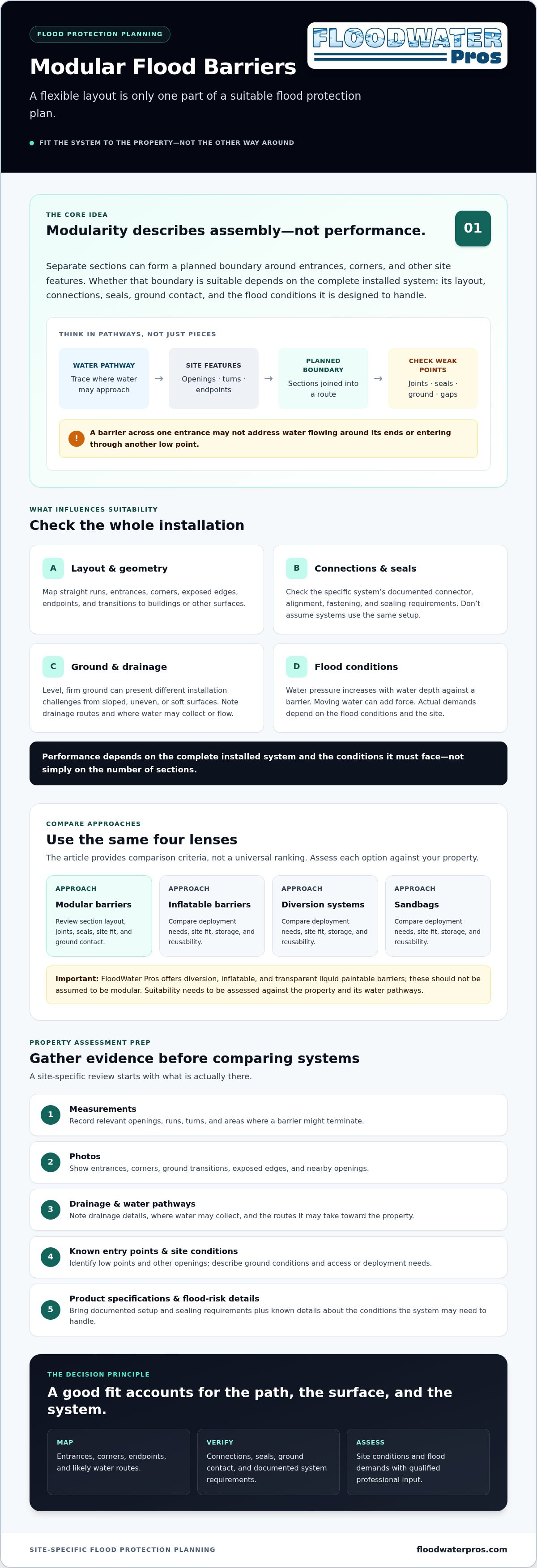
A modular flood barrier is assembled from separate sections to create a planned boundary against floodwater. Depending on its design, that boundary may help limit water entry or redirect flow away from a vulnerable area. Modularity provides flexibility in how a system is arranged, not automatic protection. The sections, joints, ground surface, and expected flood conditions all affect whether a particular system is suitable.
In short: A modular flood barrier uses separate components to form a floodwater boundary. Its modular design describes how it is assembled, not how well it performs.
How Do Modular Barrier Sections Fit Together?
Depending on the system, sections may connect in a straight run, align with an opening, or meet at corners. Pay attention to those connections. Joints, endpoints, changes in direction, and transitions to a building or ground surface can become weak points if they aren’t planned for. Check the manufacturer’s instructions and product specifications rather than assuming every barrier uses the same connectors, setup method, or sealing approach.
Barriers differ in form and deployment, as this overview of temporary flood barriers illustrates. A modular layout by itself doesn’t show that the assembled system will keep water out. Performance needs to be assessed for the specific system and site.
Where Might a Modular Flood Barrier Be Considered?
Potential assessment points include doorways, loading or access openings, exposed building edges, and property boundaries where water may approach. Start by tracing the likely water pathway. A barrier across one entrance may not address water flowing around its ends or entering through another low point.
Suitability depends on the site layout, ground conditions, drainage, and the system’s documented specifications. For a broader look at planning protection for a home, explore residential flood protection systems. FloodWater Pros offers diversion, inflatable, and transparent liquid paintable barriers, but these should not be assumed to be modular. Their suitability needs to be assessed against the property and its water pathways.
How Modular Flood Barriers Work: Connections, Layout, and Water Pressure
A barrier protects only the path it covers. Planning starts at the first section, follows the intended line through each straight run and corner, then checks where the barrier ends or meets a building. If water can pass around an endpoint, through a gap, or along a poorly fitted transition, the planned boundary may be incomplete.
Water also puts force on a barrier. Pressure increases with the depth of water against it, and moving water can exert additional force. The actual demands depend on flood conditions and the site, so performance can’t be judged from the number of sections or the layout alone. The U.K. Environment Agency discusses how temporary barriers are used to reduce flood risk, including the importance of appropriate deployment.
Modularity describes configuration, while performance depends on the complete installed system. That includes the barrier, its connections, its contact with the ground, and the conditions it must face.
Why Joints, Corners, and Endpoints Need Attention
Every joint and change in direction affects the continuity of the barrier. A site plan can show where sections meet, where the route turns a corner, and how the ends are intended to terminate. It can also reveal awkward transitions, gaps beside openings, or a layout that leaves part of the property exposed.
Don’t guess how the connections work. Confirm the documented details for the specific system, including any stated alignment, fastening, or sealing requirements. If the specifications don’t explain a transition clearly, flag it for qualified review instead of treating it as a minor installation detail.
How Site Conditions Affect Barrier Performance
A level, firm surface can present different installation challenges from sloped, uneven, or soft ground. Drainage routes matter too. Water may collect or flow toward the protected area from a direction the barrier layout doesn’t account for. Nearby doorways, vents, and other openings can create additional paths inside.
Record these features and have the water pressure and flow conditions reviewed for the specific site. Planning should consider where water travels, not just where a barrier can be placed. FloodWater Pros’ overview of flood diversion system design explores how water movement can inform protection planning. You can also review FloodWater Pros’ flood protection options.
Modular Flood Barriers Compared With Other Protection Approaches
No single barrier format suits every property or flood scenario. A modular flood barrier may provide a layout made from separate sections, but that feature doesn’t establish tested capacity, reliable sealing, or suitability for a particular site. Compare options based on the water pathway, openings to protect, available storage, and who will deploy the system. The temporary and demountable flood protection guide from GOV.UK provides further planning context.
| Approach | Deployment and site fit | Storage and reusability | Assessment focus |
|---|---|---|---|
| Modular barriers | Separate sections may suit a planned route around openings or boundaries. Joints, corners, and endpoints need a system-specific plan. | Consider where sections will be stored and how they’ll be moved. Reuse depends on the system and its condition. | Confirm documented connection, ground-contact, and performance requirements. |
| Inflatable barriers | Assess the intended deployment method, available space, and whether the layout suits the site. | Check storage requirements, inspection needs, and reuse instructions for the specific barrier. | Verify operating instructions and suitability for expected flood conditions. |
| Diversion systems | May be considered when the plan is to redirect water, making the route water will take central to the design. | Storage and reuse depend on the system’s configuration and requirements. | Review flow paths, nearby exposures, and site-specific design. |
| Sandbags | Placement is manual and must account for openings, edges, and the path water may take. | Plan for handling, storage, and disposal or reuse based on their condition and local guidance. | Assess the intended use and whether placement can address the site’s vulnerabilities. |
When Could a Modular Layout Be a Better Fit?
Consider a segmented approach if the protection route needs to pass several openings or follow a boundary with turns. Sketch the route and identify who will prepare and deploy each section, where components can be stored, and what conditions could affect setup. Don’t assume a modular system is easier to install or offers stronger protection. Confirm those details in its documentation and assessment.
When Should You Consider a Different Barrier Approach?
If the plan is to redirect water, a diversion approach may warrant review. If you’re considering an inflatable format or a less visible treatment, compare its documented requirements with the property instead of assuming it will fit. FloodWater Pros offers the Fortress Flood Diversion System, Fortress Inflatable Flood Barrier, and Fortress Transparent Liquid Paintable Flood Barrier. These are confirmed offerings, not confirmed modular systems. Explore inflatable flood barriers for homes, or review FloodWater Pros’ barrier options as part of your comparison.
How to Evaluate a Modular Flood Barrier for Your Property
Start with the site, not a product name. Separate what you can observe from what a qualified professional needs to determine. You can document where water has entered and what the ground looks like, while system design and performance need expert review.
- Identify water pathways. Note where water has approached or entered, then trace possible routes toward the building or property.
- Map openings. Measure doors, garage openings, low points, and corners where a barrier may need to meet or turn.
- Document ground conditions. Photograph slopes, uneven surfaces, drainage features, and changes in paving or ground level along the potential barrier line.
- Define access needs. Record which routes must remain usable and who would be responsible for deploying the system.
- Seek expert review. Share your notes and ask for a site-specific assessment of the layout, system requirements, and suitability.
These observations can make a professional review more productive. They don’t replace engineering decisions about how a modular flood barrier should be designed or what conditions it can address.
What Information Should You Gather Before an Assessment?
Prepare a simple site plan, even if it’s hand-drawn. Mark doors, garage openings, corners, low points, drainage paths, and the directions from which water could approach. Add measurements and clear photos of the proposed barrier route, including surface changes and known locations of previous water entry. Note which access routes must remain open, who would handle setup, and what storage space may be available.
What Should You Ask a Flood Protection Professional?
Ask how the proposed layout addresses joints, endpoints, transitions, ground conditions, and water pathways. Request product documentation that explains performance claims, limitations, maintenance, and storage. Clarify what the provider handles across engineering, manufacturing, and on-site installation, and which decisions require site-specific review.
For another perspective on planning around water movement, read about flood diversion system design. Once you’ve gathered your site information, request a professional flood protection assessment to discuss which system options may fit your property.
From Modular Flood Barrier Research to a Professionally Planned Solution
Choosing protection starts with the property, not the barrier label. A modular flood barrier may seem to match the site layout, but the right decision depends on where water travels, which areas need protection, and what a specific system is designed to address. Plan the full route, including openings and transitions, before settling on a format.
How FloodWater Pros Can Support System Planning
FloodWater Pros manages projects from engineering and manufacturing through professional on-site installation. This end-to-end process connects site conditions with system selection and installation planning. The appropriate option still depends on the property and verified product capabilities. No barrier format should be assumed to suit every site or flood condition.
FloodWater Pros’ offerings include the Fortress Flood Diversion System, Fortress Inflatable Flood Barrier, and Fortress Transparent Liquid Paintable Flood Barrier. These are distinct options to assess for site-specific suitability, not products to assume are modular. Ask how a proposed system relates to your water pathways, openings, ground conditions, access requirements, and documented performance information.
What to Prepare Before Requesting a Consultation
Bring observations that can help frame a useful discussion. Gather:
- Photographs of entrances, property edges, ground surfaces, drainage features, and likely water approaches.
- Rough measurements of openings and the areas you want to protect.
- Notes on known water entry points, surface slopes, and routes where water has collected or flowed.
- Access requirements, including routes that must remain usable and who may be responsible for deploying a system.
- Questions about visibility, storage, setup responsibilities, maintenance, and product limitations.
These details describe what you’ve observed. A qualified professional should evaluate what they mean for system design and performance. That distinction keeps the discussion grounded in your site without turning photos or measurements into an engineering conclusion.
With your notes in hand, discuss the property’s conditions and suitable protection options with FloodWater Pros. A considered plan can help you move from general research to a clearer understanding of what may fit and what still needs to be verified.
Turn Your Site Assessment Into a Clear Protection Plan
A modular flood barrier’s sections can adapt to a planned layout, but that alone doesn’t establish how well the system will perform. The right choice starts with your property: where water may travel, which openings need attention, and how ground conditions and access affect the proposed layout.
Bring those observations into a professional review. Measurements, photos, drainage details, and known water entry points can help guide a site-specific discussion. FloodWater Pros manages projects from engineering and manufacturing through professional on-site installation. Its offerings include the Fortress Flood Diversion System, Fortress Inflatable Flood Barrier, and Fortress Transparent Liquid Paintable Flood Barrier. Their suitability depends on your site and verified product capabilities.
Take the next step with a clearer picture of your property and the questions you need answered. Discuss a site-specific flood protection plan with FloodWater Pros.
Frequently Asked Questions
Is a modular flood barrier suitable for every property?
No. Site layout, openings, ground conditions, likely water pathways, and a system’s documented capabilities all affect suitability. A modular flood barrier may allow sections to be arranged around site features, but that flexibility doesn’t establish how well the assembled system handles particular flood conditions. Ask a qualified flood protection professional to assess the complete layout and site exposure before selecting a system.
How do modular flood barriers connect?
Connection methods vary by manufacturer and system design. Sections may be aligned or joined using specified components, with careful planning at corners, endpoints, and transitions. Don’t assume barriers from different systems will connect or seal together. Review the product documentation for the exact assembly method, surface requirements, maintenance needs, and limitations. Then confirm with a qualified professional that the proposed layout fits the property and its potential water pathways.
Can modular flood barriers be reused?
Some systems are designed for repeated deployment, but reuse depends on the product, materials, storage conditions, maintenance, and any damage sustained. Don’t assume every modular barrier can be reused. Check the manufacturer’s instructions for how to inspect, clean, and store components, and when they should be replaced. Ask whether the system needs professional checks before another deployment, especially if it has experienced exposure or damage during use.
Do modular flood barriers stop all floodwater?
No. Don’t assume any barrier will stop all floodwater in every condition. Performance depends on the system design, installation, joints, ground contact, water levels, flow, and the property’s exposure. Look for documented limits and request a site-specific assessment rather than relying on the word modular. A qualified professional can help identify water pathways the proposed layout may not address and discuss other measures that may be appropriate.
How do I choose the right modular flood barrier?
Start by mapping where water could reach the property and identifying openings, corners, surface changes, and access needs. Compare documented performance, connection details, deployment responsibilities, storage requirements, and maintenance instructions. Ask a qualified provider to assess the whole site and explain the proposed layout’s limitations. Choose based on verified suitability for your property and conditions, not modularity alone or a product description without supporting information.
How much does a modular flood barrier cost?
There’s no reliable single figure without knowing the property and proposed system. The scope may depend on the area to protect, site conditions, design requirements, product selection, and professional installation. Request a site-specific assessment and written scope that explains the proposed system and installation details. Don’t compare offers on a headline figure alone. Check what design work, components, installation, and ongoing support are included.
Do modular flood barriers require professional installation?
Installation requirements vary by product and site. Some systems may include owner deployment instructions, while an engineered layout may call for professional assessment and installation. Follow the manufacturer’s guidance, and don’t assume that connecting sections ensures correct placement. Ask who will assess the ground, joints, endpoints, and water pathways. Clarify what site preparation, deployment, inspection, and maintenance the property owner is expected to handle.


