

Your clean gutters are a baseline, not a shield. Most homeowners believe that clearing debris is enough to stop a storm, but they're often left watching the water rise with a familiar knot of anxiety. You’ve done the chores. You’ve cleared the drains. Yet, the basement still seeps when the clouds truly open up. With over 20% of National Flood Insurance Program claims now coming from outside high-risk zones, the threat is no longer theoretical. Mastering the art of preventing water damage from heavy rain requires a fundamental shift in strategy. It's time to move beyond basic home maintenance and embrace a philosophy of engineered perimeter defense.
It’s exhausting to wonder if your home is truly flood-proof or merely water-resistant while a storm rages outside. We understand that vulnerability. This guide provides the blueprint for total fortification, ensuring your property remains dry even during the most severe downpours. You'll learn how to transition from passive hope to active structural diversion. We're going to break down the professional-grade systems that offer total peace of mind and long-term property value. This is your path from uncertainty to an impenetrable sanctuary.
Key Takeaways
- Understand why standard maintenance like gutter cleaning isn't enough when soil reaches its saturation point and hydrostatic pressure takes over.
- Learn the strategic shift from simple water retention to engineered diversion as the only reliable method for preventing water damage from heavy rain.
- Identify the hidden vulnerabilities in your home's envelope where water intrudes through porous materials and sub-surface pressure points.
- Discover how to build a multi-layered defense that uses engineered diversion to stop water before it ever touches your foundation.
- Find out why a professional engineering-led approach provides the total peace of mind that DIY solutions can't match.
Beyond Gutters and Grading: Why Standard Storm Prep Fails
Rainfall patterns have shifted. High-intensity moisture plumes, often called atmospheric rivers, now deliver months of rain in mere hours. These events are turning "100-year storms" into annual occurrences. Most homeowners rely on legacy methods that were never built to handle this volume. Standard drainage is a baseline. It isn't a solution for preventing water damage from heavy rain when the environment becomes truly hostile. With over 20% of flood insurance claims coming from homes outside of high-risk zones, the danger is closer than many realize.
There's a dangerous gap between a water-resistant property and a flood-protected one. Water-resistant homes can shed a typical shower. Flood-protected properties are engineered to withstand total saturation. Relying on basic maintenance to survive an engineered threat is a strategy destined for failure. You need a shield, not just a shovel.
The Failure of Conventional Maintenance
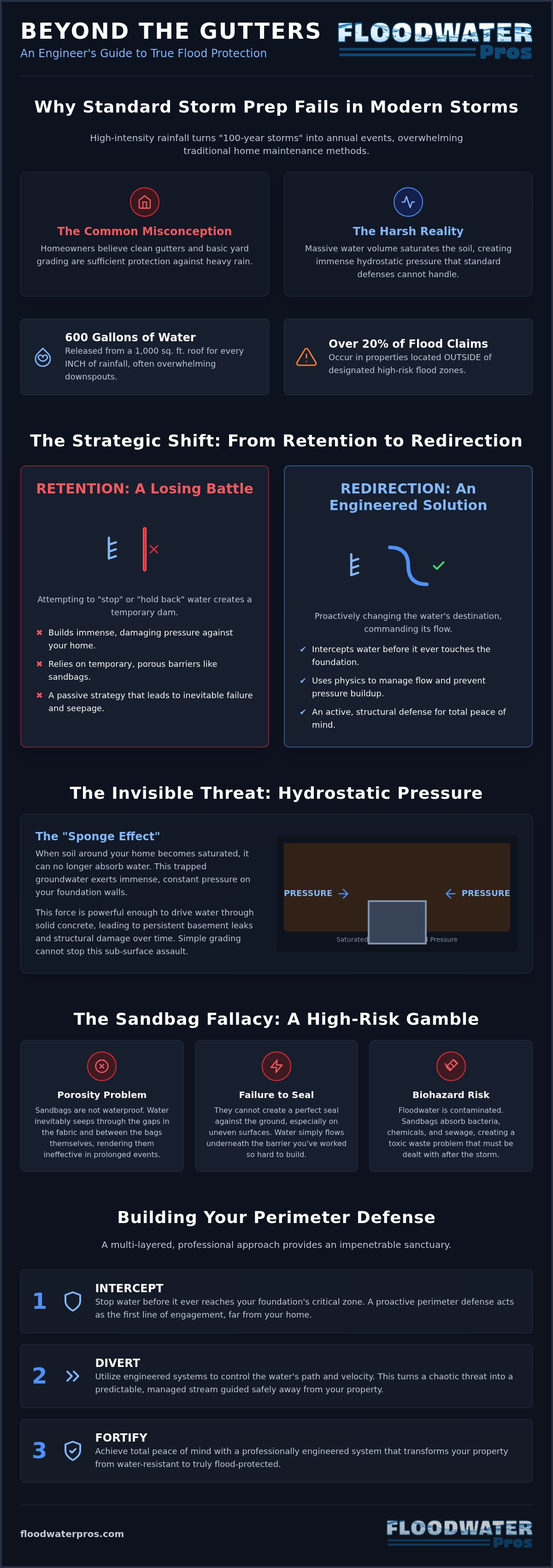
Traditional advice focuses on cleaning gutters and checking downspouts. While necessary, these actions are often insufficient. A 1,000 square foot roof sheds approximately 600 gallons of water for every inch of rain. Many downspout extenders dump this massive volume directly into the "critical zone" of the foundation. This creates a concentrated pool of liquid right where the structure is most vulnerable. Even a perfect DIY slope of one inch per foot can fail when the volume of water exceeds the soil's ability to absorb it. At this point, maintenance ends and structural risk begins. True protection requires comprehensive flood management strategies that look beyond simple debris removal.
Understanding Hydrostatic Pressure
When the ground around your home reaches its saturation point, it creates the "Sponge Effect." The soil can no longer hold water. Instead, that water becomes an invisible, heavy weight pressing against your foundation walls. This is the silent enemy of every homeowner. Hydrostatic pressure is the force that drives groundwater through solid concrete. It doesn't matter how thick your walls are. If the pressure isn't diverted, the water will find a way in. This underground threat is a primary cause of recurring basement seepage. It represents a level of danger that standard grading cannot fix. Preventing water damage from heavy rain requires a plan that addresses this sub-surface reality before the first drop falls.
Redirection vs. Retention — The Strategy of Diversion
Most homeowners approach a storm with a defensive mindset. They try to "stop" the water. This is the strategy of retention, and it's a dangerous gamble. When you attempt to hold water back using seals or sandbags, you're essentially building a temporary dam. Eventually, the weight of the accumulation creates immense pressure against your home’s envelope. Preventing water damage from heavy rain requires a mental and physical shift. You must move from "stopping leaks" to "commanding the current."
The strategy of diversion is rooted in engineering rather than hope. Instead of fighting the volume, you change the water's destination. By utilizing a structural answer like the Fortress Flood Diversion System, you exploit the physics of flow. You don't wait for the water to reach your foundation. You intercept it. This proactive approach turns a chaotic environmental threat into a managed, predictable stream that stays far away from your valuable property.
The Physics of Water Redirection
Water in motion possesses kinetic energy. When that motion is abruptly stopped by a flat barrier, that energy transforms into static pressure. This is often where structural failures begin. Engineered redirection systems are designed to manage the "Velocity Factor." By steering the water at an angle, these systems maintain the water’s momentum but dictate its path. This prevents the dangerous build-up of hydrostatic weight against your walls. It's the difference between a car hitting a wall and a car following a curved exit ramp. One is a catastrophe; the other is a controlled transition.
Why Barriers Beat Sandbags Every Time
Sandbags are the most common tool for retention, yet they're fundamentally flawed for modern storm protection. They present a "porosity problem" where water eventually seeps through the gaps in the fabric. Beyond their failure to provide a true seal, sandbags carry significant risks:
- The Biohazard Reality: Flood water is rarely clean. Sandbags absorb bacteria, chemicals, and sewage, turning your defense into a toxic waste problem once the storm passes.
- Deployment Speed: A professional barrier can be set in minutes. Proper sandbagging for a single doorway requires hours of back-breaking labor and hundreds of pounds of material.
- Structural Weight: Wet sandbags are incredibly heavy and can actually damage the very thresholds they're meant to protect.
If you're ready to stop reacting to the clouds and start protecting your legacy, it's time to consider an engineered diversion strategy that provides permanent security. Real protection isn't found in a pile of burlap. It's found in a system designed to outsmart the storm.
Identifying Critical Failure Points — From Foundations to Envelopes
Your home isn't a sealed tank. It's a complex assembly of joints, seams, and porous materials. Modern construction often prioritizes speed and aesthetics over absolute impermeability. When preventing water damage from heavy rain, you must look beyond the roofline. The real battle happens at ground level and below. Water is a patient invader. It finds every microscopic gap in your building envelope. By the time you see a puddle, the intrusion has likely been happening for hours.
Ignoring a small trickle is a high-stakes mistake. Minor seepage leads to rot, structural decay, and toxic mold colonies. These issues don't just lower property value; they compromise the health of your sanctuary. Repairing a foundation after it has shifted costs significantly more than securing it beforehand. Vigilance is your first line of defense against an environmental threat that never stops searching for a weakness.
The Vulnerability of the Ground-Level Opening
Garage doors are the most frequent point of failure during a storm. They're designed for vehicles, not for keeping out a surging current. Most thresholds lack the height or seal integrity to withstand high-volume runoff. During a heavy downpour, water pools against these openings and finds the path of least resistance. Evaluation is key. Check your door seals for light or air gaps. If air can get in, water will follow. Window wells are another critical weak point. They act as funnels during a deluge. If the drainage at the bottom of the well fails, the water has only one place to go. It goes through the glass or the frame.
Foundation Seepage and Hydrostatic Threats
A dry basement in July doesn't guarantee safety in August. Heavy rain causes the local water table to rise rapidly. This creates a vertical pressure that pushes against your floorboards from beneath. Preventing water damage from heavy rain means identifying these sub-surface threats before the rain starts. Look for the early warning signs of foundation stress:
- Efflorescence: A white, salty crust on concrete walls indicating moisture movement.
- Hairline Cracks: Small fissures in the floor or walls that widen under pressure.
- Musty Odors: The first sign of dampness trapped behind finished walls.
- Damp Spots: Discoloration at the base of foundation walls where the floor meets the wall.
Understanding these failure points allows you to move from reactive repairs to proactive fortification. You can't control the weather, but you can control how your home responds to it.
Building Your Perimeter Defense — A Multi-Layered Approach
Surrendering your ground floor is not a plan. It's a defeat. Many traditional guides suggest moving your valuables to higher floors when a storm approaches, but this is a retreat strategy. True fortification requires a proactive, multi-layered defense that stops the threat at your property line. This is the only reliable way to master preventing water damage from heavy rain. You don't just wait for the water. You meet it at the gate.
A professional-grade defense consists of three distinct layers of protection. Each layer is designed to address a specific environmental challenge. The first layer is the engineered perimeter. By installing a Fortress Flood Diversion System, you intercept rushing water before it touches your lawn. This primary shield ensures that high-volume runoff is redirected toward safe drainage zones. It removes the burden from your soil and protects your foundation from the hydrostatic pressure that causes long-term structural decay. This isn't a temporary fix; it's a permanent structural upgrade.
The Power of the Invisible Shield
Modern architecture often features beautiful but porous materials like stone, brick, and wood. These are the entry points for moisture. The second layer of defense is structural sealing using the Fortress Transparent Liquid Paintable Flood Barrier. This specialized coating fills the microscopic gaps in your home's envelope. It's ideal for sealing door frames and masonry that traditional barriers might miss. Transparent coatings provide structural-grade protection without altering your home’s curb appeal. It is an invisible, military-grade shield that remains vigilant even when you aren't home. This layer ensures that even if water reaches the structure, it cannot penetrate the surface.
Strategic Deployment of Inflatable Barriers
Sometimes the environment delivers an unexpected surge that exceeds typical drainage capacity. This is where the third layer comes in. The Fortress Inflatable Flood Barrier is designed for rapid deployment during rapid-onset storms. It allows you to create a temporary sea wall across driveways or low-lying garage entries in minutes. These barriers are reusable, giving you a tactical advantage storm after storm. They're a structural answer to a high-stakes environmental threat.
The integrity of these layers depends on precision. Engineering-led design and professional installation ensure that every component works as a unified system. Without expert calibration, even the best tools can leave a gap for the water to find. If you're ready to secure your property with a professional engineered perimeter defense, the time to act is before the next warning is issued. You deserve the profound relief that only total security can provide.
Professional Fortification — The Fortress Flood Diversion Advantage
Eyeballing a flood risk is a recipe for disaster. Most home maintenance guides offer suggestions that rely on luck. Professional fortification relies on physics. When you're serious about preventing water damage from heavy rain, you need a solution that matches the scale of the threat. The Fortress Flood Diversion System isn't a temporary patch. It's a structural answer to an environmental problem. We handle the entire process. This includes everything from site-specific engineering to professional on-site installation. You aren't just buying a product. You're securing a strategic partner who understands the gravity of environmental threats. We've seen what happens when standard defenses fail. We've seen the loss that follows. That's why we don't settle for "good enough."
Engineered for Permanence
Retail-grade "quick fixes" fail because they're generic. They don't account for the specific slope of your driveway or the way your lawn naturally channels runoff. Our design philosophy integrates the Fortress system with your property’s unique topography. We use professional-grade materials built for durability. These systems are designed to withstand the velocity and weight of extreme moisture plumes. This level of precision is why we provide a Professional Flood Barrier System Installation Guide to explain our methodical approach. We don't guess. We engineer. Our experts have seen the consequences of inaction. We build to ensure those consequences never reach your front door. This is total transformation. It's about turning a vulnerable asset into an impenetrable sanctuary.
The Peace of Mind Factor
The true value of fortification isn't just a dry floor. It's the profound relief that comes when the storm sirens sound. You no longer have to pace the hallways or check the basement every hour. Vulnerability is replaced by mental well-being. This shift happens the moment our team completes the professional installation. We act as the final seal on your property's safety. Every joint is calibrated. Every barrier is tested. It's time to stop hoping the rain stops and start knowing your home is ready. We provide more than just equipment. We provide a shield against uncertainty. Your home is your most valuable investment. Protecting it requires more than a weekend project. It requires the seasoned wisdom of experts who have mastered the niche of protection. Secure your legacy with a Fortress Flood Diversion System today.
Secure Your Sanctuary Before the Clouds Break
The next storm isn't a matter of if, but when. Relying on basic maintenance leaves your property vulnerable to the growing threat of intense rainfall events. You now understand that true security requires a shift from passive retention to active redirection. By identifying critical failure points and building a multi-layered perimeter defense, you take command of the environment. Mastering the art of preventing water damage from heavy rain is the only way to ensure your legacy remains intact.
FloodWater Pros provides the structural answers you need. Our proprietary Fortress Diversion Technology is engineered to redirect water flow, not just retain it against your foundation. With national engineering and installation teams ready to deploy, we manage every step of your property’s transformation. You deserve the profound tranquility that comes with professional fortification. Don't wait for the water to rise before you act. Fortify your home against the next storm with FloodWater Pros. Your peace of mind is worth the investment. Build your shield today.
Frequently Asked Questions
How do you divert heavy rain away from your house effectively?
Effective diversion requires intercepting water before it reaches your foundation. You should utilize an engineered system like the Fortress Flood Diversion System to change the water's path based on your property’s specific topography. This approach moves the volume toward safe drainage zones rather than allowing it to pool against your walls. It is the most reliable method for preventing water damage from heavy rain during high-intensity storms.
What is the best alternative to sandbags for heavy rain flooding?
Engineered barriers are the superior choice because sandbags are porous and prone to leaking. The Fortress Inflatable Flood Barrier provides a much tighter seal and can be deployed in a fraction of the time. Unlike sandbags, which become heavy and contaminated with biohazards, professional barriers are reusable and easy to store. They offer a structural defense that handles the velocity of rushing water without the back-breaking labor of burlap bags.
Does homeowners insurance cover water damage from heavy rain?
Standard homeowners insurance policies typically exclude damage caused by surface water or flooding. In most cases, you need a separate policy through the National Flood Insurance Program (NFIP) or a private provider. NFIP policies for residential buildings have a coverage limit of $250,000 and usually require a 30-day waiting period. It is vital to secure coverage early, as private flood insurance waiting periods can still range from 10 to 15 days.
How do I stop water from coming under my door during a storm?
You can stop intrusion by combining structural seals with rapid-deployment barriers. Applying the Fortress Transparent Liquid Paintable Flood Barrier to door frames and thresholds creates an invisible, waterproof seal on porous surfaces. For larger openings like garage doors, the Fortress Inflatable Flood Barrier provides a temporary sea wall that blocks surging runoff. This dual-layer approach ensures that water is stopped at the threshold before it enters your living space.
What is the difference between a flood barrier and a flood diversion system?
A flood barrier is designed for retention, meaning it holds water back at a specific entry point like a door. A flood diversion system, such as our proprietary Fortress system, is an engineered solution that redirects the current entirely. While barriers are excellent for stopping leaks, diversion systems manage the physics of flow to ensure water never reaches the structure. Diversion reduces the hydrostatic pressure that often causes foundation failure.
Can I install a professional flood barrier system myself?
Professional-grade systems require expert engineering to function correctly under extreme pressure. At FloodWater Pros, we manage the entire process from site engineering to professional on-site installation across the United States. DIY attempts often fail because they miss microscopic gaps or don't account for the velocity of the water. Professional installation ensures that your defense system is calibrated to your home's unique vulnerabilities for total peace of mind.
How long do inflatable flood barriers last in heavy rain?
The Fortress Inflatable Flood Barrier is engineered from military-grade materials to withstand the entire duration of a severe storm. These systems are designed for durability and are fully reusable storm after storm. Unlike temporary DIY fixes that degrade when saturated, professional inflatable barriers maintain their structural integrity against constant pressure. They provide a reliable, tactical advantage for preventing water damage from heavy rain whenever a rapid-onset surge occurs.
Are liquid flood barriers really invisible once applied?
Yes, the Fortress Transparent Liquid Paintable Flood Barrier is specifically formulated to dry clear. This allows it to protect porous masonry, brick, and door frames without altering your home's curb appeal or architectural details. It provides a military-grade shield that is virtually undetectable to the naked eye. This makes it an ideal solution for homeowners who want professional fortification without sacrificing the aesthetic integrity of their property’s exterior.


