

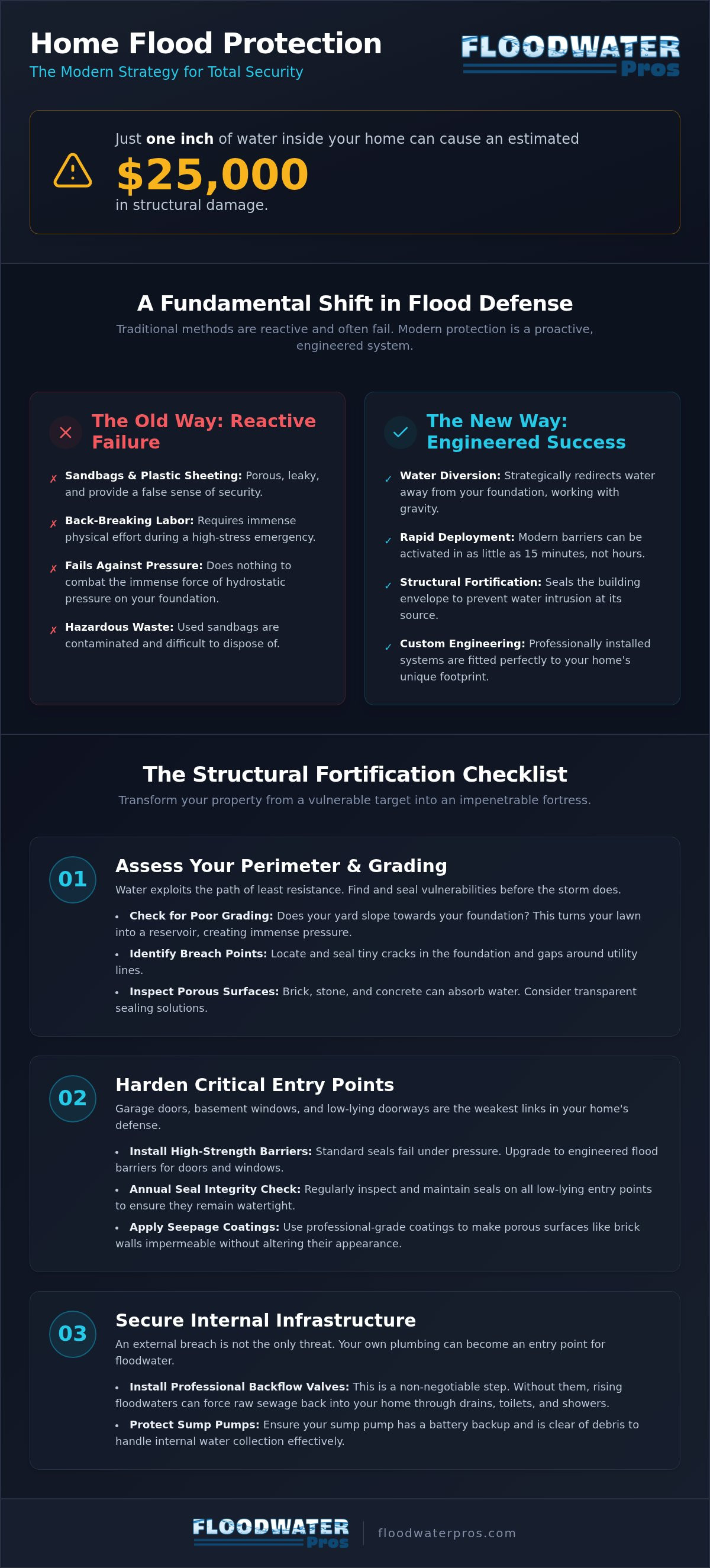
A single inch of water entering your home can trigger $25,000 in structural damage. It's a staggering figure that makes the typical emergency kit feel dangerously inadequate. You've likely spent nights listening to the heavy rain, wondering if your basement will hold or if this is the storm that finally breaks through. Sandbags and plastic sheets are often a losing battle against rising tides. To truly safeguard your property, you need a comprehensive home flood protection checklist that prioritizes structural fortification over temporary fixes. Relying on outdated maps or basic supplies isn't a strategy; it's a gamble with your most valuable asset.
We're moving past basic survival kits to focus on professional grade engineered defense. This guide provides a strategic roadmap designed to divert water away from your foundation before it ever becomes a threat. You'll learn how to implement high level barriers and strategic diversion systems that offer genuine, long term peace of mind. We will examine exactly how to transform your property from a vulnerable target into an impenetrable fortress. By the end of this checklist, you'll have a clear path toward a dry home and the relief of total security.
Key Takeaways
- Traditional methods like sandbags often fail under the weight of hydrostatic pressure. Learn why redirection is a more effective strategy than basic retention.
- This home flood protection checklist focuses on securing the building envelope. Identify critical entry points and the vital role of professional backflow valves.
- Speed is the ultimate differentiator during a flood event. Master the 15-minute rule with modern barriers that deploy rapidly without the need for heavy labor.
- Strategic diversion reduces the immense physical load on your foundation. Work with the laws of gravity to lead water away from your structure.
- Custom engineering provides a level of security that DIY kits can't match. Professional installation ensures your defense system is perfectly fitted to your home's footprint.
Beyond the Sandbag: Why Traditional Flood Prep Fails
The sandbag is a relic of a reactive era. For decades, homeowners have relied on these heavy burlap sacks as a primary line of defense. It's a myth. This approach provides a dangerous, false sense of security. Sandbags are porous. They leak. They require backbreaking labor at the exact moment you should be focusing on safety. Most importantly, they do nothing to address the silent threat of hydrostatic pressure. When floodwaters rise against your home, the weight of the water exerts immense force on your foundation. Without a professional-grade home flood protection checklist, you're essentially hoping your walls can hold back thousands of pounds of lateral pressure.
In 2026, the stakes have changed. With NFIP premiums rising under Risk Rating 2.0 and a single inch of water causing approximately $25,000 in damage, protecting your home is no longer just about surviving a storm. It's about preserving a high-value asset. Modern flood management strategies have evolved. We must move beyond the bucket brigade mentality and toward structural fortification. Defense is a strategy, not an accident.
The Hidden Costs of Reactive Prep
Reactive preparation is exhausting and expensive. Deploying hundreds of sandbags during a high-stress emergency window is a logistical nightmare. Once the water recedes, you're left with a secondary crisis: disposal. Used sandbags are often classified as hazardous waste because they soak up sewage, oil, and chemicals from floodwaters. Beyond the physical toll, there's the financial reality. FEMA estimates that one in four flood claims come from properties outside high-risk zones. Insurance often fails to cover the full scope of residual water damage. Relying on temporary fixes often leads to permanent losses.
Defining Engineered Flood Protection
Engineered flood protection is a structural defense system designed to provide a permanent or semi-permanent barrier against rising water. This approach shifts the focus from the house itself to the perimeter. By securing the building envelope, you maintain structural integrity. You prevent the foundation from reaching its breaking point. This is the transition from emergency mode to fortress mode. Instead of fighting the water once it arrives, you're deploying a pre-verified strategy that works. A robust home flood protection checklist must prioritize these engineered solutions, like the Fortress Flood Diversion System, to ensure your property remains a sanctuary rather than a recovery site.
The Structural Fortification Checklist: Securing the Perimeter
Cleaning gutters is a basic step, but it won't save your foundation from a surge. True security requires a rigorous home flood protection checklist that treats your property like a sealed unit. You must identify every breach point before the storm arrives. Water follows the path of least resistance. It finds the tiny cracks in your foundation and the gaps around utility lines. These invisible gaps are often ignored by traditional prep. A single unsealed utility penetration can allow hundreds of gallons of water into your crawlspace or basement within minutes. Look at your yard. Does the ground slope toward your walls? Poor grading turns your lawn into a reservoir. This creates hydrostatic pressure that can buckle concrete. You need a proactive strategy to redirect this volume away from the structure.
Hardening Entry Points
Garage doors and basement windows are the weakest links in your building envelope. Standard seals aren't built for sustained water pressure. You need high strength barriers that can withstand a surge. For homeowners who value aesthetics, the Fortress Transparent Liquid Paintable Flood Barrier provides an invisible layer of defense on porous surfaces like brick or stone. It seals the microscopic gaps without changing the look of your home. This coating acts as a shield against seepage. High strength seals for low lying doorways must be checked for integrity annually. Reinforcing these points ensures that your perimeter remains impenetrable even during a catastrophic event.
Infrastructure Integrity
Interior protection is just as critical as exterior walls. Backflow valves are essential components of any professional home flood protection checklist. Without them, rising floodwaters can force raw sewage back into your home through drains and toilets. It's a catastrophic scenario that standard insurance often fails to cover. Referencing Ready.gov flood preparedness standards, you should also elevate external HVAC units and electrical panels above the base flood elevation. Your sump pump needs a redundant, battery backed power source. If the grid fails, your primary defense shouldn't fail with it. Professional installation ensures these systems work when they're needed most. You can explore the Fortress line of barriers to see how an engineered approach secures your perimeter.
Diversion vs. Damming: The Strategy of Redirecting Water
Damming water is a defensive struggle. Redirecting it is a strategic victory. Most homeowners focus solely on holding water back, effectively turning their walls into a dam. This is a high risk gamble. Static water creates immense hydrostatic pressure that can lead to catastrophic structural failure. To ensure total security, your home flood protection checklist must prioritize diversion. By channeling water away from your foundation, you reduce the physical load on your building envelope. You aren't just trying to survive the surge. You're controlling it.
The physics of water flow are simple. Gravity is the ultimate architect. If you fight it, you lose. If you work with it, you win. Creating a dry zone around your entire estate requires a definitive plan for where the water goes once it is stopped. Controlled runoff is essential. You have a duty to mitigate the impact on neighboring properties while safeguarding your own. A professional strategy ensures that your defense doesn't become someone else's disaster.
Redirection Techniques
Effective diversion utilizes non permeable barriers in high flow areas. These aren't temporary sandbags. They are engineered systems that create a definitive line of defense. You must identify where the water naturally pools and establish a path for it to exit your property safely. This proactive approach ensures your perimeter isn't just a wall, but a sophisticated bypass system. Key tactics include:
- Identifying the primary flow path of storm surges across your unique topography.
- Installing rigid barriers that do not bow or leak under sustained pressure.
- Establishing clear channels that lead directly to natural drainage or designated safe zones.
The Fortress Diversion Philosophy
The Fortress Flood Diversion System represents the gold standard of this philosophy. It moves beyond simple damming to provide a structural answer to high volume threats. These systems are capable of redirecting thousands of gallons per minute. They work by integrating with your existing landscape features to maintain a natural aesthetic while providing military grade security. It is about total transformation of your property's resilience.
Investing in a diversion system offers a profound long term ROI. It prevents water contact entirely. This means you avoid the moisture, mold, and structural rot that follow even minor flooding events. A dry foundation is a stable foundation. By shifting from emergency mode to fortress mode, you gain the tranquility of knowing your home is shielded by professional engineering. Every second of heavy rain becomes a non event when your home flood protection checklist includes a master plan for redirection.
Rapid Deployment Protocol: Protecting Your Home in Minutes
Flash floods don't respect schedules. While traditional advice suggests preparing 72 hours in advance, modern environmental threats often provide only a few minutes of warning. This is where the 15 minute rule becomes the ultimate differentiator in your home flood protection checklist. If your defense system takes hours to assemble, it is already obsolete. You need a protocol that transitions your home from vulnerable to fortified before the first wave hits. Speed is the only metric that matters when the water begins to rise.
Heavy manual installs and sandbags are the enemies of speed. They are relics of a slower age. Today, the Fortress Inflatable Flood Barrier provides a military grade alternative that can be deployed by a single person in a fraction of the time. Staging is the secret to this efficiency. Store your barriers at the exact points of entry they are designed to protect. Do not bury them in the back of a crowded garage. Automation also plays a critical role. Modern sensors can alert you to rising water levels long before they reach your porch. This gives you the critical head start needed to engage your perimeter defense with total confidence.
The Modern Deployment Steps
A practiced protocol ensures that panic never dictates your actions. Follow these four steps to secure your property when the clouds break:
- 1. Activate perimeter monitoring: Engage your weather alert systems to gain immediate situational awareness.
- 2. Deploy rapid inflation barriers: Position inflatable systems at primary surge points like driveways and low lying entryways.
- 3. Verify seal integrity: Check all liquid coated surfaces and mechanical gates to ensure no seepage occurs.
- 4. Engage diversion channels: Open your primary diversion systems to manage peak flow and lead water away from the foundation.
Training and Readiness
Reliability is not a coincidence. It is the result of rigorous maintenance and practice. Conduct an annual dry run of your entire protection protocol to ensure every component is functional. This practice allows you to meet the 15 minute deployment goal even under extreme pressure. Inspect your barriers for any signs of wear and check the battery backups on all monitoring sensors. A practiced defense is a successful defense. It transforms high stakes anxiety into the profound relief of total security. You can find the right tools for your home flood protection checklist by exploring the Fortress line of barriers today.
Professional Engineering: The Fortress Solution for Total Security
Generic flood prep is a reactive hope. Professional engineering is a proactive certainty. When finalizing your home flood protection checklist, the transition from hardware store supplies to engineered systems is the most critical step you can take. DIY solutions often fail because they lack the structural integrity to withstand sustained hydrostatic pressure. A professional grade defense is calculated. It considers the weight of the water and the specific vulnerabilities of your foundation. We provide a strategic partner in your defense, ensuring your property remains an impenetrable sanctuary. Every home has a unique footprint. A one size fits all barrier is simply a gap waiting to be exploited.
Custom fit protection is the only way to ensure total security. Off the shelf products ignore the subtle topography of your land and the specific entry points of your building envelope. Engineering allows us to tailor barriers to the exact dimensions of your doorways, vents, and garage perimeters. This precision eliminates the weak links that lead to catastrophic failure. We focus on structural fortification that integrates seamlessly with your home. You shouldn't have to choose between an attractive property and a safe one. Our systems provide the resilience of a military installation with the discretion of modern architecture.
The Fortress Product Suite
The Fortress line offers a tiered defense strategy designed for high stakes environments. The Fortress Flood Diversion System serves as the primary engineered solution for high volume redirection. It is the gold standard of any home flood protection checklist, built to withstand extreme conditions that would cause traditional walls to buckle. For rapid response, the Fortress Inflatable Flood Barrier provides heavy duty protection that a single person can deploy in minutes. To protect the aesthetic integrity of your home, the Fortress Transparent Liquid Paintable Flood Barrier offers an invisible defense. It seals porous brick and stone surfaces without altering their appearance, creating a hidden shield against seepage.
Your Path to Fortification
Success starts with an expert consultation. Our process begins by mapping your property’s specific flood risk and identifying natural drainage patterns. This data informs a custom blueprint for your defense. From the initial engineering phase to professional installation, we ensure your system is calibrated for maximum reliability. We don't just provide equipment; we deliver a seamless journey toward total peace of mind. Professional installation is the key to barrier success, ensuring every seal is perfect and every diversion channel is optimized. Secure your perimeter with a professional Fortress system today.
Secure Your Legacy: The Path to Total Fortification
Environmental threats in 2026 demand a shift from reactive hope to engineered certainty. You've seen why traditional sandbags fail and how this home flood protection checklist prioritizes structural integrity over temporary fixes. True security isn't about holding water back; it's about redirecting force through professional diversion and rapid deployment protocols. By securing your building envelope and mastering the 15 minute rule, you transform your property into an impenetrable sanctuary.
Relief comes from knowing your defense is absolute. Our national structural defense experts specialize in proprietary Fortress engineering and professional on-site installation. We ensure every barrier is a perfect fit for your home's unique footprint. Don't wait for the next surge to test your readiness. Fortify your home with an engineered Fortress Flood Diversion System today. You've taken the first step toward resilience; now it's time to finish the job and protect what matters most.
Frequently Asked Questions
Is a flood protection checklist enough to stop a major storm?
A checklist is a strategic roadmap, but the physical defense comes from the systems it mandates. A checklist helps identify vulnerabilities like foundation cracks and unsealed utility lines. However, stopping a major storm requires engineered hardware like the Fortress Flood Diversion System. It's the difference between having a plan and having a shield. Total security depends on following the checklist to implement professional-grade fortifications that stand up to extreme hydrostatic pressure.
What is the difference between flood diversion and a flood barrier?
A flood barrier is designed to hold water back, essentially acting as a dam. In contrast, flood diversion systems like the Fortress Flood Diversion System are engineered to channel water away from the structure entirely. Diversion is often superior because it reduces the hydrostatic pressure on your home's foundation. While barriers stop water, diversion manages the flow to ensure it doesn't pool and create structural stress that could lead to failure.
Can I install professional flood barriers myself?
Professional systems require expert engineering and installation to ensure they don't fail under pressure. While some temporary barriers are designed for rapid deployment, the initial setup and structural integration should be handled by national defense experts. Professional on-site installation by FloodWater Pros ensures there are no weak links in your perimeter. This guarantees that the system is perfectly calibrated to your home's unique footprint and topography, providing a level of defense DIY kits can't match.
How do inflatable flood barriers work compared to sandbags?
Inflatable barriers use air or water to create a heavy, non-porous seal that far outperforms traditional sandbags. Sandbags are porous, heavy, and difficult to deploy quickly. The Fortress Inflatable Flood Barrier can be staged and activated in minutes by a single person. It provides military-grade security without the backbreaking labor or hazardous waste issues associated with contaminated sandbags. It is a modern, rapid-deployment solution designed for high-stakes protection when every second counts.
What is a paintable flood barrier and is it actually effective?
The Fortress Transparent Liquid Paintable Flood Barrier is a specialized coating that seals porous surfaces like brick and stone. It is highly effective at stopping seepage through the building envelope without altering the home's appearance. This invisible shield fills microscopic gaps that traditional barriers miss. It is an essential component of a home flood protection checklist for homeowners who want to maintain curb appeal while achieving total security against rising water levels.
Do I still need flood insurance if I have a Fortress system?
Yes, you should maintain flood insurance as a secondary layer of financial protection. While a Fortress system is designed to prevent physical damage and the trauma of a flood, insurance covers the financial risk of catastrophic events. FEMA estimates a single inch of water causes $25,000 in damage, so a dual approach is best. Use your home flood protection checklist to implement physical defenses while keeping your policy active for total peace of mind and long-term security.
How long does it take to deploy a home flood defense system?
A professionally engineered system can be deployed in under 15 minutes. Speed is the ultimate differentiator during a flash flood. Systems like the Fortress Inflatable Flood Barrier are designed for rapid deployment, allowing you to secure your perimeter almost instantly. Traditional methods like sandbagging can take hours or days of heavy labor. By staging your materials at primary entry points, you ensure your home is protected before the water levels begin to rise and cause damage.
Will flood diversion systems affect my home's curb appeal?
Modern diversion systems are designed to be discreet or even invisible. The Fortress Transparent Liquid Paintable Flood Barrier protects your home's exterior without changing its look. Other structural systems can be integrated into your existing landscape features to maintain a natural aesthetic. You don't have to sacrifice your home's beauty for military-grade security. Professional engineering ensures your defense is as visually seamless as it is physically impenetrable, maintaining the value and appearance of your property.


