

Can a flood defense help preserve a property’s appearance without standing between it and rising water? That’s the promise suggested by a clear waterproof flood barrier coating, but transparency alone doesn’t tell you how a product performs under flood exposure. A clear finish may appeal when appearance matters. The key is understanding what protection the product is designed to provide and where its limits begin.
Waterproof paint, sealants, penetrating treatments, and flood-specific barriers are not interchangeable. A surface coating may help resist water on certain materials, but it doesn’t automatically protect joints, openings, or damaged areas, or replace a complete flood defense plan.
This guide explains what clear coatings are designed to do, how they differ from ordinary waterproofing, and what to assess before relying on one. You’ll learn where a coating may fit, when additional defenses are needed, and how to evaluate your property’s vulnerabilities. FloodWater Pros offers the Fortress Transparent Liquid Paintable Flood Barrier as part of a broader flood protection approach.
Key Takeaways
- A clear waterproof flood barrier coating is applied to a surface. Its role depends on the product, the surface, the exposure, and the property’s condition.
- Distinguish flood-specific coatings from ordinary waterproof paint and sealants by checking their intended use and place in a wider defense plan.
- Start by tracing where water could enter, then record the surface material and condition before considering a coating.
- Assess joints, transitions, openings, and damaged areas carefully. A surface treatment may not address the full water pathway.
- Consider how the Fortress Transparent Liquid Paintable Flood Barrier may fit alongside other defenses in a plan supported by FloodWater Pros’ engineering, manufacturing, and professional installation.
What Is a Clear Waterproof Flood Barrier Coating, and What Can It Protect?
A clear flood barrier coating is a surface-applied protective layer intended to help limit water penetration while retaining a transparent appearance. It may form part of a flood defense, but it isn’t a universal shield. Its potential role depends on the product, the surface, the type and duration of water exposure, and the property’s overall condition.
A clear flood barrier coating is a surface treatment intended to remain transparent and help resist water on suitable surfaces. Its flood-protection role depends on product performance and the conditions around the property. Floodwater can test more than a wall’s surface. Seams, transitions, openings, and other weak points may offer separate paths into a building, so assess the coating as one element of a wider defense plan.
Waterproofing includes a range of methods for limiting water entry, but routine moisture resistance and flood protection are different goals. A coating that helps manage dampness or rain exposure may not be designed or tested for flood conditions.
How is a flood barrier coating different from waterproof paint?
Waterproof paint is generally used to resist moisture on a surface. A product described as a flood barrier coating is intended for a flood-protection role, but the label alone doesn’t establish how it performs. Look for product-specific information that identifies compatible surfaces, intended exposure, and the performance being addressed. Without those details, don’t assume a water-resistant finish is suitable for floodwater.
Surface compatibility matters, too. A coating suited to one material or condition may not suit another. Even an appropriate surface treatment may leave untreated joints or openings as potential entry routes.
What does “clear” mean for a flood coating?
“Clear” describes the intended transparent category, not a promise that the treatment will be invisible after application. The underlying material, its texture and condition, and the application can all affect the final appearance. A clear product may still change how a surface looks.
Review product-specific information about compatible surfaces and appearance before choosing a treatment, especially if preserving the existing finish matters. These are separate questions: a product’s intended clarity doesn’t establish that it suits a particular wall, finish, or flood exposure.
How a Transparent Liquid Flood Barrier Works on Vulnerable Surfaces
A transparent liquid flood barrier is applied to a surface to create a protective layer. The general purpose is to treat a suitable part of the building envelope so it may resist water exposure at that surface. The product and material determine its specific role. Compatibility, preparation, application, and performance are product-specific, so don’t assume a coating works the same way on every wall or under every flood condition.
A surface treatment may help protect the area it covers, but it doesn’t provide whole-structure flood protection by itself. Water can cross a surface, but it can also find another route into a building. That distinction is central to assessing any clear waterproof flood barrier coating.
Which surfaces and water-entry points need assessment?
Start by tracing the route water could take, then record the surface material and its condition. Concrete, masonry, wood, and previously coated surfaces may respond differently. Check product-specific guidance rather than assuming compatibility. Note visible deterioration, cracks, and places where the surface meets another material.
Pay close attention to:
- Cracks, joints, and seams where surfaces meet or separate.
- Transitions such as the connection between a wall and foundation.
- Penetrations and openings around pipes, cables, doors, and vents.
- Drainage paths that could carry water toward or into the structure.
Treat these as separate assessment points. Covering the main surface doesn’t automatically seal or protect the adjoining details.
Why can a coating not address every flood pathway?
A coating affects the surface where it’s applied. Floodwater may enter through an untreated door, vent, foundation connection, or service penetration instead. It may also follow a route that isn’t obvious during a quick inspection. Assess each pathway separately. A treated wall doesn’t establish that other entry points are protected.
Openings and drainage deserve particular attention because they involve gaps or routes beyond the coated area. A coating may be one layer in a prepared defense, while other measures address vulnerable openings and water movement around the property. Match each observed pathway with an appropriate part of the overall plan rather than expecting one surface treatment to do every job.
FloodWater Pros designs flood protection systems around a property and its vulnerabilities. Explore engineered flood protection planning as you consider how a surface treatment could fit alongside other defenses.
Clear Flood Barrier Coating vs. Waterproof Paint, Sealants, and Physical Barriers
These options address different parts of a flood problem. A coating treats a surface. A sealant targets a joint or gap. A physical barrier is positioned to block or redirect water at a selected point. Compare each option by the pathway it is intended to address, not by assuming the products are interchangeable.
Flood-specific coating
Purpose: Help protect a suitable treated surface under the exposure described in the product information.
Application area: Surfaces identified as compatible with that product.
Visibility: May be intended to remain transparent; appearance depends on the product and finished surface.
Role: One possible layer in a broader flood plan.
Ordinary waterproof paint
Purpose: Resist moisture for the use described by its manufacturer, which may differ from flood exposure.
Application area: Surfaces specified for that paint.
Visibility: A painted finish, with appearance depending on the product.
Role: Don’t assume it provides flood-specific protection.
Sealant
Purpose: Address a particular crack, joint, seam, or gap, depending on the product.
Application area: The detail it’s designed to seal.
Visibility: Varies by sealant and application.
Role: May address a localized entry point, not an entire wall or property.
Physical barrier or diversion system
Purpose: Block water at a selected opening or influence its route.
Application area: The planned barrier or diversion location.
Visibility: A physical system is present when deployed or installed.
Role: A distinct defense that may complement surface treatment.
When might a clear coating be relevant?
A clear waterproof flood barrier coating may be relevant when the assessed concern involves a surface, the product information matches the intended exposure, and its compatible-surface guidance fits the property. Appearance may also be a consideration when preserving the existing look is a priority. “Clear” describes an intended category, not a guarantee that the finish will be invisible.
When should it be considered alongside physical barriers?
Use a coating and a physical barrier to address different vulnerabilities, not as substitutes by default. A surface treatment may suit an appropriate treated area, while a barrier may address a vulnerable opening. If the plan needs to control water’s route, a diversion system may also be relevant. FloodWater Pros offers the Fortress Flood Diversion System and the Fortress Transparent Liquid Paintable Flood Barrier as options within a broader protection approach.
Choose by pathway: match each defense to where water could enter or where it needs to go. For a broader planning framework, see the property flood mitigation solutions guide.
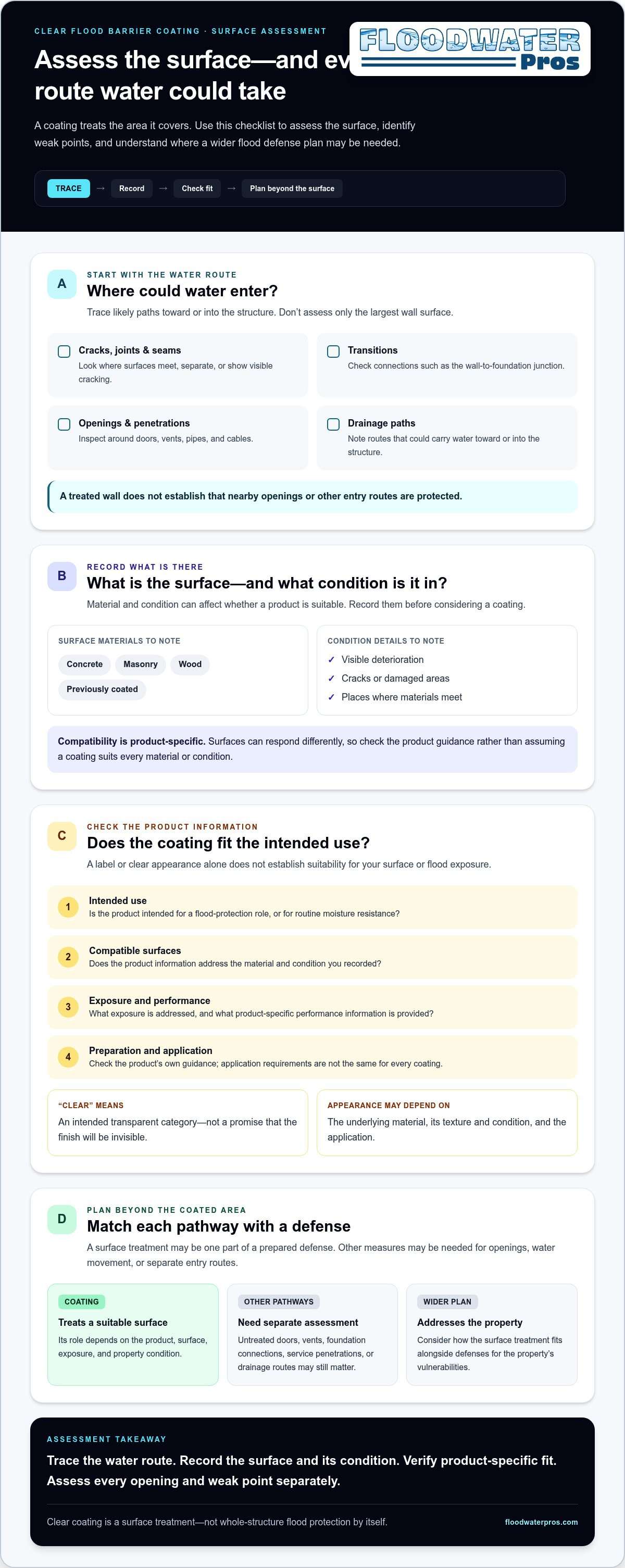
How to Assess a Surface Before Choosing a Clear Flood Barrier Coating
Assess the water pathway before focusing on the coating. You can evaluate a clear waterproof flood barrier coating meaningfully only after identifying where water has entered, which surface it would treat, and which routes lie beyond that surface.
- Step 1: Trace the water pathway. Record where water has entered before or where it could travel during a flood. Note the direction it approaches from and the areas it reaches. Separate observed evidence, such as a visible water mark, from assumptions about what may happen next.
- Step 2: Identify the surface material. Document what the affected area is made of and whether different materials meet there. Compatibility depends on product-specific guidance, so don’t assume a coating suited to one material is suitable for another.
- Step 3: Record surface condition. Note visible damage, cracks, seams, joints, existing coatings, and other changes in the surface. Photographs can help document what you observed and distinguish it from expectations about future performance.
- Step 4: Map other entry routes. Include doors, vents, service penetrations, drainage paths, and adjacent untreated areas. Looking only at the main wall can miss routes water may use around it.
- Step 5: Compare the record with product guidance. Review the product’s stated compatible surfaces, intended exposure, preparation requirements, and application conditions. If the guidance doesn’t address a key condition in your assessment, don’t fill the gap with an assumption.
How should preparation and application be planned?
Follow the specific product instructions, not a generic coating routine. Cleaning, repairs, and drying may be required, but whether they’re needed and how to do them depends on the product and surface. Application conditions are product-specific as well. Don’t infer preparation steps, curing requirements, or compatibility from another coating’s directions.
Keep the full entry pathway in view. If a product is intended for one surface, that doesn’t establish protection for nearby joints, openings, drainage routes, or untreated sections. Mark these separately in your plan so the surface treatment isn’t mistaken for a complete defense.
A property-specific approach brings surface condition and other vulnerabilities into one view. Use this residential flood protection systems guide to explore how different defenses may fit together. For help planning engineered flood protection around your property, explore FloodWater Pros’ system planning.
Where the Fortress Transparent Liquid Paintable Flood Barrier Fits in a Complete Plan
The Fortress Transparent Liquid Paintable Flood Barrier is part of FloodWater Pros’ flood protection offerings and can be considered within a property-specific plan. Its place depends on the property’s exposure, the surface being assessed, and the other routes water could take. The product name alone doesn’t establish compatible surfaces or performance limits, so don’t treat it as a stand-alone answer for every flood risk.
How can a transparent liquid barrier fit with other defenses?
Different defenses address different parts of the problem. Consider a surface-applied barrier in relation to the surface and its product-specific guidance. A physical barrier addresses a planned location, while a diversion system is intended to factor into how water is routed. These roles are distinct. Don’t assume one replaces another or protects untreated openings and areas.
FloodWater Pros also offers the Fortress Flood Diversion System and Fortress Inflatable Flood Barrier. These products can be considered alongside the Fortress Transparent Liquid Paintable Flood Barrier when planning for a property’s vulnerabilities. The appropriate combination depends on the conditions being addressed, not on a universal formula.
A useful plan connects each measure to an observed need: a surface, an opening, or a route water may travel. It also accounts for areas the treatment won’t cover. This keeps a clear waterproof flood barrier coating in perspective as one possible component, not a promise of whole-property protection.
What are the next steps toward a prepared property?
Bring the key details into one clear record before choosing a defense:
- Surface: Note the material, visible condition, damage, and any existing finish.
- Water pathways: Record where water has entered or may travel, including around joints, openings, and drainage routes.
- Property exposure: Identify the areas and access points that need consideration, including sections a surface treatment would leave untreated.
Keep observations separate from assumptions about product performance. Product-specific guidance should inform compatibility and preparation. FloodWater Pros manages flood protection projects from system engineering through manufacturing and professional on-site installation, bringing property details into a broader protection approach.
Ready to turn your observations into a plan? Explore a project-specific flood protection approach with FloodWater Pros.
Build a Flood Defense Plan That Fits Your Property
A clear waterproof flood barrier coating may help protect a suitable surface, but its role depends on product-specific guidance, surface condition, and water exposure. It won’t automatically protect joints, openings, or untreated areas. Compare coatings, sealants, and physical barriers by the pathways they’re intended to address, then assess those pathways across the property.
The Fortress Transparent Liquid Paintable Flood Barrier is one option in FloodWater Pros’ broader flood protection line. The company manages flood protection systems from engineering and manufacturing through professional on-site installation for customers nationally across the United States.
Preparedness starts with understanding your property’s vulnerabilities and matching each defense to a clear purpose. Explore FloodWater Pros flood protection solutions to take the next step toward a project-specific plan.
Frequently Asked Questions
Does a clear waterproof flood barrier coating stop floodwater?
Not necessarily. Don’t assume any coating will stop floodwater in every situation. A clear waterproof flood barrier coating may help protect a suitable treated surface when the product’s stated performance matches the exposure. Floodwater can also enter through joints, doors, vents, drainage routes, and untreated areas. Assess the property’s water pathways and treat a coating as one possible part of a broader flood protection plan.
Is clear flood barrier coating the same as waterproof paint?
No. Waterproof paint is generally intended to resist moisture under the conditions described for that product. A flood barrier coating is presented for a flood-protection role, but its label alone doesn’t establish performance. Compare product-specific information, including intended exposure and compatible surfaces. Don’t assume ordinary waterproof paint is interchangeable with a flood-specific product, or that either treatment protects a whole building without other defenses.
Can a transparent flood barrier coating be applied to any surface?
No. Suitability depends on the product’s surface compatibility and the material’s condition. A coating intended for one substrate may not be appropriate for another, and existing finishes, damage, seams, or repairs can affect the assessment. Document the surface and review the product’s specific guidance before selecting a coating. Don’t infer compatibility from the fact that a product is described as clear or liquid-applied.
Will a clear flood barrier coating protect doors and windows?
Don’t assume it will. Doors and windows are openings, and treating a nearby wall doesn’t establish that they’re protected. Assess their frames, edges, and connections as potential water-entry routes, then consider which defenses address those points. Keep a coating’s stated role distinct from measures designed for openings, such as a physical barrier, within a property-specific plan.
How long does a clear flood barrier coating last?
There isn’t a single lifespan that applies to every clear flood barrier coating. Durability depends on the product, surface, application conditions, exposure, and care over time. Use the product documentation for any stated service-life or maintenance information rather than relying on a general estimate for another coating. Inspect the treated area according to product guidance and reassess it if the surface becomes damaged or changes.
Can a clear flood barrier coating replace sandbags or flood barriers?
Not automatically. A coating addresses a treated surface, while sandbags or physical barriers are separate defenses that may block or redirect water at particular locations. Their roles aren’t interchangeable by default. Identify the water pathways and the protection each one calls for. FloodWater Pros offers the Fortress Transparent Liquid Paintable Flood Barrier alongside physical options, including the Fortress Inflatable Flood Barrier and Fortress Flood Diversion System.
How do I prepare a surface for a clear flood barrier coating?
Follow the specific product’s preparation instructions rather than applying a generic routine. First record the surface material, visible damage, existing coatings, and nearby joints or openings. Then use the product guidance to determine whether cleaning, repairs, or drying are required and which application conditions apply. Don’t assume another coating’s instructions will transfer. Preparation and compatibility are product-specific, so base each step on the relevant documentation.


