

A single inch of floodwater inside your facility isn't just a mess. It's a $25,000 catastrophe for your assets and infrastructure. As FEMA implements new 2026 Flood Insurance Rate Maps, many businesses are discovering they're now in high-risk zones without a proper defense. Professional commercial flood barrier installation has shifted from an optional upgrade to a mandatory strategic fortification. You can't rely on the "wait and see" approach when your inventory, machinery, and reputation are on the line.
You understand the frustration of unreliable temporary solutions like sandbags that fail when the pressure mounts. It's exhausting to watch insurance premiums hike while your structural vulnerability remains high. You deserve total site security and the peace of mind that comes with rapid deployment capability. We're here to help you move from a state of vulnerability to one of unwavering readiness. Protecting your livelihood requires more than a hope; it demands a structural answer.
This guide helps you master the engineering requirements of commercial flood barrier installation to secure your assets against the evolving threats of 2026. You'll learn how to integrate professional-grade systems like the Fortress Flood Diversion System into your site's blueprint. We will examine the logistical steps to reduce your insurance liability and maintain your building's aesthetic while building an impenetrable shield against rising waters.
Key Takeaways
- Understand how modern flood threats impact structural integrity and business continuity beyond simple surface damage to protect your bottom line.
- Discover why professional commercial flood barrier installation is the critical bridge between purchasing hardware and creating an engineered, impenetrable perimeter for your facility.
- Learn the strategic advantage of water redirection over retention to significantly reduce the physical hydraulic force applied to your building during a flood event.
- Master the essential steps of a professional installation blueprint, starting with comprehensive site assessments and topographical mapping to ensure total site security.
- Secure your operations with the Fortress product line, designed to provide military-grade defense and reduced insurance liability for the rising threats of 2026.
The High Stakes of Commercial Inundation: Beyond Surface Damage
Flood damage isn't just a cleanup project. It's a fundamental threat to your structural integrity and your bottom line. When water breaches a perimeter, it brings massive physical force that can compromise foundations and buckle walls. In 2026, the landscape of risk has shifted. With the reauthorization of the National Flood Insurance Program (NFIP) and updated FEMA maps, professional commercial flood barrier installation has become the only viable path to maintaining coverage and securing assets.
The hidden costs of a breach often outweigh the visible destruction. Catastrophic business downtime, severed supply chains, and the loss of localized data servers can paralyze an organization for months. Beyond the physical, there's a heavy psychological toll. Stakeholders and employees need to know they're walking into a fortified environment. Uncertainty breeds hesitation; security breeds growth. You're not just protecting floors. You're protecting the future of your workforce.
Structural Vulnerabilities in Modern Commercial Buildings
Modern architecture often creates unintended pathways for water. Loading docks, pedestrian entryways, and low-lying HVAC vents act as invitations for inundation. Hydrostatic pressure is the primary concern for large-scale facilities. This force can exert thousands of pounds of pressure against glass facades and basement walls, leading to sudden, explosive structural failure. While many rely on standard landscaping, these features often wash away during extreme weather, leaving the building exposed. A strategic defense requires understanding Commercial Barrier Technologies and how they integrate with your specific building footprint.
Revenue Protection as a Risk Management Strategy
Every hour your doors are closed is an hour of lost market share. For industrial facilities, which represent 41% of commercial demand for defense systems, the cost of a single day of operational shutdown can be devastating. Implementing robust commercial flood barriers is a direct investment in investor confidence. It signals that your leadership is proactive, not reactive. Protecting specialized machinery and high-value inventory from water ingress ensures you can resume operations the moment the storm passes. In the competitive environment of 2026, resilience is your most valuable asset. Proper commercial flood barrier installation transforms your facility into a fortress that stands firm when others falter.
Engineering the Perimeter: Commercial Barrier Technologies
Modern defense isn't just about blocking water. It's about engineering a perimeter that responds to the specific hydraulic dynamics of your site. A successful commercial flood barrier installation requires a multi-layered approach. You need systems that work together to create an impenetrable shield. Relying on a single line of defense is a risk your business can't afford. Before choosing a specific technology, start with a professional FEMA flood risk assessment to understand the exact height and force of the water you're up against.
The goal is total site security through a combination of redirection and rapid response. In 2026, the technology has evolved to handle extreme weather without disrupting the daily operations of your facility. Whether you're protecting a loading dock or a luxury storefront, the hardware must match the threat level.
The Fortress Flood Diversion System
Redirection is superior to simple retention. The Fortress Flood Diversion System is engineered for large-scale protection. It utilizes the water's own weight to compress a specialized bottom seal. This creates a hydrostatic lock that grows stronger as water levels rise. It's a proactive solution that turns the threat into a part of the defense. Custom engineering ensures the system fits the unique topographical contours of your commercial site. This level of flood diversion system design is essential for high-flow areas where traditional barriers often buckle under pressure. It provides a structural answer to a massive environmental challenge.
Rapid Deployment and Aesthetic Defense
Flash floods don't wait for a crew to arrive. The Fortress Inflatable Flood Barrier offers a solution for scenarios where minutes matter. These systems move from storage to fully fortified in a fraction of the time required for traditional sandbagging. They're lightweight but incredibly resilient. This allows your team to achieve a state of readiness without specialized heavy machinery.
For retail storefronts and high-end facades, bulky hardware is often a dealbreaker. The Fortress Transparent Liquid Paintable Flood Barrier provides invisible protection. It seals porous surfaces and entry points without altering the building's appearance. You get military-grade security without the "war zone" look. Proprietary materials in 2026 are designed to be both functional and discreet. If you're unsure which technology fits your specific facade, you can consult with a specialist to design a custom fortification plan that protects your assets while maintaining your brand image.
Redirection vs. Retention: The Strategic Advantage
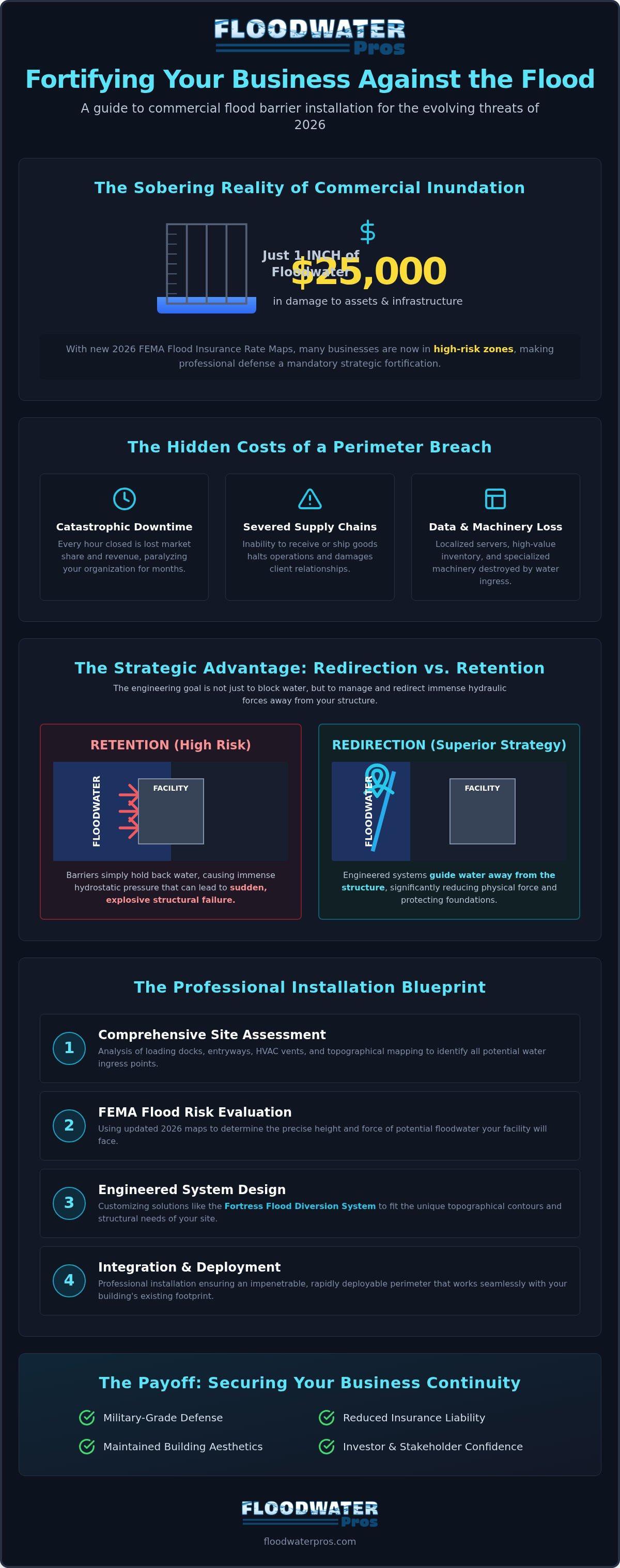
Retention is a gamble. It assumes your building walls can withstand the crushing weight of a river. Most commercial structures are designed for vertical loads, not the horizontal hydraulic pressure of a flash flood. Attempting to hold water back creates a massive accumulation of force against your foundation. Redirection is the strategic alternative. It uses the physics of flow to move water around your assets rather than letting it pile up against them. The success of a commercial flood barrier installation depends on this fundamental shift in philosophy. You aren't just blocking a threat. You're managing a current.
Managing velocity is critical to preventing erosion and structural scouring. When water is forced to a dead stop, its energy is transferred directly into your building. By creating a guided path, you maintain the water's momentum while steering it toward existing municipal drainage or designated safe zones. This reduces the total load on your perimeter defenses. It ensures that your fortification remains stable even during prolonged inundation. Strategic pathing is the difference between a building that survives and a building that collapses under the strain of static pressure.
The Failure Points of Traditional Retention
Traditional methods like sandbags or rigid temporary walls often succumb to seepage. They're porous. They're heavy. They're prone to shifting. Beyond the physical failure, the logistical cleanup is a nightmare. Sandbags become biohazards after soaking in contaminated floodwaters. Disposing of thousands of pounds of toxic material adds a hidden layer of cost and liability to your recovery. Understanding what is a flood diversion system changes this defense calculus. It replaces reactive, absorbent materials with an engineered, non-porous shield that directs water away before it can infiltrate your facade.
Designing the Path of Least Resistance
True fortification requires looking beyond the doorway. Using the Fortress system, you can guide water around building corners and away from vulnerable loading docks. This isn't just about protection. It's about site-wide fluid dynamics. While basic guidance on floodwall construction focuses on height, our approach focuses on direction. We integrate diversion with your site's topography to ensure water finds the path of least resistance away from your inventory. The long-term ROI of engineered redirection is clear. You spend less on structural repairs and cleanup because the water never had the chance to exert its full force. A professional commercial flood barrier installation ensures your business stands firm by letting the water move on.
The Installation Blueprint: From Engineering to Deployment
Hardware is just a component. A system is a solution. Professional commercial flood barrier installation serves as the critical bridge between a physical product and a functional defense. You cannot simply buy protection; you must engineer it. This process transforms a series of barriers into a cohesive, impenetrable perimeter. When the water rises, the quality of the setup determines the survival of your assets. It is the difference between a minor inconvenience and a total loss.
- Step 1: Comprehensive site assessment and topographical mapping to understand water behavior.
- Step 2: Custom engineering of the Fortress barrier layout tailored to your building’s footprint.
- Step 3: Professional on-site installation and meticulous hardware calibration.
- Step 4: Stakeholder training to ensure your team masters rapid deployment protocols.
The Site Assessment: Identifying the Ingress Points
Ingress points are often hidden until it's too late. We analyze how water moves across your concrete and asphalt surfaces during high-volume events. Every slope and drain matters. We evaluate soil stability to ensure anchor points for heavy-duty barriers won't shift or pull out during a surge. This isn't based on outdated maps. We use 2026 projections to anticipate the increased volume and velocity of modern flood events. Identifying these vulnerabilities early is the first step toward true fortification. We look for the path of least resistance so we can block it permanently.
Professional Execution and Quality Assurance
A DIY approach to commercial flood barrier installation often leads to catastrophic failure. Minor gaps in a seal or improper anchoring can cause the entire system to buckle under hydraulic force. Specialized technicians bring the tools and experience needed to ensure a watertight fit across every linear foot of your perimeter. We don't just set the hardware and leave. We conduct post-installation testing to simulate water flow and verify that redirection paths function as engineered. We test the integrity of every joint and seal. This level of quality assurance provides the proof of protection that stakeholders and insurers demand in 2026. It keeps your insurance premiums manageable and your inventory dry.
It's time to move from a vulnerable state to a position of strength. You can schedule a professional site assessment to begin your fortification journey today.
Fortress Protection: Securing Your Business Continuity
True security isn't a transaction. It's an ongoing state of readiness. When you choose a partner to manage the entire lifecycle of your defense, you're not just buying hardware. You're securing your legacy. A "Fortress" certified perimeter represents the gold standard in 2026 environmental protection. It provides the profound relief that comes from knowing your assets are shielded by military-grade engineering. But a shield requires vigilance. Annual maintenance and system audits ensure your barriers remain ready for the next surge. We don't just walk away after the commercial flood barrier installation is complete. We stand as your strategic partner. We are the vigilant guardian of your operational uptime.
The transition from vulnerability to total structural resilience changes how you do business. It removes the paralyzing weight of "what if" from your strategic planning. Instead of fearing the forecast, you can focus on growth. You move from a reactive posture to a proactive one. This shift is felt by your employees, your investors, and your insurers. A fortified building is a reliable building. It is a structure that commands confidence because it has been engineered to endure the most severe hydraulic challenges of our era.
The Full-Service Advantage
We own the process from the initial manufacturing to the final professional installation. This end-to-end control ensures that every component meets our rigorous standards for structural integrity. For leadership teams managing multi-location commercial portfolios, our national support network provides a unified defense strategy. You don't have to coordinate different vendors or varying standards for every site. You get one proprietary system engineered specifically for 2026 threats. This consistency reduces administrative friction. It simplifies your risk management protocols. Most importantly, it ensures that your commercial flood barrier installation performs identically across your entire footprint, regardless of geography.
Taking the First Step Toward Fortification
Waiting for the next storm warning is a strategic failure. By the time the clouds gather, the window for engineering a proper defense has closed. Reactive measures are often expensive, hurried, and prone to failure. The process of initiating a professional site consultation is straightforward and decisive. We analyze your specific topographical risks. We present a structural answer to your vulnerability. This is the moment to act. Don't let your business be defined by what you lost in a flood. Let it be defined by the foresight you showed in protecting it. Secure your future with an engineered defense that doesn't just block water. It preserves your legacy and ensures your doors stay open when the world outside is underwater.
Securing Your Commercial Legacy
The environmental landscape of 2026 demands a shift from reactive sandbagging to proactive fortification. You now understand that effective defense relies on engineered redirection technology rather than brute-force retention. By prioritizing professional commercial flood barrier installation, you transform a set of hardware into a comprehensive security system. It's the difference between hoping for the best and ensuring it. This strategic move protects your bottom line and preserves your operational continuity when the unexpected happens.
Our national installation teams ensure that every seal is calibrated for maximum structural integrity. Using the proprietary Fortress product line, we build more than a barrier. We build an impenetrable shield that safeguards your inventory, your machinery, and your people. The choice to act before the next storm warning is the mark of a strategic leader. You don't have to face the rising tides with uncertainty. Fortify your business with a professional Fortress installation consult and gain the peace of mind that comes with total site security. Your facility is ready to stand firm against whatever nature brings next.
Common Questions About Commercial Flood Defense
How long does a commercial flood barrier installation typically take?
The duration of a commercial flood barrier installation depends on the size of your perimeter and the complexity of the engineering plan. Most standard commercial projects are completed within three to five business days once the site assessment and custom hardware fabrication are finalized. Our national teams manage the entire workflow to minimize operational downtime. This ensures your facility moves from a state of vulnerability to total fortification with maximum efficiency.
Do commercial flood barriers require permanent modifications to my building?
Requirements for permanent modifications vary based on the specific Fortress system you choose. The Fortress Flood Diversion System often requires small, recessed anchor points to ensure stability against hydraulic pressure. However, the Fortress Transparent Liquid Paintable Flood Barrier provides invisible protection without altering the building’s structural profile. We design each installation to provide military-grade security while maintaining the aesthetic integrity and professional appearance of your commercial facade.
Can inflatable flood barriers handle the high-velocity debris found in urban floods?
The Fortress Inflatable Flood Barrier is engineered with proprietary, heavy-duty materials designed to withstand the impact of urban debris. While no barrier is completely indestructible, these systems utilize high-tensile strength fabrics that resist punctures and abrasions during high-velocity events. This provides a resilient shield for your inventory and machinery. It offers a much higher level of protection than unreliable temporary solutions like sandbags, which often fail when struck by submerged objects.
What is the difference between a flood gate and a diversion system?
A flood gate is a retention tool designed to block water at a specific opening. In contrast, the Fortress Flood Diversion System is a strategic engineering solution that redirects water away from the entire structure. By managing the path of least resistance, a diversion system reduces the total hydrostatic pressure applied to your building. This redirection philosophy is central to our approach. It ensures that water is moved toward safe drainage zones rather than piling up against your foundation.
Are Fortress flood barriers compliant with national commercial building codes?
Yes, our systems are engineered to meet or exceed relevant 2026 commercial building standards and FEMA technical bulletins. Every commercial flood barrier installation is guided by professional engineering principles to ensure compliance with local and national codes. This includes meeting the rigorous ANSI/FM 2510 standards for dry floodproofing products. Proper certification and professional installation are the keys to reducing your insurance liability and securing your commercial assets against rising environmental threats.
How often should a commercial flood barrier system be inspected?
We recommend a comprehensive system audit and inspection at least once per year. This annual maintenance check ensures that seals remain watertight and deployment hardware is fully functional before the next storm season arrives. Our vigilant guardian approach means we help you keep your shield ready for action. Regular testing allows your team to practice rapid deployment protocols. It ensures that your business continuity plan remains a reliable reality rather than just a document on a shelf.
Can the paintable liquid barrier be applied to any commercial surface?
The Fortress Transparent Liquid Paintable Flood Barrier is compatible with most common commercial surfaces, including brick, concrete, and stone. It is particularly effective for high-end retail storefronts where aesthetic impact must be minimal. However, a professional site assessment is necessary to confirm the surface's structural integrity and porosity. This invisible coating seals entry points and prevents water ingress through the building envelope itself. It provides a seamless layer of defense for your facility’s most vulnerable facades.
How many people are required to deploy a Fortress inflatable system during an emergency?
Efficiency is the core of our rapid deployment capability. A Fortress inflatable system can typically be deployed by just two people in a matter of minutes. This eliminates the need for large crews or heavy machinery during a flash flood scenario. The lightweight design allows your staff to establish a fortified perimeter quickly. This speed of action is critical for protecting your bottom line. It transforms your team into a prepared force that can safeguard assets with minimal friction.


