
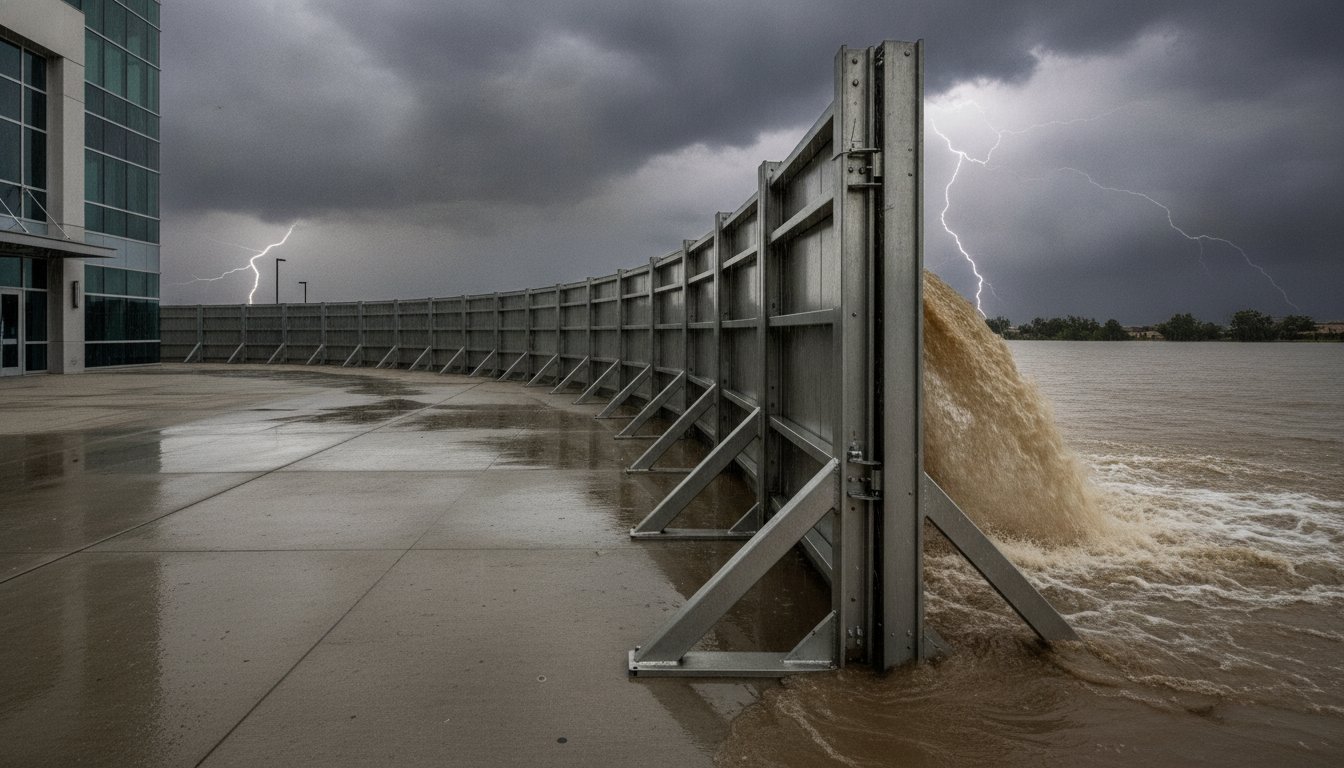
The traditional sandbag isn't a strategic defense; it's a desperate gamble against the inevitable weight of rising water. You've likely spent hours hauling heavy bags in the rain, only to watch them leak and fail when the pressure peaks. It's exhausting and inefficient. Modern temporary flood wall systems have rewritten the rules of engagement. These engineered barriers can be hundreds of times more labor-efficient than sandbags. They shift the focus from absorbing water to strategically redirecting its path away from your assets.
We understand the paralyzing fear that arrives with every storm warning and the confusion of choosing a defense that won't buckle under the surge. You deserve a professional-grade shield that offers absolute peace of mind. You'll learn how these systems outperform legacy methods through superior structural integrity and rapid deployment. We will explore the diversion philosophy and show you how to transition from temporary panic to a reusable, professional state of readiness. It's time to replace uncertainty with an impenetrable line of defense.
Key Takeaways
- Shift your strategy from holding water to professional redirection. Learn how temporary flood wall systems provide a removable, high-stakes shield without permanent property alterations.
- Compare the three pillars of modern defense. Choose between modular panels, inflatable barriers, or liquid-applied solutions based on your specific terrain and tactical needs.
- Master the physics of protection. See how engineered systems use the weight of the flood itself to create a pressurized seal that traditional methods simply can't match.
- Identify your property's vulnerabilities. Map the path of least resistance and calculate critical height to ensure your perimeter is fortified against historical surge data.
- Move beyond off-the-shelf solutions. Discover why professional engineering and national installation are the final steps in securing absolute peace of mind during a storm.
The Evolution of Defense: What Are Temporary Flood Wall Systems?
Modern flood defense has moved beyond the era of heavy lifting and hope. Today, temporary flood barriers represent a sophisticated evolution in property protection. These are engineered, removable structures designed to fortify perimeters against rising water without requiring permanent alterations to your land or architecture. They don't just sit there. They work. By utilizing materials that meet rigorous performance standards, these systems offer a level of reliability that manual methods cannot touch.
The core of this evolution is the Fortress philosophy. It marks a decisive shift from 'holding water' to 'strategic diversion.' Traditional thinking suggests you should build a wall and pray it holds. We believe in guiding the threat away. By focusing on diversion, temporary flood wall systems transform a chaotic environmental surge into a manageable flow. This isn't just about dry floors. It's about the emotional ROI of moving from blind panic to a state of unwavering readiness. When the sirens sound, you don't scramble. You deploy.
Redirection vs. Retention: The Strategic Difference
Fighting the full weight of a flood is often a losing battle. Hydrostatic pressure increases with every inch of water depth. A static wall that only seeks to retain water faces immense stress. It's a brute-force approach that invites structural collapse. Diversion acts as a force multiplier. Instead of absorbing the impact, these systems guide the water toward the path of least resistance. This keeps the pressure off your foundations and prevents the catastrophic seepage that often occurs when water is trapped against a building. Engineered systems maintain their integrity because they work with the physics of the surge, not against it.
The Failure of the Sandbag Standard
In 2026, relying on sandbags is a dangerous commitment to a false sense of security. The logistics are a nightmare. You need thousands of bags, a massive labor force, and hours of lead time that you usually don't have. Industry data indicates that modular barriers can be up to 375 times more labor-efficient than traditional sandbagging. That is the difference between a secured perimeter and a flooded basement.
- The Sandbag Gap: Rapid-onset floods don't wait for you to fill and stack thousands of bags.
- Contamination Risks: Post-flood sand is often a biohazard. It absorbs sewage, chemicals, and toxins from the water.
- Structural Failure: Sandbags leak, shift, and eventually fail under sustained pressure.
Choosing a professional system means you aren't left with a pile of toxic waste. You're left with a reusable, professional-grade defense that's ready for the next alert. It's a transformation from vulnerability to absolute control.
Engineered Barrier Categories: Choosing Your Shield
Choosing the right defense is a high-stakes tactical decision. It's the difference between a dry interior and a catastrophic loss. Modern temporary flood wall systems fall into three distinct categories, each engineered for a specific environmental challenge. We've moved beyond the era of makeshift barriers. Today, military-grade polymers and stainless steel are the industry standard. These materials offer the structural dominance required to withstand the crushing force of a storm surge while remaining light enough for rapid deployment. Selecting the correct shield depends on your terrain, your lead time, and your property's specific entry points.
Modular and Interconnecting Panel Systems
Think of these as the "Legos of Defense." Interlocking panels create a seamless, impenetrable line that can be scaled to any length. The Fortress Flood Diversion System is the premier choice for rigid perimeters. It excels at securing garage doors, storefronts, and long commercial boundaries with mechanical precision. The secret lies in the seal technology. High-performance compression gaskets ensure a watertight lock, turning individual components into a single, unyielding shield. This system is designed for high-pressure scenarios where structural rigidity is non-negotiable.
Inflatable Barriers: Rapid Deployment Fortification
Speed is a form of protection. The Fortress Inflatable Flood Barrier allows you to move from complete vulnerability to a secured state in under 20 minutes. These barriers are designed for maximum versatility. They conform to uneven terrain, gravel drives, and estate entrances that would challenge a rigid wall. By harnessing air or the water's own weight, they create a heavy, form-fitting seal that stays in place even as the surge rises. It's the ideal choice for rapid-onset storms where you need a professional-grade defense with minimal setup time.
Transparent Liquid Barriers: The Modern Frontier
There's a hidden threat in every perimeter. Micro-entry points like vents, cracks, and door frames often allow water to bypass traditional walls. The Fortress Transparent Liquid Paintable Flood Barrier addresses this gap directly. It's an invisible shield that provides protection you can't see but can absolutely trust. This paintable solution seals the vulnerabilities that modular walls might miss. It's the ultimate secondary defense. It ensures that your property remains dry without altering the aesthetics of your architecture. Matching the barrier to your specific terrain is how you achieve absolute security. You can explore these engineered systems to find the perfect shield for your unique property layout.
Deployment Dynamics: Speed, Weight, and Structural Integrity
Success in flood defense isn't just about having a barrier; it's about how that barrier behaves when the pressure peaks. Deployment is a high-stakes race against the elements. If a system is too heavy to move or too complex to assemble, it's a liability rather than an asset. Modern temporary flood wall systems solve this through human-centric engineering. They prioritize lightweight materials that don't sacrifice an ounce of structural strength. When the first inch of water arrives, your defense must already be an impenetrable line. This is the 'Flash Flood' test. It's the difference between a dry interior and a total loss.
Structural integrity depends on a fundamental shift in how we view water. Instead of fighting the surge, professional systems use the water's own physics to create a seal. This turns a destructive force into a stabilizing one. It's a proactive approach to fortification that ensures your property remains a sanctuary while the surrounding environment remains in flux. You don't need a thousand laborers; you need a single, well-engineered strategy.
Hydrostatic Pressure and the 'Anchor' Effect
The 'L-shape' principle is a masterclass in engineering. As water rises, it flows onto the horizontal base of the barrier. This creates immense downward pressure that pins the structure to the ground. This 'Anchor Effect' means the higher the water climbs, the tighter the seal becomes. As the water level climbs, the downward pressure on the system's base intensifies the seal against the ground. Surface type plays a critical role here. While concrete offers a high friction coefficient for a perfect seal, uneven grass requires flexible components to maintain contact. Choosing the right system means understanding the ground beneath your feet.
Logistical Readiness: Storage and Reusability
The true cost of a defense system includes its life after the storm. Disposable barriers are a logistical nightmare and a financial drain. Professional-grade systems offer a superior long-term ROI because they're built for a decade of service. Design efficiency allows you to store a 100-foot wall in a small corner of a garage. For instance, some modular panels weigh only 33 pounds per piece, which is a fraction of the weight of traditional sandbags. One single section can replace 144 sandbags, drastically reducing the storage footprint. Post-flood recovery is simple. A quick cleaning and inspection ensure your shield is ready for the next alert. It's a cycle of readiness that provides total tranquility.

Assessing Your Perimeter: A Strategic Checklist
A wall is only as effective as the strategy behind its placement. Before the first clouds gather, you must conduct a cold, calculated audit of your property. This isn't just about measuring doors. It's about understanding the fluid dynamics of your specific landscape. You need to identify the path of least resistance. Water is relentless. It will find every dip in your driveway and every crack in your foundation. By mapping these routes, you can deploy temporary flood wall systems where they will have the most impact. This is the difference between a reactive scramble and a proactive fortification.
Determining your critical height is the next priority. Look at historical flood data for your area to establish a baseline for your defense. FEMA guidance suggests that temporary measures for residential buildings should provide protection for no more than 3 feet of water depth. If your historical data suggests a higher surge, you need a system engineered for those specific loads. Once you know the height, analyze your surfaces. Tarmac and concrete provide excellent friction for gaskets. Soil and grass require different tactical choices to prevent the barrier from shifting under pressure. Finally, perform a weak link audit. Check every vent, pipe entry, and basement window. These are the silent entry points that can bypass even the strongest wall.
Mapping the Water Diversion Route
The goal isn't to stop the water entirely. The goal is to guide it somewhere safe. Strategic redirection is a force multiplier for your defense. You must ensure that your diversion route doesn't create a neighbor conflict. Pushing water off your land and directly into a neighbor's basement is a liability, not a solution. Integrate your landscaping with your barrier placement. Use natural slopes to assist the wall in moving the surge away from your foundation. This creates a professional-grade defense that respects the surrounding environment while maintaining your own security.
Mechanical and Seal Integrity Check
Readiness is a perishable skill. You must test your thresholds and door frames for hidden gaps before an emergency occurs. Even a millimeter of space can allow hundreds of gallons of water to enter over time. This is where the Fortress Transparent Liquid Paintable Flood Barrier becomes essential. It acts as the final seal for those micro-entry points that physical panels might miss. We recommend conducting an annual dry run deployment. Train your staff or family to assemble the system under pressure. If you want to ensure your property is truly battle-ready, get a professional perimeter assessment today. It's the only way to achieve absolute peace of mind during a storm warning.
The Fortress Approach: Why Engineered Protection Wins
Off-the-shelf solutions are a gamble you cannot afford to take. When a storm surge bears down on your property, a generic retail barrier offers little more than a suggestion of safety. True security requires professional engineering. Temporary flood wall systems must be precisely calibrated to the specific hydrostatic loads and terrain of your perimeter. The Fortress approach moves beyond simple retail products. It treats flood defense as a cohesive, engineered shield. By integrating the Fortress Flood Diversion System with specialized seals and barriers, we create an impenetrable line of defense that respects the unique architecture of your estate or commercial asset.
We don't just sell equipment. We provide a strategic partnership. The FloodWater Pros difference starts with an initial design phase and follows through to national professional installation. This ensures that every component of your system is optimized for performance. We look at the variables that others ignore, such as soil saturation, surface friction, and the specific entry points that represent your greatest vulnerability. It's a comprehensive transformation from a state of exposure to a state of total fortification. Secure your legacy now. Don't wait for the clouds to gather to realize your defense is insufficient.
Professional Installation: The Missing Link
Even the most advanced barrier will fail if the engineering of the perimeter is flawed. A gap of just a few millimeters is enough to compromise an entire system. This is why professional installation is the essential missing link in modern flood defense. As a national partner, we offer expert consultation and on-site setup that ensures your shield is battle-ready. We customize the Fortress system to fit the exact contours of your property. Whether you are protecting a historic storefront or a sprawling coastal estate, our team ensures the seal is absolute. This level of precision is impossible to achieve with a DIY approach.
Peace of Mind as a Service
The true value of an engineered system is the profound emotional relief it provides. Imagine the next storm warning. Instead of the frantic, exhausting scramble to haul sandbags, you experience a quiet sense of readiness. There is no more sandbag panic. You have a professional-grade defense that deploys in minutes and performs for decades. This is a one-time investment for a lifetime of resilience. You aren't just buying panels and gaskets; you are buying the certainty that your property will remain dry and your assets will remain safe. It's time to take control of your environment. You can consult with a FloodWater Pros Engineer today to begin fortifying your perimeter against the unknown.
Fortify Your Future: The Path to Absolute Readiness
Waiting for the next storm warning isn't a strategy; it's a vulnerability. You've seen how modern temporary flood wall systems replace the exhaustion of sandbags with the precision of military-grade engineering. By prioritizing strategic diversion over simple retention, you aren't just blocking water. You're mastering the physics of your perimeter. True security comes from knowing that your defense is as unyielding as the surge it faces. It's the difference between hoping for the best and being prepared for the worst.
The transition from uncertainty to total tranquility requires more than just off-the-shelf equipment. It requires a professionally engineered shield. With the Fortress Flood Diversion System, you gain access to proprietary military-grade materials and the expertise of our national professional installation team. This isn't a temporary patch. It's a professional fortification designed to protect your legacy for decades to come. Every minute spent in preparation today is an hour of peace during the next storm.
Don't let the next surge catch you unprepared. Take the first step toward a permanent state of readiness today. Request a Professional Perimeter Defense Consultation and secure the protection your property deserves. You've done the research. Now, it's time to act and ensure your sanctuary remains dry and secure.
Frequently Asked Questions
Are temporary flood walls as effective as permanent flood walls?
Engineered temporary systems provide equivalent protection for specific flood events without the permanent architectural impact or high fixed costs of concrete. While permanent walls offer 24/7 readiness, temporary flood wall systems allow for tactical flexibility and rapid deployment when a threat is imminent. They are designed to withstand the same hydrostatic pressures as fixed structures while remaining removable once the danger passes.
How long does it take to deploy a temporary flood wall system?
Deployment speed depends on the specific barrier type and perimeter length. Inflatable systems can be fully operational in under 20 minutes. Modular panel systems are also highly efficient. Industry data shows that professional modular barriers are up to 375 times more labor-efficient than sandbags. A small team can often secure a standard commercial perimeter in a few hours.
Can one person set up a Fortress Inflatable Flood Barrier alone?
Yes, the Fortress Inflatable Flood Barrier is specifically engineered for rapid, solo deployment. Its lightweight design allows a single individual to position and activate the shield without heavy machinery or a large crew. This makes it a premier choice for residential estates or small businesses where manpower is limited during a rapid-onset storm event.
Do temporary flood walls work on uneven ground or grass?
Specific temporary flood wall systems are designed to handle terrain variations. While rigid modular panels perform best on flat surfaces like concrete or tarmac, inflatable and flexible barriers conform to the natural contours of soil, gravel, or grass. This versatility ensures that your seal remains intact even if your property's perimeter isn't perfectly level.
What happens if the flood water exceeds the height of the barrier?
If water levels surpass the critical height of the system, overtopping will occur. This is why we emphasize analyzing historical flood data before selecting your wall height. Once overtopped, the barrier's ability to protect the interior is compromised. We always recommend choosing a height that provides a safety buffer above the highest recorded surge in your area.
How do I clean and store my flood wall after a storm?
Maintenance is a critical part of the Fortress approach. Simply rinse the components with fresh water to remove silt, salt, or environmental contaminants. Once the materials are completely dry, they can be stacked or rolled for compact storage. Unlike sandbags, which become toxic waste, these engineered systems are ready for a decade of reuse.
Is professional installation required for the Fortress Flood Diversion System?
We provide a national professional installation team to handle the initial perimeter design and tactical setup. While the system is designed for you to deploy quickly during an emergency, the initial engineering ensures that all seals and anchors are perfectly calibrated to your property's architecture. This professional foundation is what guarantees absolute peace of mind.
Can I use temporary flood walls to protect against hurricane-strength storm surges?
Yes, our engineered barriers are built to withstand the high-velocity dynamics of storm surges. These systems utilize military-grade materials that resist the crushing weight of moving water. They provide an impenetrable shield that far outperforms legacy methods. However, it's vital to ensure your system is rated for the specific surge heights expected in your coastal zone.


