

Absorbing floodwater is a losing battle when high-velocity torrents barrel toward your home. When severe weather strikes, standard yard grading washes out and makeshift sandbags crumble under dynamic hydraulic force. Dynamic overland flow doesn't ask for permission, and it won't be stopped by temporary sponges. To safeguard your structural perimeter, you need an engineered surface runoff flood diversion barrier built specifically for active hydraulic redirection rather than passive water retention.
You already know the anxiety of watching torrential downpours overwhelm your lawn, pooling against exterior walls and threatening your foundation. It's exhausting to sift through flimsy hardware-store tubes and confusing absorption products that simply cannot withstand dynamic water velocity when your largest asset is on the line.
You don't have to leave your perimeter defense to chance. Discover how engineered surface runoff flood diversion barriers redirect destructive water before it compromises your property foundation. We will walk you through evaluating your property's topography, selecting robust structural defense systems, and establishing a turnkey engineered plan that delivers lasting peace of mind.
Key Takeaways
- Understand the dynamic physics of overland sheet flow to see why an engineered surface runoff flood diversion barrier outperforms passive absorption bags.
- Compare structural diversion systems, puncture-resistant inflatable tubes, and liquid sealants to match the exact surge velocity of your property.
- Evaluate critical deployment criteria, including hydraulic load calculations, substrate anchoring compatibility, and historical peak runoff depths.
- Identify key site preparation protocols, from elevation grade mapping to perimeter leveling, that eliminate bypass channels and blowouts.
- Discover the protective advantages of turnkey engineered defense systems designed for custom structural deflection and total perimeter security.
Understanding Surface Runoff: Why Conventional Flood Defense Fails
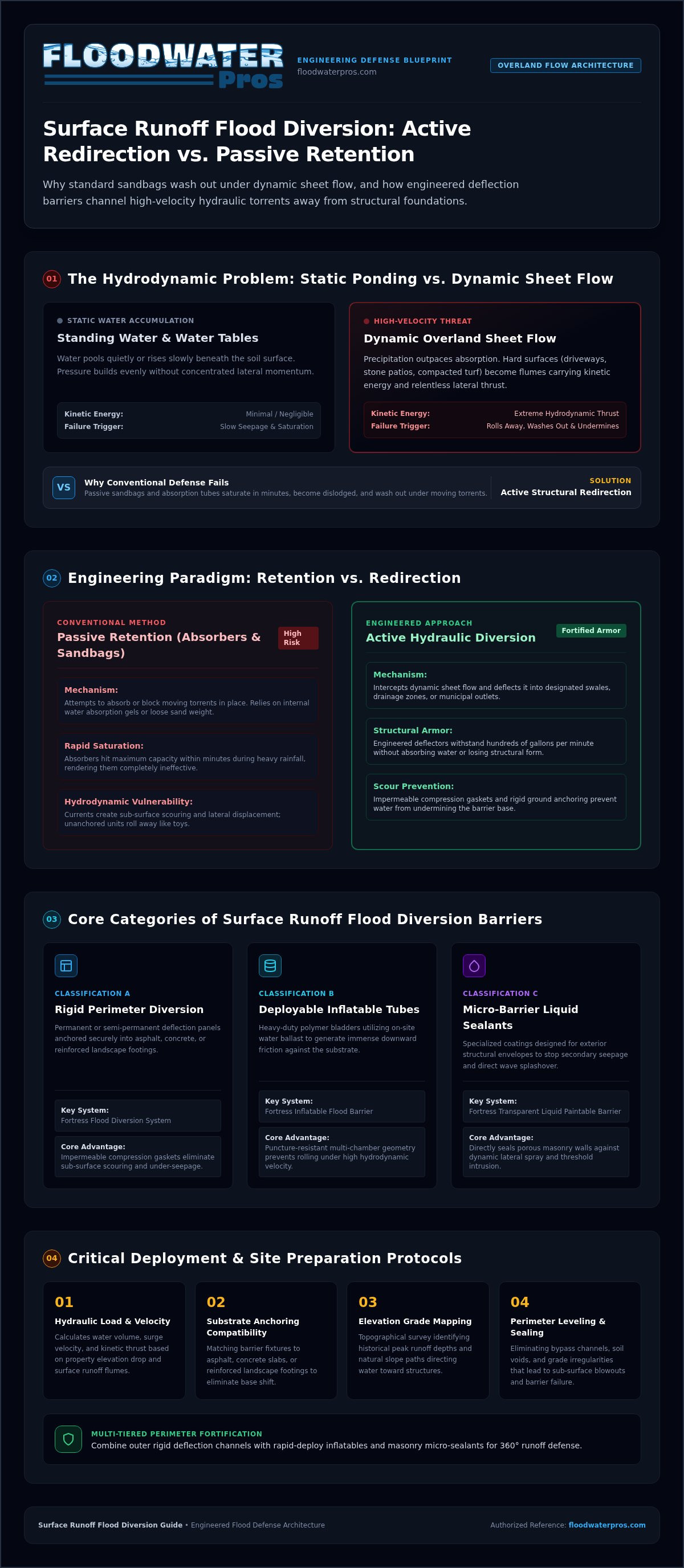
A surface runoff flood diversion barrier is an exterior engineered deflection system designed to intercept dynamic sheet flow and redirect it away from vulnerable assets. Most residential and commercial defense plans fail because they assume water is static. Standing ponding pools quietly, and rising water tables seep upward slowly. Surface runoff behaves completely differently. It gathers momentum across open ground, carrying kinetic energy and generating relentless hydrodynamic lateral pressure. Flimsy temporary sandbags wash out or dislodge because they cannot counter dynamic velocity. You cannot stop moving torrents by simply blocking them; you must deflect them along engineered paths.
The Mechanics of Destructive Overland Flow
When intense precipitation outpaces the soil's natural absorption threshold, excess water sheets across the terrain instantaneously. Non-permeable driveways, stone patios, and compacted turf convert ordinary yards into high-speed drainage flumes. Speed multiplies destructive force. As runoff accelerates down natural slopes, it exerts immense hydraulic thrust against exterior foundation walls, crawl spaces, and vulnerable thresholds. Properties positioned below adjacent parcels face severe risks as local topography relentlessly funnels hundreds of gallons per minute straight toward structural foundations.
Retention vs. Redirection: The Engineering Shift
Many property owners mistakenly deploy passive absorption socks or gel tubes against fast-moving torrents. These light products saturate within minutes. Once saturated, dynamic currents roll them away like toys. True site fortification demands an engineering shift from passive water containment to active hydraulic diversion. Rather than attempting to trap thousands of pounds of rushing water, an engineered surface runoff flood diversion barrier serves as perimeter armor. It channels high-velocity flows safely toward designated swales, municipal drains, or discharge zones. Explore what is a flood diversion system to understand redirection mechanics and how continuous deflection preserves foundation integrity.
Core Categories of Surface Runoff Flood Diversion Barriers
Every terrain presents a distinct hydraulic puzzle. Selecting the right surface runoff flood diversion barrier depends entirely on ground slope, expected water velocity, and required deployment speed. Perimeter protection falls into three primary classifications: rigid diversion channels, rapidly deployable inflatable barriers, and transparent liquid sealants. Establishing a layered defense ensures that if extreme sheet flow challenges outer boundaries, secondary structural measures protect critical structural thresholds.
Rigid Perimeter Diversion Systems
Rigid systems act as immovable armor against severe hydraulic forces. Anchored securely into asphalt, concrete, or reinforced landscape footings, these barriers direct massive runoff volumes away from structural assets. Engineered solutions like the Fortress Flood Diversion System feature heavy-duty structural deflection panels paired with impermeable bottom compression gaskets. These gaskets eliminate sub-surface scouring, preventing water from undermining the barrier on driveways or prepared grade lines.
Deployable Inflatable Water Barriers
When unexpected weather patterns bring sudden deluge risks, deployable inflatable tubes provide dynamic fortification. Heavy-duty polymer bladders use on-site water ballast to create immense downward friction against the ground. For homeowners seeking rapid staging, deploying inflatable flood barriers for homes delivers rapid perimeter containment. The Fortress Inflatable Flood Barrier uses puncture-resistant multi-chamber designs that prevent rolling or slipping under extreme hydrodynamic velocity.
- Rigid Systems: Permanent or semi-permanent deflection for high-velocity overland flumes.
- Inflatable Tubes: Rapid deployment, high stability, and compact off-season storage.
- Liquid Sealants: Micro-barrier coatings like the Fortress Transparent Liquid Paintable Flood Barrier for sealing porous masonry walls against direct splashover.
Topographical Diverters and Swale Enhancements
Hardscape deflector curbs and engineered swales reshape how runoff navigates your property. Concrete berms and diversion curbs stop driveways from acting as funnels directly into subterranean garages. While traditional earthen berms often erode under prolonged saturation, engineered structural curbing maintains crisp deflection angles season after season. If you want to evaluate your property grade and configure an impenetrable defense layout, consult the specialists at FloodWater Pros to build your custom diversion strategy.
Critical Buying Criteria: Selecting the Right Diversion Barrier
Investing in perimeter flood defenses requires rigorous evaluation. Choosing the wrong surface runoff flood diversion barrier risks catastrophic failure when torrents crest. You need a structured rubric that weighs raw hydraulic physics against your site's physical constraints. To ensure your defense holds under dynamic loads, evaluate these four critical criteria before deploying a system:
- Dynamic Surge Height: Barrier elevation relative to historic flood crests plus safety margins.
- Substrate Anchoring: Surface compatibility across asphalt, paved driveways, compacted gravel, and native turf.
- Hydrodynamic Resistance: Structural stability against lateral thrust, buoyant lift, and scouring velocities.
- Material Resilience: Puncture thresholds, UV resistance, and marine-grade compression seals.
Hydraulic Capacity and Height Specifications
Never size a diversion barrier based on average rainfall. Calculate peak runoff rates across your entire uphill catchment basin. Heavy sheet flow stacks quickly as it strikes an angled defense line. Incorporate at least six to twelve inches of freeboard margin above historic crests to prevent wave overtopping. Position the barrier at an oblique deflection angle relative to incoming currents. A 45-degree angle maintains downstream momentum, guiding water smoothly into secondary swales without generating localized pool turbulence or bank scouring.
Ground Sealing and Underflow Prevention
Water always exploits the path of least resistance. Surface fissures, gravel patches, and uneven turf create micro-gaps that permit high-pressure water seepage beneath a barrier. Once underflow begins, scouring rapidly undermines the entire installation footprint. True fortification requires heavy-duty compressible bottom seals or continuous ground anchors that conform to substrate irregularities. Read our deep dive into flood diversion system design to understand how engineered compression mechanics neutralize sub-surface hydraulic lift.
Deployment Logistics and Physical Demands
Consider the realities of severe storm staging. Can your team deploy the system within two hours of an emergency flash flood alert? Inflatable multi-chamber bladders require high-volume water access for rapid ballasting. Rigid modular panels require prepared anchor receivers and organized storage racks. Conduct annual gasket inspections, verify seal elasticity, and replace worn hardware well before storm season arrives. When execution speed determines structural survival, an engineered surface runoff flood diversion barrier system delivers predictable, reliable protection.
Site Preparation, Alignment, and Professional Installation
Flawless execution separates unyielding perimeter armor from catastrophic structural failure. Even the most robust surface runoff flood diversion barrier fails if placed haphazardly across unprepared grade. Quick drop-and-go tactics ignore fundamental hydrologic dynamics. Dynamic sheet flow relentlessly seeks out low spots, gravel voids, and loose surface debris to scour underneath unanchored equipment. Fortifying your perimeter requires a methodical engineering protocol before the first storm clouds gather:
- Elevation Grade Mapping: Survey primary runoff channels and overland flow contours across the entire parcel.
- Footprint Substrate Preparation: Excavate rocks, clear organic debris, and compact the installation line to guarantee an airtight seal.
- Laminar Redirection Routing: Establish diagonal discharge channels directly into municipal drainage tie-ins or reinforced retention swales.
- Pre-Season Controlled Commissioning: Conduct controlled hydraulic flow testing along the perimeter to confirm zero seepage.
Mapping the Path of Least Resistance
Contour lines dictate how gravity and momentum drive sheet flow across your land. Never align a diversion line perpendicular to incoming overland currents. Facing rushing water head-on maximizes hydrodynamic impact pressure, inviting structural blowouts. Instead, position the barrier diagonally at an oblique 30 to 45 degree angle. This geometry maintains laminar water velocity, sweeping high-volume torrents smoothly around building perimeters. The runoff discharges safely into designated retention basins or storm drains without impacting adjacent neighboring parcels.
Professional Engineering vs. DIY Pitfalls
Improper DIY anchoring represents the most common cause of perimeter barrier failure. Unanchored systems shift, buckle, or float when dynamic hydrodynamic forces surge. Professional engineering assessments evaluate subsurface soil density, pavement shear strength, and potential soil liquefaction risks before anchoring into the ground. For sprawling residential estates and industrial facilities requiring customized, high-capacity deflection lines, explore our comprehensive guide to commercial flood barriers.
Protecting your property demands calculated precision, not guesswork. Eliminate installation risk by partnering with our seasoned field engineers. Schedule your professional site engineering consultation with FloodWater Pros today to secure an unyielding defense perimeter.
The Fortress Advantage: Turnkey Engineered Runoff Defense
Relying on generic retail products leaves your property exposed to hydraulic blowouts. A reliable surface runoff flood diversion barrier cannot be an improvised afterthought. It must function as calibrated perimeter armor, engineered to deflect massive overland currents before they compromise your structural foundation. The Fortress Flood Diversion System unites custom structural fabrication with end-to-end engineering to deliver absolute perimeter security for residential estates and commercial grounds.
The Fortress Flood Diversion System in Action
The Fortress Flood Diversion System is built to withstand punishing overland forces. Featuring heavy-gauge structural deflection panels, the system repels high-velocity torrents and resists impacts from heavy storm debris. Its proprietary interlocking seal mechanism creates an impenetrable threshold along the ground, completely eliminating the scouring and undermining that destroy inferior barriers. For comprehensive protection from the perimeter inward, integrate perimeter deflection with advanced residential flood protection systems. Pairing the rigid diversion line with the multi-chamber Fortress Inflatable Flood Barrier establishes a resilient, layered defense across wide driveways and grounds.
Securing Your Property Perimeter
True fortification demands professional execution from start to finish. FloodWater Pros manages every phase of your runoff defense, eliminating the consumer installation errors that cause perimeter barriers to fail during severe weather events. Our turnkey process removes all guesswork:
- On-Site Hydrodynamic Survey: We assess your parcel's natural topography, elevation lines, and historical runoff volume.
- Custom Structural Engineering: Deflection barriers are fabricated to the exact dimensions and contours of your landscape.
- Professional Installation: Field specialists anchor, calibrate, and seal the defense system to guarantee structural deflection under maximum dynamic loads.
Take control of your overland water risk before the next storm system forms. Shield your property against destructive runoff with the FloodWater Pros Fortress defense network.
Fortify Your Ground: Command the Flow Before It Crests
Passive sandbags and temporary tubes cannot withstand the punishing hydrodynamic force of torrential overland sheet flow. Protecting your foundation requires calculated deflection, not futile absorption. By pairing proper topographical grade mapping with an engineered surface runoff flood diversion barrier, you guide high-velocity currents safely away before water ever reaches vulnerable exterior thresholds.
True security comes from deliberate engineering. Whether utilizing puncture-resistant multi-chamber technology for rapid deployment or erecting permanent deflection channels, precision execution determines whether your property stays dry. Our proprietary heavy-duty Fortress Flood Diversion System is specifically engineered for high-velocity deflection, supported by nationwide turnkey engineering and certified professional installation teams that eliminate critical blowout risks.
Fortify your perimeter with the Fortress Flood Diversion System from FloodWater Pros. Take command of your landscape today, safeguard your valuable structural assets, and face every storm season with unwavering peace of mind.
Frequently Asked Questions
How does a surface runoff flood diversion barrier differ from standard sandbags?
A surface runoff flood diversion barrier actively channels high-velocity sheet flow away from structures rather than attempting to soak it up or block it head-on. Traditional sandbags are porous, labor-intensive, and prone to washing out under hydrodynamic lateral pressure. Engineered diversion barriers use rigid deflection plates or ballasted bladders with compression seals to redirect thousands of gallons of moving water safely along designated drainage paths without degrading.
Can surface runoff barriers be installed across uneven lawns and unpaved soil?
Yes, but installation requires specialized ground sealing. Rigid diversion barriers use anchored footings or compressible gaskets that adapt to surface contours, preventing scouring beneath the base. Inflatable water-filled bladders contour naturally to rolling turf and gravel by distributing heavy downward water ballast. On unpaved soil, professional site preparation ensures the barrier line is cleared and leveled so moving currents can't erode underneath the footprint.
What barrier height is required to divert severe overland flash flood flows?
Most overland surface runoff requires barriers ranging from 12 to 24 inches in height. Unlike coastal storm surges, overland sheet flows rarely exceed a few feet in depth, but they move at high speeds. Sizing depends on your parcel's upstream catchment basin, historical peak precipitation volumes, and an engineered six- to twelve-inch freeboard buffer to prevent fast-moving waves from splashing over the deflection perimeter during peak crests.
Will deflecting floodwater away from my foundation cause legal issues with neighbors?
Deflecting runoff requires careful alignment to avoid discharging water onto adjacent private properties. Under common surface water drainage laws, landowners can't unnaturally concentrate and divert destructive torrents onto downstream neighbors. Engineered diversion systems resolve this by channeling overland flow strictly into established natural swales, retention ponds, or permitted municipal storm infrastructure. Comprehensive elevation planning ensures your defense complies fully with local drainage easements.
How quickly can temporary or inflatable flood barriers be deployed before a storm?
Systems like the Fortress Inflatable Flood Barrier can be staged and operational within one to two hours, depending on total perimeter length. Crews position the uninflated multi-chamber polymer bladders along mapped deflection lines and fill them rapidly using standard water hoses. Because they require no heavy excavation or sand hauling, inflatable barriers offer fast, dependable protection when severe weather warnings leave minimal prep time.
Can the Fortress Flood Diversion System handle high-velocity debris and impact loads?
Yes, the Fortress Flood Diversion System is specifically engineered to repel high-velocity hydraulic currents and dynamic debris strikes. Fabricated from heavy-gauge structural components, the deflection panels resist branches, loose gravel, and rolling items carried by flash floods. Anchored firmly into the ground with interlocking seals, the system maintains structural integrity under intense lateral thrust where generic retail barricades buckle or collapse.
Is professional installation required for heavy-duty surface runoff barriers?
Professional installation is strongly recommended for structural perimeter defense. A heavy-duty surface runoff flood diversion barrier must counter immense hydrodynamic thrust and subsurface scouring. Certified engineering teams conduct site elevation surveys, assess soil density, and properly anchor every panel into your substrate. Professional execution eliminates DIY errors, ensuring seamless gasket contact and preventing catastrophic blowouts when severe storms strike your property.


