

Can an invisible coating truly stop thousands of pounds of lateral water pressure from breaching your walls? It sounds counterintuitive, especially after decades of relying on bulky metal barricades and unsightly sandbags. You shouldn't have to sacrifice your building's architectural character just to stay dry, nor should you have to worry whether an unverified clear coat will turn yellow, peel, or trap moisture inside your masonry. Applying an engineered transparent flood sealant for building exteriors creates an impenetrable structural defense without altering your facade.
Effective flood mitigation doesn't demand permanent visual scars when molecular barriers can withstand severe hydrostatic loads. In this guide, you'll discover how transparent flood sealant fortifies exterior facades against intense water intrusion without compromising curb appeal. We break down the exact engineering criteria behind high-performance liquid barriers, reveal how breathable formulations protect structural integrity, and outline what it takes to defend your building envelope against rising waters.
Key Takeaways
- Standard water repellents fail under standing water, whereas a professional transparent flood sealant for building exteriors forms an elastomeric membrane engineered to withstand continuous hydrostatic pressure.
- Porous mortar joints and textured masonry represent critical vulnerability zones that demand deep-penetrating chemical adhesion rather than cosmetic topcoats.
- Liquid flood barriers provide seamless, passive defense that protects your entire facade without the aesthetic disruption or labor demands of mechanical flood gates.
- Proper envelope auditing and precise mechanical surface preparation are vital to prevent peeling, efflorescence, and lateral water intrusion.
- Proprietary solutions like the Fortress Transparent Liquid Paintable Flood Barrier combine structural resilience with certified installation to deliver invisible, long-term building fortification.
What Is Transparent Flood Sealant for Building Exteriors?
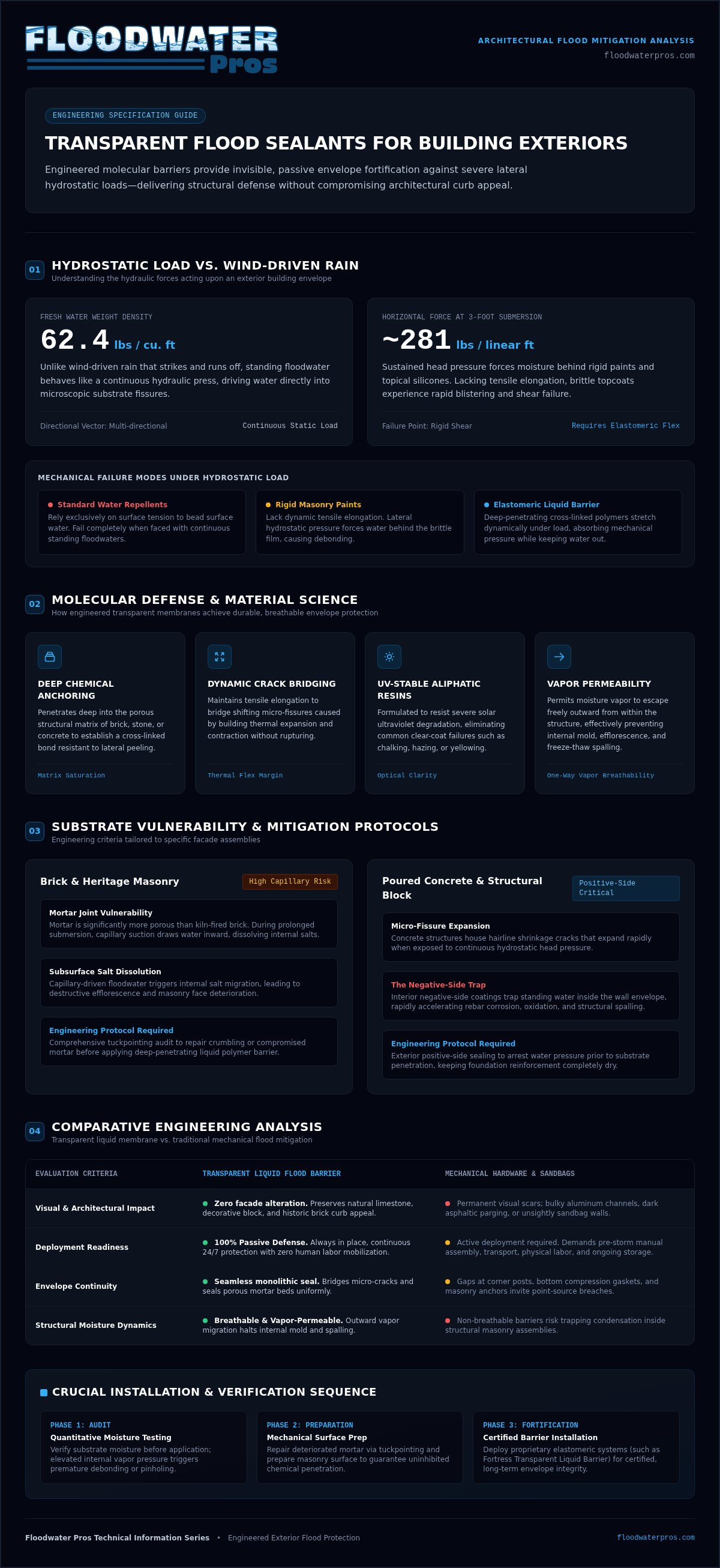
A true transparent flood sealant for building exteriors is not a simple clear coat from the local hardware store. It is a specialized, optically clear elastomeric membrane engineered to withstand relentless hydrostatic load. Retail water repellents rely on surface tension to bead falling rain, but they fail completely against standing water. When floodwaters rise, water exerts continuous lateral force, driving liquid directly into microscopic substrate fissures.
A professional liquid flood barrier operates on molecular defense. It penetrates deep into the porous matrix of brick, stone, or concrete, establishing a robust cross-linked chemical bond. At the surface, it cures into a continuous, flexible shield that bridges micro-cracks without rupturing. Crucially, high-grade formulations remain vapor-permeable. Moisture vapor escapes freely outward from inside the building, preventing internal mold, efflorescence, and destructive freeze-thaw spalling.
Hydrostatic Pressure vs. Wind-Driven Rain
Wind-driven rain strikes and runs off. Floodwater behaves like a hydraulic press. Fresh water exerts 62.4 pounds per cubic foot, generating approximately 281 pounds of horizontal force per linear foot at a depth of just three feet. Standard exterior masonry paints and topical silicones are rigid. They lack tensile elongation. Under sustained hydrostatic head, water forces its way behind brittle films, causing rapid blistering, shear failure, and massive interior intrusion. An engineered liquid barrier stretches under load, absorbing mechanical stress while keeping water out.
Preserving Architectural Aesthetics and Curb Appeal
Fortification doesn't require visual sacrifice. Traditional mitigation often relies on bulky permanent aluminum channels, sandbags, or dark asphaltic parging that ruin facade aesthetics. Deploying an engineered transparent flood sealant for building exteriors preserves the natural visual character of limestone, decorative block, and heritage brick. Formulated with advanced UV-stable aliphatic resins, these coatings resist solar degradation, preventing chalking, hazing, or yellowing over time. It delivers silent, reliable flood defense for luxury commercial assets and historic properties where visual alterations aren't an option.
How Exterior Liquid Barriers Perform Across Substrates
Every building envelope presents unique structural variables. Applying a high-performance transparent flood sealant for building exteriors requires matching polymer chemistry directly to the underlying facade material. Concrete, split-face block, historic brick, and limestone possess distinct pore networks and surface energies. If the coating cannot achieve a deep chemical anchor within those pores, continuous hydrostatic pressure will peel it away from the substrate.
Successful installation hinges on structural readiness and moisture verification. Before coating application, technicians must conduct quantitative moisture testing. High internal moisture vapor pressure forces surface coatings outward, causing pinholes or premature debonding. Additionally, structures naturally expand and contract with temperature shifts. A flood barrier must deliver dynamic crack-bridging capability, flexing across shifting micro-fissures without tearing under load.
Sealing Porous Brick and Masonry Mortar
Mortar joints represent the weakest link in any exterior masonry wall. Mortar is substantially more porous than kiln-fired brick. During prolonged flood submersion, capillary action draws water deep into unsealed mortar beds, dissolving internal salts and triggering severe efflorescence. High-grade liquid polymers saturate these porous channels, hardening within the matrix to form a monolithic barrier. Performing a thorough tuckpointing inspection is essential beforehand; crumbling or compromised mortar must be repaired before applying a permanent liquid barrier.
Poured Concrete and Structural Block Applications
Poured concrete and structural masonry units present different failure points. Concrete contains micro-fissures that widen when subjected to standing water. Addressing this vulnerability requires positive-side protection on the exterior face. Interior, negative-side coatings merely trap water inside the foundation wall, accelerating rebar corrosion and spalling. Exterior positive-side sealing stops hydrostatic load before it touches structural concrete, keeping the building envelope dry and intact. Property owners seeking to secure porous foundations often evaluate professional options through certified facade defense specialists to guarantee impenetrable, code-compliant sealing.
Comparing Exterior Flood Barriers: Coatings vs. Hardware
Mechanical barriers stop water at entry points, but they leave surrounding exterior walls completely unprotected. A building is only as secure as its most porous boundary. While aluminum gates shield doorways, unsealed brick and masonry allow lateral seepage directly into living and working spaces. Property owners evaluating comprehensive residential flood protection systems quickly realize that physical panels solve only half the structural equation. Layering clear surface coatings with targeted hardware delivers true resilience.
Passive Invisible Defense vs. Active Manual Systems
Deploying hardware barriers requires advance warning, physical strength, and perfect timing. If a storm hits overnight or while you're away, manual barriers remain uninstalled. Human error remains the primary vulnerability in active defense. Permanent mechanical gates also require structural mounting brackets drilled into door frames, permanently altering entryways. Compression gaskets degrade under UV radiation, demanding regular replacement to maintain a watertight seal.
In contrast, applying a transparent flood sealant for building exteriors delivers zero-deployment, passive defense. It stays on watch around the clock without human intervention. The cured polymer maintains clean architectural lines, protects substrate pores, and eliminates the visual clutter of permanent metal channels.
Integrating Liquid Coatings with Diversion Infrastructure
Complete structural resilience doesn't rely on a single defensive line. Standing hydrostatic water demands sealed surfaces, but high-velocity runoff presents kinetic threats. Rapid currents can scour exterior finishes and slam debris into structural walls. Pairing facade sealants with targeted flood diversion system design redirects fast-moving surface runoff safely away from the perimeter.
When diversion systems channel rushing currents toward municipal drainage or designated swales, an applied transparent flood sealant for building exteriors repels whatever residual standing water accumulates against the foundation. This layered strategy neutralizes both kinetic flow and hydrostatic pressure simultaneously.
Selecting and Applying Exterior Liquid Flood Barriers
Applying an effective liquid barrier requires rigorous engineering protocols rather than casual surface painting. The process starts with a complete building envelope audit. Engineers calculate the local Base Flood Elevation (BFE) and incorporate required safety freeboard to establish precise barrier termination heights. Surface area calculations dictate the exact dry film thickness (DFT) needed to resist projected lateral water loads. Once cured, technicians must verify membrane continuity across the entire elevation using wet-sponge spark testing or high-voltage holiday detection to identify pinholes before flood conditions strike.
Substrate Preparation and Decontamination
Adhesion failure happens when surface preparation is skipped. Technicians must mechanically profile the substrate to remove biological growth, atmospheric oils, efflorescence salts, and failing legacy sealers. Moisture vapor transmission rates must be measured using quantitative test methods to ensure outbound vapor won't blast the curing polymer off the wall. Control joints, structural transitions, and window returns require detail-tooling with elastomeric structural caulk, creating flexible transition planes before the main field coating goes on.
Professional Application vs. Retail DIY Risks
Amateur roller applications create catastrophic failure points. Rolling heavy elastomeric formulas introduces air pockets and uneven coverage, leaving microscopic pathways for water under pressure. Specialized, high-pressure airless equipment delivers the uniform build necessary for a high-performance transparent flood sealant for building exteriors.
- Pinhole Formation: Manual rolling traps microscopic air pockets that pop during curing, turning into entry funnels under continuous hydrostatic head.
- Variable Film Thickness: Uneven manual spread leaves thin spots that shear under the weight of rising floodwaters.
- Atmospheric Cure Failures: Applying liquid barriers outside specific ambient temperature and dew point windows prevents proper polymer cross-linking, destroying tensile strength.
Fortifying your exterior against severe water intrusion requires certified precision and calibrated application. To safeguard your property's exterior with lab-tested polymer barriers, consult the engineering team at FloodWater Pros to schedule a structural facade evaluation.
Fortress Engineered Defense: Advanced Invisible Protection
When environmental threats escalate, relying on retail-grade sealers is an unacceptable gamble. FloodWater Pros engineers the Fortress Transparent Liquid Paintable Flood Barrier to resolve the tension between architectural preservation and unyielding flood resilience. Designed from the ground up for extreme hydrological exposure, this system provides invisible structural defense that bonds directly to raw masonry, structural concrete, and stone. For commercial enterprises, integrating this clear facade barrier with heavy-duty commercial flood barriers creates a comprehensive defense strategy that seals structural boundaries and secures wide access portals without altering exterior branding.
Proprietary Elastomeric Science and Durability
The Fortress Transparent Liquid Paintable Flood Barrier is formulated specifically to counteract deep lateral hydrostatic loads that shatter conventional exterior paints. The cured membrane provides exceptional elongation, maintaining structural flexibility across brutal freeze-thaw cycles and intense heat. Formulated with advanced aliphatic polymer chains, it delivers superior UV resistance that prevents yellowing, hazing, or chalking. By functioning as a true transparent flood sealant for building exteriors, it dries completely clear. Original masonry textures, brick colorations, and stonework remain fully visible while gaining high-performance water resistance.
Single-Source Engineering and Installation Assurance
Most coating failures stem from finger-pointing between separate chemical manufacturers and third-party painting crews. When an exterior barrier leaks, suppliers blame improper prep, while painters blame defective chemistry. FloodWater Pros eliminates this vulnerability through end-to-end operational accountability:
- Proprietary Design: Formulations engineered specifically for real-world flood pressures rather than standard precipitation.
- Direct Manufacturing: Strict factory batch controls that ensure chemical consistency and high tensile performance.
- Certified Turnkey Installation: Precision application by trained technicians utilizing industrial equipment and holiday leak detection.
Property owners can also establish redundant perimeter protection by deploying rapid-response inflatable flood barriers for homes alongside exterior wall coatings. Pairing perimeter diversion with an engineered transparent flood sealant for building exteriors guarantees that your structure stands ready against unpredictable environmental challenges.
Fortify Your Facade: Invisible Defense Meets Unyielding Protection
Rising water levels demand serious structural defense, but safeguarding your building envelope doesn't mean sacrificing architectural character. Floodwaters actively exploit microscopic pores in unsealed masonry, brick, and mortar joints. Applying an engineered transparent flood sealant for building exteriors establishes an impenetrable, breathable molecular barrier that withstands sustained hydrostatic load while keeping your original stonework and architectural vision completely intact.
True security comes from verified engineering rather than retail clear coats that bubble and fail under load. FloodWater Pros provides complete single-source assurance through proprietary chemical formulation, direct manufacturing standards, and certified professional installation. Our Fortress barrier technology ensures you never have to choose between aesthetic elegance and structural resilience. Fortify your property with professional exterior flood barriers from FloodWater Pros and take command of your building's defense before the next storm arrives.
Frequently Asked Questions
Can a transparent flood sealant withstand standing hydrostatic water pressure?
Yes, an engineered transparent flood sealant for building exteriors can withstand continuous hydrostatic pressure when formulated with high-tensile elastomeric polymers. Standard weather sealers fail under constant immersion because they only repel falling droplets. In contrast, specialized flood-grade barriers create an impenetrable molecular bond across porous substrates, flexing under lateral water loads without tearing or debonding from the structural wall.
Will an exterior liquid flood barrier alter the color or texture of my masonry?
No, professional-grade formulations cure completely clear and preserve a natural exterior finish. Premium aliphatic resins are non-yellowing and UV-stable, ensuring brick, limestone, and mortar retain their authentic tone without hazing, glossing, or chalking over time. You gain complete structural resilience against rising floodwaters while maintaining the original architectural character and curb appeal of your property.
How high up the building exterior should a transparent flood barrier be applied?
Application height depends on your local Base Flood Elevation (BFE) plus mandated freeboard safety buffers. Building standards and engineering guidelines typically recommend extending dry floodproofing at least one to two feet above anticipated flood levels, up to the standard three-foot depth limit for unreinforced walls. Certified specialists assess specific site elevations and historical flood risks to establish the precise boundary line needed for dependable protection.
How long does a professional transparent exterior flood coating last?
A professionally installed clear barrier provides long-term defense, typically lasting 10 to 15 years depending on environmental exposure and substrate conditions. Formulations containing advanced cross-linking polymers resist aggressive UV radiation, severe freeze-thaw cycles, and airborne contaminants without degrading. Periodic visual inspections help verify membrane continuity, ensuring the building envelope remains fully fortified against sudden seasonal surge events.
Can transparent flood sealants be applied over painted or treated surfaces?
No, high-performance liquid barriers must bond directly to raw, porous substrates to resist hydrostatic load. Applying a clear coating over existing exterior paint or deteriorating retail sealers creates a weak secondary bond that fails under pressure, as the underlying paint shears off the wall. Certified technicians use mechanical profiling and specialized cleaning methods to remove legacy finishes before applying the permanent barrier.
Does a clear exterior flood barrier prevent water entry around doors and windows?
Exterior coatings seal porous wall surfaces, but they must integrate with mechanical barriers to protect open structural voids. Applying a transparent flood sealant for building exteriors fortifies brick, stone, and mortar lines against lateral intrusion, while removable stop logs or inflatable barriers secure entry thresholds. Pairing liquid wall barriers with opening hardware guarantees that no weak links remain across your entire building perimeter.
Is professional application required for the Fortress Transparent Liquid Paintable Flood Barrier?
Yes, FloodWater Pros provides turnkey certified installation to ensure complete structural reliability. Proper defense requires industrial high-pressure spray delivery, precise mil-thickness calibration, and electronic holiday testing to eliminate microscopic pinholes. By managing both the chemical manufacturing and on-site certified application, FloodWater Pros eliminates contractor errors and guarantees that your Fortress barrier performs reliably under active flood conditions.


