

Static retention is a failing strategy when sudden cloudbursts turn commercial parking lots into raging flumes. Trying to dam moving water against a vulnerable loading dock or low-lying entrance invites disaster; real structural defense requires redirecting the surge before it reaches your foundation. Installing a dedicated storm runoff diversion barrier for commercial properties transforms active flood defense from a desperate holding action into decisive site management.
You've likely watched municipal stormwater drains choke in minutes, dreading the moment temporary sandbags buckle under sheer hydrodynamic force. That vulnerability threatens catastrophic inventory loss, weeks of operational downtime, and climbing insurance liabilities. You don't have to leave your facility's survival to chance. Discover how engineered diversion barriers protect commercial facilities from flash stormwater runoff without relying on failing retention methods. This 2026 buying guide cuts through the confusion between passive containment, deployable tubes, and structural systems, delivering the clear criteria you need to fortify your facility's topography.
Key Takeaways
- Understand why passive holding methods fail under sudden cloudbursts and how active water redirection protects vulnerable facilities.
- Discover the critical engineering criteria to demand when selecting a storm runoff diversion barrier for commercial properties, from hydrodynamic load limits to irregular ground sealing.
- Compare deployable inflatable systems against structural modular panels to match the exact operational footprint of your access roads and yards.
- Learn how to map elevation gradients and vulnerable corridors to intercept sheet flow before it inundates docks, warehouse bays, or utility vaults.
- Explore end-to-end engineered defense models that combine custom hydraulic manufacturing with turnkey nationwide installation.
Commercial Storm Runoff: Why Redirection Outperforms Static Water Retention
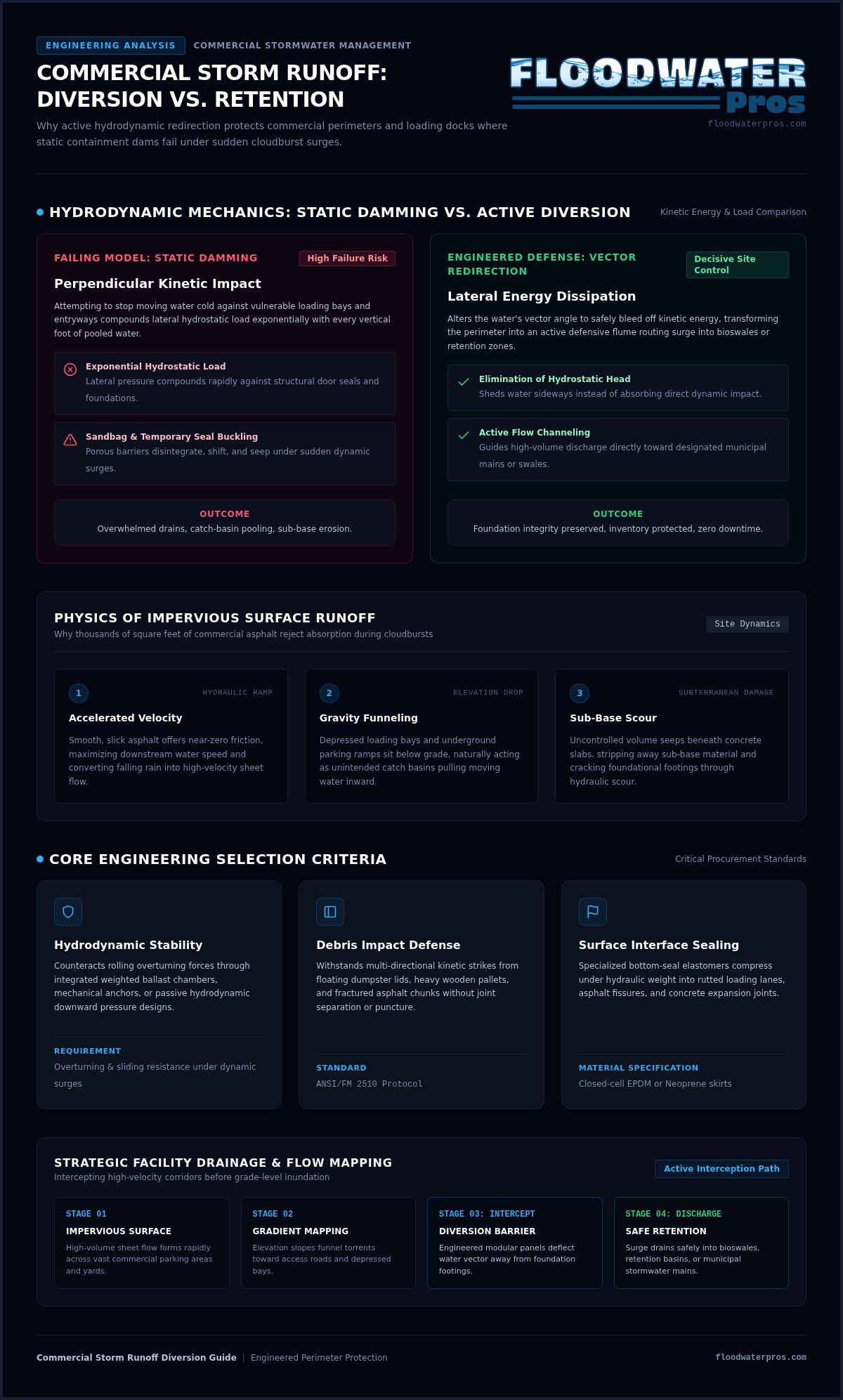
Commercial storm runoff acts as high-velocity sheet flow across vast, impermeable surfaces. When heavy cloudbursts strike, thousands of square feet of concrete and asphalt reject absorption, converting falling rain into rapid, moving volume. Attempting to dam this sheer mass at your doorway invites structural catastrophe. Deploying a purpose-built storm runoff diversion barrier for commercial properties re-routes that moving hydraulic force toward designated retention zones, outperforming static dams that quickly overwhelm and fail.
The Physics of Impervious Surface Runoff
Massive commercial parking lots act as hydraulic ramps during cloudbursts. Water gains speed across slick tarmac, concentrating into deep torrents before municipal systems can react. As explored in broader stormwater management frameworks, unchecked runoff routinely strips away sub-base material and overwhelms perimeter grade elevations. Depressed loading docks and underground parking ramps face the worst exposure; they function as unintended catch basins that pull moving water inward. Once water pools against foundational walls, severe undermining begins, eroding soil stability and cracking subterranean footings.
- Accelerated Velocity: Smooth asphalt offers near-zero friction, maximizing downstream water speed.
- Gravity Funneling: Loading bays and parking ramps sit below grade, naturally drawing sheet flow.
- Sub-Base Scour: Uncontrolled volume seeps beneath slabs, compromising building foundations through hydraulic scour.
Diversion vs. Damming: Mitigating Structural Hydrostatic Load
Static containment dams create immense lateral hydrostatic pressure. For every foot of pooled water standing against an aperture, lateral load compounds exponentially. When facilities rely on perimeter dams or porous sandbags, they gamble on seals that cannot tolerate dynamic, surging loads. Sandbags disintegrate, shift, and seep. Conversely, understanding what is a flood diversion system reveals the power of active hydrodynamic control: rather than absorbing raw kinetic impact, diversion panels alter the water's vector angle, safely bleeding off energy and guiding discharge into bioswales or municipal mains.
Implementing an engineered storm runoff diversion barrier for commercial properties transforms a vulnerable perimeter into an active defensive flume. By shedding water laterally rather than stopping it cold, facilities eliminate hydrostatic head, safeguard critical inventory bays, and protect structural foundations from catastrophic displacement.
Key Engineering Criteria for Selecting Commercial Diversion Barriers
Specifying a storm runoff diversion barrier for commercial properties requires moving beyond static flood stage calculations. High-velocity surface flows carry physical energy, suspended grit, and aggressive shear loads. Facilities teams evaluating these defensive installations must base their procurement decisions on verified hydrodynamic thresholds, surface interaction mechanics, and operational deployment realties rather than simple water height specifications.
Hydrodynamic Stability and Debris Impact Defense
Moving runoff generates tremendous momentum. A viable barrier must counteract rolling overturning forces through integrated weighted ballast chambers, mechanical foundational anchors, or passive hydrodynamic downward pressure designs. Beyond sheer water velocity, commercial yard flumes drag detached dumpster lids, heavy wooden pallets, and fractured asphalt chunks. Products certified under rigorous dynamic protocols like the ANSI/FM 2510 standard prove their structural resilience through physical water testing, guaranteeing the assembly will withstand sudden multi-directional hydrodynamic surges without puncture or joint separation.
Surface Interface Sealing and Ground Adhesion
Commercial lots present imperfect surfaces. Heavy tractor-trailer traffic rutts loading lanes, frost creates asphalt fissures, and expansion joints interrupt concrete pads. A storm runoff diversion barrier for commercial properties must feature specialized bottom-seal elastomers, such as industrial closed-cell EPDM or neoprene skirts. These flexible membranes compress under hydraulic weight into grade voids, preventing underflow scour. Additionally, the materials must resist hydrocarbon degradation from diesel wash, motor oil residues, and harsh industrial deicers typical of logistics yards.
- Flexible Base Gaskets: Compensate for surface ruts up to several inches deep without losing negative pressure.
- Chemical Inertness: Prevents premature membrane embrittlement caused by surface fuel residues.
- Anchoring Versatility: Blends self-ballasted friction stability with optional pre-drilled flush foundation receivers.
Operational Logistics: Deployment Hours and Crew Requirements
Advance warning for severe cloudbursts rarely exceeds a few hours. Selecting structural barriers that demand a dozen maintenance workers to hand-crane individual aluminum planks into place often leads to unsealed perimeters during off-shift storms. Aligning site defenses with verified Best Management Practices (BMPs) means factoring operational staffing into technical designs. Facilities managers frequently compare modular panel systems against deployable inflatables to secure vulnerable assets efficiently. Reviewing enterprise case frameworks in this guide to commercial flood barriers clarifies exact deployment timelines. For a comprehensive review of your facility footprint and equipment alignment, connect with the specialist engineering team at FloodWater Pros.
Comparing Core Barrier Technologies for Commercial Applications
Every commercial facility presents unique layout challenges, from open distribution yards to restricted drainage easements. Selecting the right storm runoff diversion barrier for commercial properties requires matching structural defensive hardware to your site's physical configuration. Rather than applying a single generic solution across every access point, facilities managers must evaluate how modular panels and deployable inflatable systems address different operational zones.
Engineered Modular Diversion Systems
Modular diversion panels utilize heavy-gauge structural faces engineered to withstand relentless hydrodynamic forces. Positioned along perimeter boundaries or parking edges, these interlocking panels meet moving water at an angle, safely redirecting sheet flow away from building apertures and directly toward municipal culverts. Reviewing our technical guide on flood diversion system design reveals how internal deflectors dissipate kinetic momentum. This continuous lateral redirection prevents localized pooling, ensuring commercial grade elevations remain intact even through severe downpours.
High-Volume Inflatable Flood Barriers
Sprawling freight lanes and wide arterial entries cannot always support fixed concrete footings or permanent structural rails. Inflatable flood barriers solve this operational friction by offering swift, adaptable containment. Powered by high-output commercial blowers, dual-chamber high-tensile elastomer barriers inflate across expansive transit corridors in minutes. The internal pressure anchors the barrier firmly against asphalt, blocking water while conforming to broad surface spans. Deploying these units gives industrial parks an adaptable perimeter that satisfies EPA Best Management Practices for responsive runoff management without disrupting daily freight logistics.
The True Operational Cost of Disposable Defenses
Relying on improvised sandbags to divert active storm volume is an expensive liability. Sandbags lack the structural coherence to resist high-velocity sheet flow; swift currents displace individual bags within minutes, opening conduits for flooding. Consider the operational pitfalls of disposable containment:
- Structural Failure: Unbonded sandbag stacks wash away under sustained hydraulic velocity.
- Toxic Disposal Costs: Saturated sandbags trap surface oils and fuel residues, reclassifying them as hazardous industrial waste that demands specialized, expensive hauling.
- Massive Labor Drain: Stacking thousands of heavy bags demands hours of emergency manpower that maintenance teams simply don't have during sudden cloudbursts.
Investing in a reusable, engineered storm runoff diversion barrier for commercial properties eliminates the recurring expense of single-use materials while establishing a dependable, permanent defense protocol.
Commercial Facility Assessment: Strategic Placement and Drainage Mapping
Deploying flood defense without topographical mapping is an expensive gamble. Water seeks the lowest path at maximum speed. To successfully position a storm runoff diversion barrier for commercial properties, facility directors must identify natural hydrologic gradients across parking aprons, freight courts, and perimeter ditches before severe cloudbursts strike.
Topographical Analysis and Flow Path Mapping
Effective defense begins with a comprehensive site grading audit. High-volume flat roofs discharge thousands of gallons per minute through external downspouts, creating sudden localized torrents alongside adjacent roadway runoff. Engineering teams must calculate these convergence points to pinpoint where sheet flow gathers critical velocity. Implementing proven property flood mitigation solutions requires establishing directional deflection angles that route water into retention ponds rather than letting it pool against foundation walls.
Protecting Critical Infrastructure: Docks, Vaults, and Entries
Certain commercial assets present acute flood vulnerabilities. Depressed loading docks form natural catch basins; once water crests the apron curb, dock bays rapidly turn into subterranean reservoirs. Exterior pad-mounted transformers, backup generators, and ground-level inventory doorways face catastrophic damage from even six inches of moving surface runoff.
- Depressed Loading Bays: Position barrier angles obliquely across apron ramps to shed runoff sideways into perimeter swales.
- Utility Transformers and Vaults: Erect multi-sided perimeter shields with elevated deflectors to isolate high-voltage equipment from moving currents.
- Warehouse Access Apertures: Secure roll-up doors with interlocking channel barriers flush with finished slab elevations.
Regulatory Integration and Downstream Impact
Deflecting stormwater cannot come at the expense of adjacent properties. Civil drainage codes strictly forbid discharging concentrated flood currents onto neighboring parcels. Commercial diversion plans must marry site elevation channels with municipal drainage mains and onsite detention basins. Maintaining annual deployment drills prepares in-house crews to place hardware swiftly under pressure, while documented floodproofing measures provide underwriters with verified risk mitigation during insurance liability audits.
Ready to map your site hydrology and build a customized defense protocol? Schedule a commercial facility assessment with FloodWater Pros to safeguard your footprint.
The Fortress Advantage: Complete Engineered Flood Protection Systems
Securing an industrial facility demands more than ordering unvetted equipment from an online catalog. Real protection requires a unified engineering approach where hydraulic modeling, equipment manufacturing, and certified field installation align under a single standard. FloodWater Pros operates nationwide as that dedicated partner, engineering and deploying the premier storm runoff diversion barrier for commercial properties facing severe hydrologic threats.
The Fortress Flood Diversion System
The proprietary Fortress Flood Diversion System actively redirects high-velocity surface water away from vulnerable building envelopes. Built from heavy-duty structural components, this barrier absorbs intense hydrodynamic loads and resists blunt impacts from floating site debris. Each system adapts to your property's specific grade elevations, locking into custom receivers to maintain absolute perimeter integrity along logistics aprons, pedestrian portals, and warehouse dock bays.
Rapid Defense: The Fortress Inflatable Flood Barrier
When flash storms develop without warning, rapid mobilization protects your operational continuity. The Fortress Inflatable Flood Barrier delivers temporary, high-volume perimeter defense across wide access roads, underground garages, and transit corridors. Crafted from rugged, puncture-resistant elastomers engineered for repeated industrial deployment cycles, these units inflate in minutes using commercial air blowers to create an impenetrable, conforming seal against uneven pavement.
Full-Service Turnkey Execution: Design to Certified Installation
Third-party equipment resellers sell barriers in crates, leaving critical anchoring calculations to facilities teams. Independent contractors frequently install systems they don't understand, creating dangerous failure points when storms hit. FloodWater Pros eliminates contractor finger-pointing through end-to-end single-source accountability. Our specialists handle complete hydraulic assessment, proprietary manufacturing, and certified professional installation nationwide.
- Custom Engineering: Tailored modeling mapped precisely to facility grade contours.
- Proprietary Manufacturing: Rigorous quality control ensuring uncompromised material strength.
- Certified Turnkey Installation: Precision placement and testing executed by trained technicians.
Secure your operations before the next cloudburst overwhelms your perimeter. Partner with our engineering specialists by scheduling a commercial flood risk consultation to establish a permanent barrier strategy.
Fortify Your Perimeter: Master Commercial Runoff Defense
Waiting for the next torrential storm to test failing retention methods is a gamble your operations can't afford. High-velocity surface flows demand proactive channel control, not porous makeshift dams. Implementing an engineered storm runoff diversion barrier for commercial properties guarantees that moving water is deflected safely along designed pathways before it breaches loading docks or compromises warehouse foundations.
Real site resilience requires hardware built to absorb punishing hydrodynamic forces and seal against cracked industrial pavement. By choosing the proprietary Fortress Flood Diversion System, you gain permanent operational peace of mind backed by single-source nationwide accountability, spanning initial hydraulic design to turnkey installation. Take the decisive step toward total facility security. Schedule a Commercial Site Assessment with FloodWater Pros today, and ensure your enterprise stands fortified against any storm.
Frequently Asked Questions
What is a storm runoff diversion barrier for commercial properties?
A storm runoff diversion barrier for commercial properties is an engineered structural system designed to redirect high-velocity surface water away from vulnerable building openings and logistics yards. Unlike static dams that trap pooling water, diversion barriers alter the runoff vector, channeling volume toward designated municipal storm mains, detention ponds, or swales before hydrostatic pressure compromises foundations or loading bays.
How does a diversion barrier differ from a traditional flood dam or sandbags?
Traditional flood dams and sandbags attempt to block water outright, which creates massive lateral hydrostatic load and risks structural blowouts under high volume. Sandbags also degrade rapidly and absorb hazardous yard contaminants. A diversion barrier guides moving water laterally along controlled paths. This mechanism dissipates hydraulic kinetic energy rather than absorbing it head-on, keeping structural pressure completely off your building walls.
Can diversion barriers be deployed on uneven commercial pavement or cracked asphalt?
Yes, commercial-grade systems are specifically engineered to accommodate asphalt imperfections, heavy ruts, and joint seams. High-performance diversion setups use flexible industrial elastomeric bottom seals that compress directly into surface voids under ballast or hydraulic weight. This compression blocks underflow scour and creates an impervious hydraulic barrier without requiring extensive ground repaving or concrete trenching across your property.
How quickly can a commercial facility team deploy the Fortress Inflatable Flood Barrier?
A standard facility crew can deploy the Fortress Inflatable Flood Barrier in minutes using high-volume commercial air blowers. Because the dual-chamber units roll out flat and inflate rapidly across wide transit corridors, operations teams don't need heavy lifting machinery or complex tools. This rapid response allows warehouses and logistics parks to seal off sprawling perimeters immediately after flash flood alerts are issued.
Will redirecting storm runoff violate municipal drainage regulations?
No, provided the water is routed into approved civil infrastructure rather than onto adjacent private property. Civil drainage codes strictly prohibit dumping concentrated runoff onto neighboring parcels. Engineered diversion plans map site contours to direct discharge into established detention ponds, bioswales, or existing municipal stormwater mains, keeping your facility compliant with local civil requirements while lowering corporate insurance liabilities.
What level of debris impact and hydrodynamic force can engineered barriers withstand?
Commercial diversion barriers are engineered to withstand severe hydrodynamic current loads and blunt debris impacts, including floating timber, detached dumpsters, and shipping pallets. Systems tested under rigorous standards like ANSI/FM 2510 verify structural stability against physical water pressure without joint failure. Heavy-gauge materials and dynamic ballast mechanics ensure the installation won't overturn or puncture during intense flash flood conditions.
Why is professional installation recommended over self-installation for commercial facilities?
Self-installation introduces dangerous variables, including improper anchor depth, misaligned deflection angles, and unsealed pavement interfaces. FloodWater Pros provides turnkey professional installation nationwide to ensure the barrier matches site hydrology exactly. Our certified installation technicians calibrate every connection, verify compression gaskets, and validate structural anchorage, removing contractor blame-shifting and ensuring the system performs flawlessly when high-velocity storms strike.
How do diversion barriers protect subterranean parking garages and depressed loading docks?
Depressed ramps act as natural funnels that draw surface sheet runoff directly into subterranean levels. Installing a storm runoff diversion barrier for commercial properties across the top apron of a ramp creates an oblique defensive deflection angle. Rushing water is intercepted and guided sideways into perimeter drainage channels, stopping the downward surge before it inundates ramps, dock levelers, and underground utility vaults.


